Jump to ratings and reviews
Rate this book

Le isole Aran

Rate this book
Nel 1934 Robert Flaherty, uomo di cinema che era rimasto estraneo alla produzione industriale e che aveva collaborato al Tabu di Murnau, realizzava un film documentario avvincente quanto il più drammatico film a soggetto, L'uomo di Aran. Rivisitati in immagini di assoluta purezza e intensità, erano i luoghi e gli uomini che John Millington Synge aveva rappresentato, circa trent'anni prima, in questo libro. Andatoci per consiglio di Yeats, dalla Parigi fine secolo in cui si era stabilito, Synge aveva trovato nelle isole Aran la fonte, reale e visionaria insieme, della sua ispirazione e questo libro è come il preludio alla sua opera drammatica. Particolare non trascurabile: vi era andato, nelle isole, anche per apprendere il gaelico: una lingua che è un mondo quasi ai confini del mondo.

187 pages, Paperback

First published January 1, 1907

105 people are currently reading
1294 people want to read

About the author

J.M. Synge

408 books99 followers
Edmund John Millington Synge (pronounced /sɪŋ/) was an Irish playwright, poet, prose writer, and collector of folklore. He was one of the cofounders of the Abbey Theatre. He is best known for the play The Playboy of the Western World, which caused riots during its opening run at the Abbey theatre. Synge wrote many well known plays, including "Riders to the Sea", which is often considered to be his strongest literary work.

Although he came from an Anglo-Irish background, Synge's writings are mainly concerned with the world of the Roman Catholic peasants of rural Ireland and with what he saw as the essential paganism of their world view.

Ratings & Reviews

What do you think?
Rate this book

Friends & Following

Create a free account to discover what your friends think of this book!

Community Reviews

5 stars
255 (23%)
4 stars
435 (40%)
3 stars
306 (28%)
2 stars
66 (6%)
1 star
12 (1%)
Displaying 1 - 30 of 110 reviews
Profile Image for Rowan MacDonald.
214 reviews658 followers
November 24, 2023
My sister just returned from the Aran Islands, off the west coast of Ireland. I was captivated by her travels and beautiful pictures. I had to learn more. I immediately went to the library and borrowed this book, first published in 1907.

I was soon time traveling, transported somewhere else. The story of author, J. M. Synge, captivated me too. Considered a disappointment to family, music became his escape route, taking him to Europe. He found himself in Paris, and drifted towards writing - only to meet rejection. It was in Paris, that fellow Irish writer, W. B. Yeats, suggested:

“Go to the Aran Islands. Live there as if you were one of the people themselves; express a life that has never found expression.”

So, he did. He visited each of the islands - Inishmore, Inishmaan, and Inisheer. His time there, starting in 1898, is depicted in this book. It feels like a precursor to creative nonfiction. Synge would sadly die age 37.

The Aran Islands got under my skin. I looked forward to disappearing into this world each night. It’s part travelogue, part slice-of-life. Synge explores the islands and talks to locals, hearing their stories and folklore. It was rather endearing, complemented with great illustrations by Jack B. Yeats. I could smell the kelp, feel the ocean spray, hear the Gaelic voices.

“A week of sweeping fogs has passed over and given me a strange sense of exile and desolation. I walk round the island nearly every day, yet I can see nothing anywhere but a mass of wet rock, a strip of surf and then a tumult of waves.”

I fell in love with these people, their home and way of life. I felt as though I was living among them. I enjoyed Old Pat’s stories, and was intrigued by the Islanders’ relationship with “fairies” – a sharp needle under the collar of your coat keeps them at bay. Apparently.

The author’s friendship with Michael was touching - their letters made me want to write someone far away. I laughed and smiled, felt dread and heartache. Synge eloquently depicts this tough existence. The evictions, drownings, and funerals. He often explores the fragility of life, which has added poignancy given his own limited time.

“The black curagh working slowly through this world of grey and the soft hissing of the rain gave me one of the moods in which we realise with immense distress the short moment we have left us to experience all the wonder and beauty of the world.”

Occasionally, Synge appeared condescending, and treatment of animals left much to be desired. But the language, Irishness, and sweeping landscapes often made up for it.

This book makes me want to read all the other Irish greats. I know that when I step foot there one day, it will be with a mild sense of familiarity and comfort, thanks to the time I spent with this classic.

“I have never heard talk so simple and so attractive as the talk of these people.”
Profile Image for Dem.
1,263 reviews1,437 followers
October 10, 2016
The Aran Islands by J.M Synge is a remarkable and insightful read of life on the Aran Islands From 1898 to 1903.

Having just returned from an amazing 2 day trip to the Islands I was eager to read this remarkable little book that had been recommended to me by one of the Islanders. .

Synge, in his relatively short life helped revolutionize Irish Threater, was a poet, prose writer, musician,playwright and collector of folklore. He spent part of his summers for 5 years on the Aran Islands collecting and documenting stories and customs and traditions of the Islanders and the end product ( this little book) is a remarkable and important collection of information and folklore.


This is not a story but rather a series of journal accounts as the author says in his introduction

" In the pages that follow I have given a direct account of my life on the Islands and of what I met with amoung them, Inventing nothing , and changing nothing this is essential"

There is so much that I found intriguing and insightful in this account, the way of life and the hardship of the Islanders, the bleak and harsh and yet stunning landscape, the tradition, stories, food, clothing and the religion and beliefs are so interesting and I came away with a better understanding of their life and struggles at this time.


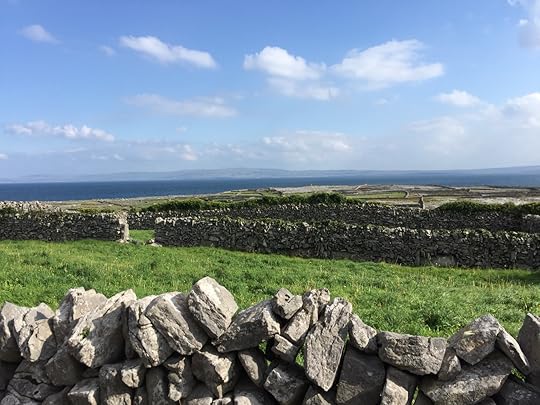
While everything has changed on the Islands with modernization , nothing has changed like, landscape, remoteness, beauty, quiet and those rugged and stunning stone walls and ruins. I loved the fact that after stepping foot on the island you can hire a bike and within 5 minutes be utterly by yourself and step back in time.

I loved this book and can't stop thinking about it, I would recommend it to those who have an interest in folklore and history of Ireland. It's not for everyone but I can see many enjoying this and at 208 pages is not very taxing.
Profile Image for Paul Haspel.
728 reviews218 followers
June 3, 2024
The Aran Islands are a small and isolated enclave to the west of the Irish mainland, separated from the rest of Ireland by some highly treacherous seas. The Irish playwright John Millington Synge brought the distinctive culture of the Aran islanders to the world through classic plays like Riders to the Sea (1904) and The Playboy of the Western World (1907). And the reader who wants to gain a greater understanding of how the Aran Islands inspired Synge’s work can turn to the journals that the playwright kept while visiting the islands in 1901, published as The Aran Islands in 1907.

John Millington Synge, like his contemporary William Butler Yeats, was an upper-class Irish Protestant who was thoroughly conversant with all of the intellectual and philosophical streams of literary modernism – and who, in a seeming paradox, engaged that modernist movement through an embrace of the mythological and cultural traditions of Ireland’s Catholic peasantry. His treatment of the rough lives of the fishing families of the Aran Islands was sometimes controversial – Dublin audiences rioted at the Abbey Theatre premiere of The Playboy of the Western World, feeling that traditional Irish culture was being treated with disrespect – but his plays are now regarded as being among the classics of Irish literature.

The Aran Islands shows Synge getting to know the culture that he would share with the world through his plays. At the book’s beginnings, Synge recalls heading out to the islands, stating that “It gave me a moment of exquisite satisfaction to find myself moving away from civilisation in this rude canvas canoe of a model that has served primitive races since men first went to sea” (p. 6). His sense of being different from the people that he will live among suffuses the pages of this book.

Synge also sets forth his impressions of how the material culture of the Aran Islands expresses the inner life of the people of the islands:

Every article on these islands has an almost personal character, which gives this simple life, where all art is unknown, something of the artistic beauty of medieval life. The curaghs and spinning-wheels, the tiny wooden barrels that are still much used in the place of earthenware, the home-made cradles, churns, and baskets, are all full of individuality, and being made from materials that are common here, yet to some extent peculiar to the island, they seem to exist as a natural link between the people and the world that is about them. (p. 7)

Synge focuses not only on material culture but also on a variety of aspects of the everyday lives of Aran Islanders – remarking, for example, that “The absence of the heavy boot of Europe has preserved to these people the agile walk of the wild animal, while the general simplicity of their lives has given them many other points of physical perfection” (p. 14).

Life in the Aran Islands is certainly and clearly different from life in Dublin, where one always knows the time of day. Synge writes at one point that “The general ignorance of any precise hours in the day makes it impossible for the people to have regular meals” (p. 15), and goes into detail regarding timekeeping in the islands:

The general knowledge of time on the island depends, curiously enough, on the direction of the wind. Nearly all the cottages are built, like this one, with two doors opposite each other, the more sheltered of which lies open all day to give light to the interior. If the wind is northerly the south door is opened, and the shadow of the door-post moving across the kitchen floor indicates the hour; as soon, however, as the wind changes to the south the other door is opened, and the people, who never think of putting up a primitive dial, are at a loss. (p. 14)

Readers of Synge plays like Riders to the Sea, with its tragic focus on the risks that Aran fishermen take in wresting their living from the sea, might want to focus in on Synge’s description of the ritual of the keen, when women cry for the dead:

This grief of the keen is no personal complaint for the death of one…but seems to contain the whole passionate rage that lurks somewhere in every native of the island. In this cry of pain the inner consciousness of the people seems to lay itself bare for an instant, and to reveal the mood of beings who feel their isolation in the face of a universe that wars on them with winds and seas. (p. 21)

The dangers of the fishing and seafaring life seem to cultivate, among the islanders, a certain fatalism. When describing a difficult sea-voyage between two of the islands, Synge recalls how an old man described to him the importance of respecting the power of the sea: “The old man gave me his view of the use of fear. ‘A man who is not afraid of the sea will soon be drowned,’ he said, ‘for he will be going out on a day he shouldn’t. But we do be afraid of the sea, and we do only be drownded now and again’” (p. 50).

Like Yeats, Synge has an acute interest in Irish folklore of the supernatural. He says of the Aran Islanders that “These people make no distinction between the natural and the supernatural” (p. 57), and describes how one of his informants, Old Pat Dirane, describes sightings of faery creatures other supernatural experiences as all a very real part of ordinary life. Old Pat Dirane states, for example, that one night “he heard a voice crying out in Irish, ‘mhathair ta me marbh’ (‘O mother, I’m killed’), and in the morning there was blood on the wall of his house, and a child in a house not far off was dead” (p. 25).

The islanders’ isolation, according to Synge, has led to a mindset that regards with distrust the mainland world and its laws and norms. In that connection, Synge recounts hearing the story of a man from Connaught, in western Ireland, who murdered his father in a moment of anger, was overcome with immediate remorse, fled to the Aran Islands, and was sheltered by the islanders until he could take a boat for America. Synge says of this story that

This impulse to protect the criminal is universal in the west. It seems partly due to the association between justice and the hated English jurisdiction, but more directly to the primitive feeling of these people, who are never criminals but always capable of crime, that a man will not do wrong unless he is under the influence of a passion which is as irresponsible as a storm on the sea. If a man has killed his father, and is already sick and broken with remorse, they can see no reason why he should be dragged away and killed by the law. (p. 36)

Sometimes, Synge’s sense of being different from the islanders may give his recollections too much of the feel of old issues of National Geographic – the sophisticated scholar observing the supposedly “primitive” natives in their “natural habitat.” At one point, a beautiful young woman sits next to Synge to see some photos he took of the community on his last year’s visit. “The complete absence of shyness or self-consciousness in most of these people gives them a peculiar charm, and when this young and beautiful woman leaned across my knees to look nearer at some photograph that pleased her, I felt more than ever the strange simplicity of the island life” (pp. 42-43). Really, Mr. Synge? I would tend to think, rather, that in cultures round the world, when a young and beautiful woman leans in close to a young man, both people are apt to feel a certain excitement at their close proximity, whether the space that they are sharing is a table at a pub in Dublin’s Temple Bar, or a fireside chair at a cottage in the Aran Islands.

Synge seems to be on stronger ground when he considers the potential for violence in the down-to-earth, nature-oriented lives of these people. One evening, when Synge has been asked to play his fiddle for a dance, he hears “a fierce wrangle going on between a man and a woman near the cottages to the west”. Duly tuning his fiddle and preparing for the dance, he listens to the ongoing quarrel and notes that “the dispute to the west [is] going on still to the west more violently than ever. The news of it had gone about the island, and little bands of girls and boys were running along the lanes towards the scene of the quarrel as eagerly as if they were going to a racecourse.” Synge fears, hearing “the volume of abuse that was rising across the stillness of the island” (pp. 76-77), that the dispute will end in violence, but the women of the island assure him that the two people who are fighting are closely related and will be right as rain in no time.

And sure enough, by the time the dance is over, “The altercation was still going on at the cottage below us, and the people were anxious to see what was coming of it. About ten o’clock a young man came in and told us that the fight was over. ‘They have been at it for four hours,’ he said, ‘and now they’re tired.’” Another observer notes that “‘Indeed it is time they were, for you’d rather be listening to a man killing a pig than to the noise they were letting out of them’” (p. 78).

Yet this humourous story – of a quarrel that remained strictly verbal – leads directly into an older islander’s recollection of the consequences of an offhand joke by an islander who was sharpening his knife at the time. The joke was misunderstood by a friend who responded by taking up his own knife. “Then the two men began making fun about their knives, and from that they began raising their voices, and it wasn’t long before there were ten men fighting with their knives, and they never stopped till there were five of them dead” (p. 79). The juxtaposition of the comic and the tragic seems very characteristic of what one sees in Synge plays like The Playboy of the Western World.

Synge himself died young, rather like some of the characters in some of his plays; he was just 37 years old when he passed away from Hodgkin’s disease. Yet his plays live on, immortal; and in The Aran Islands, he provides a sense of how fruitful it all proved to be when a city lad from Dublin undertook to live, for a time, among the isolated folk of a faraway and remote island.
Profile Image for Gloria.
294 reviews26 followers
September 4, 2013
It must be the 80% Irish in me rising to the top, for I've never had a book make me homesick for a place I've never been...
Profile Image for Chrissie.
2,811 reviews1,421 followers
May 10, 2014

Delightful. I highly recommend this audiobook narrated by Donal Donnelly if you want immersion into the most Irish of Ireland, the Aran Islands. The three islands (Inis Mór, Inis Meáin and Inis Óirr) are located in Galway Bay. This is a book relating the author's experiences, a famed playwright, who visited the island several times 1898-1901 on the suggestion of Yeats. These visits are the bedrock for his plays. The narrator's brogue is fantastic and further enhances ones experience. Listen to it, don't read it.

You get fables, depiction of the food, clothing, occupations and the islanders' simple "manner of being". You learn about kelp burning, thatching, rope making, farming, fishing, the festivals and the fairies.

What makes this book is HOW it is written - the language used, the brogue, and the simple, straight-forward speech of the islanders. The stories are simple and many you will recognize (Three Billy Goats Gruff and The Goose that Lays Golden Eggs and more), although clothed in the islands' mantle. There is subtle humor. You will feel as though you are yourself sitting in front of a hearth hearing the stories, engulfed by fog and tangy salt smells. A delightful reading experience.

I never felt the author looked down on these islanders, as some other readers have noted.
Profile Image for 7jane.
826 reviews367 followers
December 26, 2021
In 1898-1901, Synge made several visit to the Aran Islands, which is a group of three islands 30 miles from Galway in western Ireland. He seems to have stayed mostly on the middle island, Inishmaan, but did visit the other two also. He decided to start visiting there when suggested to do so by the poet Yeats, to record some old ways as the modernism, emigration, and such things were starting to come in and make changes. He stayed a few weeks each year, recording his observations on his notebook. Synge’s other works are mainly plays inspired by his visits, some of which caused uproars, and one not performed at all during his lifetime.

‘Aran’ means ‘the ridge’. The islands lack trees (which vanished in the very early years of settlement there; the islands have been inhabited since the stone age, with many buildings of ancient times still there (monasteries, graves, old buildings). The islands are quite bare where they haven’t been worked on, and the many walls there protect from the elements. Much gatherings are done around the kitchen fireplace. Many outsiders have come there to study the history, the language, the flora, and just as tourists. Synge here collects some of the stories (which have other versions in other lands), songs, and poems, especially in the fourth part. He himself was just an Anglo-Irish man, who studied well, was a decent violin-player, and eager to improve his Gaelic. Some photographs of his from his visits still exist, including the one on the book cover here, and he writes about showing some to the islanders too.

The introduction notes that some kinds of subjects were not included in this book, but its story doesn’t really suffer. His talks about how many men drown there is a bit exaggerated, though it’s easy to see why it happens from the examples.
Synge’s generally quite positive about the people, though he makes note of some not so nice sides of them also, including having not much sympathies for pain. The way they hold funerals is quite interesting: lamenting (keening) is practiced, and sometimes also hitting the casket in some kind of rhythm happens. Hooker in this book is always a boat type. And by the way, Aran-knitting is an imported thing, including all the patterns, as the notes note.

His observations about the moods and the weather (good and bad) of the place brings the place-feel on really well. Once he also observes the train ride away from Galway as he leaves to go back home. Island people dress in layers, and gender division shows in colors used (the usual red-feminine, blue-masculine kind). The word for their shoes, ‘pampooties’, is kinda cute, and the way the people are named is interesting, a really good part in the book. Time is told by which door is open, there is no clocks, except the one alarm clock Synge gives to one young man (who likes it). Diet is very simple. There is much to do: fishing, driving the pigs/cows/horses in and out of the islands on boats, thatching the roofs, gathering and burning kelp, hunt with a ferret, etc.

I think the first part is a good introduction and has the most variety in its subjects. The second one was moody and short. The fourth one has the most of the stories, songs, and poems, sort of gathering-place for it. Two characters with names stand out: the first part’s Old Pat the storyteller, and Michael, young man who eventually works on the mainland, but stays occasionally working on the middle island too. In Synge’s opinion, the middle islanders are the most genuine of them all.

It feels like he bookends the book with moments of when he stays in some upstairs room place and hears the people below; a moment not of irritation but just observation of the place. Synge might be an outsider in these stories but he brings things that have vanished, the nature and the sense of the place for the reader in clearly, and it makes this a really good string of stories.

(I have seen a glimpse of one of the islands now, I think in a document about Ireland as seen from above, on National Geographic channel – I imagined the islands being a lot higher than they really are haha)
Profile Image for Andrea.
Author 8 books208 followers
February 27, 2013
A lovely book that is incredibly evocative of a way of life that has long since passed away through its stories and reflections of the fishermen and women who lived on the Aran islands. Synge went there to learn Irish and return to his gaelic roots. He seems to have been one of a long parade of anthropologists, artists and writers in fact, a reflection of the huge upsurge of a certain kind of nationalism at the time. There is a lyrical beauty in many of his descriptions, and an honest attempt to enter into and understand the daily lives of the islanders with a great deal of respect, though he spends a lot fo time lying around in the sunshine, while also pondering the unbridgeable distance between them. As a man he cannot seem to enter the women's world really at all, but his wanderings with the old men and his recountings of their tales and poems are quite wonderful. I loved his description of how islanders told time...or failed to tell it when the wind was in the right direction (an excerpt of which is to be found in E.P. Thompson which I had forgotten). His description of the evictions was particularly poignant, even when the pigs the landowner was having rounded up as rent bowled over three policemen. It was something I couldn't quite forgive him for, the absence of any kind of political economy in his understanding, the fact that the villagers were so poor because they lived on land that barely provided subsistence -- their ingenious ways of extracting every last possible use from it are incredible -- yet still was land owned by someone else, for which they had to pay rent in coin. Who was it? How did some one person come to own an island on which these people had lived for generations? And Synge with his privilege just sat and watched it being taken away. Women keening after losing everything. There isn't even an attempt to come to terms with it. He just soaks in the local colour and moves on, though the letters he exchanges with the island residents (most of whom of a certain age seem to move to America) are lovely and show some human connection was made.
Profile Image for Nick Garbutt.
319 reviews11 followers
March 9, 2025
Playwright JM Synge was one of the key figures in the Gaelic Revival. He was a mainstay at the Abbey Theatre, Dublin in the early years of the 20th Century, and hugely controversial. His Playboy of the Western World provoked rioting and the police had to be called to break up the ensuing disorder.
Like many of his Irish contemporaries he became obsessed with the Aran Islands, where Gaelic was still spoken and whose people clung to ancient ways, scratching a living beyond the Western most edge of Europe.
He spent several summers there, living with local people, learning Irish, absorbing folklore and getting to understand that this was still a magical land where there were no boundaries between the natural and supernatural worlds. Fairies still walked the land here.
This book is the fruit of those visits, offering a precious glimpse of lost lifestyles and lost lives. He writes of “strange men with receding foreheads high cheekbones and ungovernable eyes” who represent “some old type found on these few acres at the extreme borders of Europe, where it is only in wild jests and laughter that they can express their loneliness and desolation” and of bright, extraordinarily beautiful island women who wore striking scarlet dresses and spoke only in the ancient tongue of their people.
The Aran Islands was written in 1905 and is a precious record of how things used to be in the last outpost of an ancient civilization.
Profile Image for Matt.
197 reviews31 followers
July 18, 2008
If you go to the Aran Islands today, you find that a few thousand people live there, mostly tending B&Bs or tourist shops. The only remnant of the old Ireland is the hundreds of miles of stone walls that still divide the land into tiny plots.

Synge's diary is hardly a masterwork of ethnography. ("The complete absence of shyness or self-consciousness in most of these people gives them a particular charm, and when this young and beautiful woman leaned across my knees to look nearer at some photograph that pleased her, I felt more than ever the strange simplicity of the island life." ) He's an anachronism writing about greater anachronisms.

But it's a good read. I found two general benefits. First, you do get a sense of what life was like there in the late 19th century – the fishing, the poverty, the migration. And second, you get some really odd anecdotes, which undoubtedly reflect traditional Irish culture.
Profile Image for Andrew.
38 reviews14 followers
September 17, 2008
Synge's travelogue of the Aran Islands is a mostly a curiosity. Drawn from multiple visits, the scenes and stories recounted are fascinating, patronizing, and boring by turns. Synge's prose is always clear an precise, but the book is weighted down by his often condescending attitude toward his subjects so typical of the author's day and age. Here we have Noble Savages of the Irish sort, a view we can't help but feel uncomfortable with. But if you're willing to cut through this cultural screen, the places and the people Synge encounters are truly remarkable. Most firmly etched into my mind are scenes of an island funeral, full of bluster and pain, culminating in the mother of the deceased beating on the coffin before it was lowered into the grave, the skull of her own dead mother in her other hand, and a great keening rising from all the women of the island. A strange and amazingly human moment.
Profile Image for Joseph.
8 reviews4 followers
December 17, 2007
I'm reading a 1911 edition of this that I got from the UW library. The pages are soft and delicate and the prose is simple and beautiful. Anyone who thinks fairies are pretty little women with tinkerbell wings will think twice before inviting one into their home!
I picked this up as part of my research for the probable Akropolis Performance Lab production of Synge's Riders to the Sea.
It's an indispensible resource to the life and customs of the Aran Island inhabitants. Full of impecable details, striking anecdotes, and rich folk tales.

Slainte!
Profile Image for Cody.
604 reviews50 followers
Read
May 14, 2020
All of life--its wonder and terror, joy and suffering, meaning and mystery--can be found on a tiny, rocky island, if you just take the time to go, stay, listen, look. "No two journeys to these islands are alike." Indeed.
Profile Image for David.
Author 1 book73 followers
July 18, 2025
It was an unusual read for a literary travel book. I know that Synge is very important, but I could not really appreciate his genius in this work.
Profile Image for Sarah B.
1,335 reviews30 followers
March 19, 2024
This turned out to be a fascinating account of how the people live on the Irish Aran Islands way back in 1907 (or should I say a bit before that as surely it takes time from manuscript to actual published book). Before I picked this up I never even heard of these islands before but I do enjoy reading these kind of stories. And even when this was written these islanders were still living very "old fashioned" compared to the rest of Ireland. These are apparently very poor islands where its often foggy and damp... I got the impression that a blue sky is rare. Rocky and surrounded by the sea. They don't seem to have any trees and most people speak Gaelic. They also use nicknames.

The thing that probably surprised me the most in here were the stories about faeries. There are folk tales in here too but many of the people in here who the author met in person had fairy encounters to share with him. And not all of these were the same. One even sounded very much like a haunted house with strange loud bangings during the night that had no source. Others told him of seeing oddly dressed figures they met on the road (ghosts??)... These people definitely believe in the supernatural. I found these tales just fascinating.

Another thing I really loved in here was about the daily life on the islands. Some of the things in here were perplexing to me. Like how they made rope out of straw. Really? I didn't know rope could be made from straw. Wouldn't it break?? They then used it to thatch the roof. Straw roofs I have seen in photos + at my local museum but I didn't know it had required rope..hmmm....

Since I am stuck on a limited diet due to food allergies I am always interested in what groups of people eat on their "native diets". I believe this book describes that very well. And it was written long enough ago that the diets were not goofed up yet my modern convenience foods as we have today. It seems they mainly ate potatoes, bread, strong tea, pork and fish. Even more fascinating was the description of one man who went away to America for twenty years and came back sick. Makes me ponder if food was related? They do have cattle but they apparently didn't eat them but sold them instead? Also mentioned was the way they ate: mainly they ate when they were hungry, often going long hours with nothing (intermittent fasting??).

The kelp harvests are mentioned along with many other seasonal things including moving the horses to another island for the summer, moving cattle + pigs on the ships, the beehive dwellings (cloghauns) are mentioned too.

One of the most startling things to me in here were the curaghs. These are the ships the locals make. They are very unusual. They are round and look very much like a half of a walnut shell! I saw pics of them online. Very amazing. I never knew a boat could have such a shape. And the sea is mentioned very often in here as the sea is part of these people's lives. Also some of the rocks are so sharp that they were slicing the bottom of the author's shoes so the locals made him some pampooties. These would be today described as "barefoot shoes" that moves and flexes with the feet so you can use your toes.

There is much more in here too including the nature of the people living there. The women wear red.

There were a few sections in here that didn't exactly interest me but all in all it was a good read. And I do think different readers will be interested in different parts of this book.

The natives in here do one very startling thing: opening the front or back door depending on where the wind was blowing from. I wonder if they do that year round?? Do they do it in winter too??? I googled and apparently snow is very rare on these islands. And often the open door serves as a clock too. They never heard of a clock we have with hands on it that tell the time. Their entire time telling is based onna entirely different idea.

Just fascinating! And did the one person really get rheumatism from the salty sea water??? Hmmm... These old ideas are just fascinating!

This was very easy to read. Its in a nice style too. No pictures in this edition but I do love the horse image on the cover.

These people live very hard lives but their island oddly enough is not their own. They had landlords and evictions too.
Profile Image for Brian.
670 reviews87 followers
January 29, 2018
I first read The Aran Islands when I spent the first semester of my senior year of university in Ireland. I went over in August but the Irish term doesn't begin until September, so for the first month we were there, University College Cork organized a special program for the foreign students. The literature students all read the same books and took the same classes, and in the midst of reading The Aran Islands, we packed up for a trip. After lunch at Ballymaloe and a visit to Coole Park, we stopped in Galway and took a ferry over to Inis Meáin where we would spend four days. We had class in Dún Chonchúir, sitting on the terraces inside as our professor lectured as we discussed the book, and then spent hours wandering around the low stone walls and paths of the island. Finding Leaba Dhiarmada agus Ghráinne, the bed of Diarmuid and Gráinne as they fled across Ireland, suddenly after talking to a friend who had been looking for hours and never found it. Visiting the knitwear shop and buying a sweater made from the wool of the sheep we had seen wandering in the island's fields. Staying in a bed and breakfast and listening to the owners speak English to us and Irish to each other. And standing next to Cathaoir Synge, "Synge's Chair," hundreds of feet above the sea, and watching the sun sink down into the ocean in the West. I could well understand what it was that Synge saw in the island and why he wrote so approvingly about it.

When I opened the book, a business card fell out for the gentleman at the Bank of Ireland who got me my bank account.

Now when I read The Aran Islands, though, I can't help me feel how condescending it seems. Synge views the people of Inis Meáin as living a pure pastoral life, unspoiled by modernity, with a kind of innate arcadian nobility. Not even the other Aran Islands get as much praise as Inis Meáin does. But I can't help but notice that the lives of the islanders sound terrible, full of death and grinding poverty. There's one incident where some police from the mainland come over in the service of absentee landlords to perform evictions, and while Synge watches and writes in his notebook about it, the police turn old women out of their homes and the villages laugh as the police try to round up pigs. I couldn't help but imagine Synge, a man who had studied in France and been to Germany, sitting and writing impassively while the people of Inis Meáin suffered after having been dispossessed of the island that they had lived for generations on.

He keeps delivering backhanded insults even while he's trying to complement the people. After one description of a man who knew both Irish and English and took issue with a translation of Moore's Irish Melodies, and was able to quote both the Irish original and the English translation in order to explain his argument, Synge writes:
In spite of his singular intelligence and minute observation, his reasoning was medieval.
in reference to the man's belief that Irish wouldn't die out on the Aran Islands because of its use in daily industry. Well, the man was right. I've been to Inis Meáin and passed groups of teenagers speaking Irish amongst themselves, so shows what Synge knows about his reasoning.

Later, Synge writes:
Although these people are kindly towards each other and to their children, they have no feeling for the sufferings of animals, and little sympathy for pain when the person who feels it is not in danger. I have sometimes seen a girl writhing and howling with toothache while her mother sat at the other side of the fireplace pointing at her and laughing at her as if amused by the sight.
Ah, humanity unspoiled by European civilization. It's not that I think Synge is lying here, it's that I think he wants the people of Inis Meáin to exist as some kind of museum monument to what was. The ancient practices of rural Ireland, still alive on the shores of Atlantic, no matter the cost in men lost at sea, women turned out of their homes, and endless stories about people that Synge doesn't even deign to give a name to in his writings.

I'm glad I read this while I was on Inis Meáin and have those memories to carry me through this reading. I think I would have found it pretty dire otherwise.
Profile Image for Tom.
446 reviews35 followers
November 15, 2020
Full of fairies, funerals, and fine, fine prose. Pairs well with Synge play "Riders to the Sea," though nowhere near as bleak. Synge's photos worth the price alone.

“This is the haunt so much dreaded by the women of the other islands, where the men linger with their money till they go out at last with reeling steps and are lost in the sound. Without this background of empty curaghs, and bodies floating naked with the tide, there would be something almost absurd about the dissipation of this simple place where men sit, evening after evening, drinking bad whiskey and porter, and talking with endless repetition of fishing, and kelp, and of the sorrows of purgatory.”
Profile Image for Dan.
151 reviews32 followers
March 7, 2015
This book is a very dark glimpse into a dying world that once existed through all of human civilization. Fairies and giants and ghost ships are as much a part of these people's real world as is God and the police who come onto the islands to kick people out of their homes.

I do wonder, however, what Synge's intention was to portray these people as being so simple. He does admire their skill with the boats but he spends so much time with old men who tell tales that have no point that it's easy to think the whole island lives and thinks as these old men do. Yet the young men, Michael in particular, leaves the islands to find work elsewhere because he knows there is no future on those grey, wet rocks. And the other danger is that we get pulled into a nostalgic portrait of the islands that never really existed outside of the imaginations of these old men.

Still, there are moments that are quite beautiful and telling as to how things really are on the Aran Islands. First is the priest, whom we never meet but are always told about braving the rough sees day after day and risking his life as he tends to his flock. Though we never meet this man, I couldn't get the image out of my head of a man dressed in priest's black, standing upright on a small boat tumbling upon the waves in a fierce gale. I would love to have heard his story. The other telling moment was for the funeral of the young man. This was a beautiful and very sad scene where they bury him in the same spot where his grandmother had been buried and they find her skull among the black planks on her coffin. This image, coupled with the young man having lost his head at sea, is a wonderfully confusing image where the nostalgic sensibility of the old is placed on the dead body of the young that can't carry it to any future other than the grave.

Perhaps this is why all the stories end with absolutely no point because life is, to them, pointless. Life is hard, the women wear out in childbirth before they're even 20, the men drink and fight and die at sea for a pittance of a catch, or the lucky ones move to America and never come back, their story unfinished.


Profile Image for Jacob Hurley.
Author 1 book45 followers
November 1, 2022
Synge was better known for his plays, the better half of the Irish theatre revival, but this book is something of an hidden core to those plays: four month-long visits to the Aran Islands, relatively isolated rocky isles that became the crowning symbol of the 20th century's Irish nationalism. Mostly recounting his day-to-day incidents about boating, fishing and chatting with the islanders, Synge seems to have been totally disinterested in commentating or anthropologizing, being less of an active political figure and more of an upper/upper-middle class literati who committed himself to immersion with his own people. As such, his narrations (I think culled from diary entries) are more bare-bone and straight-forward, focusing on recreating the dialogues and encounters he had with his new friends on islands, and describing in fairly lucid detail aspects of daily life -- clothing, the technical details of boating, and above all the intricate colors and tones of the sea and sky. To that effect, it's a quite beautiful read, not least for the attention to gaelige tintings of the english language in conversation.
Profile Image for Mira.
116 reviews
June 15, 2009
Synge wrote this in pieces, but I think it works that way...very beautiful snapshots of the everyday and the sublime. Which is what life must constantly be like on these islands. Not sure if it is still the same there, there was a storm when I was supposed to go, so maybe I wont ever find out!

He goes back a few times, never mentions his own appearance or disruption/lack of to the people's lives, and observes things the way a ghost might...very strange! But I have read he was a strangely closed man...so that might be why he loved this place so much and the fact that not much besides the weirdness of the fairies shock the Aran folk...and even then they are both matter of fact and humorous about their beliefs. Good book about a way of life that is so much more basic than ours today, but somehow more emotionally sophisticated.

The descriptions of normal people on the islands and how they behave when "away" with the little folk are chilling.
Profile Image for Slávek Rydval.
360 reviews30 followers
June 7, 2011
Aranské ostrovy je velmi pěkný obrázek ze života lidí na počátku 20. století na Aranských ostrovech psaný dokumentárně-deníkovým stylem. Synge popisuje nejen vlastní pozorování, ale zachycuje i příběhy, báje a pověsti na ostrovech tradovaných. Snad jediným nedostatkem (a nelze jej přičítat autorovi) je absence vnitřního světa Araňanů. Sám Synge si posteskl, že sice s lidmi strávil mnoho času (léto či podzim během pěti let), ale nikdy jej nepřijali jako sobě vlastního.

Autor své postřehy použil i v jiných dílech, jmenujme alespoň Jezdce k moři či Stín doliny.

Chcete-li se dozvědět, jak se žilo víceméně v izolaci (častá otázka lidí z ostrovů, když tam dorazil cizinec, byla, zda je ve světě nějaká nová válka) na počátku minulého století, nebo se zajímáte o irskou literaturu jako takovou, přečtením této knihy budete zase o kousek znalejší.
Profile Image for Ethan.
82 reviews
October 15, 2024
The conceit of turn of the century ireland's fixation on the Aran Islands is perhaps born of a fascistic romanticization of traditional west irish life, but Synge avoids doting or idolization of the people of the islands in these accounts. He shows many sides through many people, some inebriated and obnoxious, others cryptic and jolly. What I found most compelling was hearing the peoples thoughts about the wider world, whether they'd travelled through it or not.

The population of the islands, despite the famine years and proceeding exodus, was allegedly just under 3,000 during the time of Synge's writing. Today its less than half that many. Windswept and largely devoid of trees, the islands depend on turf from the mainland to keep their homes warm. In Synge's time they traded dried kelp for the turf. Despite the tourist industry today and amenities like the Spar market in Kilronan, its still harsh living. Still every year the young people move away. Funny enough I found in these pages older folks STILL complaining about the young folks not knowing enough of the irish language, over a hundred years ago.

This book, though Synge doesnt spend much time on Inishmore (referred to as Aranmore back then), truly brought me back to my day spent on the big island in '22.
50 reviews1 follower
May 5, 2021
I started reading this book because I wanted to understand more about John Millington Synge. This book seems more like a journal or a book of notes than an organized narrative. I loved seeing the seeds of his play The Playboy of the Western World in a folk tale that someone told him about a town that dug a hole to hide a man who had come to their village after killing his father. The townspeople figured that a man wouldn't kill his father without a good reason. Anyway, there were many fun moments where I could see how he took a some observation and turned it into brilliant art in his later plays. There were just poignant moments too where he would talk about the "genial, whimsical" old men that could be found all over Ireland and it made me think of my own sweet dad.
Profile Image for evelyn.
206 reviews11 followers
Read
September 16, 2023
On these rocks, where there is no growth of vegetable or animal life, all the seasons are the same, and this June day is so full of autumn that I listen unconsciously for the rustle of dead leaves.

Really, properly beautiful. I loved this so much and the style is just great.
19 reviews
October 26, 2025
A step back in time to the islands at the turn of the 19th century, one with tradition still alive and just before the beginning of modernisation.

The description of keening or wailing at the funeral of a young man who drowned at sea will certainly stick with me.
Profile Image for Jennifer Hughes.
874 reviews36 followers
July 23, 2013
I have enjoyed listening to this book on cd and the wonderful lilt and cadence of the man reading it, but it seems that there is a visual element to the book that I've missed, since many stories seem to be small snippets and I can't see the visual breaks between when one story ends and another begins.

What I have enjoyed most about this book is the way it captures a picture, a moment in time, of the Aran Islands at the end of the 19th century. Some of the stories are fascinating to me and some are boring, but overall, the effect of capturing the moment is wonderful. It reminds me of the way the Little House books so perfectly capture the time and customs and flavor of frontier American life, as lived by the author.

Synge is a product of his times, of course, and comes to the subject with what seem to me kind of bizarre biases--just because someone lives on a remote island off the coast of your country it doesn't make them "savages"--yet I would argue that his perceptions, although certainly flawed at times, are valid expressions through his perspective.

As I listen to this book, I picture the abandoned island in the delightful movie "The Secret of Roan Inish." It's lovely and magical in my mind. I like having that mental image I can bring up as I imagine the people and the stories of long ago. I have the same kinds of feelings as I consider these islands, abandoned and the people and culture erased, as I've had when I have visited real ghost towns--kind of filled with poignancy.

I'm glad that Synge took the time to write of his experiences on the Aran Islands to preserve that now-obsolete way of life for us to catch a glimpse of today.
Profile Image for Frank.
239 reviews15 followers
September 17, 2010
William Butler Yeats encourage Synge to go to the Aran Islands, to listen to the voices, hear the stories, live among the people. And so he did. That there is a patronising tone to his recollection is perhaps understandable given the rigid social stratification in the British Isles at the time: as a member of the Anglo-Irish "Protestant Ascendancy", it was remarkable that Synge was so willing to follow Yeats advise in the first place. But despite Synge's sometimes condescending tone, one gets a sense of a genuine affection for his subjects; there had to be something that kept drawing him back to the islands year after year between 1896 and 1903.

Neither anthropology nor travelogue, The Aran Islands is a peculiar, personal portrait of a place and time. His experiences on the islands, the people he met, the stories he heard, provided a framework for his more widely recognised literary efforts: the plays, In the Shadow of the Glen (1903), Riders to the Sea (1904) and perhaps his masterpiece, The Playboy of the Western World (1907).
Profile Image for Padraic.
291 reviews39 followers
May 15, 2008
We weren't from there, I've been there twice, and where do they get all those stones?

In 1975 I took a course in Irish literature from the late, lamented (at least by me) Dr. Stephen Patrick Ryan at the University of Scranton. He introduced me to so much -- he opened my eyes to the brilliance of James Joyce by pointing out that Ulysses was, if nothing else, hilariously funny.

About this he said, merely, "You should read it." I've read it many times since then. It made walking the islands a much richer experience.

This edition features a wonderful introduction by Tim Robinson - the essay is worth the price of admission all by itself.

Profile Image for Sierra.
134 reviews
September 13, 2024
It was really wonderful to learn about the folk and fairytales of the Aran Islands and day-to-day habits and superstitions. It's also interesting the way Synge considers the Islanders "primitive" but also has moments of deep respect for and jealousy of them. I found some of the transitions jarring and confusing, but overall, I found it a curiosity-provoking introduction to the Aran Islands of 100 years ago. I started reading it on Inis Mór last month, so I feel I can at least partially visualize the imagery of the island. I really want to go back and see the other two islands to learn more about their culture, people, and history.
Displaying 1 - 30 of 110 reviews

Can't find what you're looking for?

Get help and learn more about the design.