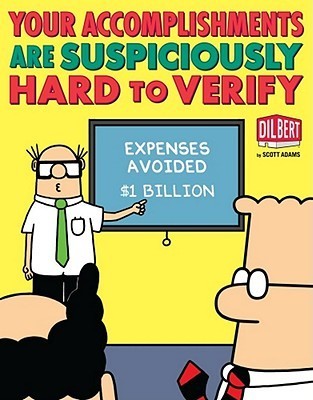
The latest collection from best-selling cartoonist Scott Adams that touches on the subject of underperforming and sneaky co-workers.
Inside Your Accomplishments Are Suspiciously Hard to Verify, Adams tackles the subjects of Elbonian slave labor, faulty product recalls, less-than-anonymous employee surveys, and more.
If you've ever looked among your co-workers and thought, "I hope feral cats eat every one of you," or briefly celebrated a well-deserved promotion only to realize that the word "promotion" now means that you're responsible for doing two jobs for the price of one, then chances are you find the corporate cubicle culture represented inside Dilbert alive and well inside your own work environment—and that's exactly what makes Dilbert so topical and funny.
From Dilbert's invention of a portable brain scanner (with a popcorn microwave option) to his moonlighting as a professional corporate crime scene cleaner, Your Accomplishments Are Suspiciously Hard to Verify chronicles pointless projects, interminable meetings, and ill-conceived office policies one Dilbert strip at a time.
Scott Adams was a defining voice of the American white-collar experience who transitioned from a prominent cartoonist into a polarizing political commentator. After earning an MBA from UC Berkeley and spending years in management at Pacific Bell, Adams launched the comic strip Dilbert in 1989. The strip’s sharp satire of corporate bureaucracy and the "Dilbert Principle"—the idea that incompetent employees are promoted to management to minimize their damage—resonated globally, eventually appearing in 2,000 newspapers and winning the prestigious Reuben Award. Beyond the funny pages, Adams explored philosophy and persuasion in works like God's Debris and Win Bigly, the latter of which analyzed Donald Trump’s rhetorical strategies during the 2016 election. His career took a dramatic turn during the mid-2010s as he shifted focus to his daily "Real Coffee" livestream, where he combined his background in hypnosis and corporate strategy to comment on the "culture wars." This period of independent commentary culminated in 2023 when he reacted to a poll regarding racial tensions with a series of inflammatory remarks. Labeling Black Americans a "hate group" and advocating for racial segregation, Adams faced immediate and widespread repercussions; hundreds of newspapers dropped his strip, and his publisher canceled his upcoming projects. Undeterred, he moved his work to the subscription-based platform Locals, rebranding his comic as Dilbert Reborn. In his final years, he faced severe health challenges, including stage IV prostate cancer and vocal cord issues, yet he remained a prolific presence on social media. He eventually announced the end of his hand-drawn work due to focal dystonia but continued to direct the strip's vision. Adams’s legacy remains a complex study in the power of branding, the evolution of digital influence, and the volatile intersection of creative genius and political provocation in the modern era.
I wish I had read this when I was 18 as an introduction to the real world of work. So many truths and even a few inadvertent but useful tips, for management and non-management alike, that if I had realized earlier, my disappointments in the working world may have been moderated. 😣
I think in rating this 5-stars, I'm obviously outed as a worker in tech who deeply understands what this book represents. And, it's got me wondering if this book wasn't used by some of my previous bosses as a "how to manage" manual. So much so, that I'm nearly tempted to shelve this as nonfiction. Despite it hitting eerily close to home, I can't help but be constantly amused. 5-stars.
Another nice Dilbert collection. It's interesting because you can see how he evolved over the years (the first strips are from 15 years ago, and definitely not the best), plus there are some really great lines in there!
Another winner of the "It happens at my work all the time" award
Happens everyday and it just tickles my funny bone to see it is part of US corporate culture. Mangers don't like seeing it in print but most can't appreciate their mistakes. E
Maybe more so a 3.5. Pretty funny though not as consistently great as others I've read. Wally not wanting to work is relatable as I see people do that all the time. Also, there were some overlapping comics that were in prior collections.
We all might have started out like Calvin with a great view of life. But after hitting the workforce we all somewhat become Dilbert. Everyone knows someone like one of the characters in the strips. Highly recommended