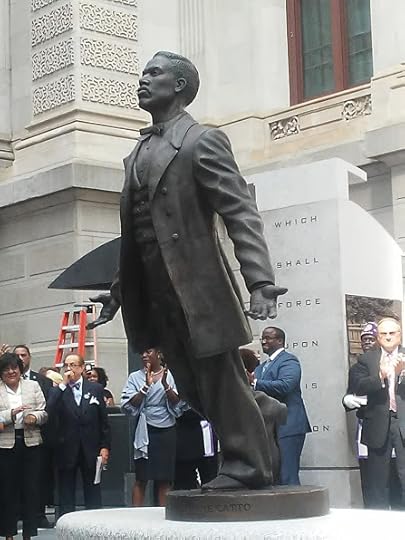
Octavius Valentine Catto was an orator who shared stages with Frederick Douglass, a second baseman on Philadelphia s best black baseball team, a teacher at the city s finest black school and an activist who fought in the state capital and on the streets for equal rights. With his racially-charged murder, the nation lost a civil rights pioneer one who risked his life a century before Selma and Birmingham.
In Tasting Freedom Murray Dubin and Pulitzer Prize winner Dan Biddle painstakingly chronicle the life of this charismatic black leader a free black whose freedom was in name only. Born in the American south, where slavery permeated everyday life, he moved north where he joined the fight to be truly free free to vote, go to school, ride on streetcars, play baseball and even participate in July 4th celebrations.
Catto electrified a biracial audience in 1864 when he proclaimed, There must come a change, calling on free men and women to act and educate the newly freed slaves. With a group of other African Americans who called themselves a band of brothers, they challenged one injustice after another. Tasting Freedom presents the little-known stories of Catto and the men and women who struggled to change America.
This book really is not, despite its claims, a biography of Octavius Catto. Sure, there are multiple pages devoted to him, but I'd say that at most 20 per cent of the book is about Catto.
So what is the book about? I'd say it tells the story of African Americans in the Northern United States during the middle decades of the 19th Century. It has a primary, not not exclusive, focus on events in Philadelphia. It's a worthy subject for a book, especially the accounts of the abolition movement, the fight for black suffrage (and the efforts to intimidate black voters once they had received access to the ballot box) and a battle to desegregate the Philadelphia streetcars, a century before Rosa Parks and Montgomery, Alabama.
So there's a lot of good stuff in the book. Unfortunately, there's just a lot of stuff in this book. It tends to meander from subject to subject, a parade of facts that don't quite work as a narrative structure. It's almost as if the authors felt they had to include every tidbit that they discovered during their research. (I doubt that this is literally true, but the book would definitely have benefited if it had been streamlined a bit. Maybe it should have been about 300 pages instead of 486.)
Octavius Catto has received quite a bit of attention during recent years in the Philadelphia area. His statue was installed in front of City Hall in 2017. I've been aware of this book for several years, and have been looking forward to reading it. I was surprised and disappointed that despite its interesting subject it became a chore to finish.
I recently decided that I'm going to try to read at least one book per year about Philadelphia. (I'm a New Yorker by birth and by sentiment, but I've now lived more than half my life in the Philadelphia suburbs and decided it's time to devote at least a small portion of my reading to this nearby city.)
Living in South Jersey and the Philadelphia area, and being an historian and history teacher, it is hard to ignore the rich local history that surrounds me. It is a joy to behold and savor. Reading this biography of Octavius Valentine Catto (1839-71), native of Charleston, SC and later of Philadelphia, was both an eye-opener in the world of 19th Century Civil Rights, and an education unto itself. When I was a kid growing up in Camden, NJ in the1960s, there was an Octavius V. Catto school just blocks from my house. I always had an inkling to find out who this person really was. This book covered, in detail, the life of this incredibly gifted educator, civil rights activist, and baseball player. To say this is a scholarly work is an understatement, as nearly every paragraph is well-documented and researched. I always love learning something I don’t know, and this book made me learn things I was never aware of. Of course I was always aware of the prejudice that blacks in America have always faced, but this book made me finally realize just how deep and profound that prejudice and hatred really was, as they permeated every fabric of the American tapestry. What Catto, his family, and his colleagues overcame was a hurdle no one should ever be forced to run. To have this beautiful person’s life cut short the way it was is sad and heart-breaking. I have read hundreds and hundreds of books, but this one stands in my top twenty. What an amazing book!
Biddle and Dubin, two journalists, wrote this book which explores the battles in Philadelphia between the multiracial abolitionists and their opponents in Irish diaspora and Democratic Party allies. The book, as others have noted, is not just about Octavius Catto but about the multigenerational effort to bring about the abolition of slavery and bring about full participation of Black Americans as citizens in the middle 19th century. The narrative goes roughly from the 1840s-1871, ending with the assassination of Catto on election day which brought the Republicans to power in Philadelphia. Catto was a giant in what can be termed the first civil rights movement that arose from both the abolitionist movement and the transformation of the Civil War.
The book begins with the torching of Pennsylvania Hall near 4th and Lombard during an abolitionist event by a mob of Irish rioters. Biddle and Dubin explore why the Irish became so racist towards Black Americans, arguing that they both sought to make sure they were not at the bottom of society but also because the Democratic Party with its southern slaveholding leadership and northern conservatives sought to include the Irish as citizens. Through that portal and exposure of white supremacy in the Democratic Party, as well as the nativism of the Whigs/Republicans, the Irish became very anti-Black and loyal Democrats.
On the otherhand, circles of abolitionists included radicals and moral opposition to slavery as well as nativist white opposition to competition with white people. Abolitionists operated pacifist resistance that grew bolder as the national consensus broke down over co-existence between the North and South. Conservative Democratic politicians argued that opponents to slavery would spark a race war and better to leave Black Americans in "mild slavery" as Pennsylvania Democrat James Buchanan argued before he became President. Meanwhile, the Reverand William Catto moved his young family from South Carolina in 1848, as more southern states forceably expelled free blacks, and he became involved in abolitionist circles. His son, Octavius, would become active in Black professional literary circles, anti-slavery organizations, black baseball teams (like the Pythians), and mobilizing Black volunteers to join the union army during the Civil War.
Biddle and Dubin note that, as President Buchanan actively seem to side with the South to expand slavery, John Brown's raid on Harper's Ferry, while failing at sparking a larger slave insurrection, did help mobilize both white and black abolitionists, as well as push the Southern white supremists over the edge into paranoia about "the next John Brown." When Lincoln was elected, it was too much for the South, and Civil War was on. Catto and other black organizers helped push Lincoln to making it a war of abolition, year by year, and not at all at first.
By the end of the war, Black voters were firmly Republicans, though the ability to vote would be challenged on the ground at every turn. Catto helped push the first Civil Rights movement in Philadelphia by pushing for the integration of new street cars, which was a long battle from 1866 on that would cost lives and create riots by whites. Finally, when Catto helped bring the Republicans to power, he was murdered by an Irishman who was never convicted for his murder by white juries, though he all but admitted he killed Catto and other African-Americans.
This book is long and well researched. While not just the story of Catto, Biddle and Dubin do a fabulous job illustrated the violent race relations in Philadelphia, and the struggle to achieve real freedom and equality, while unfinished, has seen victories paved with blood of men like Catto. Recently, a statue of him went up in Philadelphia, and it was long overdue.
This book is an important addition to the history of racism, the Civil War and Civil Rights in the US. While the title suggests that the book focuses solely on the life and work of Octavius Catto, it is much more than that. It really is a history of the black struggle for freedom and basic human rights in the decades leading up the Civil War and the first 10 years after the war, leading up to the passage of the 15th Amendment which gave the vote to African Americans. The first 100 pages focus on William Catto, the father of Octavius, who in his own right was courageous leader in Charleston, SC and then Philadelphia. Then the story focuses on a cadre of young scholar-leader-activists that included Catto and many more who led the fight for racial justice in Philadelphia, Pennsylvania and along the Eastern seaboard. There are chapters that focus on abolitionists like William Lloyd Garrison, Angelina & Sarah Grimke, Lucretia Mott, Theodore Weld and more. There is a chapter on Frederick Douglass and another on John Brown, the towering abolitionist figures of their era, and a chapter on the lukewarm support for abolition from Abraham Lincoln.
What is so important about the book is that it dispels all the false impressions of the smooth transition from slavery to freedom for blacks in the US. Catto and his colleagues worked for passage of a bill that allowed blacks to ride street cars, but even when the law was passed, the enforcement of the law was at best weak and so blacks were routinely beaten and killed for exercising their rights. The climax comes when Catto was killed on voting day by white mobs, mostly Irish, who controlled South Philadelphia and routinely used violence to intimidate blacks to maintain their power. It also shows how the Republican support for giving blacks the right to vote was very politically motivated. They figured most blacks would vote Republican and so add to their political dominance after the war.
What is most troubling is that the patterns of racist behavior existing today, have their counterparts 150 years ago: police violence against blacks, voter suppression, and under-resourcing education, the need for black teachers for black students, the role of the black church and the courage of some white allies.
An interesting sidebar was the formation of the first Negro baseball league who for a brief time were able to play white teams like the Philadelphia Athletics. Among all that he did, Catto was also a 2nd baseman on the Negro baseball team, the Pythians.
All in all this is a must-read for every Philadelphian who walks by the newly constructive Octavius Catto statue south of City Hall, and to every person who has yet to grasp the pernicious hatred embedded in our country's ongoing battle against racism.
Recent history texts of The American Civil Rights Movement have tended to roll back its timeline before 1954 and expand its cast of heroes. Well, this book is about a civil rights leader whose murder came six years after the assassination of a great American President. Oh, you might think, another book about MLK and JFK. Biddle and Dubin are writing about the death of Octavius Valentine Catto in Philadelphia in 1871, six years after Abraham Lincoln’s assassination.
Expertly researched, this book exploded all my notions about civil rights timelines. It painstakingly connected the 19th century struggles of African Americans to end slavery, to serve in the military, to ride in streetcars, to agitate for voting rights, with all their subsequent battles during Reconstruction and the rise of Jim Crow. I’ll be citing this informative text for many years to come. It was not, however, an easy read. For that reason I gave it only four stars.
Part of the reason I’m giving this exhaustively researched, very well-written discussion of extremely important and disturbingly relevant subject matter a mere 3 stars is just the fact that it was so soul-crushingly depressing and disheartening to read it, especially given the context of what’s going on in the U.S. right now. That’s hardly fair to its talented authors, of course, but life, like American elections, is not and never was designed to be fair.
I also feel the authors missed a golden opportunity to clarify a point recognized by every American with even a rudimentary understanding of American History, i..e. a relatively small minority: Back in the mid-19th century, the new Republican party was formed in the North, by what would today be described as “liberals.” The Democrats, back then, dominated the South, and championed “state’s rights” in stark contrast to the GOPs’s support for the expansion of federal authority to address slavery, polygamy and other social evils (i.e. what today's Republicans would describe as "nanny-stateism.") In the first presidential election for the new party, it swept New England but didn’t win a single state south of the Mason-Dixon line, where the Democrats prevailed *. In the following presidential election, 11 Southern states seceded from the union precisely because a big government liberal Republican won. Those states are of course extremely Republican today. Virtually every single asshole flying a Confederate flag today is a Republican.
The book details one atrocity after another by the Democrats, but at no point does it emphasize that the Democratic party of the 19th century was the conservative, southern, “state’s rights” overwhelmingly white party (i.e. the GOP of its day) while the Republicans were the northern, liberal, “big government” party of multiculturalism.
Back then, members of the conservative, “state’s rights”, overwhelmingly white party of the South murdered Catto and others in their efforts to win elections through thuggery and disenfranchisement when they realized that democracy wouldn’t work for them now that brown people were voting. They are doing the same thing today, but they call themselves “Republicans” now.
"Tasting Freedom" by Dan Biddle and Murray Dubin is an indelible portrait of a man whose life spanned the last days of legal slavery in this country and the beginning of hard-won freedom. It was in that quest for freedom, on the streets of Philadelphia, that Octavius Catto lost his life. "Tasting Freedom" is a riveting slice of American history, beautifully told and offering very valuable background for the struggle for equality that continues today. Bravo, Messrs. Biddle and Dubin! Lisa Tracy
This is such an interesting approach to biography, taking the man in context with his generation and the civil rights movement he was at the forefront of, though I wish that since it had been named for Catto, it had focused more on him, or included more excerpts from letters he'd written or speeches he'd penned. I also think the authors let their personal opinions slip into the book a few too many times, in the forms of comments at the end of chapters. But I really loved this take on biography, since Catto is such a man of his time, one example of a generation of people who fought for civil rights in the 1800s, during the civil war and reconstruction period. The authors capture the strangeness of those times- where black people owned slaves, people fought for voting rights prior to slavery ending, and black people were elected to office in the South shortly after slavery ended. I think the timespan this book worked to its advantage, covering three generations of Cattos, showing the different movements active in each period, and slowly building up to the Civil War, then Reconstruction. The authors manage to link everything back to Catto and his core group well, showing what their experiences would have been like in this time period, the challenges they faced, and the tensions in Philadelphia at the time. Catto's death was written with a lot of impact, tracing his day from beginning to end, showing the mob at the time and the trial afterwards. I think the line about what he last saw, integrated streetcars, was the most impactful, and had me on the verge of tears. The authors also wrapped everything up well, showing not only the course of the lives of Catto's friends but the way that Catto and his generation impacted future generations. The paragraphs at the end about Catto's descendants worked really well, especially the thread that there were a "hundred Cattos", working both in terms of his descendants but also his generation. The authors wrapping up the end of the I.C.Y. and other important structure worked well as well. I also am glad for the bibliography, the index, and the openness about sources throughout the novel, since many of the papers at the time had heavy leans one way or another. This is a great work, really fascinating and hard to put down overall, with lots of branching out, detail on the time period. It draws attention to a period that needs more academic focus overall, given its influence.
Much good information here about a number of less well known figures in the fight for civil rights, including Octavius Catto, but may be too detailed for some. It seemed to take a long time to get to the story of Octavius, and a long time to finish the book.
Octavius catto is a person who helped with black getting the right to vote. He died on Election Day. He got shot by Frank Kelly. His whole life is very interesting to read. Not that many people know about him.
Great contents, inspiring and heartbreaking story, 5/5. At times confusing writing style, bloated language, 3/5. The Kindle edition, without properly coded chapters and with weird spacing all over, 1/5.
A very interesting and detailed book centered around the people who fought against slavery and oppression in the early 1800s. While the book title focuses specifically on Octavius Catto, the reader is introduced to many, many fascinating people. Almost too many--adding a list of people mentioned in the book would have been helpful in keeping track of everyone. At 500+ pages, the book offers a detailed look at life for African-Americans in the early 19th century but was perhaps a bit too detailed. A bit more editing could have made this book a bit easier to follow. That being said, I learned a great deal and enjoyed the book overall.
Another helpful tile in the grand and complex mosaic of African American History. It also had personal resonance because Catto was friend of my great great grandmother and the book includes poem he wrote to her. My cousin Lillie is also interviewed in the book.
Very good book but I just couldn't finish it. Maybe someday. Highly recommended for folks who want to learn more about the African-American freedom struggle in the 19th century.
Very detailed, at times repetitive, but I learned a great deal about a part of our nation's history - and the people involved in it - that our history textbooks have neglected.