I remember thinking Lovecraft is not really my cup-of-tea when I first tried to read some of his stories. To a twelve years old curious about science and about voyages of discovery, the mystical and obscure master of horror could not compete with the likes of Jules Verne, Karl May or Alexandre Dumas. So it took almost 40 years (and a homage novella written this year by Kij Johnson) to make me come back to these nightmares realms ruled by malefic gods.
At the start of the quest, Randolph Carter looks to me like a scion of John Carter of Mars : he goes to sleep and wakes up in an alternate world, where he is carving out a kingdom for himself with daring sword and unflinching courage. Lovecraft may share the starting point with Burroughs, but the focus of the story is not pulpy planetary romance (alas! no scantily clad princess of Barsoom awaits Randolph in the Dreamland) but an indepth exploration of the hidden and often scary depths of our subconscious mind.
Carter resolved to go with bold entreaty whither no man had gone before, and dare the icy deserts through the dark to where unknown Kadath, veiled in cloud and crowned with unimagined stars, holds secret and nocturnal the onyx castle of the Great Ones.
While John Carter lies down in the desert and dreams of distant stars, Randolph Carter goes in his sleep to a magical city of indescribable beauty, a twilight wonder of marble halls, slender columns and twisting alleys by a topaz sea, a city that is locked against him by the hands of invisible Great Ones.
It was a fever of the gods, a fanfare of supernatural trumpets and a clash of immortal cymbals. Mystery hung about it as clouds about a fabulous unvisited mountain. [...] Vaguely it called up glimpses of a far forgotten first youth, when wonder and pleasure lay in all the mystery of days, and dawn and dusk alike strode forth prophetic to the eager sound of lutes and song, unclosing fiery gates towards further and surprising marvels.
Is Randolph on a quest to rediscover his youthful enthusiasm for the world, his thirst for adventure and for distant shores? How did the world of adults betrayed him, disappointed him? What made him reject the present day and take refuge in fantasy? A brief foray into the biography of the author, a sensitive man, alternatively passionate and depressive, tormented by life in the metropolis and yearning for a return to his home in Providence, Rhode Island, may offer an answer to these questions, but it is not a prerequisite for enjoying the journey Randolph Carter embarks on.
So to Celephais he must go, far distant from the isle of Oriab, and in such parts as would take him back to Dylath-Teen and up the Skai to the bridge by Nir, and again into the enchanted wood of the Zoogs, whence the way would bend northward through the garden lands by Oukranos to the gilded spires of Thran, where he might find a galleon bound over the Cerenarian Sea.
These names are resonant with promise of adventure and marvels, but right from the start the quest is threatened by the true rulers of the Dreamland, lesser and higher gods that dance to unknown tunes and bicker among themselves while turning a blind eye to the pityful affairs of human ants. To unlock the gate of the sunset city, Randolph must address his plea to the highest supernatural authority in the universe. Problem is, the higher you climb up the god's ladder, the more fickle and irrational the gods become. I am not truly familiar with the Cthulhu Mythos, but I believe there exists in the Lovecraft oeuvre a coherent vision of the things that lurk in the shadows of the waking world. The present novella is a prime example of this vision.
Always upward led the terrible plunge in darkness, and never a sound, touch or glimpse broke the dense pall of mystery.
A quick browse of the florid prose favoured by Lovecraft in describing these 'superior' beings can partly explain his lasting influence on readers and writers interested in the study of the supernatural:
unearthly immanence
tyrannous gods
elder witchery
cryptical
sinister
Cyclopean
gargantuan
prodigious void
gigantic, blind, voiceless, mindless
crawling chaos
grotesque
Makes you wonder what kind of nightmares haunted the dreams of Lovecraft, what existential dread sent him into despair and made him imagine that there is no ultimate answer to the question of life, nothing but a last amorphous blast of nethermost confusion which blasphemes and bubbles at the centre of all infinity
I didn't much like this bombardment of lurid images, this insistence that we are doomed by invisible chaos, not when I was twelve, and honestly not so much now in my fifties. But I can at least appreciate the monumental struggle of the individual against the darkness waiting to engulf him every night, the heavy price paid by the artist, by the dreamer who dared to descend into Hell and bring back to us a clarion call of warning and an entreaty not to loose sight of our private sunset city, this symbol and relic of your days of wonder
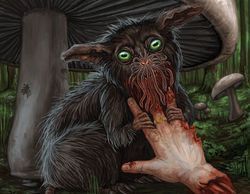
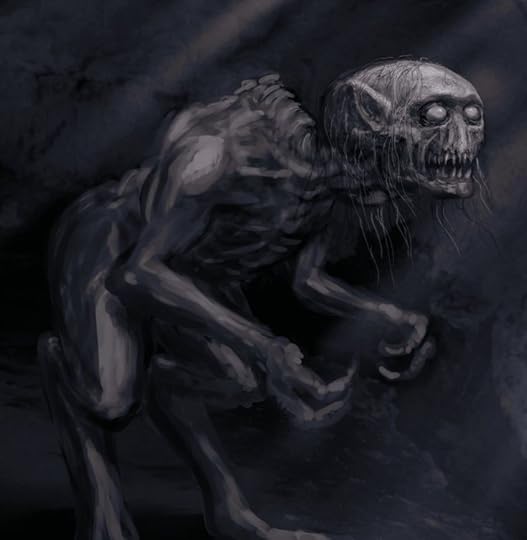
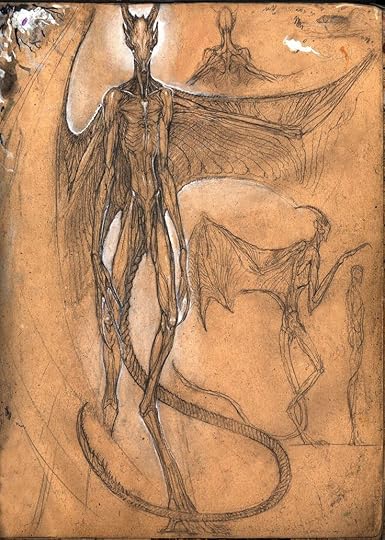
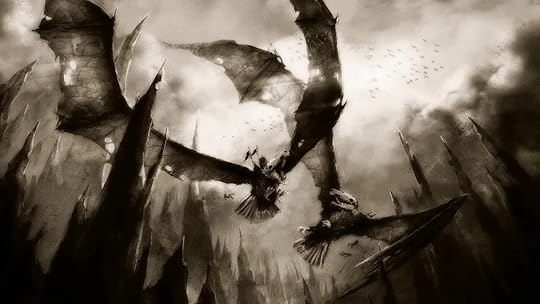
Lovecraft, like Randolph Carter, was constantly plagued by night-gaunts, ghouls, gugs, ghasts, zoogs, moon-beasts, shantak-birds and evil priests, but parts of the Dreamland are still reminiscent of his youthful days of wonder. The author's utopia bears witness to the less savoury things I heard about the author : a W.A.S.P. exclusive resort, male only, darkies to be used as slaves or servants or cannon-fodder. Cats are allowed favored-nation status, but that's about it as far as Lovecraft is concerned. Most of the racial insensivity is not particular to Lovecraft, but a mirror of the larger views held by his anturage and by a lot of philosophers and political leaders of the period the story was written. Same can be said about the purple prose, something most of the readership expected in their Weird Tales. I would never recommend banning an author for his private views, especially since his contribution and influence on the genre is undeniable.
Since October with its Halloween themed reads is just a month away, I plan to further explore the universe of Lovecraft. I am sure there are more haunting gems to be discovered among his stories:
Perched on that ledge night found the seeker; and in the blackness he might neither go down nor go up, but only stand and cling and shiver in that narrow place till the day came, praying to keep awake less sleep loose his hold and send him down the dizzy miles of air to the crags and sharp rocks of the accursed valley. The stars came out, but save from them there was only black nothingness in his eyes; nothingness leagued with death, against whose beckoning he might do no more than cling to the rocks and lean back away from an unseen brink.






 , which has the same title but binds the novella with five other works by Lovecraft. However, I didn't read the other five at this time. Though it wasn't published until after his death, the author wrote this, according to his letters, primarily in 1926-27, making it one of his earlier works..