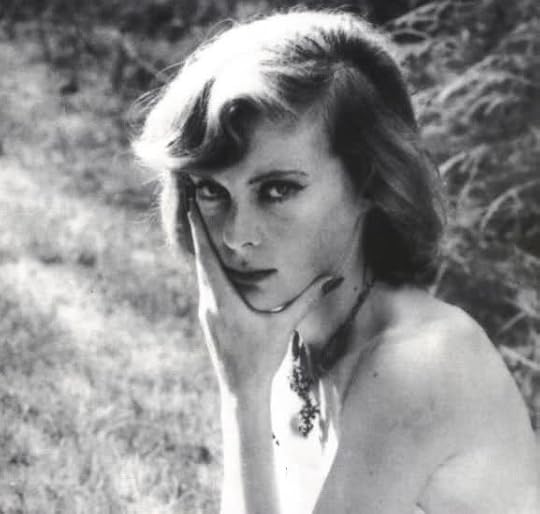
Born into one of the most celebrated Anglo-Irish families, the Guinnesses, Ivana Lowell grew up at the whim of two literary heavyweights—her mother, writer Lady Caroline Blackwood, and stepfather, poet Robert Lowell.
Now, with an incisive eye and a wicked sense of humor, she shares the stories we’ve always wanted to hear. She tells of following the famous authors from one crumbling, drafty country house to another, and of summers spent with madcap relatives such as her maternal grandmother, the Marchioness of Dufferin and Ava, and her “old friend,” the Queen Mother. But Ivana also has darker stories to about her childhood accident, about her own stints in rehab, and, finally, about discovering the secret Lady Caroline had successfully kept from Ivana her entire life.
Ivana Lowell is a Guinness heiress. That means every time someone cracks open a pint of Guinness, cha-ching, Ivana gets richer. She hobnobs with actors, writers, the very rich, and royalty. Oscar de la Renta made her wedding dress. She got handed a job at Miramax, she has a "condo" (that's Brit-speak for penthouse) in Manhattan, a house in Long Island, a castle in Ireland, another castle that her mother bought from Princess Diana's brother, and she grew up in the USA and the UK. She went to exclusive boarding schools and acting academies until she grew tired of them and ran away. She had a nervous breakdown on the floor of a haberdashery because she couldn't get the appropriate name tags for her school clothes. She hangs out in the most exclusive and the sparsest rehab facilities. She doesn't move in mere social circles, no. Her people are "sets."
Anyway, I'm rambling. Ivana really means to tell us that her life is HARD! Why, she's been an alcoholic and abused drugs and comes from a family rife with dysfunction! She's dated bad dudes, made a fool of herself with booze, and wouldn't you know it, she's just plain unhappy! Stars! They're just like us!
I have about as much sympathy for a rich boozer as I did for Britney Spears when, rolling in her millions, complained about being put on the cover of Rolling Stone when she was just 15. ARHGGHGH!!! Even though Ivana did suffer some real trauma (molestation, death of a sibling, severe burns, paternity issues), guess what? It doesn't separate you, elevate you, or make you any different from the rest of us. It just makes you a lot friggin luckier because you have about a billion more bucks than we do. So, either make it interesting (she doesn't), be a sympathetic subject (she isn't), or make damn sure you're a celebrity (she isn't) before penning out a memoir.
Ivana Lowell can't write for shit, which makes me think her therapist put her up to writing this book and then her powerful friends in New York got it published. She never even tells us any of the details of all those drunken nights, preferring instead to say, I was drunk, it was bad. The the name dropping of royals, Vanderbilts, Freuds, and intellectuals in her "set" then ensues. She sums up her entire story near the very end -- which, if she'd done at the beginning would have saved me a lot of time, eye-rolls, and seven bucks -- by saying she spent her life "drinking, being difficult, marrying an addict, having fights with him, and then divorcing him." The rest is just the simple ramblings of a 40-something poor little rich girl who no one's ever heard of. Sheesh. At least James Frey would have us believe that he had girls snorting coke off his ... never mind, at least there was some action there.
The best part? Ivana never even tells us if she got off the booze! Unfortunately, due to the sheer dullness of this book, I'm inclined to think she's clean. Damn. I'm sure she'd have written a much more interesting tale after a couple of dry martinis.
One star for the touching (and only real thing in the book) description of her mother's passing.
Ivana Lowell is the daughter of Lady Caroline Blackwood, a member of the Northern Irish aristocracy who was the third wife of the American poet Robert Lowell, as well as being a spectacularly messy alcoholic and a very talented writer herself and an amusing friend. I read this book whilst recovering from fairly major surgery. Ivana Lowell is herself excellent company and this is just the sort of gossipy but intelligently written distraction you need when you are dealing with a lot of pain. It will also cure any traces of class envy you may be tempted to. Aristocrats seem to be especially bad at parenting. It was also fascinating to read the author's account of her encounters with the Weinstein brothers. The #MeToo revelations would have been very old news to Ivana.
This slightly flat memoir apparently ticked off many people (is it the feeling that if someone's this glamorous, well-connected and wealthy, they don't really have any business fucking up?) but it wasn't that bad. Her memories of her stepfather (Famous Poet Robert Lowell), mother (Famous Muse/Writer Caroline Blackwood) and grandmother (Famous Bitchy Eccentric) are evocative, even if the prose style is slack, and if the details of her relationship with Mr Miramax drag on, her struggle to choose between three possible fathers is oddly compelling. The psychological sense, early on, of unstable ground and a puzzling blurriness depicted here are familiar from Angelica Garnett's more vivid and far more petulant memoir, but where Garnett felt consistently cut off from her real father Duncan Grant and muffled by her mother, Ivana Lowell tries to emphasize her connection with Robert Lowell (she took his name at her mother's suggstion) with a kind of touching dignity, even if he was part of her family for less than a decade, off and on. She has many small, almost momentary memories of him reading plays out loud with her, asking her opinions on his poetry (not far-fetched at all; Lowell dragged EVERYONE into editing his poetry), playing word games, treating her with love and respect. What makes these moments almost heartbreaking is how obviously highly cherished they are, like small personal mementos of someone long dead that are rarely handled because losing them would be so terrible.
Her love for her mother -- who was, clearly, a terrible mother, absolutely no good at it, and who equally clearly loved her children and was a good if wildly unpredictable friend after they grew up -- is also clear, and surprisingly warm and affectionate. The chilly disapproving biography by Nancy Schoenberger, which stuck Blackwood on a pin and stared at her with beady eyes, isn't supplanted but illuminated by Lowell's memories of her mother's quips and catchphrases ("Too bad, even for us!" is a favourite). Lowell also developed love for her (rather terrible) grandmother, and it's oddly poignant to see her trying to connect to the background Caroline so determinedly cut and ran from. I also liked her emphasis on Blackwood's writing: that no matter how many the men, how wild the nights, how plentiful the bottles, her mother would determinedly sit herself down, focus on the page, and write.
That said, this book is probably most rewarding to someone already interested in Blackwood, Robert Lowell, or both, but if you are, there are a lot of little hidden gems. If not, it might be as off-putting as a remarkable number of GoodReaders seem to think it is.
If you have read and enjoyed A Charmed Life: Growing Up in Macbeth's Castle and/or Dead End Gene Pool: A Memoir, and you enjoy hearing about the dysfunction, self medicated lives of the children loosely raised by parents who were never really equipped to function like resposible adults, then this book is definitely for you.
Ivana Lowell tells the story of her rather lonely and chaotic childhood. She lived in a succession of different houses, spent time in England, Ireland, Boston and New York growing up with the only constant being her rather troubled and alcoholic mother who, in spite of her shortcomings, was a fairly devoted and loving mother. You can't help but feel for what a lonely and sad childhood she experienced, and it's not overly surprising that she herself struggles with alcoholism as an adult. She is quite frank and honest about her experiences and her narrative made for a very engaging reading experience. It didn't take me any time at all to finish this book, and I could hardly put it down once I started it.
I usually detest gushy, mushy, self reflective, abuse & addiction filled, A Child Called It-esque first person stream of consciousness memoirs, particularly those written by celebrities. I rank them right below textbooks and right above instructions manuals written in China. Celebrity tell-alls are always filled with tales of woe and cocaine, and pretty light on the actual names. Naming names is the most exciting part of a celebrity memoir, right? Ivana Lowell's memoir names names and doesn't pull any punches, and it's actually really well written. It still has the abuse and the addiction, the inside of her head feel, the crummy first person at an AA confessional (they all have to have that, don't they?). But there was something tongue in cheek about the whole book, a bit of bite, wanting us to notice the juxtaposition of extreme wealth and privilege and parties with the Queen Mother with crazy hideously funny life behind the glam. So she's rich - poor little rich girl stories are everywhere; there's obviously an interest and market for them, as they come out in droves every year. At least Ivana Lowell's is well written. The Queen Mother's nickname among her aristo cronies was "Cake?" Who knew?
Don't be put off by those who are bitching about the poor little rich girl who doesn't recognize the value of her millions or her connections. There are far too many celebrity memoirs being written today, but this is one that is remarkably compelling and quite unflinching in its honesty. Ivana Lowell, despite every advantage, is impoverished in every way that counts and has had to face real tragedy, and a gene pool that although wealthy (Guinness Breweries) is also afflicted with alcohol, suicide, abuse and secrets. At the heart of this story is Ivana's conflicted relationship with her possibly amoral, drunken and intelligent mother, the writer Caroline Blackwood. While the writing could have been tighter and more linear, this first book is a page turner for sure.
What happened is Crazy Families and their legacy. The famously bipolar Robert Lowell, whose canonical poem, “For the Union Dead,” recently had its half-century anniversary celebrated (http://www.theatlantic.com/culture/ar... ) went so far as to help create another Crazy Family in England, and while he was not Ivana Lowell's biological father (this particular issue is a crucial one in this throughly enjoyable book), he is warmly remembered by his stepdaughter.
In fact, if mostly shielded from the worst of his biologically-induced depredations, Ms. Lowell takes her title from one of Lowell’s most piercing and self-confrontational lines, which seems the obvious impetus for the approach of Ms. Lowell to her material. Her mother, Lady Caroline Blackwood, is the eponymous subject of Lowell’s THE DOLPHIN and an essential figure in both FOR LIZZIE AND HARRIET and Lowell’s last book, DAY BY DAY, all of which can be found in the COLLECTED POEMS (FSG), began to take her own work seriously only after her third husband’s death. The Anglo-Irish heir to the Guinness fortune, alcoholic, and none-too-stable herself, Blackwood was gifted with a dark sense of humor and a highly distinctive prose style that remains, unfortunately, mostly out of print. Perhaps the publication of this enthralling memoir will change that. I recommend reading it after Nancy Schoenberger's DANGEROUS MUSE THE LIFE OF LADY CAROLINE BLACKWOOD (Da Capo), and my own brief review of that book can be found here on Goodreads.
That's right, I'm giving this one the big 5 stars. Read it and weep, haters. Ivana Lowell tells her story with the only title fitting, Why Not Say What Happened?, b/c that's pretty much the tone of the book. I can't imagine her having held anything back. It must be all here (pubic hair transplant, drunken disgraces, dating second cousins, etc.). The subject was definately interesting. Her mother was nothing less than fascinating, AND, I found Iavana to be a pretty good writer to boot (there is a strong writer's gene there, no denying that). So there it is. I love hearing women tell their own stories. I guess it can be said that Ivana was born into "privledge", but trust me, you would never, ever want to trade circumstances. A lot of unfortunate and deep unhappiness. I found Ivana's voice to be very honest and likable. Well done, Ivana. Thanks for your story.
What a mess! And yet, impossible to put down! The most addictive kind of junk food read--I gobbled it up, but had a distinctly queasy feeling afterwards. The book is filled with surprising gossip (Why the Queen Mother was called "Cake" by her friends), literary hijinks (the author's stepfather was Robert Lowell), and some great anecdotes sprinkled amongst the visits to rehab and tales of increasingly impossible men. Ivana Lowell may be the quintessential poor little rich girl (and she really did have a hell of a life), but she tells a damn good story and knows how to poison her arrows with just enough of that satisfying sting.
Very honest and raw. I found it very interesting. Lowell writes about someone who was a friend of my parents - Ivan Moffat - who she later discovers was her biological father. Her descriptions of him really capture the man I knew as a child.
I am a huge fan of Caroline Blackwood and was flabbergasted that I just found out this memoir existed. I disagree with the reviews that imply that it is tawdry and self-indulgent-I loved every second of it and could not read it fast enough.
Ivana Lowell's memoir of her life as a member of the famed Guinness clan has some fascinating moments. Her mother was novelist and muse to many Caroline Blackwood, and her stepfather (and the main father figure in her life) was poet Robert Lowell. This didn't exactly make for a stable childhood; Blackwood was an alcoholic and Lowell was bipolar. Ivana's maternal grandmother, Maureen Guinness, is both fascinating and rather repugnant. She was an aristocrat, but her sense of humor was rather low-brow (she apparently enjoyed fart jokes and torturing her dinner guests by pretending to be her own maid). And in the tradition of grandmothers everywhere, she would say really awful things. For example, when she learns that the man Ivana believed was her biological father may not be after all, Maureen is delighted because this means that Ivana isn't half Jewish and thus has a better chance of landing a husband.
Ivana shares her mother's problem with alcohol, and much of the book discusses her struggles with it. Her stories of rehab are funny, but also a bit terrifying. I enjoyed this memoir, but it felt like it needed some editing. There were a few things that didn't make sense in terms of time (her age at various events seemed to vary a bit), and parts of it felt disjointed. However, it was still an entertaining fast read.
I loved this book. Ivana Lowell and her parents Caroline Blackwood and Robert Lowell. Dysfunction at its best. Truly interesting characters trying to find their way in the world. Reading this book sent me on a fact finding mission to read mini-biographies of the various characters in Ivana's life. I also read a full length biography of Robert Lowell after reading this book.
Many reviews of this book are negative. There's a whole lot of hate because of the affluence Ivana was born into (Guinness money) and the idea that wealth should just make all things right, or at least stop you from complaining or admitting to a less than stellar life. I don't believe money has anything to do with happiness so I find this argument petty. Addiction and dysfunction happen at all levels of society. Happiness is not a wealth based attribute. We only know what we are born into in life unless we make a serious and determined effort to open ourselves up enough to feel what another might feel like.
For some people such as myself, growing up without a father is something we just absorb into our lives. But for Ivana Lowell, growing up with a step-father, the poet Robert Lowell whom she adored, and three potential biological fathers whom she knew, paternity was shifting ground. This memoir is fascinating on many levels: Ivana's journey of self-discovery and the discovery of her father's identity; the relationship between her and her mother, Lady Caroline Blackwood; and the legacy of being a member of the Guinness family of brewery fame. I am always intrigued by accounts of the aristocracy and their pursuits, particularly how they manage to fund their lavish lifestyles while crying poor. I can't wait to read more, particularly books by and about Caroline Blackwood.
By the end of this book I loved Ivana and have watched interviews with her on YouTube which give me an artificial sense of familiarity with her. I might even friend her on Facebook - if she'll have me but I fear I mightn't be posh enough.
Really breezy, gossipy read. Ivana Lowell is a Guinness (beer) heiress and the daughter of the writers Robert Lowell and Caroline Blackwood (also a Guinness girl). It's a memoir (how do I keep reading these?) full of the seemingly predictable trials of addiction and abuse. I enjoyed her writing style (very conversational, light) and she has an interesting perspective, having grown up as an aristocrat among her parents' literary circle. Probably not for anyone with a taste for more serious material. Better as a quick weekend or beach book.
Interesting for its portrait of writer Caroline Blackwood and Robert Lowell. Not very well written and very sad but the author is likable and it is easy to read this despite the uneven quality of the writing.
Not what I expected yet still pretty good. I wanted a better picture of Lady Caroline, but I didn't feel like I got to know her any better at all. That said, Lowell's life is very interesting, if privileged, and it was an enjoyable read.
I read this virtually in one sitting. A splendid and sometimes macabre caste of eccentric and sometimes tragic characters. Caroline's neglect of her daughters mirrored her own childhood. You would have thought she would avoid that.
Dit boek is boeiend, humoristisch maar choqueert ook. Niets is wat het lijkt: adel en rijken: decadentie en schone schijn! Sommige gebeurtenissen zijn haast filmisch. Tragikomisch. Review door een lezer van bibliotheek 'de Priool' - Bocholt.
Harrowing in parts, but very astute and thoughtful. A family story that touches on the life of the author's mother, novelist Lady Caroline Blackwood, and her various father figures, as well as her own journey to maturity.
Fascinating that I found this book. Ivana Lowell has a similar childhood to my own, abandoned by her mother due to alcoholism and her mom's mental illness and not sure who her father is and told several different stories about it by her mother. Her life and mine are parallel, except she lived in bigger houses and always had financial security. Brutally honest, it gives one hope that if you can get to the bottom of your grief, your angst, your insecurities you can heal. Is there any other way?
The world of the have-a-lots is intrinsically appealing to outsiders and insiders. Glamour and power bounce from the gilded facades of the rich, famous and infamous, and we might just catch a ray; a secondary glow seems better than none. We can’t help at least glancing through the tabloids to read about the latest scandal and to get a glimpse of someone’s tumble or rise. Ivana Lowell’s memoir “Why Not Say What Happened?” plays directly into our eager appetites for the lavish and sensational. A descendant of the wealthy Guinness family, she is also the step-daughter of the American poet Robert Lowell. The lure for the reader is both the wealth and the brilliance of the players.
The memoir opens with the death of the author’s mother, Lady Caroline Blackwood, wife of Lucien Freud and Robert Lowell. Whisked away from mourning in order to lunch with a friend of Caroline’s, Lowell finds herself forced to question her paternity. Her dining partner suggests, coyly, that by now Lowell knows that she has a different father than her sisters. Lowell is startled and this quandary is meant to be a driving force behind the book. But Israel Citkowitz, who Lowell believed to be her father for thirty odd years, died when she was a child, and her most vivid memories of a father figure are of Robert Lowell himself, who chronologically cannot be her father. Because Lowell’s sense of paternity is already benignly disjointed one wonders if the mystery needs to be solved.
Lowell speeds through her narrative by illustrating anecdotes of splendid wealth, whimsical indulgences, and a veritable menagerie of names worth mentioning. Her grandmother Maureen is portrayed as something of a tyrannical social climber, and her mother’s moods sway in tandem with her inebriation. Maureen touts the queen mother as among her closest friends, and is only saved from the “family problem” of alcoholism by fatally embarrassing herself in front of the royals and swearing off liquor altogether. Neither Lowell nor her mother escape so easily.
The second thread of the memoir is the author’s struggle with alcohol. Lowell tells us that she has gone to rehab many times, occupying those of both a sparse and luxurious nature. She trots through them at unspecified points in her life and mentions them so lightly it is difficult to discern if she takes them seriously. It is even harder to know if she’s close to conquering her alcoholism or interested in doing so, and your heart goes out to her daughter Daisy, who is a glimmering apparition of hope in her mother’s narrative.
For all of the glamorous hullabaloo Lowell kicks up, there is very little revealed about the depth of either her or her mother’s struggle with alcohol; nor are any of the author’s relationships delineated with concrete particulars or insight. I understand the delicacy of family and the sacred nature of its history. Bringing the public into family secrets is a tricky business. But if you are going to write about it, you have to peel back all the layers. Otherwise the result is not worth even a modicum of the discomfort it will inevitably cause.
Robert Lowell is little more than a benevolent, phantom presence in the narrative and it is disappointing to find his complexities so easily dismissed. The major matriarchal figures in Ivana Lowell’s life are described with an awareness of their venom but without any real exploration of their truths or the consequences of their behavior. Perhaps this stems from a reluctance to accuse or, merely, to find fault, but Lowell’s inability to truly examine her predecessors makes it impossible for her to incorporate their lessons into her understanding of herself. As a result, not even the reader learns anything of note.