

What do you think?

Forever Peace #1
Pace Eterna
Anno 2043: guerre sub-nucleari devastano la Terra e i robot telecomandati che massacrano con implacabile efficienza militari e civili preparano il genocidio. Ma due giovani scienziati - Julian Class e Amelia Harding - stanno per fare la scoperta che cambierà tutto. L'arma assoluta, l'arma capace di distruggere non solo il pianeta, ma l'universo intero. Deterrente che tutti aspettavamo o terribile incubo? Il romanzo, ispirato ai temi di Guerra eterna, ha vinto il premio Hugo nel 1998 e ritorna qui in una nuova, accurata traduzione.
Copertina di Franco Brambilla
Copertina di Franco Brambilla
419 pages, Paperback
First published October 1, 1997
About the author
Joe Haldeman
440 books2,269 followersBrother of Jack C. Haldeman II
Haldeman is the author of 20 novels and five collections. The Forever War won the Nebula, Hugo and Ditmar Awards for best science fiction novel in 1975. Other notable titles include Camouflage, The Accidental Time Machine and Marsbound as well as the short works "Graves," "Tricentennial" and "The Hemingway Hoax." Starbound is scheduled for a January release. SFWA president Russell Davis called Haldeman "an extraordinarily talented writer, a respected teacher and mentor in our community, and a good friend."
Haldeman officially received the Damon Knight Memorial Grand Master for 2010 by the Science Fiction and Fantasy Writers of America at the Nebula Awards Weekend in May, 2010 in Hollywood, Fla.
Haldeman is the author of 20 novels and five collections. The Forever War won the Nebula, Hugo and Ditmar Awards for best science fiction novel in 1975. Other notable titles include Camouflage, The Accidental Time Machine and Marsbound as well as the short works "Graves," "Tricentennial" and "The Hemingway Hoax." Starbound is scheduled for a January release. SFWA president Russell Davis called Haldeman "an extraordinarily talented writer, a respected teacher and mentor in our community, and a good friend."
Haldeman officially received the Damon Knight Memorial Grand Master for 2010 by the Science Fiction and Fantasy Writers of America at the Nebula Awards Weekend in May, 2010 in Hollywood, Fla.
Ratings & Reviews
Friends & Following
Create a free account to discover what your friends think of this book!
Community Reviews
Displaying 1 - 30 of 798 reviews

August 25, 2008
Welcome to the future...where the final war is being waged

....against war itself.
There is such a bounty of wonderful, insightful and important ideas stuffed into this novel that I find myself seriously bummed that weak storytelling and plodding central plot flow marred my enjoyment enough to keep me from awarding this a 4th star.
Still, from a component standpoint, this is a collection of gems.
THE POLITICS:
The Haves:
The Alliance, led by the U.S., but including most of what we would consider the elite industrialized nations (e.g., U.K., Japan, France, Germany, Russia) is engaged in a bloody, relentless guerilla/terrorist/revolutionary war against the Ngumi (see Have Nots below). The Alliance's primary weapon is the soldierboy:


Each soldierboy unit is controlled from 1000s of miles away by an engineer who is "jacked-in" to the machine via an advanced neurological link that can not be duplicated or hacked. War as VR video game...
*shudder*...is it just me or do you just sense that something like this is right around the corner and it’s only a matter of time.
While jacked, all ten humans in the platoon share each others consciousness, memories and thoughts and Haldeman does a very good job of addressing the issues of gender, sexuality and intimacy that result from such a merging of male and female identities. Another unusual aspect that Haldeman brilliantly employs is that most of the humans “jacked” into the soldierboys are pacifists by nature. They are professors, doctors and scholars who hate what they are required to do and usually attempt to limit loss of life to the enemy...though they still kill boat loads the size of the titanic.
The psychological effect of the war on these people is a central part of the story.
The Have Nots
The other side of the conflict are the Ngumi: a loose confederation of 54 rebel groups comprised of (1) the majority populations of most of the underdeveloped nations, (2) strong minority factions within Alliance member states and (3) untethered revolutionaries fighting the resource distribution disparity. Not having the resources or the technology (see Societal description below), the Ngumi can't muster anywhere near the firepower of the Alliance. They are more like:
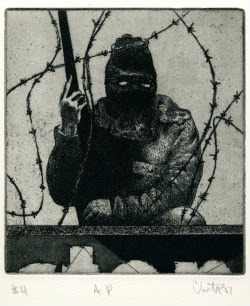
They are severely outgunned but highly motivated to the “cause.” This “cause” has nothing to do with ideology, religion or cultural differences, but rather is centered around wealth and the access to resources (specifically, the nano forges discussed below).
Again...is it just me or is a version of a have vs haven’t conflict also slouching towardsBethlehem the near future to be born.
While not a central aspect of the conflict, Haldeman does introduce significant racial elements into the plot which I thought he handled well. The majority of the Alliance members are white, the majority of the Ngumi are not. Ironically, the main character, Julian, is African-American and confronts issues of discrimination and prejudice during the course of the novel.
THE SOCIETY:
The great divide between the Alliance and Ngumi stems from the Alliance’s possession of nano forges.These devices can manufacture just about anything with sand, water and trace chemicals (the exception to this being certain items like nuclear weapons which will still require components like uranium to be included). The nano forges have changed the Alliance into a proto post-scarcity society and the government has been reformed as a socialist state in which people are provided the necessities of life in exchange for 3 years military service.
The nano forges allow for construction of all of the soldierboys needed to conduct the war and the only restraint on the numbers in the field are that only a small percentage of the population can successfully undergo the “jacking” procedure.
The rest of the population gets to live vicariously through the soliders byturning on CNN and watching 24/7 coverage of laser guided bomb slamming video game-like into far away targets renting edited versions of the mental recordings made by soldierboys in the field.
In addition to the central "war story" thread, the book also has another major plot thread involving a scientific experiment being taken on an orbital platform orbiting Jupiter that is designed to provide definitive answers to what happened at the “Big Bang”...if it doesn’t destroy the universe in the process. This story-line intersects with the main plot in a kind of Childhood’s End moment that sets the stage for where humanity goes next as a species.
THE ALLEGORIES:
If you have clued into it yet, let me say plainly that this novel is absolutely dripping with
allegories and eerie parallels to our world. First, the Iraq War with its video game-like conflict shown on TV 24/7 and vicariously experienced (and enjoyed) by civilians safe at home. Second, 9/11 and the War on Terror in which a shocking terrorist attack (claimed by the other side to be the work of the Alliance itself) is used as the justification for a global war against the loose-never-entirely-defined enemy that is everywhere.
Given that this book was written in 1997, the prescience of Haldeman’s foreshadowing
is scary to the point of AHHHHHHHHHH!!!
MY THOUGHTS:
This story, while not a sequel to Haldeman’s classic The Forever War, is part of what Haldeman refers to as a triptych (the third piece being 1968 Co which I have not read yet). As Haldeman so eloquently puts it, the three novels define
The world that Haldeman envisions is fascinating. It’s both hopeful and yet extremely troubling. The obvious parallels to current events adds an even greater degree of hair-raising to the narrative.
His ability to idea generate in impressive.
His story-telling, in this instance, not so impressive. I am a fan of Haldeman and generally enjoy his plot deliveries. However, in this case, I found it merely okay and was periodically disengaged from the story by bouts of boredom with the scene choices or impatience with the pacing between events. It wasn’t horrible, but it was weaker than I would have liked and it decreased my enjoyment of a story that had oodles going for it.
The worst flaw in my opinion was the poor characterization. While not caricatures, the players were too wooden and lifeless for me to engage with to any significant degree. This will usually kill a story for me as it makes scenes appear to go on for much longer than they actually do. When you don’t care what happens to person A, than person A talking about a bad thing happening doesn’t exactly keep you riveted to the page.
This lack of character connection is even more troubling in this story because this novel is, at its core, a psychological examination of the human species and its propensity for aggression. Much of what occurs is reactive to the stresses placed on the soldiers by the requirement of their job. The reader needs to be able to connect with them and feel their internal struggle.
Sadly, I didn’t.
I understood it intellectually but was never vested in the personal well-being of the protagonists. As you might guess, this led to a less than enthusiastic reading experience .
Despite all of the books story-telling flaws, this is a book I recommend to SF fans and fans of military fiction. There is so much win in the world-building and the ideas peppering the story that it makes the lack of a page-turning plot worth the trouble.
Creative...original...important...a bit of a slog. 3 out of 4 isn’t too bad.
3.5 stars. HIGHLY RECOMMENDED!
Winner: Hugo Award for Best Science Fiction Novel
Winner: Nebula Award for Best Science Fiction Novel
Winner: John W. Campbell Award for Best Science Fiction Novel
Nominee: Locus Award for Best Science Fiction Novel

....against war itself.
There is such a bounty of wonderful, insightful and important ideas stuffed into this novel that I find myself seriously bummed that weak storytelling and plodding central plot flow marred my enjoyment enough to keep me from awarding this a 4th star.
Still, from a component standpoint, this is a collection of gems.
THE POLITICS:
The Haves:
The Alliance, led by the U.S., but including most of what we would consider the elite industrialized nations (e.g., U.K., Japan, France, Germany, Russia) is engaged in a bloody, relentless guerilla/terrorist/revolutionary war against the Ngumi (see Have Nots below). The Alliance's primary weapon is the soldierboy:

All ten people in Julian Class’s platoon had the same basic weapon-- the soldierboy, or Remote Infantry Combat Unit: a huge suit of armor with a ghost in it. For all the weight of its armor, more than half of the RICU’s mass was ammunition. It could fire accurate sniper rounds to the horizon, two ounces of depleted uranium, or at close range it could hose a stream of supersonic flechettes. It had high explosive and incendiary rockets with eyes , a fully automatic grenade launcher, and a high-powered laser. Special units could be fitted with chemical, biological or nuclear weapons, but those were only used for reprisal in kind.FYI, the photo above is the frontispiece from my Easton Press copy of the novel so I thought it was the best representation of the RICU. However, before I found that I had already set aside the following pic and so I will go ahead and share rather than waste it because I thought it was pretty cool.

Each soldierboy unit is controlled from 1000s of miles away by an engineer who is "jacked-in" to the machine via an advanced neurological link that can not be duplicated or hacked. War as VR video game...
*shudder*...is it just me or do you just sense that something like this is right around the corner and it’s only a matter of time.
While jacked, all ten humans in the platoon share each others consciousness, memories and thoughts and Haldeman does a very good job of addressing the issues of gender, sexuality and intimacy that result from such a merging of male and female identities. Another unusual aspect that Haldeman brilliantly employs is that most of the humans “jacked” into the soldierboys are pacifists by nature. They are professors, doctors and scholars who hate what they are required to do and usually attempt to limit loss of life to the enemy...though they still kill boat loads the size of the titanic.
The psychological effect of the war on these people is a central part of the story.
The Have Nots
The other side of the conflict are the Ngumi: a loose confederation of 54 rebel groups comprised of (1) the majority populations of most of the underdeveloped nations, (2) strong minority factions within Alliance member states and (3) untethered revolutionaries fighting the resource distribution disparity. Not having the resources or the technology (see Societal description below), the Ngumi can't muster anywhere near the firepower of the Alliance. They are more like:

They are severely outgunned but highly motivated to the “cause.” This “cause” has nothing to do with ideology, religion or cultural differences, but rather is centered around wealth and the access to resources (specifically, the nano forges discussed below).
Again...is it just me or is a version of a have vs haven’t conflict also slouching towards
While not a central aspect of the conflict, Haldeman does introduce significant racial elements into the plot which I thought he handled well. The majority of the Alliance members are white, the majority of the Ngumi are not. Ironically, the main character, Julian, is African-American and confronts issues of discrimination and prejudice during the course of the novel.
THE SOCIETY:
The great divide between the Alliance and Ngumi stems from the Alliance’s possession of nano forges.These devices can manufacture just about anything with sand, water and trace chemicals (the exception to this being certain items like nuclear weapons which will still require components like uranium to be included). The nano forges have changed the Alliance into a proto post-scarcity society and the government has been reformed as a socialist state in which people are provided the necessities of life in exchange for 3 years military service.
The nano forges allow for construction of all of the soldierboys needed to conduct the war and the only restraint on the numbers in the field are that only a small percentage of the population can successfully undergo the “jacking” procedure.
The rest of the population gets to live vicariously through the soliders by
In addition to the central "war story" thread, the book also has another major plot thread involving a scientific experiment being taken on an orbital platform orbiting Jupiter that is designed to provide definitive answers to what happened at the “Big Bang”...if it doesn’t destroy the universe in the process. This story-line intersects with the main plot in a kind of Childhood’s End moment that sets the stage for where humanity goes next as a species.
THE ALLEGORIES:
If you have clued into it yet, let me say plainly that this novel is absolutely dripping with
allegories and eerie parallels to our world. First, the Iraq War with its video game-like conflict shown on TV 24/7 and vicariously experienced (and enjoyed) by civilians safe at home. Second, 9/11 and the War on Terror in which a shocking terrorist attack (claimed by the other side to be the work of the Alliance itself) is used as the justification for a global war against the loose-never-entirely-defined enemy that is everywhere.
Given that this book was written in 1997, the prescience of Haldeman’s foreshadowing
is scary to the point of AHHHHHHHHHH!!!
MY THOUGHTS:
This story, while not a sequel to Haldeman’s classic The Forever War, is part of what Haldeman refers to as a triptych (the third piece being 1968 Co which I have not read yet). As Haldeman so eloquently puts it, the three novels define
a surface as, in mathematics, three points define a surface. It’s a philisophical surface that everyone of our age has been concerned with all our intellectual lives: the problems of war and pacifism...Why has any of this happened?.There are important matters being examined here and SF fans interested in these issues should check this out. There is much to make your brain swoon.
The world that Haldeman envisions is fascinating. It’s both hopeful and yet extremely troubling. The obvious parallels to current events adds an even greater degree of hair-raising to the narrative.
His ability to idea generate in impressive.
His story-telling, in this instance, not so impressive. I am a fan of Haldeman and generally enjoy his plot deliveries. However, in this case, I found it merely okay and was periodically disengaged from the story by bouts of boredom with the scene choices or impatience with the pacing between events. It wasn’t horrible, but it was weaker than I would have liked and it decreased my enjoyment of a story that had oodles going for it.
The worst flaw in my opinion was the poor characterization. While not caricatures, the players were too wooden and lifeless for me to engage with to any significant degree. This will usually kill a story for me as it makes scenes appear to go on for much longer than they actually do. When you don’t care what happens to person A, than person A talking about a bad thing happening doesn’t exactly keep you riveted to the page.
This lack of character connection is even more troubling in this story because this novel is, at its core, a psychological examination of the human species and its propensity for aggression. Much of what occurs is reactive to the stresses placed on the soldiers by the requirement of their job. The reader needs to be able to connect with them and feel their internal struggle.
Sadly, I didn’t.
I understood it intellectually but was never vested in the personal well-being of the protagonists. As you might guess, this led to a less than enthusiastic reading experience .
Despite all of the books story-telling flaws, this is a book I recommend to SF fans and fans of military fiction. There is so much win in the world-building and the ideas peppering the story that it makes the lack of a page-turning plot worth the trouble.
Creative...original...important...a bit of a slog. 3 out of 4 isn’t too bad.
3.5 stars. HIGHLY RECOMMENDED!
Winner: Hugo Award for Best Science Fiction Novel
Winner: Nebula Award for Best Science Fiction Novel
Winner: John W. Campbell Award for Best Science Fiction Novel
Nominee: Locus Award for Best Science Fiction Novel

June 16, 2012

Following the resounding success of my Locus Quest, I faced a dilemma: which reading list to follow it up with? Variety is the spice of life, so I’ve decided to diversify and pursue six different lists simultaneously. This book falls into my HUGO WINNERS list.
This is the reading list that follows the old adage, "if it ain't broke, don't fix it". I loved reading the Locus Sci-Fi Award winners so I'm going to crack on with the Hugo winners next (but only the post-1980 winners, I'll follow up with pre-1980 another time).
I'm probably in a distinct minority, having read Forever Peace but not Forever War (yet). Apparently, in comparison, a lot of people think this one comes off the weaker - but on it's own, without that comparison I thought it was top notch.
The moments of action have a heart-attack intensity, but the bigger slice of the book is focused on the psychological effect that has on the soldiers, and how turning a weapons-tech on it's head can actually be the spark that unites mankind and triggers a mini-transcendence. This is the eye-of-the-needle between utter-destruction and utopia. Big stakes, a lot of smarts and a flawed hero I really felt my heart go out to.
I'd really like to read the other two books in this series, and will definitely be adding them to my 'Finishing-the-Series' list as soon as I clear enough of the sequels currently clogging it up!
I have 40+ books sitting on my 'review-soon' shelf that I just don't have time to write proper reviews for, so I'm going to bash out as many of these mini-reviews as I can before Christmas :-)
*Note: If you're surprised by how many likes this review has, it's because during the Great Goodreads Debacle following the GRAmazon merger (when good folk were leaving the community due to the unnecessary moderation/censorship of reviews) I used this book review (which I hadn't read at the time) as a place to chip-in my own two cents regarding reconcilliation, community engagement and a route to our own slice of 'forever peace'. That rambling post got a fair amount of likes, and has now been replaced with this stub of a review :-)
After this I read: A Wizard of Earthsea

May 24, 2015
This is not a sequel to The Forever War.
Haldeman says it is not, in a statement at the beginning of the 1997 novel, that it is related in setting but not a sequel, and not really related that much.
So why the title?
Well, it’s about the storyline, a strangely intriguing idea that the reader doesn’t entirely get until near the end. Fans of his earlier Forever War, first published in 1974, will notice some similarities in the centralized welfare state and obligatory civil service, and in his casually disaffected narration. Both protagonists are fringe elements, a part of the described society but not card-carrying proponents of the larger socio-political majority.
Forever Peace is an intriguing mix of John Brunner, John Scalzi and William Gibson and blended together with Haldeman’s exceptional storytelling ability. (Both books earned the Hugo and Nebula awards). Set in the middle of the twenty-first century, Haldeman describes a world where the Forever War society is at war with the Ngumi, a loose confederacy of South American and African nations, and where the heavy lifting of war falls primarily on the “Soldier Boys” remote controlled androids with superhuman abilities. Soldier Boy platoons are “jacked” together and experience a telepathic union.
The novel also illustrates a scientific discovery of a potential doomsday device and a fanatical religious society’s intervention in the mix. Told with a sometimes confusing shifting first and third person narration, Haldeman also explores the warlike fundamental nature of man.
Good SF.
Haldeman says it is not, in a statement at the beginning of the 1997 novel, that it is related in setting but not a sequel, and not really related that much.
So why the title?
Well, it’s about the storyline, a strangely intriguing idea that the reader doesn’t entirely get until near the end. Fans of his earlier Forever War, first published in 1974, will notice some similarities in the centralized welfare state and obligatory civil service, and in his casually disaffected narration. Both protagonists are fringe elements, a part of the described society but not card-carrying proponents of the larger socio-political majority.
Forever Peace is an intriguing mix of John Brunner, John Scalzi and William Gibson and blended together with Haldeman’s exceptional storytelling ability. (Both books earned the Hugo and Nebula awards). Set in the middle of the twenty-first century, Haldeman describes a world where the Forever War society is at war with the Ngumi, a loose confederacy of South American and African nations, and where the heavy lifting of war falls primarily on the “Soldier Boys” remote controlled androids with superhuman abilities. Soldier Boy platoons are “jacked” together and experience a telepathic union.
The novel also illustrates a scientific discovery of a potential doomsday device and a fanatical religious society’s intervention in the mix. Told with a sometimes confusing shifting first and third person narration, Haldeman also explores the warlike fundamental nature of man.
Good SF.

December 18, 2012
Never have I disagreed more with people who's opinions I respect. Forever Peace is a highly acclaimed and beloved book to many, but I disagree.
To begin with, this had nothing to do with The Forever War. So to market it as Forever War #2, sounds like a cash grab. That irritated me off the bat. The Forever War dealt with an interstellar war, where time dilation kept the players on an eternally shifting background.
It was a brilliant analogy for the futility of war, written by a Vietnam veteran towards the close of that war. It was brilliant in its time, and I think it still holds up today. He should've called it something like "Jacked Up" or "Homo Pacificus" or "Casualties of the Last War". But don't relate it to The Forever War please.
It feels bizarre to critisize Haldeman for not being a very good writer on one hand, while praising what he wrote in 1974, but he isn't a good writer. Sometimes he has great ideas, but the execution. Ah the execution. Take for instance:
"I usually did my unwinding back in Houston, though. It was easy for rebels to slip across the border and pass as Panamanians".
Wait, which border? Does he mean the border with Texas? Because he was just talking about relaxing in Houston. But that wouldn't make much sense; Houston is not on any border, and Panama is the furthest Central American country from Texas ...oh wait. I guess he means the border between Costa Rica and Panama, where his platoon is stationed. I gathered that later. But he just threw that sentence in about rebels slipping across the border apropo of nothing as he said he was relaxing in Houston. I was a little confused, but I shouldn't be reading something wondering who, what, where, when, and why, with the frequency as I did while reading this book.
There are no chapters and very little organization. I mean, the book reads like he started with one idea of writing a book about one idea, and then about halfway, he just changed his mind and wanted to write about something else. I constantly had the image of Haldeman just
wandering through the woods with a digital recorder, narrating for a few hours everyday, and then eventually typing it up. Sloppy organization and execution.
If Peter Hamilton is the hardcore extreme of too much worldbuilding, I feel Joe Haldeman is at the anorexic other end of that spectrum. Guy doesn't give a shit about his setting. You'd think that in such a technologically advanced society, where technology exists that allows us to share and empathize with every feeling and sensation with other humans in that net, to the ridiculous point where the protagonist--I kid you not, actually FUCKING MENSTRUATES, we'd see more
interesting travel technology than planes and trains. The setting has no thought put into it. He did the same thing with his last book The Accidental Time Machine, where he made jumping into the far future so.. boring. I apologize if I may be carrying some baggage from that
horrible thing.
By the way, just as a question for the intermission. Who the fuck designs combat robots where the controller can PHYSICALLY FUCKING DIE if the aforementioned controlled subject suffers heavy trauma? It's akin to attaching a transmitter to the Mars Rover that transmits
ELECTRICAL SHOCKS TO THE HEART to its NASA operators for whenever it encounters some sort of trouble roving the Martian landscape. Isn't the point of creating remotely operated killing machines that the operator would be safe from death? Nope. In fact, the author quickly points out at the outset that the operators actually have the highest death rate in the military. WTF??? I think I was down for the count right there within the first 20 pgs when he said that.
Moving on.
Our protagonist is black, and dating an older white woman. This brings them alot of unpleasant and unwanted attention. In the year 2043?? I'd like to think we would've way past the point where mixed raced relationships would still garner harsh looks, 31 years in the
future. He sort of tries to explain it by saying that racism has made a nasty comeback, because in the future, the West is in a war with a global nebulous guerilla faction(s) operating from Central America, South America, part of Asia, and Africa. So its set up as a
war between the darker skinned people versus the lighter skinned people. That's the explanation, but I feel more like he was just trying to force a racial theme where it wasn't really needed.
And then the solution. The way to Forever Peace. The solution to war is....I will spare you the details of that because I will spoil the ending. I just think it was pretty ridiculous. I can deal with fantasy, I can deal with Daenerys and her dragons, Ozzie and his wormholes, and the Culture's shipminds, but I couldn't deal with the ridiculous solution to war that comprises the second half of this book. Dont take my word for it, I'm in the minority. Read it to believe it and get back to me. Disagree with my scalding rant? I welcome you too.
To begin with, this had nothing to do with The Forever War. So to market it as Forever War #2, sounds like a cash grab. That irritated me off the bat. The Forever War dealt with an interstellar war, where time dilation kept the players on an eternally shifting background.
It was a brilliant analogy for the futility of war, written by a Vietnam veteran towards the close of that war. It was brilliant in its time, and I think it still holds up today. He should've called it something like "Jacked Up" or "Homo Pacificus" or "Casualties of the Last War". But don't relate it to The Forever War please.
It feels bizarre to critisize Haldeman for not being a very good writer on one hand, while praising what he wrote in 1974, but he isn't a good writer. Sometimes he has great ideas, but the execution. Ah the execution. Take for instance:
"I usually did my unwinding back in Houston, though. It was easy for rebels to slip across the border and pass as Panamanians".
Wait, which border? Does he mean the border with Texas? Because he was just talking about relaxing in Houston. But that wouldn't make much sense; Houston is not on any border, and Panama is the furthest Central American country from Texas ...oh wait. I guess he means the border between Costa Rica and Panama, where his platoon is stationed. I gathered that later. But he just threw that sentence in about rebels slipping across the border apropo of nothing as he said he was relaxing in Houston. I was a little confused, but I shouldn't be reading something wondering who, what, where, when, and why, with the frequency as I did while reading this book.
There are no chapters and very little organization. I mean, the book reads like he started with one idea of writing a book about one idea, and then about halfway, he just changed his mind and wanted to write about something else. I constantly had the image of Haldeman just
wandering through the woods with a digital recorder, narrating for a few hours everyday, and then eventually typing it up. Sloppy organization and execution.
If Peter Hamilton is the hardcore extreme of too much worldbuilding, I feel Joe Haldeman is at the anorexic other end of that spectrum. Guy doesn't give a shit about his setting. You'd think that in such a technologically advanced society, where technology exists that allows us to share and empathize with every feeling and sensation with other humans in that net, to the ridiculous point where the protagonist--I kid you not, actually FUCKING MENSTRUATES, we'd see more
interesting travel technology than planes and trains. The setting has no thought put into it. He did the same thing with his last book The Accidental Time Machine, where he made jumping into the far future so.. boring. I apologize if I may be carrying some baggage from that
horrible thing.
By the way, just as a question for the intermission. Who the fuck designs combat robots where the controller can PHYSICALLY FUCKING DIE if the aforementioned controlled subject suffers heavy trauma? It's akin to attaching a transmitter to the Mars Rover that transmits
ELECTRICAL SHOCKS TO THE HEART to its NASA operators for whenever it encounters some sort of trouble roving the Martian landscape. Isn't the point of creating remotely operated killing machines that the operator would be safe from death? Nope. In fact, the author quickly points out at the outset that the operators actually have the highest death rate in the military. WTF??? I think I was down for the count right there within the first 20 pgs when he said that.
Moving on.
Our protagonist is black, and dating an older white woman. This brings them alot of unpleasant and unwanted attention. In the year 2043?? I'd like to think we would've way past the point where mixed raced relationships would still garner harsh looks, 31 years in the
future. He sort of tries to explain it by saying that racism has made a nasty comeback, because in the future, the West is in a war with a global nebulous guerilla faction(s) operating from Central America, South America, part of Asia, and Africa. So its set up as a
war between the darker skinned people versus the lighter skinned people. That's the explanation, but I feel more like he was just trying to force a racial theme where it wasn't really needed.
And then the solution. The way to Forever Peace. The solution to war is....I will spare you the details of that because I will spoil the ending. I just think it was pretty ridiculous. I can deal with fantasy, I can deal with Daenerys and her dragons, Ozzie and his wormholes, and the Culture's shipminds, but I couldn't deal with the ridiculous solution to war that comprises the second half of this book. Dont take my word for it, I'm in the minority. Read it to believe it and get back to me. Disagree with my scalding rant? I welcome you too.

June 16, 2013
Forever Peace: Wildly implausible and poorly conceived
For the life of me, I can’t understand why Forever Peace won the Hugo, Nebula, John W. Campbell Memorial Awards for Best SF novel in 1997. Certainly his earlier 1975 The Forever War is a beloved SF classic that deals with the Vietnam War, time paradoxes, and the absurdity of endless conflict. First off, this book is not a direct sequel, and is hardly related other than sharing a military SF theme. Even that connection is tenuous, so I can only think the publisher intended to sell more copies by linking them. It creates unfair comparisons, as this booked should be judged solely on its own merits (or lack of). I though this book was pretty bad, but the only way to explain why is to enter spoiler territory, so if you plan to read the book, stop right now. Here we go…
Forever Peace is about a near future Earth split into two groups: the advanced, lighter-skinned countries (the ‘haves’), and the poorer, darker-skinned countries (the ‘have-nots). In the richer countries, the development of ‘nano-forges’ has let to a post-scarcity society in which hunger and hardship are conquered, but the rest of the world is locked out of this and is understandably upset about it. So the Alliance is fighting an endless guerilla conflict in dozens of locations against the loosely-connected Ngumi. It’s never clear why the overwhelmingly superior technology of the Alliance cannot prevail over the far-inferior Ngumi countries. It’s just assumed that guerrilla tactics drag out the conflict. It’s also never explained why ‘nano-forge’ technology cannot be shared with the ‘have-nots’ to create a more harmonious world.
Anyway, the book starts out fairly interesting. Julian Class is a middle-aged physicist who operates a “soldierboy” (an ultra-powerful weaponized-mech that is controlled remotely via telepathic link) and controls a squad of 20 other “soldierboys” who conduct various limited-engagement operations (in Panama, in this case). When the squad is linked telepathically, they share all their innermost thoughts and form a very tight bond. This helps them function fairly seamlessly as a team, but prevents any thoughts from staying private. Julian is not a war-mongerer, but citizens must provide several years of military service, and he feels strongly attracted to that psychic bond, even though the military ops leave him morally-conflicted sometimes. This escalates to PTSD when a peace-keeping operation goes terribly wrong, killing hundreds of civilians.
Julian is also dating an older particle physicist named Amelia “Blaze” Harding, who happens to be working on an ultra-secret theoretical project to replicate the initial Big Bang conditions on the other side of Jupiter (dubbed “The Jupiter Project”). With absolutely no plausible explanations, we are led to understand that the experiment could either “result in a greater number of universes, or destroy our universe completely.” But for some crazy reason, Amelia and her physicist partners don’t really see this as a big problem and submit the technical details to an academic journal for review! Well, it so happens there is a secret Christian fundamentalist cult that has infiltrated the top levels of the military called “Hammer of God”, and they’ve been eagerly awaiting an opportunity like this – the chance to destroy an evil godless world and create a new universe. How convenient! This was so completely ridiculous that I laughed out loud, until I realized that Haldeman was completely serious.
So having started out as a fairly interesting exploration of psychic-linked military ops, the story suddenly devolves into an incoherent techno-thriller in which ultra-deadly Hammer of God assassins stalk Julian and Amelia and their friends in an attempt to make sure that the Jupiter Project is not interfered with, which is confusing since it was Amelia and her science partners that proposed it in the first place.
Events culminate with a big high-tech battle on a US military base where soldiers controlled by Hammer of God try to take over and ensure that the world can be destroyed as planned via the Jupiter Project (say what???). There are quite a number of characters trying to kill each other, and I couldn’t keep them straight.
Somewhere during the story we also learn how the US has become more racist in the future (remember the dark-skinned and light-skinned Alliance and Ngumi conflict), and Julian and Amelia are a mixed-race couple, which is frowned upon. This seemed to serve no real purpose in the story other than as a half-baked attempt to appear sensitive to race issues. Just making your characters mixed-race does not count as a meaningful examination of race relations. There are also Julian’s suicidal feelings as a result of his PTSD thrown in, but this gets fairly short-shrift amid the chaotic techno-thriller business.
Just when I though that a single book couldn’t pile on any more implausibilities, the conclusion of the story was a complete stunner. It turns out that…(drum-roll)…the psychic link that the soldierboy operators share (called “jacking in”) actually suppresses all aggressive thoughts if the link is shared for a prolonged stretch of….two weeks! So Haldeman is trying to convince me that for this incredible technology that links minds together and lays all secrets open, which must have been developed over many years with hundreds of test subjects, NOBODY EVER NOTICED THIS??????? That military units didn’t at first know their soldiers would lose the will to fight after 2 weeks. And that’s why they rotate them before then. And that this amazing technology is routinely used throughout society but nobody recognized the implications.
To make things even more absurd, Julian and Amelia and their friends decide the best way to cure the world of war, conflict, and economic gaps is to conduct mass surgeries to install the jacking technology to as many people as possible to demonstrate its wonderful pacifying effect. Their only concern is to make sure to operate on both sides at the same time so the non-pacified side doesn’t wipe out the other side first. I’m sorry, but the whole scheme is completely hare-brained and I was stunned once again that this book swept the major awards in 1997. I kept wondering if I was perhaps reading the wrong book, but sadly not.
So in the end the Jupiter Project is foiled (Yay!), the Hammer of God fanatics are beaten (Hooray!), the interracial couple is saved (Yahoo!), and all war and economic inequality will be vanquished (Yippee!) once we all share our innermost thoughts, because everyone knows that you won’t have bad thoughts if you have to share your mind with others. Are you kidding me? I think if people knew the innermost thoughts of each other, they’d be at each other’s throats in a heartbeat. Call me a cynic, but I think it’s only the fact that we can keep our less charitable thoughts private that we can maintain the façade of civility.I’ve read a lot of high-quality SF in the last year, so this book really stood out as a dud. I’ll keep my fingers crossed for better books ahead.
For the life of me, I can’t understand why Forever Peace won the Hugo, Nebula, John W. Campbell Memorial Awards for Best SF novel in 1997. Certainly his earlier 1975 The Forever War is a beloved SF classic that deals with the Vietnam War, time paradoxes, and the absurdity of endless conflict. First off, this book is not a direct sequel, and is hardly related other than sharing a military SF theme. Even that connection is tenuous, so I can only think the publisher intended to sell more copies by linking them. It creates unfair comparisons, as this booked should be judged solely on its own merits (or lack of). I though this book was pretty bad, but the only way to explain why is to enter spoiler territory, so if you plan to read the book, stop right now. Here we go…
Forever Peace is about a near future Earth split into two groups: the advanced, lighter-skinned countries (the ‘haves’), and the poorer, darker-skinned countries (the ‘have-nots). In the richer countries, the development of ‘nano-forges’ has let to a post-scarcity society in which hunger and hardship are conquered, but the rest of the world is locked out of this and is understandably upset about it. So the Alliance is fighting an endless guerilla conflict in dozens of locations against the loosely-connected Ngumi. It’s never clear why the overwhelmingly superior technology of the Alliance cannot prevail over the far-inferior Ngumi countries. It’s just assumed that guerrilla tactics drag out the conflict. It’s also never explained why ‘nano-forge’ technology cannot be shared with the ‘have-nots’ to create a more harmonious world.
Anyway, the book starts out fairly interesting. Julian Class is a middle-aged physicist who operates a “soldierboy” (an ultra-powerful weaponized-mech that is controlled remotely via telepathic link) and controls a squad of 20 other “soldierboys” who conduct various limited-engagement operations (in Panama, in this case). When the squad is linked telepathically, they share all their innermost thoughts and form a very tight bond. This helps them function fairly seamlessly as a team, but prevents any thoughts from staying private. Julian is not a war-mongerer, but citizens must provide several years of military service, and he feels strongly attracted to that psychic bond, even though the military ops leave him morally-conflicted sometimes. This escalates to PTSD when a peace-keeping operation goes terribly wrong, killing hundreds of civilians.
Julian is also dating an older particle physicist named Amelia “Blaze” Harding, who happens to be working on an ultra-secret theoretical project to replicate the initial Big Bang conditions on the other side of Jupiter (dubbed “The Jupiter Project”). With absolutely no plausible explanations, we are led to understand that the experiment could either “result in a greater number of universes, or destroy our universe completely.” But for some crazy reason, Amelia and her physicist partners don’t really see this as a big problem and submit the technical details to an academic journal for review! Well, it so happens there is a secret Christian fundamentalist cult that has infiltrated the top levels of the military called “Hammer of God”, and they’ve been eagerly awaiting an opportunity like this – the chance to destroy an evil godless world and create a new universe. How convenient! This was so completely ridiculous that I laughed out loud, until I realized that Haldeman was completely serious.
So having started out as a fairly interesting exploration of psychic-linked military ops, the story suddenly devolves into an incoherent techno-thriller in which ultra-deadly Hammer of God assassins stalk Julian and Amelia and their friends in an attempt to make sure that the Jupiter Project is not interfered with, which is confusing since it was Amelia and her science partners that proposed it in the first place.
Events culminate with a big high-tech battle on a US military base where soldiers controlled by Hammer of God try to take over and ensure that the world can be destroyed as planned via the Jupiter Project (say what???). There are quite a number of characters trying to kill each other, and I couldn’t keep them straight.
Somewhere during the story we also learn how the US has become more racist in the future (remember the dark-skinned and light-skinned Alliance and Ngumi conflict), and Julian and Amelia are a mixed-race couple, which is frowned upon. This seemed to serve no real purpose in the story other than as a half-baked attempt to appear sensitive to race issues. Just making your characters mixed-race does not count as a meaningful examination of race relations. There are also Julian’s suicidal feelings as a result of his PTSD thrown in, but this gets fairly short-shrift amid the chaotic techno-thriller business.
Just when I though that a single book couldn’t pile on any more implausibilities, the conclusion of the story was a complete stunner. It turns out that…(drum-roll)…the psychic link that the soldierboy operators share (called “jacking in”) actually suppresses all aggressive thoughts if the link is shared for a prolonged stretch of….two weeks! So Haldeman is trying to convince me that for this incredible technology that links minds together and lays all secrets open, which must have been developed over many years with hundreds of test subjects, NOBODY EVER NOTICED THIS??????? That military units didn’t at first know their soldiers would lose the will to fight after 2 weeks. And that’s why they rotate them before then. And that this amazing technology is routinely used throughout society but nobody recognized the implications.
To make things even more absurd, Julian and Amelia and their friends decide the best way to cure the world of war, conflict, and economic gaps is to conduct mass surgeries to install the jacking technology to as many people as possible to demonstrate its wonderful pacifying effect. Their only concern is to make sure to operate on both sides at the same time so the non-pacified side doesn’t wipe out the other side first. I’m sorry, but the whole scheme is completely hare-brained and I was stunned once again that this book swept the major awards in 1997. I kept wondering if I was perhaps reading the wrong book, but sadly not.
So in the end the Jupiter Project is foiled (Yay!), the Hammer of God fanatics are beaten (Hooray!), the interracial couple is saved (Yahoo!), and all war and economic inequality will be vanquished (Yippee!) once we all share our innermost thoughts, because everyone knows that you won’t have bad thoughts if you have to share your mind with others. Are you kidding me? I think if people knew the innermost thoughts of each other, they’d be at each other’s throats in a heartbeat. Call me a cynic, but I think it’s only the fact that we can keep our less charitable thoughts private that we can maintain the façade of civility.I’ve read a lot of high-quality SF in the last year, so this book really stood out as a dud. I’ll keep my fingers crossed for better books ahead.

October 31, 2022
I was not enamored with The Forever War to begin with, but tried to bring an open mind to its related book, Forever Peace. I read about 100 pages before giving up. Maybe I should have given up earlier with Forever War as well. I mean, there are some good ideas like the soldierboys and so forth, an attempt at diversity in casting Julien as a black male, but still, the sexism is a total turnoff and the characters just are not very interesting. I realize there is a twisted kind of critique of American colonial militarism under Raygun in Central America here, but it is either too explicit or too convoluted to redeem the entire book. One idea I did like which may have inspired Red Mars by Stanley Robinson were the nanoforges.

April 21, 2022
اول از همه باید بگم که داستان کتاب صلح ابدی کلا هیچ ارتباطی با کتاب جنگ ابدی نداره و این قابلیت رو داره که بطور مستقل خونده بشه. حتی مشخص نیست که آیا این داستان در همان یونیورس جنگ ابدی اتفاق میافته یا نه!!!
و اینکه داستانش هم برخلاف جنگ ابدی، اساسا هیچ ربطی به فضا و بیگانگان و سفر فضایی و اینها نداره...
این داستان بیشتر یک بیانیه اجتماعی ضدجنگ هست که بدنبال ایجاد دکترین یک جامعه آرمانیه که جنگ و خشونت در اون جایی نداره.
ایدهای هم که از طریقش میخواد بهش برسه، به زعم من یک ایدهی فوق آبکی هست که نمیتونم در موردش توضیح بیشتری بدم به این دلیل که یکی از اسپویلهای بزرگ داستان خواهد بود.
داستان عملا هیچ اکشن و هیجان و توئیست خاصی نداره و بسیار یکنواخت جلو میره.
دو تا ایدهی فوق العادهی علمی تخیلی و آیندهنگر داره که واقعا بینظیر هستن ولی متاسفانه داستان فقط در همون حد باقی میمونه!
این کتاب پر از مفاهیم انسانی، روانشناسانه و اجتماعی هست ولی ویژگیهای دیگه در اون بسیار کمرنگ هست، حداقل در مقام قیاس با کتاب دیگهی همین نویسنده.
در نهایت باید بگم که اگر به دنبال تجربه و لذتی مشابه اون چه از کتاب جنگ ابدی بدست آوردید، هستید، کتاب صلح ابدی یک شکست و سرخوردگی بزرگ برای شما به ارمغان خواهد آورد 🙅
و اینکه داستانش هم برخلاف جنگ ابدی، اساسا هیچ ربطی به فضا و بیگانگان و سفر فضایی و اینها نداره...
این داستان بیشتر یک بیانیه اجتماعی ضدجنگ هست که بدنبال ایجاد دکترین یک جامعه آرمانیه که جنگ و خشونت در اون جایی نداره.
ایدهای هم که از طریقش میخواد بهش برسه، به زعم من یک ایدهی فوق آبکی هست که نمیتونم در موردش توضیح بیشتری بدم به این دلیل که یکی از اسپویلهای بزرگ داستان خواهد بود.
داستان عملا هیچ اکشن و هیجان و توئیست خاصی نداره و بسیار یکنواخت جلو میره.
دو تا ایدهی فوق العادهی علمی تخیلی و آیندهنگر داره که واقعا بینظیر هستن ولی متاسفانه داستان فقط در همون حد باقی میمونه!
این کتاب پر از مفاهیم انسانی، روانشناسانه و اجتماعی هست ولی ویژگیهای دیگه در اون بسیار کمرنگ هست، حداقل در مقام قیاس با کتاب دیگهی همین نویسنده.
در نهایت باید بگم که اگر به دنبال تجربه و لذتی مشابه اون چه از کتاب جنگ ابدی بدست آوردید، هستید، کتاب صلح ابدی یک شکست و سرخوردگی بزرگ برای شما به ارمغان خواهد آورد 🙅

October 11, 2017
Pe la începutul anilor 2000, progresul nanotehnologiei a condus la descoperirea nanoforjelor, niște minunății care puteau crea aproape orice obiect material, de la mâncare până la bijuterii și alte produse de lux. Ce ar putea merge oare prost într-o lume în care oamenii nu mai sunt obligați să muncească (cu excepția celor trei ani obligatorii de stagiu militar) și statul le oferă cetățenilor cuminți o viață sigură și confortabilă fără ca aceștia să miște un deget? Ei bine, faptul că secretul nanoforjelor este păzit cu strășnicie de către Statele Unite și aliații ei, ar putea fi o problemă... Pe plan internațional, monopolul instituit de Alianță asupra bunăstării conduce la formarea Coaliției Ngumilor (alcătuită în principal din statele asiatice și africane) și la izbucnirea unui război ce va dura peste un deceniu.
Povestea îl are ca pion principal pe Julian Class, un fizician prins în acest conflict fără sens. Rapid și inteligent, tânărul este ales ca mecanic de soldier-boy (un soi de armuri uriașe controlate de la distanță de către oameni prin intermediul unei mufe, aceștia contopindu-și conștiința cu a mașinăriei și cu cele ale celorlalți participanți din grupul de luptă), ajungând să coordoneze un pluton.
Cam atât se întâmpla până la jumătatea cărții... apoi acțiunea pornește brusc în altă direcție - distrugerea Universului, conspirații, asasini, fanatici religioși și una dintre ideile interesante ale cărții: .
Cu un stil diferit și mai puțin impresionantă decât Războiul etern , Pacea eternă este oarecum lipsită de substanță. Pe lângă universul insuficient conturat și prăpastia dintre premisele inițiale ale poveștii și deznodământul acesteia, personajele par a fi niște șabloane cu care nu te poți conecta, unidimensionale și prinse în capcana unor stereotipuri care îmi par a fi greu de acceptat pentru anii 2040 și ceva (de exemplu, relația dintre un bărbat de culoare și o femeie albă). Sunt destul de multe lucruri care scârțâie în cartea asta, parcă îi lipsește intensitatea, pasiunea și disperarea din Războiul etern , detașarea naratorului de poveste și personaje învăluie cititorul într-un fel de nepăsare care îl însoțește până la ultima pagină.
Voiam mai mult.
Povestea îl are ca pion principal pe Julian Class, un fizician prins în acest conflict fără sens. Rapid și inteligent, tânărul este ales ca mecanic de soldier-boy (un soi de armuri uriașe controlate de la distanță de către oameni prin intermediul unei mufe, aceștia contopindu-și conștiința cu a mașinăriei și cu cele ale celorlalți participanți din grupul de luptă), ajungând să coordoneze un pluton.
Cam atât se întâmpla până la jumătatea cărții... apoi acțiunea pornește brusc în altă direcție - distrugerea Universului, conspirații, asasini, fanatici religioși și una dintre ideile interesante ale cărții: .
Cu un stil diferit și mai puțin impresionantă decât Războiul etern , Pacea eternă este oarecum lipsită de substanță. Pe lângă universul insuficient conturat și prăpastia dintre premisele inițiale ale poveștii și deznodământul acesteia, personajele par a fi niște șabloane cu care nu te poți conecta, unidimensionale și prinse în capcana unor stereotipuri care îmi par a fi greu de acceptat pentru anii 2040 și ceva (de exemplu, relația dintre un bărbat de culoare și o femeie albă). Sunt destul de multe lucruri care scârțâie în cartea asta, parcă îi lipsește intensitatea, pasiunea și disperarea din Războiul etern , detașarea naratorului de poveste și personaje învăluie cititorul într-un fel de nepăsare care îl însoțește până la ultima pagină.
Voiam mai mult.

November 8, 2023
This is an SF novel, which formally (e.g. here on GR) is a sequel to The Forever War, but in reality is a completely independent story set in a different universe and published over a decade later. I read it as a part of the monthly reading for November 2023 at Hugo & Nebula Awards: Best Novels group. The book was first published in 1997 and won Hugo, Nebula and Locus awards.
The story starts in 2048 with Julian Class, a Black physicist and mechanic who operates a ‘soldierboy’ on an anti-guerrilla mission in Costa Rica for the Alliance (the US plus) government. Mechanics are remotely connected to the soldierboys, giant humanoid killing machines (a Remote Infantry Combat Unit: a huge suit of armor with a ghost in it) but also to each other (they are usually used as a team of 10 half-male and half-female), allowing them to experience battles through the machines and share thoughts with other mechanics who are simultaneously "jacked in." thanks to electronic "jacks" implanted in their skulls. in full combat jack we are this one creature with twenty arms and legs, with ten brains, with five vaginas and five penises. This sharing of thoughts and experiences makes them closer to each other than any other human.
In this world, the Alliance military employs nearly indestructible soldierboys to combat third-world guerrillas in a worldwide series of wars driven by the great distance between haves and have-nots. The ‘developed’ / ‘first-world nations’ possess a unique nanoforge technology, which can create anything from basic materials, so there is an almost-paradise for some, but almost nothing for others (the Ngumi). This is because nanoforge can create literally anything, including H-bombs with ease, therefore they are strictly controlled.
The story is narrated rather strangely: partly from the first-person perspective of Julian and partly by an anonymous third-person narrator who provides insights into Julian's personality and background. Julian is actually a pacifist conscripted to his post. While he is on the mission, his lover Amelia "Blaze" Harding, also a physicist becomes aware of a problem with an automated particle physics project on one of Jupiter's moons that could potentially trigger something calamitous.
A story with both solid new ideas, dilemmas and action.
The story starts in 2048 with Julian Class, a Black physicist and mechanic who operates a ‘soldierboy’ on an anti-guerrilla mission in Costa Rica for the Alliance (the US plus) government. Mechanics are remotely connected to the soldierboys, giant humanoid killing machines (a Remote Infantry Combat Unit: a huge suit of armor with a ghost in it) but also to each other (they are usually used as a team of 10 half-male and half-female), allowing them to experience battles through the machines and share thoughts with other mechanics who are simultaneously "jacked in." thanks to electronic "jacks" implanted in their skulls. in full combat jack we are this one creature with twenty arms and legs, with ten brains, with five vaginas and five penises. This sharing of thoughts and experiences makes them closer to each other than any other human.
In this world, the Alliance military employs nearly indestructible soldierboys to combat third-world guerrillas in a worldwide series of wars driven by the great distance between haves and have-nots. The ‘developed’ / ‘first-world nations’ possess a unique nanoforge technology, which can create anything from basic materials, so there is an almost-paradise for some, but almost nothing for others (the Ngumi). This is because nanoforge can create literally anything, including H-bombs with ease, therefore they are strictly controlled.
The story is narrated rather strangely: partly from the first-person perspective of Julian and partly by an anonymous third-person narrator who provides insights into Julian's personality and background. Julian is actually a pacifist conscripted to his post. While he is on the mission, his lover Amelia "Blaze" Harding, also a physicist becomes aware of a problem with an automated particle physics project on one of Jupiter's moons that could potentially trigger something calamitous.
A story with both solid new ideas, dilemmas and action.
September 8, 2011
This book starts slowly, then builds up a formidable foundation of ideas and possibilities before devolving to a fairly silly conclusion. In some ways I found it similar to works by the likes of Crichton or (Neal) Stephenson that build a fascinating world on an engaging premise, then rapidly and artificially generate and resolve a crisis to stand as a plot. I often wish that these authors could take the course of books that exist without plots of deadly peril or fearsome crisis... books like some of Clark's work or even "On the Beach" (well, the peril is unavoidable in that one...). The ideas in this book especially could have benefited from such treatment, and there are a lot of interesting ideas packed in this book.
The book alternates between first and third person sections. At first, this seems to highlight the alienation of the protagonist from his own reality, which is perfectly in keeping with the initial themes and premises of the book. Most of the third person sections are limited subjective, especially at first. However, fairly early in the book there are "bursts" of objective omniscient. These become more frequent as the book continues, and the first person sections also shift to being future aware. I found this effect jarring and somewhat mystifying, it seemed as if Haldeman started with an effect that was thematically meaningful and then threw it away when it became inconvenient. There were also a few sections where third and first person perspectives were intermingled, suggesting that the author just didn't care that much about the possible meaning of the effect, and he was just doing it for forms sake. Either that, or he had given up on his themes entirely and was just trying to wrap up the story.
Unfortunately, there are lots of other indications that this latter possibility may be the case. Interesting threads are dropped and mangled. Characters behave more and more inconsistently. One of the main character features of the protagonist is that he has suicidal tendencies. One of the major ideas of the book is collective identity building through a sort of machine-assisted telepathy, which becomes a central part of the plot resolution when we abruptly learn that people who have gone sufficiently "hive-mind" can no longer abide the idea of violence to other people, because their empathy is so great. The fact that this explanation doesn't work for people who are fundamentally self-destructive is completely ignored, which might be overlooked if we hadn't already established that the focal character is on the brink of total self-destruction through the entire book.
Then there are the antagonists and their plot to end the universe. In order to make their goal make sense, Haldeman makes them religious fanatics. In order to make them formidable, he makes them outrageously effective and lethal assassins, highly trained and extremely highly placed, with thousands of operatives in the highest branches of government (including, you guessed it, the vice president of the united states... why is it always the vice president?) Before the book is half over, Haldeman has abandoned any attempt to keep these guys believable or even consistent. They become cartoon boogeymen (and women) who are all instantly recognizable as dangerous psychopaths, yet keep upper-echelon jobs in academia and government. It's all pretty silly. Then there's the ending of the book... a neat "bow on a package" ending that is precious (a giant death-machine robot and a naked little girl walking hand-in-hand across a battleground), but not particularly compelling or believable.
All of this nonsense is necessary for Haldeman's plot to be achieved, but the shame of it is that there would have been plenty to engage me in this book without the plot. A simpler story, or even a "landscape" treatment with no central plot at all would have been preferable to the overwrought and belabored doomsday story that required the author to sell off the books promise piecemeal.
The book alternates between first and third person sections. At first, this seems to highlight the alienation of the protagonist from his own reality, which is perfectly in keeping with the initial themes and premises of the book. Most of the third person sections are limited subjective, especially at first. However, fairly early in the book there are "bursts" of objective omniscient. These become more frequent as the book continues, and the first person sections also shift to being future aware. I found this effect jarring and somewhat mystifying, it seemed as if Haldeman started with an effect that was thematically meaningful and then threw it away when it became inconvenient. There were also a few sections where third and first person perspectives were intermingled, suggesting that the author just didn't care that much about the possible meaning of the effect, and he was just doing it for forms sake. Either that, or he had given up on his themes entirely and was just trying to wrap up the story.
Unfortunately, there are lots of other indications that this latter possibility may be the case. Interesting threads are dropped and mangled. Characters behave more and more inconsistently. One of the main character features of the protagonist is that he has suicidal tendencies. One of the major ideas of the book is collective identity building through a sort of machine-assisted telepathy, which becomes a central part of the plot resolution when we abruptly learn that people who have gone sufficiently "hive-mind" can no longer abide the idea of violence to other people, because their empathy is so great. The fact that this explanation doesn't work for people who are fundamentally self-destructive is completely ignored, which might be overlooked if we hadn't already established that the focal character is on the brink of total self-destruction through the entire book.
Then there are the antagonists and their plot to end the universe. In order to make their goal make sense, Haldeman makes them religious fanatics. In order to make them formidable, he makes them outrageously effective and lethal assassins, highly trained and extremely highly placed, with thousands of operatives in the highest branches of government (including, you guessed it, the vice president of the united states... why is it always the vice president?) Before the book is half over, Haldeman has abandoned any attempt to keep these guys believable or even consistent. They become cartoon boogeymen (and women) who are all instantly recognizable as dangerous psychopaths, yet keep upper-echelon jobs in academia and government. It's all pretty silly. Then there's the ending of the book... a neat "bow on a package" ending that is precious (a giant death-machine robot and a naked little girl walking hand-in-hand across a battleground), but not particularly compelling or believable.
All of this nonsense is necessary for Haldeman's plot to be achieved, but the shame of it is that there would have been plenty to engage me in this book without the plot. A simpler story, or even a "landscape" treatment with no central plot at all would have been preferable to the overwrought and belabored doomsday story that required the author to sell off the books promise piecemeal.

November 23, 2013
Definitely not the quality of The Forever War. Don't get confused by the similar "Forever" title - this is not a second part of Forever War, it doesn't share the setting and is only vaguely based on similar ideas. (The second part of Forever War is Forever Free).
Nice story-telling. Characters are a bit extreme with suicidal tendencies and a good bit confusion. The last third reads rushed and the ending was a bit of a letdown.
Nice story-telling. Characters are a bit extreme with suicidal tendencies and a good bit confusion. The last third reads rushed and the ending was a bit of a letdown.
August 18, 2009
This book is either the best "bad book" or the worst "good book" in science fiction, depending on your perspective. Its plot and structure are a jumbled mess: It basically reads like two separate novellas forced together into a single storyline. The first storyline revolves around the technological as well as psychological needs for fighting a near-future worldwide guerilla war, in which the powers behind a globalized World System must suppress desperate peasants who are on the losing end of that equation with little hope for changing it. The second storyline revolves scientists pursuing a technological revolution that will transform the very nature of human existence and make war obsolete or even psychologically impossible. What is tragic is that either storyline would have been interesting on its own, but smashed together neither is very convincing or rewarding.
There are still reasons to read this book. Haldeman's vision of the future seems uncannily astute to me. He wrote this novel several years before the global conflict between the Western-led World System and terrorist insurgencies that has flared up in the early 21st century, yet Haldeman's book may offer a vision of what that conflict might look like in the future. Additionally, he is one of the first sci-fi authors to make compelling use of nanotechnology. His vision of a society in which work is almost discretionary because virtually everything can be built from the atomic level by automated nanotech factories may yet be prophetic, as scientists today research that very technological path.
There are still reasons to read this book. Haldeman's vision of the future seems uncannily astute to me. He wrote this novel several years before the global conflict between the Western-led World System and terrorist insurgencies that has flared up in the early 21st century, yet Haldeman's book may offer a vision of what that conflict might look like in the future. Additionally, he is one of the first sci-fi authors to make compelling use of nanotechnology. His vision of a society in which work is almost discretionary because virtually everything can be built from the atomic level by automated nanotech factories may yet be prophetic, as scientists today research that very technological path.

February 22, 2020
The novel “Forever Peace” by Joe Haldeman was published for the first time in 1997. It won the Hugo, Nebula and John W. Campbell awards.
In 2043 there’s a series of wars between an alliance of advanced nations against third world nations. The allied army consists of robots remote-controlled by soldiers who can be thousands of miles away and use neural implants to have a realistic experience of the battles they fight.
The alliance also has nanoforge technology, a form of nanotechnology that allows them to build any complex structure starting from basic elements. This has enabled the creation of a welfare state where common people can receive a free basic supply of food and basic necessities.
Julian Class is a physicist but also a draftee and is part of a platoon that controls a soldierboy, a group of warrior robots. The members of the platoon are linked together so during military actions they merge almost becoming one person, but this also brings risks to their mental health.
Amanda Harding, Julian’s girlfriend, is a scientist as well and during their work they discover that a particle accelerator produced by nanoforges in the worst case scenario could trigger a new Big Bang. When they try to publish the results of their research however someone not only blocks them but starts hunting them down.
Hope comes from another of Julian’s contacts who reveals that the same technology that allows soldiers to connect during battles can be used to increase their empathy to the point that they’d refuse to kill another human being.
Different factions within the army have different agendas for the future: the outcome of the clash between them will determine the fate of all humanity.
Joe Haldeman is the author of the critically acclaimed “The Forever War”: over the years he’s been proposed many times to write a sequel and eventually he wrote various ones but at that time he preferred to write “Forever Peace”, a novel still concerning the issues of violence and war but totally detached from the previous one.
Joe Haldeman fought in Vietnam so when he talks about war he does it having seen it first hand. In “Forever Peace” he suggests the possible socio-political and technological developments in the coming decades to describe the possible future in the middle of the XXI century. While in “The Forever War” there’s an interstellar war in the distant future between humans and an alien species in “Forever Peace” wars are similar to today’s wars between advanced nations and third world nations.
The scientific part of the novel isn’t particularly developed: Joe Haldeman isn’t a hard science fiction writer, rather he’s interested in the socio-political side of the story and the characters reactions to the situations they’re involved.
A peculiarity of this novel is that it’s partly narrated in first person from the perspective of Julian Class and partly in third person, often in the description of Julian’s actions. This makes sense in a novel in which one of the bases is that people can connect through their neural implants so the point of view of a person can change.
The first part of the novel is rather slow in describing the situation of the war and the characters, the narrative accelerates in the second half, maybe even too much so the ending seems a bit rushed.
Considering the prizes “Forever Peace” won, this novel seems a little overrated but overall the quality is good and it’s interesting to read. Besides the possible technological developments made up for the novel there’s a description of a socio-political situation that in many ways eerily recalls the present.
In 2043 there’s a series of wars between an alliance of advanced nations against third world nations. The allied army consists of robots remote-controlled by soldiers who can be thousands of miles away and use neural implants to have a realistic experience of the battles they fight.
The alliance also has nanoforge technology, a form of nanotechnology that allows them to build any complex structure starting from basic elements. This has enabled the creation of a welfare state where common people can receive a free basic supply of food and basic necessities.
Julian Class is a physicist but also a draftee and is part of a platoon that controls a soldierboy, a group of warrior robots. The members of the platoon are linked together so during military actions they merge almost becoming one person, but this also brings risks to their mental health.
Amanda Harding, Julian’s girlfriend, is a scientist as well and during their work they discover that a particle accelerator produced by nanoforges in the worst case scenario could trigger a new Big Bang. When they try to publish the results of their research however someone not only blocks them but starts hunting them down.
Hope comes from another of Julian’s contacts who reveals that the same technology that allows soldiers to connect during battles can be used to increase their empathy to the point that they’d refuse to kill another human being.
Different factions within the army have different agendas for the future: the outcome of the clash between them will determine the fate of all humanity.
Joe Haldeman is the author of the critically acclaimed “The Forever War”: over the years he’s been proposed many times to write a sequel and eventually he wrote various ones but at that time he preferred to write “Forever Peace”, a novel still concerning the issues of violence and war but totally detached from the previous one.
Joe Haldeman fought in Vietnam so when he talks about war he does it having seen it first hand. In “Forever Peace” he suggests the possible socio-political and technological developments in the coming decades to describe the possible future in the middle of the XXI century. While in “The Forever War” there’s an interstellar war in the distant future between humans and an alien species in “Forever Peace” wars are similar to today’s wars between advanced nations and third world nations.
The scientific part of the novel isn’t particularly developed: Joe Haldeman isn’t a hard science fiction writer, rather he’s interested in the socio-political side of the story and the characters reactions to the situations they’re involved.
A peculiarity of this novel is that it’s partly narrated in first person from the perspective of Julian Class and partly in third person, often in the description of Julian’s actions. This makes sense in a novel in which one of the bases is that people can connect through their neural implants so the point of view of a person can change.
The first part of the novel is rather slow in describing the situation of the war and the characters, the narrative accelerates in the second half, maybe even too much so the ending seems a bit rushed.
Considering the prizes “Forever Peace” won, this novel seems a little overrated but overall the quality is good and it’s interesting to read. Besides the possible technological developments made up for the novel there’s a description of a socio-political situation that in many ways eerily recalls the present.

September 24, 2013
-De los demonios personales del autor (y algunos de los del género humano).-
Género. Ciencia-Ficción.
Lo que nos cuenta. En un futuro no muy lejano, los Estados Unidos de América (en realidad una alianza del Primer Mundo) libran una guerra en Centroamérica (en realidad libran muchas guerras contra muchos adversarios en muchos lugares del mundo) con medios entre los que destacan los URIC (Unidad Remota de Infantería de Combate), más conocidos como “soldaditos” por sus usuarios, jóvenes que los manejan a distancia a través de conexiones neuronales que simultáneamente los conectan entre sí en muchos niveles de conciencia y pensamiento. Y es que las nanofraguas, máquinas que fabrican todo aquello que uno quiera mientras se les den las materias primas necesarias, han creado una enorme desigualdad que el Tercer Mundo sólo puede afrontar agachando la cabeza o combatiendo. Novela relacionada con algunos temas planteados en “La guerra interminable”, pero que el propio autor no considera una continuación exactamente (y con toda la razón).
¿Quiere saber más de este libro, sin spoilers? Visite:
http://librosdeolethros.blogspot.com/...
Género. Ciencia-Ficción.
Lo que nos cuenta. En un futuro no muy lejano, los Estados Unidos de América (en realidad una alianza del Primer Mundo) libran una guerra en Centroamérica (en realidad libran muchas guerras contra muchos adversarios en muchos lugares del mundo) con medios entre los que destacan los URIC (Unidad Remota de Infantería de Combate), más conocidos como “soldaditos” por sus usuarios, jóvenes que los manejan a distancia a través de conexiones neuronales que simultáneamente los conectan entre sí en muchos niveles de conciencia y pensamiento. Y es que las nanofraguas, máquinas que fabrican todo aquello que uno quiera mientras se les den las materias primas necesarias, han creado una enorme desigualdad que el Tercer Mundo sólo puede afrontar agachando la cabeza o combatiendo. Novela relacionada con algunos temas planteados en “La guerra interminable”, pero que el propio autor no considera una continuación exactamente (y con toda la razón).
¿Quiere saber más de este libro, sin spoilers? Visite:
http://librosdeolethros.blogspot.com/...

April 17, 2021
Despite the title and the way it was listed and marketed, Forever Peace is not a sequel to The Forever War, but rather a re-consideration of the themes and ideas presented in the earlier book after two decades of introspective pondering and consideration. I thought it lacked the punch of the first book, and Haldeman's style had evolved significantly with more descriptive phrases and side-narratives, but once the reader gets past the idea that they're reading a continuation of the original narrative, and accepts that it is rather a thematic parallel, it's a thought-provoking and captivating story.

September 16, 2022
I really liked this story when it wasn't the love and lust story, I just didn't find that part interesting but unfortunately that was the main focus of this book. When it was about tech advances I was all in. The creepy and brutal avenging religious extremist was also great. The universe-ending scenario was unexpected but I enjoyed that too.
"I can't be a gentleman. I'm five women and five men working together."
This is not really a review, just some things I noted down while reading.
Mind-linked soldier-boy remote control infantry. They have a hole in their head called a "jack" they "jack in" to link to each other. Jacking opens up many topics. Eg. It's hard to stay racist when you spend time living inside a black person's body.
It's really interesting, but there are too many sex scenes. It's an intimate sharing experience. The casual attitude towards sex in the future is fine, fairly run of the mill as far as imagining the future. But too much of the story is sex, in my humble.
In some ways tech had made humans obsolete but in other ways like the 'fly boys' and "soldier boys" humans are needed to control them.
Some of the social structures in place include, coupons for fair resource distribution and priority service levels for medical treatment, which go all the way down to priority level zero, meaning not important enough to receive any treatment for any condition. Things like this obviously drive a black market for medical care, jobs and food.
A Jupiter project threatens to destroy the known universe. Recreating the condition of the big bang causing a change reaction that will eventually consume everything.
Mental health stuff swings a bit from insightful to over-generalised. I especially liked a moment when the protagonist says to his doctor "anything I say could be misinterpreted if you've already decided that I'm sick." (Paraphrased). I don't think there was a unified message on the topic, which is fine because it's a complex subject. I was a little surprised that the doctor turned out to be right some pages later.
There is an Auto-bar described, which acts like a bartender taking orders from patrons and dispensing their drinks, which made me wonder how responsible service of alcohol licensing would be applied.
The narrator wasn't bad but wasn't impressive either. None of his voices sounded offensive and he was easy enough to listen to. The audiobook player on my library app is set to a playback speed of 1.5x but the reader was still so slow at that speed that I thought the app had reset to normal speed and I actually checked it several times while listening.
"I can't be a gentleman. I'm five women and five men working together."
This is not really a review, just some things I noted down while reading.
Mind-linked soldier-boy remote control infantry. They have a hole in their head called a "jack" they "jack in" to link to each other. Jacking opens up many topics. Eg. It's hard to stay racist when you spend time living inside a black person's body.
It's really interesting, but there are too many sex scenes. It's an intimate sharing experience. The casual attitude towards sex in the future is fine, fairly run of the mill as far as imagining the future. But too much of the story is sex, in my humble.
In some ways tech had made humans obsolete but in other ways like the 'fly boys' and "soldier boys" humans are needed to control them.
Some of the social structures in place include, coupons for fair resource distribution and priority service levels for medical treatment, which go all the way down to priority level zero, meaning not important enough to receive any treatment for any condition. Things like this obviously drive a black market for medical care, jobs and food.
A Jupiter project threatens to destroy the known universe. Recreating the condition of the big bang causing a change reaction that will eventually consume everything.
Mental health stuff swings a bit from insightful to over-generalised. I especially liked a moment when the protagonist says to his doctor "anything I say could be misinterpreted if you've already decided that I'm sick." (Paraphrased). I don't think there was a unified message on the topic, which is fine because it's a complex subject. I was a little surprised that the doctor turned out to be right some pages later.
There is an Auto-bar described, which acts like a bartender taking orders from patrons and dispensing their drinks, which made me wonder how responsible service of alcohol licensing would be applied.
The narrator wasn't bad but wasn't impressive either. None of his voices sounded offensive and he was easy enough to listen to. The audiobook player on my library app is set to a playback speed of 1.5x but the reader was still so slow at that speed that I thought the app had reset to normal speed and I actually checked it several times while listening.

July 30, 2012
A fascinating novel that effectively asks if war is an inevitable outcome of human nature and whether "to get rid of war, we have to become something other than human." About 100 years in the future, nanotechnology makes it unnecessary for peoples of the rich countries to work, but all citizens have to do a few years military service to deal with the pervasive revolutionary movements in the disenfranchised Third World countries under dictatorships in alliance with the dominant powers. The hero of the tale, Julian, is a draftee who is good as a team soldier but becomes alienated and eventually joins a movement to transform the world order. Haldeman effectively portrays the application of a brain interface that allows remote control of robot soldiers (soldierboys), an extreme extension of drones in use now. Their coordinatation by telepathic links between their human drivers provides an interesting basis for a powerful "band of brothers" bonding process. Empathy and secondary PTSD also get amplified, illustrated in a heartbreaking manner through Julian's experiences. The power of such interpersonal melding to provide the seeds for making humans more peaceful is exploited by a revolutionary group in the military. They must race against another group, a religious cult, with plans to exploit another technology to effect an apocalypse. Thus, we get a human story reflecting on war and empathy, imaginative projections about technology innovations, and an entertaining thriller. A fine adjunct to Haldeman's sci fi anti-war classic from 1975, "The Forever War".

July 29, 2024
В началото е нужно да се спомене авторовото предупреждение в началото на романа. Холдеман изрично пише, че това не е продължение на епохалната (според мен) "Вечната война", а е по-скоро осъвременен поглед върху някои от проблемите, които тя разглежда. Това уточнение завиши очакванията ми дови повече, защото "Вечната война" е един от най-добрите научно-фантастични романи, които съм чел, а те не са малко. Разбира се, като всяко друго гениално литературно произведение, поставянето в жанр по-скоро описва вселената, в която се развива то, но не и какви теми разглежда.
Обратно на "мирът"... И тук се усещат личните впечатления на Холдеман за безсмислието на войната и как тя отдалечава човека от собствената му същност.
В света се води война и тя е на богатите държави срещу обединените сили на различни бунтовнически групировки. Докато едните воюват чрез дистанционно управлявани с мисъл роботи, другите опират до добрата стара партизанска война.
Основният персонаж е призован в армията физик, който се чувства все по-откъснат от човечеството - с всяка следваща мисия, която не се развива съвсем по план. Човечеството е и пред завършване на най-големият си проект досега - адронен колайдер, който обикаля Юпитер и ще използва електромагнитното му поле, за да ускори частици до невъзможна иначе скорост. Пускането на машината е действие обаче, би могло да "рестартира" цялата вселена. Последното е целта и на "ендърите" - тайна организация религиозни фанатици, чиито членове са се внедрили на наи-високите етажи в управлението на САЩ.
Следват много конспирация, преследване и екшън, които понякога са резултат от странно решение на персонаж или пък - щастлива случайност.
Финалът води до интересно и оригинално решение на конфликта, но въпреки страхотно изградените персонажи, според мен отстъпва на публикуваният 23 години по-рано шедьовър.
Въпреки това не може да се отрече, че "Вечният мир" е първокласна военна фантастика, която е актуална и до днес!
4,5*
Обратно на "мирът"... И тук се усещат личните впечатления на Холдеман за безсмислието на войната и как тя отдалечава човека от собствената му същност.
В света се води война и тя е на богатите държави срещу обединените сили на различни бунтовнически групировки. Докато едните воюват чрез дистанционно управлявани с мисъл роботи, другите опират до добрата стара партизанска война.
Основният персонаж е призован в армията физик, който се чувства все по-откъснат от човечеството - с всяка следваща мисия, която не се развива съвсем по план. Човечеството е и пред завършване на най-големият си проект досега - адронен колайдер, който обикаля Юпитер и ще използва електромагнитното му поле, за да ускори частици до невъзможна иначе скорост. Пускането на машината е действие обаче, би могло да "рестартира" цялата вселена. Последното е целта и на "ендърите" - тайна организация религиозни фанатици, чиито членове са се внедрили на наи-високите етажи в управлението на САЩ.
Следват много конспирация, преследване и екшън, които понякога са резултат от странно решение на персонаж или пък - щастлива случайност.
Финалът води до интересно и оригинално решение на конфликта, но въпреки страхотно изградените персонажи, според мен отстъпва на публикуваният 23 години по-рано шедьовър.
Въпреки това не може да се отрече, че "Вечният мир" е първокласна военна фантастика, която е актуална и до днес!
4,5*

January 17, 2023
Of the three Haldeman "Forever" books, in many ways I liked this one the most; or at least equal to The Forever War. A very loose sequel of sorts to The Forever War, it honestly feels like its own book. Haldeman's writing style is extremely compelling, and even if the crux of the story did not start to get moving until halfway through the book, the beginning was still of the page-turner variety, although it was slow paced. One of the bigger sci-fi themes in this book is a discovery of a way to have the peace described in the title, and its execution was flawless. I'll be reading more Haldeman.

December 12, 2020
Notes:
Concepts are interesting but the execution is a bit weird. The thing that threw me out of the story the most was about the racism & some of the politics because it sounds like the kind of thing that happened in the 70-80's. BUT the reality is that some of those situations can happen anywhere there are small communities with little exposure. Heck, it can happen in a large city where people can live their whole life on a few blocks & it's exotic to travel a few miles away for special occasions. There's a difference between thinking something in your head and being thrown into a situation about a concept in real life. People can be surprisingly sheltered, have unexpected bias and perspective blind.
Characters are one of the strengths in both books but I thought the development in #1 was better than here.
Concepts are interesting but the execution is a bit weird. The thing that threw me out of the story the most was about the racism & some of the politics because it sounds like the kind of thing that happened in the 70-80's. BUT the reality is that some of those situations can happen anywhere there are small communities with little exposure. Heck, it can happen in a large city where people can live their whole life on a few blocks & it's exotic to travel a few miles away for special occasions. There's a difference between thinking something in your head and being thrown into a situation about a concept in real life. People can be surprisingly sheltered, have unexpected bias and perspective blind.
Characters are one of the strengths in both books but I thought the development in #1 was better than here.

March 29, 2011
Forever Peace is an interesting book in itself, describing how the group mind from The Forever War/Forever Free could come about, but I didn't really engage with it very much emotionally. Partially because the main character, Julian, is self-destructive and emotionally off. It's self-defence, perhaps. It's not a headspace I want to spend much time in. At least it's reasonably well handled.
It isn't really connected to the other books very closely, either, which doesn't help, and the switching between first/third person is odd: sometimes it felt natural, and at other times, really jarred.
I enjoyed it, in parts, but it sort of leaves me shrugging a bit in ambivalence, too. I didn't have the same compulsive drive to read just a few more pages that I did with the other two books.
It isn't really connected to the other books very closely, either, which doesn't help, and the switching between first/third person is odd: sometimes it felt natural, and at other times, really jarred.
I enjoyed it, in parts, but it sort of leaves me shrugging a bit in ambivalence, too. I didn't have the same compulsive drive to read just a few more pages that I did with the other two books.

January 26, 2016
Normally a sequel doesn't rate as high as the first book but this is an exception. A fantastic futuristic SiFi military story. Haldeman writes compelling and believable characters. plus the plot just sweeps you along. Highly recommended

March 8, 2018
I began this book wondering which Joe Haldeman I’d get. Would it be the author of the celebrated classic
The Forever War
? Or would it be the author of the ho-hum thriller
Work Done for Hire
? Turns out Forever Peace is a little bit of both.
This is a book that asks a simple philosophical question: is making war an essential part of human nature? As with most simple philosophical questions, the answer is complicated, and it’s a great question to ask as part of a science-fiction story. Haldeman sets his story on a near-future Earth, where the first world Allied countries we all know and love/hate are locked in a brutal, ongoing series of conflicts with the Ngumi, rebels who alternatively control or terrorize the so-called third world countries we all know and colonize. He posits a war fought by ordinary people drafted to become “mechanics” who “jack in” to soldierboys, aka remote-controlled killer robots. Along the way, protagonist Julian Class and his lover, Amelia Harding, discover that a physics experiment in orbit of Jupiter is a Very Bad Idea™, but that it should all be OK if they can just execute a secret conspiracy to make everyone in the world Love each other.
In other words, the first half of this book is a deep and compelling look at the horrors of 21st-century warfare and the second half is a psychedelic trip I would have expected from a Heinlein novel after someone ate the good mushrooms.
Let’s talk about that first half, since I really liked it. The whole killer robots controlled by former civilians is a mixture of Heinlein’s Starship Troopers and something ripped from a William Gibson story. It was likely super prescient for 1997—scarily, perhaps, it feels old hat and … uh … contemporary in 2018, when we literally have remote-controlled killing drones. Maybe no one is jacking in yet, but you know that’s just a matter of time until we get the brain–computer interfaces improved. So Haldeman essentially anticipated some of the technological revolutions in warfare that have quite swiftly overtaken us.
The essential problem with this form of warfare, which Haldeman explores, is the psychological impact of having disposable soldiers. There is a physical and psychological toll on mechanics who experience loss of soldierboy units—strokes, heart attacks, and grief and PTSD are all possibilities for these people. So, on the individual level, this war is still most definitely hell. Yet there is a cynical view, communicated by some of the higher-ranking characters, that there will always be more mechanics. The army can just keep drafting mechanics, keep building soldierboys, and keep waging this war indefinitely. The Allies can just keep killing rebels, no need to ever consider peace, because that is asymmetric warfare for you. War has become a business and a state of mind, a social standby rather than a disruptive element. Again, in this respect I feel like reality has overtaken Haldeman’s extrapolation a lot more quickly than even he might have expected.
Haldeman employs an interesting dual-narrator structure. The story flits back and forth between Julian’s first-person perspective and a third-person omniscient narrator who follows both Julian as well as other characters. This allows us access both to Julian’s very visceral reactions to certain events as well as access to other characters, to things happening elsewhere, and to alternative reactions. Similarly, the story alternates between Julian’s time on-duty as a mechanic and his off-duty furloughs to the university where he works and his life with Amelia. For the first bit of the book these are very parallel narratives, and Haldeman effectively exploits this structure to show us how Julian compartmentalizes and reconciles his role as a soldier, on one hand, and an academic, on the other.
OK, I think I’m sufficiently prepared to talk about the second half of this book. Fair warning: it’s a trainwreck.
Remember when people were concerned that the Large Hadron Collider would create a black hole that would sink into the core of the Earth and consume the whole planet? Well there’s an existential threat that is kind of like that, only if that were actually, you know, a thing that could happen. Haldeman kind of pulls that out of left field. And then there’s a revelation that if people stay jacked in with each other for longer than a week or two, they somehow develop so much shared empathy that they are much more peaceable, indeed, almost entirely non-violent. That, alone, would be an intriguing thing to explore. Instead, though, Haldeman decides to have Julian and Amelia pitch in with a group of characters to create a conspiracy to forcibly convert all of humanity into these pacifistic, jacked-in humans. It’s kind of like a dystopian plot except the dystopian conspiracy is coming from inside the house.
Look, I don’t even really care how silly the basic premise of making people more empathetic by jacking them together might or might not be. I’m willing to stipulate it, because it makes a small amount of sense, and it’s a really intriguing thought.
But there is only a very weak debate about the ethics around doing this in secret. One or two characters basically raise their hands and ask, “Wait, are you sure we get to make this decision for all of humanity?” and then get shot down because apparently everyone wants a jack installed in their brains.
Even putting aside the ethical questions that Haldeman brushes under the rug for the sake of story, I can’t get behind how silly this plot becomes. Forever Peace takes a turn from serious-minded war story to a loony, contrived thriller. Secret zealot assassins. Hiding out in Mexico. Pet army generals. It’s just … agh, I can’t even. Everyone took an Idiot Ball and strapped it to their backs and any respect or interest I had in any of these characters died a very loud, gargling death.
And then Haldeman waves his hand at ends the book with a “and we did the thing and everyone lived happily ever after” and I’m just not here for that. You declawed your own narrative, dude, and turned it into this limp, unappealing vegetable of a thing. I get that you’re trying to explore alternatives to war, and that in so doing you stumbled into a minefield of posthumanism and realized you were in too deep and so you backpedaled faster and farther than you have ever before only to decide that your only way out was through and boy wasn’t that a mistake. I just wish you had stopped and considered what the end result would be. Because … it’s this book.
Forever Peace is a weird hybrid of a book where the first part is incredible and the last part is just bad and that always makes rating things hard. I’m tempted to give it one star, honestly, because of how uneven it is. But I think two stars is more fitting, for me at least, just because I really was hooked on the first part of this book and did not want to put it down. I won’t let the last half’s disappointment diminish that.

This is a book that asks a simple philosophical question: is making war an essential part of human nature? As with most simple philosophical questions, the answer is complicated, and it’s a great question to ask as part of a science-fiction story. Haldeman sets his story on a near-future Earth, where the first world Allied countries we all know and love/hate are locked in a brutal, ongoing series of conflicts with the Ngumi, rebels who alternatively control or terrorize the so-called third world countries we all know and colonize. He posits a war fought by ordinary people drafted to become “mechanics” who “jack in” to soldierboys, aka remote-controlled killer robots. Along the way, protagonist Julian Class and his lover, Amelia Harding, discover that a physics experiment in orbit of Jupiter is a Very Bad Idea™, but that it should all be OK if they can just execute a secret conspiracy to make everyone in the world Love each other.
In other words, the first half of this book is a deep and compelling look at the horrors of 21st-century warfare and the second half is a psychedelic trip I would have expected from a Heinlein novel after someone ate the good mushrooms.
Let’s talk about that first half, since I really liked it. The whole killer robots controlled by former civilians is a mixture of Heinlein’s Starship Troopers and something ripped from a William Gibson story. It was likely super prescient for 1997—scarily, perhaps, it feels old hat and … uh … contemporary in 2018, when we literally have remote-controlled killing drones. Maybe no one is jacking in yet, but you know that’s just a matter of time until we get the brain–computer interfaces improved. So Haldeman essentially anticipated some of the technological revolutions in warfare that have quite swiftly overtaken us.
The essential problem with this form of warfare, which Haldeman explores, is the psychological impact of having disposable soldiers. There is a physical and psychological toll on mechanics who experience loss of soldierboy units—strokes, heart attacks, and grief and PTSD are all possibilities for these people. So, on the individual level, this war is still most definitely hell. Yet there is a cynical view, communicated by some of the higher-ranking characters, that there will always be more mechanics. The army can just keep drafting mechanics, keep building soldierboys, and keep waging this war indefinitely. The Allies can just keep killing rebels, no need to ever consider peace, because that is asymmetric warfare for you. War has become a business and a state of mind, a social standby rather than a disruptive element. Again, in this respect I feel like reality has overtaken Haldeman’s extrapolation a lot more quickly than even he might have expected.
Haldeman employs an interesting dual-narrator structure. The story flits back and forth between Julian’s first-person perspective and a third-person omniscient narrator who follows both Julian as well as other characters. This allows us access both to Julian’s very visceral reactions to certain events as well as access to other characters, to things happening elsewhere, and to alternative reactions. Similarly, the story alternates between Julian’s time on-duty as a mechanic and his off-duty furloughs to the university where he works and his life with Amelia. For the first bit of the book these are very parallel narratives, and Haldeman effectively exploits this structure to show us how Julian compartmentalizes and reconciles his role as a soldier, on one hand, and an academic, on the other.
OK, I think I’m sufficiently prepared to talk about the second half of this book. Fair warning: it’s a trainwreck.
Remember when people were concerned that the Large Hadron Collider would create a black hole that would sink into the core of the Earth and consume the whole planet? Well there’s an existential threat that is kind of like that, only if that were actually, you know, a thing that could happen. Haldeman kind of pulls that out of left field. And then there’s a revelation that if people stay jacked in with each other for longer than a week or two, they somehow develop so much shared empathy that they are much more peaceable, indeed, almost entirely non-violent. That, alone, would be an intriguing thing to explore. Instead, though, Haldeman decides to have Julian and Amelia pitch in with a group of characters to create a conspiracy to forcibly convert all of humanity into these pacifistic, jacked-in humans. It’s kind of like a dystopian plot except the dystopian conspiracy is coming from inside the house.
Look, I don’t even really care how silly the basic premise of making people more empathetic by jacking them together might or might not be. I’m willing to stipulate it, because it makes a small amount of sense, and it’s a really intriguing thought.
But there is only a very weak debate about the ethics around doing this in secret. One or two characters basically raise their hands and ask, “Wait, are you sure we get to make this decision for all of humanity?” and then get shot down because apparently everyone wants a jack installed in their brains.
Even putting aside the ethical questions that Haldeman brushes under the rug for the sake of story, I can’t get behind how silly this plot becomes. Forever Peace takes a turn from serious-minded war story to a loony, contrived thriller. Secret zealot assassins. Hiding out in Mexico. Pet army generals. It’s just … agh, I can’t even. Everyone took an Idiot Ball and strapped it to their backs and any respect or interest I had in any of these characters died a very loud, gargling death.
And then Haldeman waves his hand at ends the book with a “and we did the thing and everyone lived happily ever after” and I’m just not here for that. You declawed your own narrative, dude, and turned it into this limp, unappealing vegetable of a thing. I get that you’re trying to explore alternatives to war, and that in so doing you stumbled into a minefield of posthumanism and realized you were in too deep and so you backpedaled faster and farther than you have ever before only to decide that your only way out was through and boy wasn’t that a mistake. I just wish you had stopped and considered what the end result would be. Because … it’s this book.
Forever Peace is a weird hybrid of a book where the first part is incredible and the last part is just bad and that always makes rating things hard. I’m tempted to give it one star, honestly, because of how uneven it is. But I think two stars is more fitting, for me at least, just because I really was hooked on the first part of this book and did not want to put it down. I won’t let the last half’s disappointment diminish that.
This entire review has been hidden because of spoilers.

May 26, 2013
3.5 stars. The technological elements of the story are really intriguing, as is some of the social commentary, but ultimately the plot doesn't do either of them justice.
I came to Forever Peace with reasonably high hopes and expectations after being pleasantly surprised with The Forever War. I knew that it was more of a thematic sequel, but seeing as those themes (the pointlessness of war, alienation from one's society of origin, shifting social views toward sexuality) are of great interest to me, I was looking forward to seeing them explored in a new setting.
The pointlessness of war and the deconstruction of its heroic reputation is probably the theme that Haldeman tackles best. This is unsurprising, considering his history of service in the Army during the Vietnam War. In addition to showing the horrors and pointlessness of long term asymmetric armed conflict, he does a great job of applying SF concepts to this area to heighten their effect. The use of remotely operated combat drones is something that is even more relevant now than when the book was written, which is a testament to the author's foresight. The "action" scenes involving soldierboy's are notable for their anticlimactic nature and their focus on the imbalance in combat resources between the Alliance and Ngumi forces. Reading them, you feel more uneasy than exhilarated, a feeling that is echoed by the protagonist. On the downside, while the larger geopolitical context of the war is well developed, I feel that the Ngumi were not particularly well developed, either as a collective or in the few cases where we meet individual combatants. Given the ability of characters to intimately share minds through jacking, this feels like somewhat of an oversight to me.
As for jacking, that is the other intriguing SF aspect of the book. The ability of two or more people to share thoughts and viewpoints offers so many possibilities both for the narrative and for social commentary. As interesting as it was to see how characters changed as they were introduced to this process, I felt the more compelling issue was the conflict between the people who were capable of jacking versus those who were not. This was especially apparent in the relationship between Julian Class and Amelia Harding. The tension jacking or the inability to do so causes them was the strongest aspect of their story line.
So why didn't I rate this higher? In general it's because I felt that the narrative style of the book had a weirdly detached relationship to the plot points. Pivotal revelations or plot shifts didn't really land with much impact, even though the book features a lot of them, which made it feel simultaneously rushed and underwhelming. Roughly the first third to half of the book is pretty well placed, and the understated style of narration works well there. When things abruptly ramp up in the second half though, it feels like Haldeman struggles to keep pace with and give appropriate time to the consequences of the plot. The last 50 pages or so try to cram in about 100-150 pages of story, which isn't great. I always think it's a bad sign when I'm only 10 pages out from the end of a book and my main thought is, "How in the hell is all of this stuff going to wrap up? Is there another book in this series that continues the story and I don't know about it?"
This left the book with some underdeveloped concepts. First off, the Enders/Hammer of God could have been really interesting (who doesn't like a hugely powerful and secretive death cult) if they had been featured more regularly throughout the novel. Ingram and Gavrila are intense, interesting villains, but neither one of them is given the time needed to utilize them to their full potential. Instead they just kind of appear in the last hundred pages or so because the book needed villains to up the stakes. Secondly, I appreciated having a black main character in a future where racism is still a major problem as opposed to all of the SF that imagines a future where that kind of thing doesn't exist (often as an excuse to not have to address those oh so thorny social issues.) However, the racism Julian experiences never really goes beneath the surface, which I felt was a missed opportunity considering that the jacking technology added the perfect plot device to address it.
Joe Haldeman is one of the best SF authors when it comes to describing cultural expectations of war and the often very different visceral reality. Anyone who is interested in those topics being addressed in an SF setting should check out The Forever War. Unfortunately I feel that he stumbles when he travels beyond those boundaries, even though I respect him for trying.
I came to Forever Peace with reasonably high hopes and expectations after being pleasantly surprised with The Forever War. I knew that it was more of a thematic sequel, but seeing as those themes (the pointlessness of war, alienation from one's society of origin, shifting social views toward sexuality) are of great interest to me, I was looking forward to seeing them explored in a new setting.
The pointlessness of war and the deconstruction of its heroic reputation is probably the theme that Haldeman tackles best. This is unsurprising, considering his history of service in the Army during the Vietnam War. In addition to showing the horrors and pointlessness of long term asymmetric armed conflict, he does a great job of applying SF concepts to this area to heighten their effect. The use of remotely operated combat drones is something that is even more relevant now than when the book was written, which is a testament to the author's foresight. The "action" scenes involving soldierboy's are notable for their anticlimactic nature and their focus on the imbalance in combat resources between the Alliance and Ngumi forces. Reading them, you feel more uneasy than exhilarated, a feeling that is echoed by the protagonist. On the downside, while the larger geopolitical context of the war is well developed, I feel that the Ngumi were not particularly well developed, either as a collective or in the few cases where we meet individual combatants. Given the ability of characters to intimately share minds through jacking, this feels like somewhat of an oversight to me.
As for jacking, that is the other intriguing SF aspect of the book. The ability of two or more people to share thoughts and viewpoints offers so many possibilities both for the narrative and for social commentary. As interesting as it was to see how characters changed as they were introduced to this process, I felt the more compelling issue was the conflict between the people who were capable of jacking versus those who were not. This was especially apparent in the relationship between Julian Class and Amelia Harding. The tension jacking or the inability to do so causes them was the strongest aspect of their story line.
So why didn't I rate this higher? In general it's because I felt that the narrative style of the book had a weirdly detached relationship to the plot points. Pivotal revelations or plot shifts didn't really land with much impact, even though the book features a lot of them, which made it feel simultaneously rushed and underwhelming. Roughly the first third to half of the book is pretty well placed, and the understated style of narration works well there. When things abruptly ramp up in the second half though, it feels like Haldeman struggles to keep pace with and give appropriate time to the consequences of the plot. The last 50 pages or so try to cram in about 100-150 pages of story, which isn't great. I always think it's a bad sign when I'm only 10 pages out from the end of a book and my main thought is, "How in the hell is all of this stuff going to wrap up? Is there another book in this series that continues the story and I don't know about it?"
This left the book with some underdeveloped concepts. First off, the Enders/Hammer of God could have been really interesting (who doesn't like a hugely powerful and secretive death cult) if they had been featured more regularly throughout the novel. Ingram and Gavrila are intense, interesting villains, but neither one of them is given the time needed to utilize them to their full potential. Instead they just kind of appear in the last hundred pages or so because the book needed villains to up the stakes. Secondly, I appreciated having a black main character in a future where racism is still a major problem as opposed to all of the SF that imagines a future where that kind of thing doesn't exist (often as an excuse to not have to address those oh so thorny social issues.) However, the racism Julian experiences never really goes beneath the surface, which I felt was a missed opportunity considering that the jacking technology added the perfect plot device to address it.
Joe Haldeman is one of the best SF authors when it comes to describing cultural expectations of war and the often very different visceral reality. Anyone who is interested in those topics being addressed in an SF setting should check out The Forever War. Unfortunately I feel that he stumbles when he travels beyond those boundaries, even though I respect him for trying.

December 30, 2018
Not related to The Forever War, this is a lesser book in every respect. Author Haldeman connects world conflict and pacifism to economic instability and dubious science, then to an unconvincing technothriller that somehow won the Hugo, Nebula and Campbell awards. I remain unconvinced.
The story starts with a McGuffin that allows soldiers to connect to their machines and each other. This leads to comparisons (bloodthirsty and pacifistic soldiers) and injuries (strokes and damage to human operators when the machine is destroyed) and worse (damage to squad mates when a connected soldier is killed). Suicide, depression and racism are also factored in.
This war is between haves and have-nots, or quite clearly northern vs southern hemisphere. A second thread involves an extremely large particle collider (the Jupiter Project) which might lead to the end of the universe. These arguments were used against the LHC, which began construction the same year.
Then the story takes a left turn. It seems that this connectedness also leads to perfect compassion and then complete pacifism. Two factions - one for and one against this outcome - result in a Dan Brown type thriller, with the collider providing the ticking clock.
The book ended in a rush with some simple hand waving. That and the frequent plot holes draw the rating way down - especially when compared to The Forever War, a considerably better book. 1½ stars.
The story starts with a McGuffin that allows soldiers to connect to their machines and each other. This leads to comparisons (bloodthirsty and pacifistic soldiers) and injuries (strokes and damage to human operators when the machine is destroyed) and worse (damage to squad mates when a connected soldier is killed). Suicide, depression and racism are also factored in.
This war is between haves and have-nots, or quite clearly northern vs southern hemisphere. A second thread involves an extremely large particle collider (the Jupiter Project) which might lead to the end of the universe. These arguments were used against the LHC, which began construction the same year.
Then the story takes a left turn. It seems that this connectedness also leads to perfect compassion and then complete pacifism. Two factions - one for and one against this outcome - result in a Dan Brown type thriller, with the collider providing the ticking clock.
The book ended in a rush with some simple hand waving. That and the frequent plot holes draw the rating way down - especially when compared to The Forever War, a considerably better book. 1½ stars.

December 16, 2019
En la reseña que hacía de La chica mecánica comentaba que es muy importante el momento en el que lees una historia porque según cuándo venga te puede gustar o no, y esto es lo que me ha pasado con Paz interminable.
Esta historia no es continuación de La guerra interminable. Están englobados dentro de la misma saga porque la temática en común de estos libros es los efectos de la guerra sobre las personas. Pero en esta ocasión Haldeman se centra en los aspectos psicológicos. Y no me apetecía leer ahora mismo una historia densa sin apenas diálogos en la que los elementos de Ciencia Ficción son solo una excusa de trasfondo para centrarse en los problemas que tiene el protagonista al tener que matar a gente y luchar en una guerra en la que no cree.
No digo que sea mal libro, en otro momento lo mismo le pongo 4 estrellas, y reconozco que tiene un par de ideas muy interesantes (como la del homo pacifiensis, o algo así).
Esta historia no es continuación de La guerra interminable. Están englobados dentro de la misma saga porque la temática en común de estos libros es los efectos de la guerra sobre las personas. Pero en esta ocasión Haldeman se centra en los aspectos psicológicos. Y no me apetecía leer ahora mismo una historia densa sin apenas diálogos en la que los elementos de Ciencia Ficción son solo una excusa de trasfondo para centrarse en los problemas que tiene el protagonista al tener que matar a gente y luchar en una guerra en la que no cree.
No digo que sea mal libro, en otro momento lo mismo le pongo 4 estrellas, y reconozco que tiene un par de ideas muy interesantes (como la del homo pacifiensis, o algo así).

April 24, 2026
wowwwww 9999/10 stars! this book almost entirely slipped my mind! i read it in high school when it came out almost 30 years ago! i misremembered that it took place on a colony world, but nope its set on an alternate earth in 2043, so its more of a sidequel than sequel and golly is it wild in every right way! theres a world war on between north america and a sorta socialist global south itsa horrid and evil as wars are. there is a universe ending threat that is unique and plausible its facilitated by science loving christian doomers which have infiltrated the us government. the characters are plausible and believable and avoid the 1990s worst tropes in haldeman style! the only content warning is some talk of suicidal ideation amd an actual attempt at 40 percent on kindle, theres a couple of gruesome deaths and some off screen torture and mention of rape, but its not overlong and passes quickly. this book isnt torture porn in any way. its magnificent and i am so glad i read it again!

June 28, 2020
I loved *Forever War*, but I couldn't get into this book. There's a lot of plot, but no point.
The main character has a clear inner life, and the author tries to get him to develop, but it comes across as shallow and meaningless.
I don't really get what this book was supposed to be "about," and I didn't get the sense that the author did have a purpose here either. The best I can say is that in the last third of the book, I started *really* wanting the villains to lose, but there wasn't anything satisfying about the ending of the story. This is just one of those ultra-forgettable books.
The main character has a clear inner life, and the author tries to get him to develop, but it comes across as shallow and meaningless.
I don't really get what this book was supposed to be "about," and I didn't get the sense that the author did have a purpose here either. The best I can say is that in the last third of the book, I started *really* wanting the villains to lose, but there wasn't anything satisfying about the ending of the story. This is just one of those ultra-forgettable books.

July 3, 2022
This didn't work for me at all.
It is strange that it won Hugo as well as Nebula.
It is strange that it won Hugo as well as Nebula.

November 14, 2023
This was bad. I guess it won the Hugo and the Nebula purely because of name recognition: Forever War was great, so you'd except Forever Peace to be at least good, too, right?
Wrong. This book has very little merits but a whole lot of problems.
First of all, any emptor should caveat: this book has no connection to Forever War. I'm guessing the name is purely a marketing plot, to get unsuspecting people to buy this dreck.
Worst of all, the beginning doesn't give away how bad the book will be. I was reading the first 50 or so pages happily, thinking that this is a book that has a slow start, but looks like it could be picking up the pace soon and maybe have some good ideas. The setting didn't seem bad: the MC is a drafted soldier or a "mechanic" who remote-controls a sort of mecha. All the mechanics are connected via brain jack, so they form a loose sort of hive mind when on duty. Promising stuff.
But unfortunately the book gets worse by the page. There is a lunatic omnicidal cult that for some reason has a huge following, a galaxy-destroying superweapon, an unhinged plot to save humanity... Well, the book doesn't call the plan "unhinged", since it's the protagonists' plan, but it's completely ridiculous.
I haven't even mentioned the pacing issues, the poorly-written side characters, or the editing errors. This book is bad and I feel like I wasted my time reading it.
Wrong. This book has very little merits but a whole lot of problems.
First of all, any emptor should caveat: this book has no connection to Forever War. I'm guessing the name is purely a marketing plot, to get unsuspecting people to buy this dreck.
Worst of all, the beginning doesn't give away how bad the book will be. I was reading the first 50 or so pages happily, thinking that this is a book that has a slow start, but looks like it could be picking up the pace soon and maybe have some good ideas. The setting didn't seem bad: the MC is a drafted soldier or a "mechanic" who remote-controls a sort of mecha. All the mechanics are connected via brain jack, so they form a loose sort of hive mind when on duty. Promising stuff.
But unfortunately the book gets worse by the page. There is a lunatic omnicidal cult that for some reason has a huge following, a galaxy-destroying superweapon, an unhinged plot to save humanity... Well, the book doesn't call the plan "unhinged", since it's the protagonists' plan, but it's completely ridiculous.
I haven't even mentioned the pacing issues, the poorly-written side characters, or the editing errors. This book is bad and I feel like I wasted my time reading it.
Displaying 1 - 30 of 798 reviews