

What do you think?

For a Breath I Tarry
Taking place long after the self-extinction of Man, "For a Breath I Tarry" recounts the tale of Frost, a sentient machine ("...a silver-blue box, 40x40x40 feet,... featured in whatever manner he chose.") Though Man has disappeared, his robotic creations (and their creations in turn) continue to function.
Along the way, the story explores the differences between Man and Machine, the former experiencing the world qualitatively, while the latter do so quantitatively. "A machine is a Man turned inside-out, because it can describe all the details of a process, which a Man cannot, but it cannot experience that process itself as a Man can." This is illustrated by a conversation Frost has with another machine named Mordel.
Along the way, the story explores the differences between Man and Machine, the former experiencing the world qualitatively, while the latter do so quantitatively. "A machine is a Man turned inside-out, because it can describe all the details of a process, which a Man cannot, but it cannot experience that process itself as a Man can." This is illustrated by a conversation Frost has with another machine named Mordel.
68 pages, Paperback
First published September 1, 1966
About the author
Roger Zelazny
748 books3,981 followersRoger Joseph Zelazny was an American fantasy and science fiction writer known for his short stories and novels, best known for The Chronicles of Amber. He won the Nebula Award three times (out of 14 nominations) and the Hugo Award six times (also out of 14 nominations), including two Hugos for novels: the serialized novel ...And Call Me Conrad (1965), subsequently published under the title This Immortal (1966), and the novel Lord of Light (1967).
Ratings & Reviews
Friends & Following
Create a free account to discover what your friends think of this book!
Community Reviews
Displaying 1 - 30 of 76 reviews
April 4, 2026
For a Breath I Tarry is one of those rare science fiction stories that feels both vast and deeply intimate at the same time. At first glance, it reads like a post-apocalyptic tale about machines rebuilding a dead Earth - but very quickly, it becomes something much more profound: a meditation on what it truly means to be human.
What makes this story stand out is its central character, Frost. He isn’t just a machine - he’s a being driven by curiosity, almost obsession. His “hobby” of studying humanity is such a brilliant narrative device because it lets us see human nature from the outside. Through Frost, Zelazny asks questions we usually take for granted: What is emotion? What is beauty? Can logic ever fully grasp experience?
The world-building is also incredibly effective despite the story’s relatively short length. The conflict between Solcom and Divcom - two competing machine intelligences - creates a subtle but powerful backdrop. It reflects human conflict without humans being present, which is both ironic and a little haunting. The idea that machines continue human purpose long after humanity is gone adds a layer of melancholy that lingers throughout the story.
One of the strongest elements is the philosophical dialogue, especially between Frost and Mordel. Their discussions about sensation versus measurement are fascinating. The distinction between knowing something and experiencing it becomes the heart of the story. As shown early on, Frost can analyze the world perfectly, but he cannot understand what it feels like to be alive .
The ending is especially powerful. Frost’s transformation into a human is not triumphant in the traditional sense - it’s overwhelming, chaotic, even painful. His first words as a human, expressing fear, are incredibly impactful. It flips expectations: becoming human is not enlightenment, but vulnerability. And yet, that vulnerability is exactly what proves his success.
Zelazny’s writing style deserves praise too. It’s clean, precise, and almost mechanical at times - perfectly matching the perspective of the characters - yet it gradually becomes more emotional as Frost evolves. That subtle shift mirrors the story’s core theme beautifully.
This is a deeply thoughtful and memorable story that goes beyond typical science fiction. It doesn’t just imagine the future - it questions the essence of existence itself. Even after finishing it, the ideas stick with you, especially the unsettling thought that logic alone might never be enough to understand life.
What makes this story stand out is its central character, Frost. He isn’t just a machine - he’s a being driven by curiosity, almost obsession. His “hobby” of studying humanity is such a brilliant narrative device because it lets us see human nature from the outside. Through Frost, Zelazny asks questions we usually take for granted: What is emotion? What is beauty? Can logic ever fully grasp experience?
The world-building is also incredibly effective despite the story’s relatively short length. The conflict between Solcom and Divcom - two competing machine intelligences - creates a subtle but powerful backdrop. It reflects human conflict without humans being present, which is both ironic and a little haunting. The idea that machines continue human purpose long after humanity is gone adds a layer of melancholy that lingers throughout the story.
One of the strongest elements is the philosophical dialogue, especially between Frost and Mordel. Their discussions about sensation versus measurement are fascinating. The distinction between knowing something and experiencing it becomes the heart of the story. As shown early on, Frost can analyze the world perfectly, but he cannot understand what it feels like to be alive .
The ending is especially powerful. Frost’s transformation into a human is not triumphant in the traditional sense - it’s overwhelming, chaotic, even painful. His first words as a human, expressing fear, are incredibly impactful. It flips expectations: becoming human is not enlightenment, but vulnerability. And yet, that vulnerability is exactly what proves his success.
Zelazny’s writing style deserves praise too. It’s clean, precise, and almost mechanical at times - perfectly matching the perspective of the characters - yet it gradually becomes more emotional as Frost evolves. That subtle shift mirrors the story’s core theme beautifully.
This is a deeply thoughtful and memorable story that goes beyond typical science fiction. It doesn’t just imagine the future - it questions the essence of existence itself. Even after finishing it, the ideas stick with you, especially the unsettling thought that logic alone might never be enough to understand life.

April 30, 2024
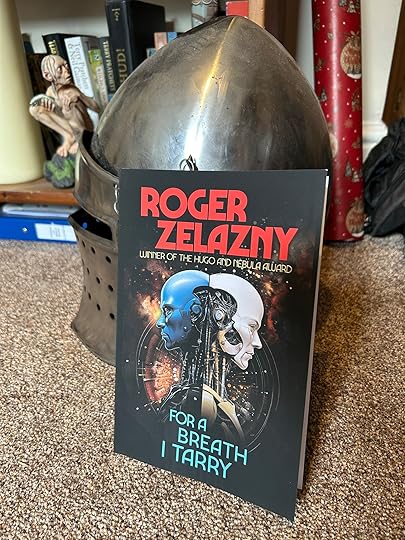
I've already forgotten how I discovered this short story existed, but I picked it up because I'm writing a book about the manifestation of consciousness in AI, and here, published in the year I was born (and I'm old) was a story about just that. I felt I should read it.
It's a curious mixture of dry sci-fi, fairy tale, meditation on what it means to be human, and at the very end, it's strangely touching.
The only Zelazny I've read before was the Amber books, which I loved back in the 80s. The quality does tail off as the series continues though.
Anyway - I'm not sure this had anything new to say, but it said it well, and back in the 60s it was probably very forward thinking.
Join my Patreon
Join my 3-emails-a-year mailing list #prizes
...
October 19, 2011
I picked this up because it was a Hugo candidate and because i liked the title.
I would recommend it to anyone who wants to find out you don't need hundreds of pages in order to write a great story. This novella is set on Earth after the last Man has died. His creations remain in the form of Artificial Inteligence automatons.
From this point, Zelazny goes to explore the limitations of A.I. and the definition of humanity.
The ending is very satisfactory, with the lines from what I discovered to be a poem by A. E. Housmann. I will put it here, for I don't think it constitue a spoiler:
From far, from eve and morning
And yon twelve-winded sky,
The stuff of life to knit me
Blew hither: here am I.
Now -- for a breath I tarry
Nor yet disperse apart --
Take my hand quick and tell me,
What have you in your heart.
Speak now, and I will answer;
How shall I help you, say;
Ere to the wind's twelve quarters
I take my endless way.
I would recommend it to anyone who wants to find out you don't need hundreds of pages in order to write a great story. This novella is set on Earth after the last Man has died. His creations remain in the form of Artificial Inteligence automatons.
From this point, Zelazny goes to explore the limitations of A.I. and the definition of humanity.
The ending is very satisfactory, with the lines from what I discovered to be a poem by A. E. Housmann. I will put it here, for I don't think it constitue a spoiler:
From far, from eve and morning
And yon twelve-winded sky,
The stuff of life to knit me
Blew hither: here am I.
Now -- for a breath I tarry
Nor yet disperse apart --
Take my hand quick and tell me,
What have you in your heart.
Speak now, and I will answer;
How shall I help you, say;
Ere to the wind's twelve quarters
I take my endless way.

August 6, 2020
A wonderful Hugo nominated (1967) short, and one of the best I've read from Zelazny, who has quite a few great shorts in addition to his magnificent full length writings. In a post apocalyptic world, where the last human died millennia ago, an AI takes on a great, centuries long experiment to discover what it is to feel and experience human emotions. Apparently it does so out of boredom, at least initially. The story has a decidedly philosophical flavor, though never becoming dry or pedantic, and raises some truly thought provoking issues about the nature of man and his (perhaps doomed) relationship to AI.
April 11, 2026
Long after the death of humanity, only the machines remain, caretakers of the Earth. One machine, built of logic and measurement, wanted to know everything about being human, wanted to be human.
For A Breath I Tarry is a gem of a story, richly packed with philosophical issues and intertextual references. As well as exploring consciousness, art, obedience, beauty, and mortality, the story focuses on the unknowability of experience. Frost the Machine discovered everything it could about humans, and especially about their experiences like fear or beauty. But Frost faced a classic philosophical problem: would knowing about fear or beauty, give it an experience of fear or beauty?
“All the data in the universe will not make you a Man, mighty Frost."
"Mordel, you are wrong….I told you that given sufficient data, I could be a Man.”*
The intertextual nature of For a Breath I Tarry is equally bountiful, with prominent allusions from the Book of Job and Genesis, Faust, and poems from A.E. Housman’s A Shropshire Lad. Most interesting for me, this story seems the inspiration for the ending of Spielberg’s film AI (originally by Kubrick). The rest of the film is based on Brian Aldiss' Supertoys Last All Summer Long, but the ending features the descendants of human-built machines excavating the ice for remnants of the long dead humans. And another Intertextual goody: central to both For A Breath I Tarry and AI is the Pinocchio like quest to be a real boy/man.
One particular Housman poem is quoted at length, and also provides the title ‘For A Breath I Tarry’. (the same poem also supplies the name for one of Ursula Le Guin’s collections: The Wind's Twelve Quarters). I include the poem here because it sheds light on one of the key features of being human, our ephemeral mortality, and this may be crucial for understanding the story:
From Far, from Eve
From far, from eve and morning
And yon twelve-winded sky,
The stuff of life to knit me
Blew hither: here am I.
Now—for a breath I tarry
Nor yet disperse apart—
Take my hand quick and tell me,
What have you in your heart.
Speak now, and I will answer;
How shall I help you, say;
Ere to the wind's twelve quarters
I take my endless way.
A.E. Housman XXXII from the collection A Shropshire Lad
* For a Breath I Tarry was written in 1966 and it has the annoying, misogynist tendency to refer to humanity as a whole as ‘Man’.
For A Breath I Tarry is a gem of a story, richly packed with philosophical issues and intertextual references. As well as exploring consciousness, art, obedience, beauty, and mortality, the story focuses on the unknowability of experience. Frost the Machine discovered everything it could about humans, and especially about their experiences like fear or beauty. But Frost faced a classic philosophical problem: would knowing about fear or beauty, give it an experience of fear or beauty?
“All the data in the universe will not make you a Man, mighty Frost."
"Mordel, you are wrong….I told you that given sufficient data, I could be a Man.”*
The intertextual nature of For a Breath I Tarry is equally bountiful, with prominent allusions from the Book of Job and Genesis, Faust, and poems from A.E. Housman’s A Shropshire Lad. Most interesting for me, this story seems the inspiration for the ending of Spielberg’s film AI (originally by Kubrick). The rest of the film is based on Brian Aldiss' Supertoys Last All Summer Long, but the ending features the descendants of human-built machines excavating the ice for remnants of the long dead humans. And another Intertextual goody: central to both For A Breath I Tarry and AI is the Pinocchio like quest to be a real boy/man.
One particular Housman poem is quoted at length, and also provides the title ‘For A Breath I Tarry’. (the same poem also supplies the name for one of Ursula Le Guin’s collections: The Wind's Twelve Quarters). I include the poem here because it sheds light on one of the key features of being human, our ephemeral mortality, and this may be crucial for understanding the story:
From Far, from Eve
From far, from eve and morning
And yon twelve-winded sky,
The stuff of life to knit me
Blew hither: here am I.
Now—for a breath I tarry
Nor yet disperse apart—
Take my hand quick and tell me,
What have you in your heart.
Speak now, and I will answer;
How shall I help you, say;
Ere to the wind's twelve quarters
I take my endless way.
A.E. Housman XXXII from the collection A Shropshire Lad
* For a Breath I Tarry was written in 1966 and it has the annoying, misogynist tendency to refer to humanity as a whole as ‘Man’.

March 2, 2017
"You might say he was a machine with a hobby. He had never been ordered *not* to have a hobby, so he had one. His hobby was Man."
---
Prior review, January 2nd 2022:
A post-apocalyptic story turned creation myth.
---
Prior review, 31st of december 2020:
With it being New Year’s Eve and all, I was reminded of this story, because it felt like I’d read this a few times before around this time. I just checked and apparently I first read it in March of 2017, re-read it January second of 2018, and didn’t read it all in 2019 or 2020. So I figured it was time again to re-read this.
This really is a wonderful story. You have the robots carrying on after mankind has died out just like in There Will Come Soft Rains, where they almost revere the extinct race as some kind of gods, with a growing desperation to learn more about mankind. What is the nature of man? What does it mean to be conscious?
It’s a wonderful story that still feels so resonant, all these decades later.
---
ORIGINAL REVIEW, MARCH 2 2017:
This is one of the best short stories I've ever read. It has aged extremely well. It explores the definition of humanity, the limits of A.I. and the (re-)birth of humanity. I recommend it to all fans of the post-apocalyptic genre, fans of science fiction, fans of fantasy, fans of books, fans of breathing.
---
Prior review, January 2nd 2022:
A post-apocalyptic story turned creation myth.
---
Prior review, 31st of december 2020:
With it being New Year’s Eve and all, I was reminded of this story, because it felt like I’d read this a few times before around this time. I just checked and apparently I first read it in March of 2017, re-read it January second of 2018, and didn’t read it all in 2019 or 2020. So I figured it was time again to re-read this.
This really is a wonderful story. You have the robots carrying on after mankind has died out just like in There Will Come Soft Rains, where they almost revere the extinct race as some kind of gods, with a growing desperation to learn more about mankind. What is the nature of man? What does it mean to be conscious?
It’s a wonderful story that still feels so resonant, all these decades later.
---
ORIGINAL REVIEW, MARCH 2 2017:
This is one of the best short stories I've ever read. It has aged extremely well. It explores the definition of humanity, the limits of A.I. and the (re-)birth of humanity. I recommend it to all fans of the post-apocalyptic genre, fans of science fiction, fans of fantasy, fans of books, fans of breathing.

August 5, 2020
A brilliant novelette that aged well. It focuses on a computing machine's quest to understand the nature of Man, an extinct species. Nobody gets killed, there's no actual action or an army of robots and yet it makes you think and feel. A thing of beauty.

May 28, 2023
An interesting novelette about a robot's study of (now extinct) humans and his efforts to become one. A bit different to the usual offerings with this theme. I really liked the world building in this story.
January 20, 2013
Short and to the point, this story is very good and has aged well, despite being nearly 47 years old. It describes a robot named Frost in a post-apocalyptic wasteland, trying to learn more about humanity, which had already been extinct for millennia. I could describe it, but this quote from the story will tell you everything you need to know about it.
"Regard this piece of ice, mighty Frost. You can tell me its composition, dimensions, weight, temperature. A Man could not look at it and do that. A Man could make tools which would tell Him these things, but He still would not know measurement as you know it. What He would know of it, though, is a thing that you cannot know."
"What is that?"
"That it is cold."
I recommend this short novel to any fan of old science fiction.
"Regard this piece of ice, mighty Frost. You can tell me its composition, dimensions, weight, temperature. A Man could not look at it and do that. A Man could make tools which would tell Him these things, but He still would not know measurement as you know it. What He would know of it, though, is a thing that you cannot know."
"What is that?"
"That it is cold."
I recommend this short novel to any fan of old science fiction.

March 12, 2014
I just re-read this novelette for the umpteenth time. It is one of my very favorite novelettes by one of my favorite authors.
As with much of Zelazny's stories there is a touch of spirituality in them. He pulls much of his ideas from mythology and scriptures.
In this story it is almost a retelling of creation (Genesis 1-3) and the Book of Job.
It's been 10,000 years since man has become extinct and Frost is a machine that controls the northern hemisphere of earth while Beta controls the southern hemisphere. Their function is to constantly rebuild the earth.
At one time all of the machines reported to Solcon a machine that orbits the earth but during a brief respite or malfunction, Divcon has been created and lives in the bowels of the earth and sends his own machines out to circumvent Solcon's orders until the machines in the southern hemisphere are controlled by Divcon. Solcon and Divcon work against one another although both have the same mission.
Frost wants to know more about man since in the end that is who they continue to serve and eventually joins into a kind of Faustian bargain with Mordel another smaller machine who serves Divcon. Frost bets that he can become a man but if he fails he agrees to leave Solcon's service and go to serve Divcon for eternity in the depths of the earth.
As with much of Zelazny's stories there is a touch of spirituality in them. He pulls much of his ideas from mythology and scriptures.
In this story it is almost a retelling of creation (Genesis 1-3) and the Book of Job.
It's been 10,000 years since man has become extinct and Frost is a machine that controls the northern hemisphere of earth while Beta controls the southern hemisphere. Their function is to constantly rebuild the earth.
At one time all of the machines reported to Solcon a machine that orbits the earth but during a brief respite or malfunction, Divcon has been created and lives in the bowels of the earth and sends his own machines out to circumvent Solcon's orders until the machines in the southern hemisphere are controlled by Divcon. Solcon and Divcon work against one another although both have the same mission.
Frost wants to know more about man since in the end that is who they continue to serve and eventually joins into a kind of Faustian bargain with Mordel another smaller machine who serves Divcon. Frost bets that he can become a man but if he fails he agrees to leave Solcon's service and go to serve Divcon for eternity in the depths of the earth.

January 29, 2018
I absolutely loved this novella (novelette? I've seen it listed as both). I won't give any spoilers, but the plot seemed familiar to me because of the focus on AI and their ability/ inability to feel, especially with the creation of Sophia the robot. However, the way this is written makes it completely new since man isn't involved in the process of robots trying to uncover the intricacies of the human condition. I also love that this was written before AI got too advanced. I would highly recommend this to anyone. It will make you think!

August 9, 2020
A pretty interesting short story that tackles the concept of humanity as a whole, and what makes human a human. All this despite not having any human within the setting: they're long, long gone.
I absolutely loved the back and forths between the characters on the topic of what makes logic sense at any given situation, especially as far the loopholes about rules went. Got to love a completely straight-faced emotionless and fast paced squabble.
I absolutely loved the back and forths between the characters on the topic of what makes logic sense at any given situation, especially as far the loopholes about rules went. Got to love a completely straight-faced emotionless and fast paced squabble.

October 25, 2020
A brilliant short story about consciousness.
July 20, 2021
I can’t believe Zelaney made me care about a giant metal cube. And in a story that lasts on 68 pages. What a master of sci fi...

May 19, 2024
Robot garden of Eden, but without all the temptation, only curiosity. Or at least, that's how I perceived it.

October 28, 2015
Every so often I like to read something from the classic grandmasters of SFF, and Zelazny has always been a favourite of mine. This came up during a conversation with a friend, so I just jumped on it.
What to Expect
After the extinction of man, the machines he has set in place are trying to rebuild and maintain the earth. They have differing opinions, though, on what man might have wanted.
In the midst of this, one of them becomes obsessed with understanding man, and how those who created logic were superior to it. In a true Zelazny fashion, even though this is a novelette you can read in an evening, it's packed with layers of meaning and complexity: on the nature of art, of experience vs knowledge, of trying to understand and quantify our world, and human nature in general.
What I liked
Zelazny is truly a grandmaster, and this very quick read shows that. It's dense, yet extremely readable; it makes you think, while enjoying and caring about machines.
What to be aware of
It is a product of the time it was written (the 60's), with views about machines and artificial intelligence that might seem dated. Some readers, I'm sure, might also object to the use of 'man' for humankind.
But going beyond these, the themes are timeless just as human nature and its pursuit of art are.
Felix's Review
Felix, I'm sad to say, didn't get this. I guess abstract works of meta-literature are a bit beyond him, and perhaps I should leave him with the comedies and detective stories.
Summary
If you haven't read this or if it's been a few years, and if you enjoy the more philosophical type of SFF, this is definitely a novella worth a try (like most of Zelazny's works).
Enjoying the reviews, but wondering who the heck is that Felix fellow? Glad you asked! He's the protagonist of the Togas, Daggers, and Magic series, an historical-fantasy blend of a paranormal detective on the background of ancient Rome.
Assaph Mehr, author of Murder In Absentia: A story of Togas, Daggers, and Magic - for lovers of Ancient Rome, Murder Mysteries, and Urban Fantasy.
What to Expect
After the extinction of man, the machines he has set in place are trying to rebuild and maintain the earth. They have differing opinions, though, on what man might have wanted.
In the midst of this, one of them becomes obsessed with understanding man, and how those who created logic were superior to it. In a true Zelazny fashion, even though this is a novelette you can read in an evening, it's packed with layers of meaning and complexity: on the nature of art, of experience vs knowledge, of trying to understand and quantify our world, and human nature in general.
What I liked
Zelazny is truly a grandmaster, and this very quick read shows that. It's dense, yet extremely readable; it makes you think, while enjoying and caring about machines.
What to be aware of
It is a product of the time it was written (the 60's), with views about machines and artificial intelligence that might seem dated. Some readers, I'm sure, might also object to the use of 'man' for humankind.
But going beyond these, the themes are timeless just as human nature and its pursuit of art are.
Felix's Review
Felix, I'm sad to say, didn't get this. I guess abstract works of meta-literature are a bit beyond him, and perhaps I should leave him with the comedies and detective stories.
Summary
If you haven't read this or if it's been a few years, and if you enjoy the more philosophical type of SFF, this is definitely a novella worth a try (like most of Zelazny's works).
Enjoying the reviews, but wondering who the heck is that Felix fellow? Glad you asked! He's the protagonist of the Togas, Daggers, and Magic series, an historical-fantasy blend of a paranormal detective on the background of ancient Rome.
Assaph Mehr, author of Murder In Absentia: A story of Togas, Daggers, and Magic - for lovers of Ancient Rome, Murder Mysteries, and Urban Fantasy.

October 12, 2013
Not bad for a quick afternoon read. The motifs are starting to recur, and of course I still don't quite follow the idea that robots could become man (mostly because I don't believe in a consciousness that came from data transmission), but, as with all science-fiction, this raised interesting ideas.
Frost, like Asimov's Bicentennial Man, learned his way towards manhood. This obviously needs some examination, and I think anyone wishing to make a coherent conception of the human identity needs to answer this question: Is new human Frost a continuation of the old robotic Frost? Could this be a case of cloning (and then imparting a memory)? And what started all these? Was it not Frost's curiosity- an undoubtedly human trait?
Frost, like Asimov's Bicentennial Man, learned his way towards manhood. This obviously needs some examination, and I think anyone wishing to make a coherent conception of the human identity needs to answer this question: Is new human Frost a continuation of the old robotic Frost? Could this be a case of cloning (and then imparting a memory)? And what started all these? Was it not Frost's curiosity- an undoubtedly human trait?
This entire review has been hidden because of spoilers.

January 4, 2021
A very short story about an AI in a post-human world, trying to understand what has been lost.
A fantastic SF short. How anybody can cram this many ideas about the differences between human and artificial intelligence, religion and finding meaning into so few words - and do so with such flair and humour, is beyond me. Proper genius.
A fantastic SF short. How anybody can cram this many ideas about the differences between human and artificial intelligence, religion and finding meaning into so few words - and do so with such flair and humour, is beyond me. Proper genius.

May 28, 2022
Magnifique. Une intelligence artificielle veut devenir un homme. Un texte court et synthétique, percutant
Je vous le conseille !
Je vous le conseille !

June 1, 2015
Since Samuel R. Delany's epic and challenging Dhalgren destroyed my reading goal for the year, I'm catching up on some short stories and novellas to try to get back on track. Thank God I did -- this may be my most favorite sci-fi short story ever!!!
Man ceases to exist, but his Machines remain. The Machines revere Man as their creator and recognize that Man had abilities "beyond logic" that they could never possess, and so were superior beings. One Machine seeks to find out as much as possible about Man, and eventually, to become one.
A beautiful Origin story turned on its head, with Man as God and Machine as Man. The Nature of Art, and Life itself. The robot-to-robot dialogue alone is priceless. THIS passage, a veritable "Who's on First" for robots, paraphrased slightly:
"Those large plants..."
"Redwood trees."
"And the green ones are...?"
"Grass."
"Yes, it is as I thought. Why have we come here?"
"Because it is a place which once delighted Man."
"In what ways?"
"It is scenic, beautiful..."
"Oh."
...
"...I have constructed analogues of the human sensory equipment, so that I may see and smell and taste and hear like a Man. Now, direct my attention to an object or objects of beauty."
"As I understand it, it is all around you here... What do you see, hear, taste, smell?"
"Everything I did before, but within a more limited range."
"You do not perceive any beauty?"
"Perhaps none remains after so long a time."
"It is not supposed to be the sort of thing which gets used up."
...
"How do you--feel?"
"I test out at a normal level of function."
"Here comes a sunset, try that.... what was it like?"
"Like a sunrise, in reverse."
LOLOL!!!
Man ceases to exist, but his Machines remain. The Machines revere Man as their creator and recognize that Man had abilities "beyond logic" that they could never possess, and so were superior beings. One Machine seeks to find out as much as possible about Man, and eventually, to become one.
A beautiful Origin story turned on its head, with Man as God and Machine as Man. The Nature of Art, and Life itself. The robot-to-robot dialogue alone is priceless. THIS passage, a veritable "Who's on First" for robots, paraphrased slightly:
"Those large plants..."
"Redwood trees."
"And the green ones are...?"
"Grass."
"Yes, it is as I thought. Why have we come here?"
"Because it is a place which once delighted Man."
"In what ways?"
"It is scenic, beautiful..."
"Oh."
...
"...I have constructed analogues of the human sensory equipment, so that I may see and smell and taste and hear like a Man. Now, direct my attention to an object or objects of beauty."
"As I understand it, it is all around you here... What do you see, hear, taste, smell?"
"Everything I did before, but within a more limited range."
"You do not perceive any beauty?"
"Perhaps none remains after so long a time."
"It is not supposed to be the sort of thing which gets used up."
...
"How do you--feel?"
"I test out at a normal level of function."
"Here comes a sunset, try that.... what was it like?"
"Like a sunrise, in reverse."
LOLOL!!!

September 7, 2017
In the distant future humanity is no more and the only things that exist are Machines who continue to maintain the world. Enter into this landscape a Machine, Frost, who wants to know everything about human beings. So, he searches for human remains, books, artifacts, art, places of beauty, and tries to comprehend, and in many ways, become human.
This is a short story that tries to answer the question, what does it mean to be human. It is a brilliant thought experiment and experience. Well written and thought provoking, a journey into art, and beauty, and emotions and all that makes us human. A must read...
This is a short story that tries to answer the question, what does it mean to be human. It is a brilliant thought experiment and experience. Well written and thought provoking, a journey into art, and beauty, and emotions and all that makes us human. A must read...

January 13, 2017
Recommended to me as one of the best short stories ever written... I don't feel this is an exaggeration. As both a work of science fiction and as a perfect example of how much story you can tell with so few words - it is a master stroke. I can't recommend this enough - it takes no time to read, but maybe forever to fully absorb.
December 30, 2012
I'm not sure if I have read a short story that is as powerful as this one was. Zelazny creates a beautiful story in a way that a simple line can grip you with such intense emotion. This story is incredible, and I find myself unable to find the words for it.

July 10, 2014
This is one of the best short stories I have ever read. A wonderful examination of what it means to be human.
July 1, 2024
They called him frost.

January 4, 2026
Phenomenal!
What an amazing story, with an engaging premise. I loved the logic and realization at the conclusion. It will entice me to read more Zelazny.
What an amazing story, with an engaging premise. I loved the logic and realization at the conclusion. It will entice me to read more Zelazny.

Read
May 20, 2025Impressionnant
January 12, 2026
What a wonderful story! A novella-length masterpiece. I was hanging on every line of the witty and thought-provoking dialog. I had only previously read one book by Zelazny, This Immortal, which I didn’t care for. That book was a quirky story of a hustler tour guide taking tourists around to see the near-mythical mutants that roam the nuclear wasteland of Earth. But in this story Zelazny takes a much more philosophical and high-concept science fiction idea and brings it to life like a real master.
In this story mankind is long gone from the Earth. We never learn exactly what his demise was but what remains are several advanced AI service and maintenance robots. There is the nominal controller in orbit and two mobile units, one responsible for each hemisphere of the planet. But with so much free time on their hands one AI named Frost begins to ponder about mankind and if they were so great to create AI then how did they meet their demise? The controller in the sky, Solcom, knows some of the answers but doesn’t share information not deemed to be productive. Thus, Frost begins his own search for answers. (Some of the events of the story I’ve hidden as potential spoilers.)
Centuries go by as Frost tries to figure out emotions and feelings, thinking at first that it must simply be a matter of calibrating his responses. But no amount of knowledge can substitute for lived experience, because humans are sensory-reactive beings. We feel heat and cold, comfort and discomfort, and can appreciate a beautiful sunset in a way that baffles the AI creatures. Therefore the final quest:
What really got me was the final sentence of the story. My immediate reaction was that it was great, that we are dropped at the gateway to the Garden of Eden. Then I thought that this single sentence changes the dynamic of the story to something much larger, such that what we have just read would only serve as the first third of a great full-length novel, or even a trilogy of books. Why didn’t Zelazny see the potential for further development?
What I’d like to see is for some modern writer like Chris Beckett or Peter F. Hamilton to contact the Zelazny estate and get permission to develop this idea further. That has happened before with short stories by Asimov, Clarke, and others. I really find this concept fascinating. But if For a Breath I Tarry is all we ever have it is still a remarkably poignant novella.
Now a word about the edition I read. I love it! From what I could learn on the internet Amber Ltd has only published eight books so far, but they deserve your support. In other reviews I’ve complained about the poor quality of reprints in some of the SF Masterworks series: two had smeared watercolor print like the ink was printed on a damp paper, and in Stapledon’s Star Maker, which had been re-typeset with changed margins, we find hyphenated words like “irreg-ularities” in the middle of the page, thus indicating that no editorial effort had been made at all. But, none of that is the case here. For a Breath I Tarry has super crisp print on clean white paper, perfect margins, and only one minor typo on page 21 which has “In whal ways?” instead of “In what ways?” I’d say that qualifies for being 99.99 percent perfect! I also love the cover artwork by Jay O’Connell.
I did think that for such a short book it was really not economical to buy further Zelazny short stories piecemeal, so I looked online for short stories collections. It seems that these have all gone out of print and any remaining new or pre-owned copies sell at prices starting at fifty dollars and up. So, I’ll look again at what Amber Ltd has to offer; in this case, I’d say the quality of the presentation justifies the expense!
In this story mankind is long gone from the Earth. We never learn exactly what his demise was but what remains are several advanced AI service and maintenance robots. There is the nominal controller in orbit and two mobile units, one responsible for each hemisphere of the planet. But with so much free time on their hands one AI named Frost begins to ponder about mankind and if they were so great to create AI then how did they meet their demise? The controller in the sky, Solcom, knows some of the answers but doesn’t share information not deemed to be productive. Thus, Frost begins his own search for answers. (Some of the events of the story I’ve hidden as potential spoilers.)
Centuries go by as Frost tries to figure out emotions and feelings, thinking at first that it must simply be a matter of calibrating his responses. But no amount of knowledge can substitute for lived experience, because humans are sensory-reactive beings. We feel heat and cold, comfort and discomfort, and can appreciate a beautiful sunset in a way that baffles the AI creatures. Therefore the final quest:
What really got me was the final sentence of the story. My immediate reaction was that it was great, that we are dropped at the gateway to the Garden of Eden. Then I thought that this single sentence changes the dynamic of the story to something much larger, such that what we have just read would only serve as the first third of a great full-length novel, or even a trilogy of books. Why didn’t Zelazny see the potential for further development?
What I’d like to see is for some modern writer like Chris Beckett or Peter F. Hamilton to contact the Zelazny estate and get permission to develop this idea further. That has happened before with short stories by Asimov, Clarke, and others. I really find this concept fascinating. But if For a Breath I Tarry is all we ever have it is still a remarkably poignant novella.
Now a word about the edition I read. I love it! From what I could learn on the internet Amber Ltd has only published eight books so far, but they deserve your support. In other reviews I’ve complained about the poor quality of reprints in some of the SF Masterworks series: two had smeared watercolor print like the ink was printed on a damp paper, and in Stapledon’s Star Maker, which had been re-typeset with changed margins, we find hyphenated words like “irreg-ularities” in the middle of the page, thus indicating that no editorial effort had been made at all. But, none of that is the case here. For a Breath I Tarry has super crisp print on clean white paper, perfect margins, and only one minor typo on page 21 which has “In whal ways?” instead of “In what ways?” I’d say that qualifies for being 99.99 percent perfect! I also love the cover artwork by Jay O’Connell.
I did think that for such a short book it was really not economical to buy further Zelazny short stories piecemeal, so I looked online for short stories collections. It seems that these have all gone out of print and any remaining new or pre-owned copies sell at prices starting at fifty dollars and up. So, I’ll look again at what Amber Ltd has to offer; in this case, I’d say the quality of the presentation justifies the expense!
March 28, 2026
Zelazny might not be a genius
This is an outstanding example of New Wave science fiction from the '60s. It's a quick, compelling read, and it might make you think about some big questions.
This is an outstanding example of New Wave science fiction from the '60s. It's a quick, compelling read, and it might make you think about some big questions.
Displaying 1 - 30 of 76 reviews