

What do you think?

The Rule of Law
The Rule of Law is a phrase much used but little examined. The idea of the rule of law as the foundation of modern states and civilisations has recently become even more talismanic than that of democracy, but what does it actually consist of? In this brilliant short book, Britain’s former senior law lord, and one of the world’s most acute legal minds, examines what the idea actually means. He makes clear that the rule of law is not an arid legal doctrine but is the foundation of a fair and just society, is a guarantee of responsible government, is an important contribution to economic growth and offers the best means yet devised for securing peace and co-operation. He briefly examines the historical origins of the rule, and then advances eight conditions which capture its essence as understood in western democracies today. He also discusses the strains imposed on the rule of law by the threat and experience of international terrorism. The book will be influential in many different fields and should become a key text for anyone interested in politics, society and the state of our world.
213 pages, Paperback
First published February 4, 2010
Ratings & Reviews
Friends & Following
Create a free account to discover what your friends think of this book!
Community Reviews
Displaying 1 - 30 of 238 reviews

June 26, 2016
One of the things I liked about Britain's being in the EU was having an extra layer of legal appeal that lay above the level of the nation-state. This is of course exactly what many anti-Europe campaigners hate most, but from my experience of Europe these myriad rulings about flammable duvets and transporting hazardous substances, all hashed out quietly by experts far away from the media pressure of any particular country, were generally sensible and politically unpartisan.
When (dare I say if) the UK does leave Europe, all of that legislation will disappear and some army of bureaucrats will have to recreate most of it again under British law. Fortunately we will, at least as far as I can tell, still be signed up to the European Convention on Human Rights, whose court in Strasbourg has already helped several Brits whose rights were not satisfactorily upheld by British rulings. (Edit – in point of fact, the Home Secretary has already said that she wants us to withdraw from the ECHR after Brexit.) The fact that EU member-states are required to sign this convention is one of the many reasons the Union has been such a force for good, as can be seen from the many former Eastern Bloc countries that bent over backwards to commit to ‘the rule of law and respect for human rights’ in order to join.
That phrase ‘the rule of law’, written into the EU's Copenhagen criteria, is a cliché that covers a lot of ground, and this small, lucid book is an attempt to set down what exactly it means to most people and why it matters. Lord Bingham was, until his death in 2010, the most senior as well as the most eminent judge in Britain, and before that was typically described as the greatest lawyer of his generation. Like only the true masters in any field, he distils the complexities of his subject into the most wonderfully simple, jargon-free, crystal-clear prose that could be understood by any smart twelve-year-old.
Particularly useful is the brief run-down of key historical landmarks in establishing the principles of western law, from Magna Carta in 1215, through Bills of Rights both British (1689) and American (1791), down to the Universal Declaration of Human Rights in 1948. Progress has been slow and incremental and sometimes rather two-steps-forward-one-step-back. It wasn't, for instance, until 1836 that defence counsel was allowed to address the jury directly on the defendant's behalf – in fact one judge in his memoirs recalls a conviction of theft that took place after a trial lasting all of two minutes fifty-three seconds, including the economical jury direction: ‘Gentlemen, I suppose you have no doubt? I have none.’
The historical context proves to be quite illuminating when it comes to contemporary debates. In the seventeenth century, for instance, Charles II's chief minister, the Earl of Clarendon, had a habit of transferring political prisoners to outlying parts of the United Kingdom where the writ of habeas corpus did not run, and where he could therefore hold people indefinitely. After his fall from power, it was felt that this practice should somehow be prevented, and the result was the Habeas Corpus Amendment Act 1679 – an Act which only just got through the House of Lords, by the way, supposedly because the person counting the ayes ‘succeeded, without his opposite number noticing, in counting a very fat Lord as 10’.
Bingham uses this story to discuss Guantánamo Bay, a facility set up to do exactly what the Earl of Clarendon did and for the same reasons, and which has seen the same tussle between the executive and the judiciary in the US that Britain went through in the 1600s. Bingham is, indeed, quite worried about roll-backs in people's legal rights, particularly following President Bush's declaration of a War on Terror (this book was written as Obama was being elected). He stresses, for instance, the vital importance that national laws should protect non-nationals (a matter of ‘equality before the law’); this is not just for their own sake, but also because curtailing the rights of non-nationals has so often been the prelude to denying the same rights to citizens.
This is very much a live issue. The USA PATRIOT Act, for example, denied foreigners basic rights of political association, due process and privacy; in the UK, meanwhile, new legislation after 9/11 meant that foreigners suspected of terrorism could be held indefinitely but British nationals accused of the same thing could not. Bingham clearly feels that detention without trial is one of the key issues that has been eroded in recent years. In Britain in 1997 the maximum time someone suspected of terrorism could be held without charge was four days. In 2000 it was seven days; in 2003 fourteen days; in 2006 twenty-eight days. Subsequent attempts to raise it further to forty-two or even ninety days have so far been defeated in Parliament.
American activities have been an order of magnitude larger and more concerning, with the Pentagon said to have conceded that some 80,000 people have been detained in various ‘black’ sites around the world, some on no charge at all. Various Supreme Court decision have spanked the administration over its behaviour – Rasul v Bush , Hamdan v Rumsfeld , Boumediene v Bush are key – as legislators attempted to stay one step ahead by creating new laws which would make outrages more technically permissible. The same could be said for torture, which was redefined in such a way as to allow, at least tacitly, what later happened at Abu Ghraib and elsewhere. Obama rolled some of this back, but of course Guantánamo is still a constant affront to many of the basic rights that, until recently, the United States had resolutely stood for, including the right to a fair trial, habeas corpus, the rejection of torture, and so on. This is how a great country can very easily surrender its previous claims to moral authority.
Bingham casts a lot of this debate, with great clarity, as an ancient and long-running showdown between Cicero's maxim Salus populi suprema est lex (‘the safety of the people is the supreme law’) and what he describes as the ‘preferable’ stance of Benjamin Franklin, that ‘he who would put security before liberty deserves neither’. He applies this to an interesting discussion of recent surveillance legislation, although events have moved on so quickly since this book was published, with Edward Snowden's revelations about the NSA, that you'll need to supplement these parts with some more contemporary reading.
Overall this is a very, very clear outline of what people are entitled to expect from legislative frameworks, and how we got there. It convinced me again of the importance of having supra-national bodies that can hold countries to account, at least in theory – but more than that it's just a pleasure to read, and should give you a good basis for working out your own thoughts about how courts work, how justice is pursued, and how countries behave on the international stage.
When (dare I say if) the UK does leave Europe, all of that legislation will disappear and some army of bureaucrats will have to recreate most of it again under British law. Fortunately we will, at least as far as I can tell, still be signed up to the European Convention on Human Rights, whose court in Strasbourg has already helped several Brits whose rights were not satisfactorily upheld by British rulings. (Edit – in point of fact, the Home Secretary has already said that she wants us to withdraw from the ECHR after Brexit.) The fact that EU member-states are required to sign this convention is one of the many reasons the Union has been such a force for good, as can be seen from the many former Eastern Bloc countries that bent over backwards to commit to ‘the rule of law and respect for human rights’ in order to join.
That phrase ‘the rule of law’, written into the EU's Copenhagen criteria, is a cliché that covers a lot of ground, and this small, lucid book is an attempt to set down what exactly it means to most people and why it matters. Lord Bingham was, until his death in 2010, the most senior as well as the most eminent judge in Britain, and before that was typically described as the greatest lawyer of his generation. Like only the true masters in any field, he distils the complexities of his subject into the most wonderfully simple, jargon-free, crystal-clear prose that could be understood by any smart twelve-year-old.
Particularly useful is the brief run-down of key historical landmarks in establishing the principles of western law, from Magna Carta in 1215, through Bills of Rights both British (1689) and American (1791), down to the Universal Declaration of Human Rights in 1948. Progress has been slow and incremental and sometimes rather two-steps-forward-one-step-back. It wasn't, for instance, until 1836 that defence counsel was allowed to address the jury directly on the defendant's behalf – in fact one judge in his memoirs recalls a conviction of theft that took place after a trial lasting all of two minutes fifty-three seconds, including the economical jury direction: ‘Gentlemen, I suppose you have no doubt? I have none.’
The historical context proves to be quite illuminating when it comes to contemporary debates. In the seventeenth century, for instance, Charles II's chief minister, the Earl of Clarendon, had a habit of transferring political prisoners to outlying parts of the United Kingdom where the writ of habeas corpus did not run, and where he could therefore hold people indefinitely. After his fall from power, it was felt that this practice should somehow be prevented, and the result was the Habeas Corpus Amendment Act 1679 – an Act which only just got through the House of Lords, by the way, supposedly because the person counting the ayes ‘succeeded, without his opposite number noticing, in counting a very fat Lord as 10’.
Bingham uses this story to discuss Guantánamo Bay, a facility set up to do exactly what the Earl of Clarendon did and for the same reasons, and which has seen the same tussle between the executive and the judiciary in the US that Britain went through in the 1600s. Bingham is, indeed, quite worried about roll-backs in people's legal rights, particularly following President Bush's declaration of a War on Terror (this book was written as Obama was being elected). He stresses, for instance, the vital importance that national laws should protect non-nationals (a matter of ‘equality before the law’); this is not just for their own sake, but also because curtailing the rights of non-nationals has so often been the prelude to denying the same rights to citizens.
This is very much a live issue. The USA PATRIOT Act, for example, denied foreigners basic rights of political association, due process and privacy; in the UK, meanwhile, new legislation after 9/11 meant that foreigners suspected of terrorism could be held indefinitely but British nationals accused of the same thing could not. Bingham clearly feels that detention without trial is one of the key issues that has been eroded in recent years. In Britain in 1997 the maximum time someone suspected of terrorism could be held without charge was four days. In 2000 it was seven days; in 2003 fourteen days; in 2006 twenty-eight days. Subsequent attempts to raise it further to forty-two or even ninety days have so far been defeated in Parliament.
American activities have been an order of magnitude larger and more concerning, with the Pentagon said to have conceded that some 80,000 people have been detained in various ‘black’ sites around the world, some on no charge at all. Various Supreme Court decision have spanked the administration over its behaviour – Rasul v Bush , Hamdan v Rumsfeld , Boumediene v Bush are key – as legislators attempted to stay one step ahead by creating new laws which would make outrages more technically permissible. The same could be said for torture, which was redefined in such a way as to allow, at least tacitly, what later happened at Abu Ghraib and elsewhere. Obama rolled some of this back, but of course Guantánamo is still a constant affront to many of the basic rights that, until recently, the United States had resolutely stood for, including the right to a fair trial, habeas corpus, the rejection of torture, and so on. This is how a great country can very easily surrender its previous claims to moral authority.
Bingham casts a lot of this debate, with great clarity, as an ancient and long-running showdown between Cicero's maxim Salus populi suprema est lex (‘the safety of the people is the supreme law’) and what he describes as the ‘preferable’ stance of Benjamin Franklin, that ‘he who would put security before liberty deserves neither’. He applies this to an interesting discussion of recent surveillance legislation, although events have moved on so quickly since this book was published, with Edward Snowden's revelations about the NSA, that you'll need to supplement these parts with some more contemporary reading.
Overall this is a very, very clear outline of what people are entitled to expect from legislative frameworks, and how we got there. It convinced me again of the importance of having supra-national bodies that can hold countries to account, at least in theory – but more than that it's just a pleasure to read, and should give you a good basis for working out your own thoughts about how courts work, how justice is pursued, and how countries behave on the international stage.

October 11, 2014
I thought I was reading a worthy but dull book on jurisprudence. A few hours of tedium were surely ahead but I would emerge a better person, educated by one of the finest legal minds on important issues of legal philosophy.
And then I turned the page to Chapter 11: Terrorism and the Rule of Law and instead found myself reading a work of crude dystopian fantasy.
Innocent people on vacation are kidnapped by secret agents of a state that proclaims itself the defender of freedom, then rendered to distant locations famed for the skills of the torturers that abide there. Once they have endured the Salt Pits and their innocence is established the victims are driven by car along desolate roads in Albania, then pushed out of the passenger door miles from habitation and expected to carry on their lives as if nothing had happened.
Thousands are rounded up based on criteria that may be connected to their race or beliefs but which are ultimately unknowable. They are held under laws with comically Orwellian names like the PATRIOT Act. Then, just as abruptly, these same thousands are released with no explanation. None are charged with any crime.
In this world words that say nothing of torture, words whose meaning is barely within the scope of human understanding, act as magic charms to make torture permissible:
Tom Bingham was also Baron Bingham of Cornill KG PC QC FBA Lord Chief Justice and Master of the Rolls. Tom Bingham was not a seller of internet conspiracies or of other overwrought reportage but a talented constitutional lawyer. This was the last book he wrote before he passed away in 2010 and he takes us patiently but skillfully through a definition and the main implications of the Rule of Law. If you are sensitive to these things you can find in this work much understated British irony and humor.
But Tom Bingham left us with a clear message in Chapter 11: the rights and freedoms that the Rule of Law seeks to defend are under threat from the hideously named War on Terror. One good example - he explains how, unlike the US, the UK has always treated acts of terrorism as criminal acts and not acts of war with far less damage to the rights of citizens.
When Tom Bingham ends Chapter 11 with a quote from a Catholic thinker, Christopher Dawson, I am sure he is leaving us with a message that is a fine tribute to our memory of him as man of great integrity but which is also a message he would not want us to ignore:
And then I turned the page to Chapter 11: Terrorism and the Rule of Law and instead found myself reading a work of crude dystopian fantasy.
Innocent people on vacation are kidnapped by secret agents of a state that proclaims itself the defender of freedom, then rendered to distant locations famed for the skills of the torturers that abide there. Once they have endured the Salt Pits and their innocence is established the victims are driven by car along desolate roads in Albania, then pushed out of the passenger door miles from habitation and expected to carry on their lives as if nothing had happened.
Thousands are rounded up based on criteria that may be connected to their race or beliefs but which are ultimately unknowable. They are held under laws with comically Orwellian names like the PATRIOT Act. Then, just as abruptly, these same thousands are released with no explanation. None are charged with any crime.
In this world words that say nothing of torture, words whose meaning is barely within the scope of human understanding, act as magic charms to make torture permissible:
"The executive branch shall construe the McCain amendment in a manner consistent with the constitutional authority of the President to supervise the unitary executive branch and as a Commander in Chief and consistent with the constitutional limitations on the judicial power".
Tom Bingham was also Baron Bingham of Cornill KG PC QC FBA Lord Chief Justice and Master of the Rolls. Tom Bingham was not a seller of internet conspiracies or of other overwrought reportage but a talented constitutional lawyer. This was the last book he wrote before he passed away in 2010 and he takes us patiently but skillfully through a definition and the main implications of the Rule of Law. If you are sensitive to these things you can find in this work much understated British irony and humor.
But Tom Bingham left us with a clear message in Chapter 11: the rights and freedoms that the Rule of Law seeks to defend are under threat from the hideously named War on Terror. One good example - he explains how, unlike the US, the UK has always treated acts of terrorism as criminal acts and not acts of war with far less damage to the rights of citizens.
When Tom Bingham ends Chapter 11 with a quote from a Catholic thinker, Christopher Dawson, I am sure he is leaving us with a message that is a fine tribute to our memory of him as man of great integrity but which is also a message he would not want us to ignore:
"As soon as men decide that all means are permitted to fight an evil then their good becomes indistinguishable from the evil that they set out to destroy.

December 28, 2015
The first thing we do, let’s kill all the lawyers
- Dick, a rebel, in Henry the 6th Part Two by William Shakespeare
*
When I read this sentence:
If you maltreat a penguin in the London Zoo, you do not escape prosecution because you are the Archbishop of Canterbury.
I conceived that Baron (call me Tom) Bingham of Cornhill, former Master of the Rolls, Lord Chief Justice and a Senior Law Lord might be the ideal guide through the unclear conglomerations of legal definition and public conduct which lay ahead. This was emphasised when he quoted his favourite attempt by a legislator to define exactly what he meant – this is from the 1979 Banking Act Appeals Procedure (England and Wales) :
Any reference in these regulations to a regulation is a reference to a regulation contained in these regulations.
However what follows in the next 174 pages has very few laughs. It’s essential, but so, so dry I cannot in conscience recommend this book unless you are submerged up to your chin in very wet water.
He takes us through the major milestones :
Magna Carta 1215
Habeas Corpus 1305 amended 1679
Bill of Rights and Act of Settlement 1689 and 1701
Constitution of the USA 1787
Declaration of the Rights of Man and the Citizen, Paris, 1789
Bill of Rights, USA, 1791
Universal Declaration of Human Rights 1948
It fair makes your head swim, all these goodlyhearted people trying to abolish torture and arbitrary imprisonment and rats and scurvy and no maltreatment of any penguin anywhere ever under pain of no pain.
But what do we mean by the rule of law?
*
A state which savagely represses or persecutes sections of its people cannot in my view be regarded as observing the rule of law, even if the transport of the persecuted minority to the concentration camp or the compulsory exposure of female children on the mountainside is the subject of detailed laws duly enacted and scrupulously observed.
We recall how the Nazis had genealogical experts to go through people’s family history to determine if they should be killed – heaven forbid that they should accidentally gas an Aryan! Similar exactness was observed in apartheid South Africa when assigning people to the correct ethnic group. So just because you have a set of laws which you then follow exactly, that does not create the rule of law. This law of which we desire the rule of is a specific type : Western liberal.
Zut alors, the rest of the book explains how Western governments spout all this goodlyhearted stuff through their mouths whilst trying to bend their own self-imposed rules whenever the shoe pinches, and thanks to a sorry parade of ne’er-do-wells from commie pinkos, wild IRA nutjobs and on right up to the currently foaming tide of jihadi Johns, the shoe pinches almost continually. And so the dark arts of redefining torture, extraordinary rendition, mass surveillance, control orders, Guantanamo Bays and all the way up to illegal invasions of sovereign countries gets the go ahead with just a little soft-shoe-shuffling at the United Nations and the Supreme Court.
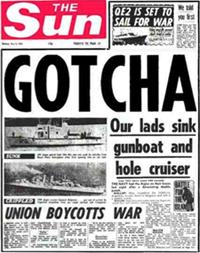
(The British Sun newspaper celebrates the sinking of the Argentinian ship the Belgrano in 1982 with the loss of 382 lives. It was sailing away from the war zone at the time.)
*
A good part of this book grapples with the notion of human rights, which is indeed thorny. He says
This [human rights] is a difficult area since there is no universal consensus on the rights and freedoms which are fundamental, even among civilised nations.
And as an immediate example :
The right to life has been described as the most fundamental of all rights, and it is indeed obvious that unless a person is alive he or she can enjoy no other rights.
You can immediately hear the Right-to-Lifers applauding and the Women’s Right to Choosers groaning. But that’s what it’s like, all the way down the line.
There’s an excellent ten pages on the exact reasoning the Bush administration used to justify the 2003 invasion of Iraq – I had forgotten the nuances of the arguments, as one does, but very interesting it was. Mr Bumble was wrong, the law is not so much an ass, more a sleek horse which will obey any skilled rider.
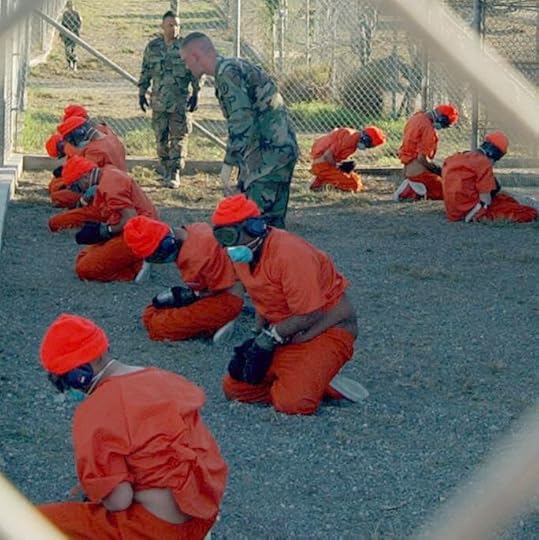
(is this cruel or just unusual?)
- Dick, a rebel, in Henry the 6th Part Two by William Shakespeare
*
When I read this sentence:
If you maltreat a penguin in the London Zoo, you do not escape prosecution because you are the Archbishop of Canterbury.
I conceived that Baron (call me Tom) Bingham of Cornhill, former Master of the Rolls, Lord Chief Justice and a Senior Law Lord might be the ideal guide through the unclear conglomerations of legal definition and public conduct which lay ahead. This was emphasised when he quoted his favourite attempt by a legislator to define exactly what he meant – this is from the 1979 Banking Act Appeals Procedure (England and Wales) :
Any reference in these regulations to a regulation is a reference to a regulation contained in these regulations.
However what follows in the next 174 pages has very few laughs. It’s essential, but so, so dry I cannot in conscience recommend this book unless you are submerged up to your chin in very wet water.
He takes us through the major milestones :
Magna Carta 1215
Habeas Corpus 1305 amended 1679
Bill of Rights and Act of Settlement 1689 and 1701
Constitution of the USA 1787
Declaration of the Rights of Man and the Citizen, Paris, 1789
Bill of Rights, USA, 1791
Universal Declaration of Human Rights 1948
It fair makes your head swim, all these goodlyhearted people trying to abolish torture and arbitrary imprisonment and rats and scurvy and no maltreatment of any penguin anywhere ever under pain of no pain.
But what do we mean by the rule of law?
*
A state which savagely represses or persecutes sections of its people cannot in my view be regarded as observing the rule of law, even if the transport of the persecuted minority to the concentration camp or the compulsory exposure of female children on the mountainside is the subject of detailed laws duly enacted and scrupulously observed.
We recall how the Nazis had genealogical experts to go through people’s family history to determine if they should be killed – heaven forbid that they should accidentally gas an Aryan! Similar exactness was observed in apartheid South Africa when assigning people to the correct ethnic group. So just because you have a set of laws which you then follow exactly, that does not create the rule of law. This law of which we desire the rule of is a specific type : Western liberal.
Zut alors, the rest of the book explains how Western governments spout all this goodlyhearted stuff through their mouths whilst trying to bend their own self-imposed rules whenever the shoe pinches, and thanks to a sorry parade of ne’er-do-wells from commie pinkos, wild IRA nutjobs and on right up to the currently foaming tide of jihadi Johns, the shoe pinches almost continually. And so the dark arts of redefining torture, extraordinary rendition, mass surveillance, control orders, Guantanamo Bays and all the way up to illegal invasions of sovereign countries gets the go ahead with just a little soft-shoe-shuffling at the United Nations and the Supreme Court.
(The British Sun newspaper celebrates the sinking of the Argentinian ship the Belgrano in 1982 with the loss of 382 lives. It was sailing away from the war zone at the time.)
*
A good part of this book grapples with the notion of human rights, which is indeed thorny. He says
This [human rights] is a difficult area since there is no universal consensus on the rights and freedoms which are fundamental, even among civilised nations.
And as an immediate example :
The right to life has been described as the most fundamental of all rights, and it is indeed obvious that unless a person is alive he or she can enjoy no other rights.
You can immediately hear the Right-to-Lifers applauding and the Women’s Right to Choosers groaning. But that’s what it’s like, all the way down the line.
There’s an excellent ten pages on the exact reasoning the Bush administration used to justify the 2003 invasion of Iraq – I had forgotten the nuances of the arguments, as one does, but very interesting it was. Mr Bumble was wrong, the law is not so much an ass, more a sleek horse which will obey any skilled rider.
(is this cruel or just unusual?)

April 10, 2022
A comprehensive but short book on the evolution of the law from the days of the Magna Carta to the present, which filled in a lot of holes for me.
Bingham, takes us back to when it all began in 1215, when King John, under threat from his rebellious barons, came up with a power and accountability devolution mechanism called the Magna Carta, which in turn gave rise to a stream of legal milestones in subsequent centuries such as Habeus Corpus, the Petition of Rights, the Abolition of Torture, the Bill of Rights, the Law of War, The US Constitution, and so on, until the Universal Declaration of Human Rights in 1948 was intended to put an end to all wars and move humankind away from “The King is Law” to “The Law is King.”
He covers slippery slopes such as the discretion exercised by judges when interpreting the law, on whether the judiciary should interfere in legislation that threatens the rule of law, and on the moribund nature of the UN Security Council when its members with veto powers break the law, as we saw with the American invasion of Iraq in 2003 and we are witnessing today with the Russian invasion of Ukraine. He covers the difference between countries with an evolved common law system (the US, Britain and its former dominions) and those with civil law such as France and Germany. And the role that International Law plays vis-a-vis national laws, and the reason why the former is increasingly needed in our interconnected world.
There are interesting explanations and examples of “trial by ambush, “the right to freedom of expression,” “the right to life,” “the law’s delay,” “statute law vs. common law,” “Public Interest Immunity,” and “full disclosure of evidence.”
We seem to have reached the pinnacle of respect for the rule of law when the Wall fell in Berlin and totalitarian states began to clamor for democracy. But the last twenty years have seen us drift back towards a less-than desirable state in the liberal west with laws such as the Patriot Act, the Rendition program, and others designed to deal with terrorism, cyberattacks, and the rise of totalitarianism. Torture has returned – check out Gitmo and Bagram; surveillance is higher than during the cold war due to the presence of CCTV; and partisanship has returned to the judiciary – check out the Bush vs. Gore election battle where the application of the rule of law boiled down to “Hooray for our side.”
Bingham however, is fully onside that the non-elected judiciary should only interpret law and not usurp the lawmaking powers of elected officials such as parliamentarians, however irrational and unfair those laws might be. He also makes an open apology up front for his politically incorrect use of the “he” and “she” pronouns instead of the currently enforced, gender-neutral form of “they” in his text, a subtle point perhaps that language, like law, is evolutionary and should reflect humankind’s development, his language being behind current trends. Law that is merely enforced in statutes could produce the likes of Nazism and Communism.
Bingham, takes us back to when it all began in 1215, when King John, under threat from his rebellious barons, came up with a power and accountability devolution mechanism called the Magna Carta, which in turn gave rise to a stream of legal milestones in subsequent centuries such as Habeus Corpus, the Petition of Rights, the Abolition of Torture, the Bill of Rights, the Law of War, The US Constitution, and so on, until the Universal Declaration of Human Rights in 1948 was intended to put an end to all wars and move humankind away from “The King is Law” to “The Law is King.”
He covers slippery slopes such as the discretion exercised by judges when interpreting the law, on whether the judiciary should interfere in legislation that threatens the rule of law, and on the moribund nature of the UN Security Council when its members with veto powers break the law, as we saw with the American invasion of Iraq in 2003 and we are witnessing today with the Russian invasion of Ukraine. He covers the difference between countries with an evolved common law system (the US, Britain and its former dominions) and those with civil law such as France and Germany. And the role that International Law plays vis-a-vis national laws, and the reason why the former is increasingly needed in our interconnected world.
There are interesting explanations and examples of “trial by ambush, “the right to freedom of expression,” “the right to life,” “the law’s delay,” “statute law vs. common law,” “Public Interest Immunity,” and “full disclosure of evidence.”
We seem to have reached the pinnacle of respect for the rule of law when the Wall fell in Berlin and totalitarian states began to clamor for democracy. But the last twenty years have seen us drift back towards a less-than desirable state in the liberal west with laws such as the Patriot Act, the Rendition program, and others designed to deal with terrorism, cyberattacks, and the rise of totalitarianism. Torture has returned – check out Gitmo and Bagram; surveillance is higher than during the cold war due to the presence of CCTV; and partisanship has returned to the judiciary – check out the Bush vs. Gore election battle where the application of the rule of law boiled down to “Hooray for our side.”
Bingham however, is fully onside that the non-elected judiciary should only interpret law and not usurp the lawmaking powers of elected officials such as parliamentarians, however irrational and unfair those laws might be. He also makes an open apology up front for his politically incorrect use of the “he” and “she” pronouns instead of the currently enforced, gender-neutral form of “they” in his text, a subtle point perhaps that language, like law, is evolutionary and should reflect humankind’s development, his language being behind current trends. Law that is merely enforced in statutes could produce the likes of Nazism and Communism.

March 18, 2017
This book confirmed that I want to study Law at university.
It is highly accessible and readable, and is applicable to almost all legal systems worldwide, though with a particular emphasis on the English legal system. I highly recommend it for everyone.
"The rule of law" is a phrase often used, but not many people know what it means, its significance and its historical context. This book - or rather an essay, more like - explains it in very simple terms. It will change the way you think and approach law, particularly if you live in a jurisdiction which has a common law based system (using prior court cases and judges' rulings as precedents).
It is highly accessible and readable, and is applicable to almost all legal systems worldwide, though with a particular emphasis on the English legal system. I highly recommend it for everyone.
"The rule of law" is a phrase often used, but not many people know what it means, its significance and its historical context. This book - or rather an essay, more like - explains it in very simple terms. It will change the way you think and approach law, particularly if you live in a jurisdiction which has a common law based system (using prior court cases and judges' rulings as precedents).

August 7, 2011
the late bingham writes so sensitively about the rule of law, that you really don't need to have ever studied the law to appreciate this book. very accessible and illuminating.

January 3, 2016
In May 2015, the British PM David Cameron famously said
He followed this up with the admonition than the government must "bring the country together" by "actively promoting certain values. Freedom of speech. Freedom of worship. Democracy. The rule of law. Equal rights regardless of race, gender or sexuality." Note that nationality and religion are conspicuously absent from that list.
Alarming as the Cameron soundbite is, there is of course precedent from the other side of the pond. Bingham quotes David Cole from 2003:
How does the removal of due process and the presumption of innocence for foreigners square with the Rule of Law?
Bingham struggles with that question after outlining the history of the Rule of Law and providing a modern definition for what we expect a country abiding by the Rule of Law to respect. It's clear that this definition is based on Western European values of tolerance and individual independence, which unfortunately are at odds with each other in any concentrated population.
And that is fine, Bingham seems to say, as long as the government abides by the laws and principles which it has set forth, no matter what the consequences.
That was Madeleine Albright, also quoted by Bingham, from April 2000. Remember 2000? Before the US collectively crapped itself at the realization that not everybody liked them, and decided that because Americans were such swell people after all, everybody else must obviously be wrong, and therefore they deserve what they get.
And who could have forseen this reaction? It seems pretty obvious in retrospect:
That was William Brennan, again quoted by Bingham, writing in 1987 and referring to such past embarrassments as the interment of Japanese-Americans and the McCarthy red scare.
But politicians are no students of history. No surprise there -- they can't handle basic maths either.
So while it's tempting to say that every elected and appointed official should read this book of Bingham's, it wouldn't make one bit of difference. A politician has the memory of a goldfish, and the attention span of a teenager.
Which means it is up to everyone else to read this excellent book, and to hold those self-aggrandizing bastards responsible for the wrongs they have wrought.
For too long, we have been a passively tolerant society, saying to our citizens: as long as you obey the law, we will leave you alone.
He followed this up with the admonition than the government must "bring the country together" by "actively promoting certain values. Freedom of speech. Freedom of worship. Democracy. The rule of law. Equal rights regardless of race, gender or sexuality." Note that nationality and religion are conspicuously absent from that list.
Alarming as the Cameron soundbite is, there is of course precedent from the other side of the pond. Bingham quotes David Cole from 2003:
With a stroke of the pen, in other words, President Bush denied foreign nationals basic rights of political association, political speech, due process, and privacy.
How does the removal of due process and the presumption of innocence for foreigners square with the Rule of Law?
Bingham struggles with that question after outlining the history of the Rule of Law and providing a modern definition for what we expect a country abiding by the Rule of Law to respect. It's clear that this definition is based on Western European values of tolerance and individual independence, which unfortunately are at odds with each other in any concentrated population.
And that is fine, Bingham seems to say, as long as the government abides by the laws and principles which it has set forth, no matter what the consequences.
One of the most dangerous temptations for a government facing violent threats is to respond in heavy-handed ways that violate the rights of innocent citizens. Terrorism is a criminal act and should be treated accordingly -- and that means applying the law fairly and consistently.
That was Madeleine Albright, also quoted by Bingham, from April 2000. Remember 2000? Before the US collectively crapped itself at the realization that not everybody liked them, and decided that because Americans were such swell people after all, everybody else must obviously be wrong, and therefore they deserve what they get.
And who could have forseen this reaction? It seems pretty obvious in retrospect:
After each perceived security crisis ended, the United States has remorsefully realized that the abrogation of civil liberties was unnecessary. But it has proven unable to prevent itself from repeating the error when the next crisis came along.
That was William Brennan, again quoted by Bingham, writing in 1987 and referring to such past embarrassments as the interment of Japanese-Americans and the McCarthy red scare.
But politicians are no students of history. No surprise there -- they can't handle basic maths either.
So while it's tempting to say that every elected and appointed official should read this book of Bingham's, it wouldn't make one bit of difference. A politician has the memory of a goldfish, and the attention span of a teenager.
Which means it is up to everyone else to read this excellent book, and to hold those self-aggrandizing bastards responsible for the wrongs they have wrought.

November 1, 2013
كتبه اللورد بنغهام قبل وفاته .. كتاب لذيذ جداً يناقش فكرة "سيادة القانون" من وجهة نظرة عامة ثم يتخصص تدريجياً ليناقش المدرسة الانجليزية بالتحديد ، من ألذ الكتاب بناءاً وعبارةً وفكرة ..

January 2, 2016
The only nonfiction I have knowingly preordered in hardback.

January 25, 2020
Tom Bingham, one of the most experienced Law Lords in the UK, died in 2010 six months after the publication of this book. He felt the term ‘The Rule of Law’ was bandied about by many people who seemed unsure of what it actually meant. Arguing that this concept is at the very heart of national and individual liberty and security, he set out the key principles – the ingredients if you will – of this most exquisite expression of human decency.
After a sweep of history that goes from Magna Carta (1215) to the Universal Declaration of Human Rights (1948) via The Bill of Rights (1701), the Geneva Convention and more, Bingham discusses eight evolved principles of The Rule of Law. These include: the accessibility of the law; the supremacy of the law; equality before the law; the exercise of power; human rights; dispute resolution; fair trial; and compliance with international law. He goes on to discuss at length the tensions between the international Rule of Law and the War on Terror that produced the Iraq War, issues surrounding Guantanamo Bay from the USA, and the extension of detention and increased surveillance in the UK. It is sobering reading.
A staggering amount of information has been packed into 175 pages. Tom Bingham’s writing is measured, spare and comprehensive, as you would expect from a judge. I read slowly. There is nothing here that an ordinary person would not already know about the basic requirements of justice, however vague the term ‘The Rule of Law’ may seem, but Bingham turns the camera lens and brings it all into sharp focus; I feel substantially better informed as a result.
The book, written six years before the UK voted to leave the European Union, concludes with a chapter on Parliamentary Sovereignty. This too is a term bandied about by many who may or may not understand what it actually means. Bingham spells it out and leaves the reader in no doubt that it both prevails and that it is fundamental to the British constitution.
His parting shot is that global compliance with The Rule of Law promises such unity, peace and prosperity that it is tantamount to a secular religion. He acknowledges there is some way to go before this aim is achieved but, after reading this book, it is not difficult to agree with him.
After a sweep of history that goes from Magna Carta (1215) to the Universal Declaration of Human Rights (1948) via The Bill of Rights (1701), the Geneva Convention and more, Bingham discusses eight evolved principles of The Rule of Law. These include: the accessibility of the law; the supremacy of the law; equality before the law; the exercise of power; human rights; dispute resolution; fair trial; and compliance with international law. He goes on to discuss at length the tensions between the international Rule of Law and the War on Terror that produced the Iraq War, issues surrounding Guantanamo Bay from the USA, and the extension of detention and increased surveillance in the UK. It is sobering reading.
A staggering amount of information has been packed into 175 pages. Tom Bingham’s writing is measured, spare and comprehensive, as you would expect from a judge. I read slowly. There is nothing here that an ordinary person would not already know about the basic requirements of justice, however vague the term ‘The Rule of Law’ may seem, but Bingham turns the camera lens and brings it all into sharp focus; I feel substantially better informed as a result.
The book, written six years before the UK voted to leave the European Union, concludes with a chapter on Parliamentary Sovereignty. This too is a term bandied about by many who may or may not understand what it actually means. Bingham spells it out and leaves the reader in no doubt that it both prevails and that it is fundamental to the British constitution.
His parting shot is that global compliance with The Rule of Law promises such unity, peace and prosperity that it is tantamount to a secular religion. He acknowledges there is some way to go before this aim is achieved but, after reading this book, it is not difficult to agree with him.

February 14, 2010
There are countries in the world where all judicial decisions find favour with the powers that be, but they are probably not places where any of us would wish to live.
I was lucky enough to attend an evening of discussion, question an answers with Lord Bingham a couple of years ago. It was the first time I had heard him speak (before I had begun my legal studies), but I still found myself fascinated by what he had to say. Two years later, with some in-depth reading of his recent judgments under my belt, his thoughts are even more captivating.
This is a short book, which I think is to his credit; when you consider the sheer volume of writings that there has been on this subject, Bingham's ability to cover the most important aspects and arguments so succinctly says a lot. As does the ease with which he explains why the invasion of Iraq was, in his opinion, illegal.
Whilst a basic legal knowledge may be required to understand some of the more complex areas, overall the book is written in a style that could be read by anyone with an interest in the subject. It's heavily referenced with dozens of footnotes, not infrequently referring to cases on which he sat as a judge, with a huge number of sources for such a short book.
I'm not sure just how much interest this book will be to the average person on the street, but I highly recommend it for those studying or working in the field, particularly those with an interest in constitutional law. A brilliant mind at work.
I was lucky enough to attend an evening of discussion, question an answers with Lord Bingham a couple of years ago. It was the first time I had heard him speak (before I had begun my legal studies), but I still found myself fascinated by what he had to say. Two years later, with some in-depth reading of his recent judgments under my belt, his thoughts are even more captivating.
This is a short book, which I think is to his credit; when you consider the sheer volume of writings that there has been on this subject, Bingham's ability to cover the most important aspects and arguments so succinctly says a lot. As does the ease with which he explains why the invasion of Iraq was, in his opinion, illegal.
Whilst a basic legal knowledge may be required to understand some of the more complex areas, overall the book is written in a style that could be read by anyone with an interest in the subject. It's heavily referenced with dozens of footnotes, not infrequently referring to cases on which he sat as a judge, with a huge number of sources for such a short book.
I'm not sure just how much interest this book will be to the average person on the street, but I highly recommend it for those studying or working in the field, particularly those with an interest in constitutional law. A brilliant mind at work.

May 29, 2015
Picked up this gem of a book today and began to skim. Skimming turned to deep reading, which turned to page-turning fixation. That says a lot for a book mainly concerned with jurisprudence.
It's not so much the subject matter that makes this book great, it is the clarity of presentation coupled with penetrating international analysis. As an American, I can use a bias-check every now and then, and Bingham provides it with erudition and wit.
We often hear of "The Rule of Law" here in the states, but it is often a rhetorical tool rather than a principle consistently applied. If there is any book able to lay out the meaning of, and need for, the rule of law, it is this one.
It's not so much the subject matter that makes this book great, it is the clarity of presentation coupled with penetrating international analysis. As an American, I can use a bias-check every now and then, and Bingham provides it with erudition and wit.
We often hear of "The Rule of Law" here in the states, but it is often a rhetorical tool rather than a principle consistently applied. If there is any book able to lay out the meaning of, and need for, the rule of law, it is this one.

May 22, 2014
This book begins:
"In 2006 I was asked to give the sixth Sir David Williams Lecture at the University of Cambridge. This is an annual lecture established in honour (not, happily, in memory) of a greatly respected legal scholar, leader and college head in that university. The organizers generously offered me a free choice of subject. . . .
"I chose as my subject 'The Rule of Law'. I did so because the expression was constantly on people's lips, I was not quite sure what it meant, and I was not sure that all those who used the expression knew what they meant either, or meant the same thing."
I was actually at this lecture (Cambridge spouse privilege), and I remember being fascinated and feverishly writing down what Lord Bingham was saying. This book, The Rule of Law, grew out of that lecture and luckily it's a lot more detailed than the notes I took, which I still have to this day.
For non-Brits, Lord Bingham was the former Lord Chief Justice of England and Wales, the English equivalent of the Chief Justice of the Supreme Court. And in particular, Lord Bingham is regarded as one of the greatest jurists in English history. I think of him as a sort of equivalent to a Justice Holmes in American history. Of course, Lord Bingham is of more recent vintage than Holmes.
This book is a wonderfully incisive and detailed explanation of the concept of the rule of law. It starts with three meanings we assign to the concept of the rule of law (first coined and explained by Dicey.) Then it gives eight principles of the rule of law. I won't recite them here, but Lord Bingham's analysis wonderfully clarifies the concept and sets out broadly what is meant when we're talking about the rule of law. Then, the eight principles outline in a practical way what kinds of laws and policies that must be enacted to give life to the concept of the rule of law. Interestingly, Lord Bingham points out that a state's laws may adhere to the rule of law (in brief, the concept that legal actions must conform to the established rules, apply equally to all persons, and be applied in the ordinary courts through the ordinary legal processes) while being repugnant to our sense of "liberty," for example, a state that outlaws drinking orange soda as a rule of universal application and applied/punished through the ordinary courts and criminal system is one acting consistent with the rule of law, but only in the "thin" meaning of that term. Lord Bingham advocates (and frankly it's the only kind that makes sense anymore) a "thick" meaning of "the rule of law" which encompasses and indeed requires protection of personal liberties as part of the concept itself.
If that interests you, I would recommend reading this book. I wouldn't call it essential reading for all lawyers and judges, because it's really big-picture, love-the-law sort of legal analysis. But it certainly is a good reminder of the principles which should guide the practice of law and jurisprudence. One problem with the book, unfortunately, is it is a little out of date. This is not helped by the unfortunate fact that Lord Bingham passed away in 2010 shortly after the book was published. So there is a short-ish section on the rule of law and the age of anti-terrorism. It is a good development of that area of recent history, though, and frankly this is what Lord Bingham will be remembered for: his guidance (and for some people, his failure to lead, unfortunately) during the decade of anti-terrorism and the challenge it brought to "the rule of law."
"In 2006 I was asked to give the sixth Sir David Williams Lecture at the University of Cambridge. This is an annual lecture established in honour (not, happily, in memory) of a greatly respected legal scholar, leader and college head in that university. The organizers generously offered me a free choice of subject. . . .
"I chose as my subject 'The Rule of Law'. I did so because the expression was constantly on people's lips, I was not quite sure what it meant, and I was not sure that all those who used the expression knew what they meant either, or meant the same thing."
I was actually at this lecture (Cambridge spouse privilege), and I remember being fascinated and feverishly writing down what Lord Bingham was saying. This book, The Rule of Law, grew out of that lecture and luckily it's a lot more detailed than the notes I took, which I still have to this day.
For non-Brits, Lord Bingham was the former Lord Chief Justice of England and Wales, the English equivalent of the Chief Justice of the Supreme Court. And in particular, Lord Bingham is regarded as one of the greatest jurists in English history. I think of him as a sort of equivalent to a Justice Holmes in American history. Of course, Lord Bingham is of more recent vintage than Holmes.
This book is a wonderfully incisive and detailed explanation of the concept of the rule of law. It starts with three meanings we assign to the concept of the rule of law (first coined and explained by Dicey.) Then it gives eight principles of the rule of law. I won't recite them here, but Lord Bingham's analysis wonderfully clarifies the concept and sets out broadly what is meant when we're talking about the rule of law. Then, the eight principles outline in a practical way what kinds of laws and policies that must be enacted to give life to the concept of the rule of law. Interestingly, Lord Bingham points out that a state's laws may adhere to the rule of law (in brief, the concept that legal actions must conform to the established rules, apply equally to all persons, and be applied in the ordinary courts through the ordinary legal processes) while being repugnant to our sense of "liberty," for example, a state that outlaws drinking orange soda as a rule of universal application and applied/punished through the ordinary courts and criminal system is one acting consistent with the rule of law, but only in the "thin" meaning of that term. Lord Bingham advocates (and frankly it's the only kind that makes sense anymore) a "thick" meaning of "the rule of law" which encompasses and indeed requires protection of personal liberties as part of the concept itself.
If that interests you, I would recommend reading this book. I wouldn't call it essential reading for all lawyers and judges, because it's really big-picture, love-the-law sort of legal analysis. But it certainly is a good reminder of the principles which should guide the practice of law and jurisprudence. One problem with the book, unfortunately, is it is a little out of date. This is not helped by the unfortunate fact that Lord Bingham passed away in 2010 shortly after the book was published. So there is a short-ish section on the rule of law and the age of anti-terrorism. It is a good development of that area of recent history, though, and frankly this is what Lord Bingham will be remembered for: his guidance (and for some people, his failure to lead, unfortunately) during the decade of anti-terrorism and the challenge it brought to "the rule of law."

December 29, 2013
The Rule of Law is one of the fundamental principles of a democratic society and the foundation of a civilized society. In this short concise book, Tom Bingham first examines the historical origins of the rule -- such as the Magna Carta 1215, Habeas corpus, Petition of Right 1628, Sir Matthew Hale's resolutions and the Universal Declaration of Human RIghts. He then advances eight Rule of law understood in western democracies today.
Tom Bingham goes into the specifics of any rule, stating the limitations, historical examples and exceptions. For example, the seventh Rule of Law is "A Fair Trial" and Tom Bingham addresses the issues of civil actions (an action is that is brought to enforce, redress or protect a private or civil right). Usually, where one party holds material which is relevant to the issues in the action, the material ought to be disclosed, but an exception arises when that party claims that disclosure would injure the public interest in a significant respect. A real case, in 1977, illustrates the problem. There was a report that a mother was seriously abusing her child, and so her house was inspected. The inspector interviewed the mother and examined the child, but found nothing amiss. But the parents of the child was shocked by the complaint and wanted to discover the identity of the informer. The NSPCC refused to reveal, claiming that it fell into the exception: the work done by the Society to protect children would be gravely hampered if members of the public could not give it information in total confidence that their identity would never be revealed. At the end of the day, none of the courts hearing the case read the document revealing the name.
I picked this book up because I was recently interested in the study of Law. Many friends recommended it to me and said it was a key text for anyone interested in Law. In fact, I think this book would be appropriate for everyone because we are living in a law-guided society, and no one is above the law.
Tom Bingham goes into the specifics of any rule, stating the limitations, historical examples and exceptions. For example, the seventh Rule of Law is "A Fair Trial" and Tom Bingham addresses the issues of civil actions (an action is that is brought to enforce, redress or protect a private or civil right). Usually, where one party holds material which is relevant to the issues in the action, the material ought to be disclosed, but an exception arises when that party claims that disclosure would injure the public interest in a significant respect. A real case, in 1977, illustrates the problem. There was a report that a mother was seriously abusing her child, and so her house was inspected. The inspector interviewed the mother and examined the child, but found nothing amiss. But the parents of the child was shocked by the complaint and wanted to discover the identity of the informer. The NSPCC refused to reveal, claiming that it fell into the exception: the work done by the Society to protect children would be gravely hampered if members of the public could not give it information in total confidence that their identity would never be revealed. At the end of the day, none of the courts hearing the case read the document revealing the name.
I picked this book up because I was recently interested in the study of Law. Many friends recommended it to me and said it was a key text for anyone interested in Law. In fact, I think this book would be appropriate for everyone because we are living in a law-guided society, and no one is above the law.

November 2, 2021
Y'all ever see those live action Death Note movies? I'm not talking about that dookie party Netflix came out with a couple years ago, but the Japan-produced pair that came out in 2006, which, let's be real, aren't a whole lot better. Anyways, there's a part at the end of the second movie where the main character, lost and blinded by the chaos of his ruthless pursuit of justice, gets rebuked by his father, who says, "the law isn't perfect. Neither are the people who've created it. But it's been made with the endless effort to do good." Like any anime fanatic worth his salt-flecked sweat, I saw the movies shortly after their release, but Detective Matsuda's words are still seared on my consciousness like a fresh brand to the brain. This book reads like a work built upon the ethos of those words.
A great deal of Tom Bingham's presentation of bedrock legal principles are exactly that, an experient review of common sense as it dictates Western society. This appraisal manifests itself much of the time into a rather sloggish time; 'Fun with Jurisprudence!' it is often not. Still, by providing readers with a solid foundation to better understand the very rule of law that dictates their lives, Bingham makes clear the friction of our intentions against the practices exercised by our governments. What results is a brilliant analysis of how what we intend doesn't always express itself in what we do. There's a portion in this book on terrorism that made for a fantastic companion read with Anand Gopal's No Good Men Among the Living, in which Bingham highlights the legal gymnastics the Bush administration performed to justify its flouting of a genuine accordance to the rule of law. I can only fault the reading experience, which can be kinda... boring.
A great deal of Tom Bingham's presentation of bedrock legal principles are exactly that, an experient review of common sense as it dictates Western society. This appraisal manifests itself much of the time into a rather sloggish time; 'Fun with Jurisprudence!' it is often not. Still, by providing readers with a solid foundation to better understand the very rule of law that dictates their lives, Bingham makes clear the friction of our intentions against the practices exercised by our governments. What results is a brilliant analysis of how what we intend doesn't always express itself in what we do. There's a portion in this book on terrorism that made for a fantastic companion read with Anand Gopal's No Good Men Among the Living, in which Bingham highlights the legal gymnastics the Bush administration performed to justify its flouting of a genuine accordance to the rule of law. I can only fault the reading experience, which can be kinda... boring.

April 30, 2022
Bench press.
Another reading experience with its origin based on my daily commute. I wanted something non-fictional and well written to get me in an appropriate headspace before work.
Tom Bingham’s book has three parts: In the first he briefly codifies what is meant by the rule of law; in the second he unpacks the political and legal aspects required for its pursuit; and in the last he looks at real world recent examples of where the rule of law is under threat in the West.
The final part was by far the most interesting. A troubling reminder that our political way of life is held together by delicate threads and of the audacity of Western Governments in the past decade.
It’s always a pleasure to read complex and nuanced concepts elegantly explained and years in the law have made Bingham a great writer. (His tone and technique also a reminder of how much more fun English judgements seem to be than Australian ones). But readability can only take a subject so far and I found a lot of this very dry. I suppose that is to be expected with a subject like this: But I often felt like I was doing homework.
To this book’s credit it was able to convince me -- having had my beliefs firmly reversed in response to the American reaction to Covid-19 – that Australia should adopt a bill or rights. And the ability to convince is hallmark of quality in books like this. Then again, I’m sure to change my mind when I pass down the forum to the next demagogue.
Another reading experience with its origin based on my daily commute. I wanted something non-fictional and well written to get me in an appropriate headspace before work.
Tom Bingham’s book has three parts: In the first he briefly codifies what is meant by the rule of law; in the second he unpacks the political and legal aspects required for its pursuit; and in the last he looks at real world recent examples of where the rule of law is under threat in the West.
The final part was by far the most interesting. A troubling reminder that our political way of life is held together by delicate threads and of the audacity of Western Governments in the past decade.
It’s always a pleasure to read complex and nuanced concepts elegantly explained and years in the law have made Bingham a great writer. (His tone and technique also a reminder of how much more fun English judgements seem to be than Australian ones). But readability can only take a subject so far and I found a lot of this very dry. I suppose that is to be expected with a subject like this: But I often felt like I was doing homework.
To this book’s credit it was able to convince me -- having had my beliefs firmly reversed in response to the American reaction to Covid-19 – that Australia should adopt a bill or rights. And the ability to convince is hallmark of quality in books like this. Then again, I’m sure to change my mind when I pass down the forum to the next demagogue.

February 16, 2011
Acts as an excellent primer on the relationship between human rights and the law.

April 8, 2013
Tremendous exposition on the development of the rule of law over the rule of man. I highly recommend this book!
November 29, 2022
this was definitely a challenging read for me. i don’t read much non-fic, let alone something as technical and “serious” as law. however, as much as it was challenging, i thought this book managed to break down this broad topic in pretty accessible language.
the rule of law is something i’ve heard of, but i’ve never really known what it entails. after reading this, i realised that the rule of law is something i’ve subconsciously been believing in. it’s something i, and many singaporeans, have taken for granted.
this book definitely helped me appreciate the overarching role of the law in societies a lot better. it’s a great introduction to the discipline.
the rule of law is something i’ve heard of, but i’ve never really known what it entails. after reading this, i realised that the rule of law is something i’ve subconsciously been believing in. it’s something i, and many singaporeans, have taken for granted.
this book definitely helped me appreciate the overarching role of the law in societies a lot better. it’s a great introduction to the discipline.
May 12, 2024
Really interesting short read on what 'The Rule of Law' in the 21st Century while also touching on medieval and early modern examples which still influence the law. Tom Bingham's style comes off as mostly reciting historical factual evidence rather than his opinion influncing the building blocks of the rule of law. Some parts of the book are dry and the book could be wittled down a bit more, with the chapter on terrorism being interesting but making Part 3 skippable. Overall a decent non-fiction book.

September 30, 2020
This book was suggested to me by my senior who wanted me to read about the working of Legal Principles in the UK and USA. This book contains various legal principles with the case laws and thorough explanations with it.
This book is a must-read for anyone who wants to learn new cases which had landmark implications in the legal system of both the USA & UK.
This book is a must-read for anyone who wants to learn new cases which had landmark implications in the legal system of both the USA & UK.

October 13, 2024
Mid - I got bored

November 14, 2021
good introduction to the rule of law but i think a wider focus internationally not just on the US would have been helpful

January 14, 2019
Firstly, a 4 star is not a denial of the quality of the book but a personal judgement on the overall reading experience. This is the first book after 'A letter to law student' that I read on the subject of Law. As recommended in the Cambridge reading list, I really really appreciate the knowledge that this book had given me. It taught me from scratch the importance of the rule of law to create a civilised society in which fundamental human rights are protected. The distinguishment between a good and a bad government is also the duly acceptance of the rule of law. I also learned that the violation of law should in no degree be tolerated, no matter who the subject is to the enactment of the law. However, the law may as well be different and changeable/flexible in different countries, according to the public need and new laws may be introduced accordingly.
Ok, after the brief summary of what I have learned from the book, I will talk a little bit about the reasons why it is a 4 star, not a 5(as I am generous when it comes to giving out 5s to good books). This is entirely due to my dull, grudging reading process. I took 2-3 minutes to read one page and usually need to repeat the parts that I just read. This may be because of the huge number of references and the large body of quotes embedded in the text, which is not entirely pleasant to need to crawl through all of them. However, I do regard this as a personal lack of getting used to the style of non-fiction books and the incompetence in speed reading. Overall I regard this book as a legal textbook and no matter what the reading experience was like, I found the information obtained after reading it satisfactory and informative to all extent.
Legislative body in the UK:
1. Commons
2. Lords
3. Parliamentary Sovereignty
Ok, after the brief summary of what I have learned from the book, I will talk a little bit about the reasons why it is a 4 star, not a 5(as I am generous when it comes to giving out 5s to good books). This is entirely due to my dull, grudging reading process. I took 2-3 minutes to read one page and usually need to repeat the parts that I just read. This may be because of the huge number of references and the large body of quotes embedded in the text, which is not entirely pleasant to need to crawl through all of them. However, I do regard this as a personal lack of getting used to the style of non-fiction books and the incompetence in speed reading. Overall I regard this book as a legal textbook and no matter what the reading experience was like, I found the information obtained after reading it satisfactory and informative to all extent.
Legislative body in the UK:
1. Commons
2. Lords
3. Parliamentary Sovereignty

August 26, 2017
Everyone's heard the term 'Rule of Law', but very few people really understand what it stands for.
In a time when every person has their own hardcore notions of how the society should operate, this books serves as a beautiful reminder of the fact that the Rule of Law forms the most important foundation of a smoothly functioning society. The law emanates from the people, not from the whims of political parties, businesses or religious organizations, thus insuring people's liberties and fair trial.
The great thing about this book is that it's very clear and does not require any formal background in law to understand it. This book is highly inclusive for people from any country, and forms a wonderful educational text for everyone, especially the youth.
In a time when every person has their own hardcore notions of how the society should operate, this books serves as a beautiful reminder of the fact that the Rule of Law forms the most important foundation of a smoothly functioning society. The law emanates from the people, not from the whims of political parties, businesses or religious organizations, thus insuring people's liberties and fair trial.
The great thing about this book is that it's very clear and does not require any formal background in law to understand it. This book is highly inclusive for people from any country, and forms a wonderful educational text for everyone, especially the youth.

May 11, 2013
Humbling. Beautifully written, as you would expect from one of the finest legal minds this country has known.
June 17, 2013
I wish The Rule of Law by Bingham was written by an Arab judge for the Arab World and read carefully by all Arabs but this book is universal

April 28, 2024
Quite easy to read as a non lawyer and got me understanding more about law in uk - bit confusing and boring I feel like I need to re read to fully understand

December 27, 2020
The phrase Rule of Law is overused especially if different people have different definitions for it. It's a bit like saying hooray for your own side. When your side wins, you say the Rule of Law has been upheld. When your side loses, you say the Rule of Law has been weakened. Despite that, there are some common beliefs when you bring up the Rule of Law. They include but are not limited to:
1. The law is applied on everyone, Prime Minister or not.
But there are exceptions. Children for example.
2. And the Law is applied not by discretion but by processes.
Judges don't give out rulings to please their boss or the media.
3. Protections are given to individuals against the State.
But does this include non-citizens? USA PATRIOT Act doesn't think so.
4. The law protects human rights.
Otherwise slavery can technically be following the Rule of Law is slavery is legal.
5. The law is accessible and understandable.
In England, justice is open to all, like the Ritz hotel. - Sir James Mathew
And How did the Rule of Law come about? Here are some significant milestones:
1. Magna Carta 1215. It was written in Latin and in a confusing way, but look at the phrases inside it: "To no one will we sell, to no one deny or delay right or justice". Back in 1215...
And Magna Carta continues to be the rallying call in courts today when abuse of authority is being challenged.
2. Habeus Corpus. "That you have the body" to question why you're being detained.
3. Abolition of torture. Weird to think of it now but it shows that no matter the threat the State faces, there are such inhumane acts that no matter the context, the State can't perform it. Torture is one of them.
4. US Constitution. Sets up a frame of government where the laws in the Constitution are supreme. Overriding the wishes of executive, judiciary, and even legislative branches. "In America, the Law is King" - Thomas Paine.
5. Universal Declaration of Human Rights 1948. It's not binding, but it shows that the Rule of Law can't just be upheld by following the law. The Law needs to protect human rights too.
And my favorite quote:
1. The law is applied on everyone, Prime Minister or not.
But there are exceptions. Children for example.
2. And the Law is applied not by discretion but by processes.
Judges don't give out rulings to please their boss or the media.
3. Protections are given to individuals against the State.
But does this include non-citizens? USA PATRIOT Act doesn't think so.
4. The law protects human rights.
Otherwise slavery can technically be following the Rule of Law is slavery is legal.
5. The law is accessible and understandable.
In England, justice is open to all, like the Ritz hotel. - Sir James Mathew
And How did the Rule of Law come about? Here are some significant milestones:
1. Magna Carta 1215. It was written in Latin and in a confusing way, but look at the phrases inside it: "To no one will we sell, to no one deny or delay right or justice". Back in 1215...
And Magna Carta continues to be the rallying call in courts today when abuse of authority is being challenged.
2. Habeus Corpus. "That you have the body" to question why you're being detained.
3. Abolition of torture. Weird to think of it now but it shows that no matter the threat the State faces, there are such inhumane acts that no matter the context, the State can't perform it. Torture is one of them.
4. US Constitution. Sets up a frame of government where the laws in the Constitution are supreme. Overriding the wishes of executive, judiciary, and even legislative branches. "In America, the Law is King" - Thomas Paine.
5. Universal Declaration of Human Rights 1948. It's not binding, but it shows that the Rule of Law can't just be upheld by following the law. The Law needs to protect human rights too.
And my favorite quote:
The poorest man may in his cottage bid defiance to all the forces of the Crown. It may be frail – its roof may shake – the wind may blow through it – the storm may enter – the rain may enter – but the King of England cannot enter – all his forces dare not cross the threshold of the ruined tenement- William Pitt

May 31, 2025
Tinha visto este livro muito recomendado por personalidades que admiro e, por isso, fiquei algo desiludida. Talvez seja um livro excelente para não juristas, ou apenas muito mais relevante genericamente na altura em que foi publicado pela primeira vez (2010). Enquanto jurista, e no meu contexto específico, a discussão sobre o Estado de Direito é tão constante e profunda que a maior parte do livro parece uma descrição interessante mas que não desenvolve ideias incomuns.
Adorei a escrita do autor, muito inglesa, clássica mas despretensiosa.
Os dois últimos capítulos, sobre Terrorismo e sobre a “soberania do Parlamento” no Reino Unido são específicos, interessantes e inovadores, com perspectivas que nunca tinha visto sobre temas conhecidos - como eu esperava que todo o livro fosse.
Adorei a escrita do autor, muito inglesa, clássica mas despretensiosa.
Os dois últimos capítulos, sobre Terrorismo e sobre a “soberania do Parlamento” no Reino Unido são específicos, interessantes e inovadores, com perspectivas que nunca tinha visto sobre temas conhecidos - como eu esperava que todo o livro fosse.
Displaying 1 - 30 of 238 reviews