Jump to ratings and reviews
Rate this book

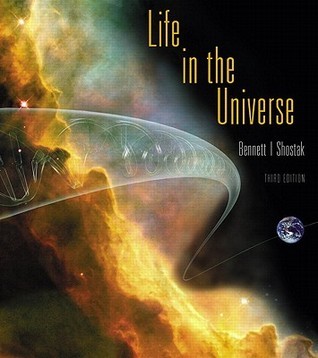
Life in the Universe (3rd Edition)

Rate this book

Key Message: Life in the Universe takes readers on a journey through the solar system and beyond, using a rigorous yet accessible introduction to astronomy, biology, chemistry, and geology to explain natural phenomena and explore unanswered scientific questions. The Second Edition has been thoroughly revised to include updated scientific discoveries, optional quantitative coverage, an enhanced illustration program, and expanded coverage of the solar system and stellar material. Key Topics: Introducing Life in the Universe: A Universe of Life?, The Science of Life in the Universe, The Universal Context of Life. Life on Earth: The Habitability of Earth, The Nature of Life on Earth, The Origin and Evolution of Life on Earth. Life in the Solar System: Searching for Life in Our Solar System, Mars, Life on Jovian Moons, The Nature and Evolution of Habitability. Life Among the Stars: Habitability Outside the Solar System, The Search for Extraterrestrial Intelligence, Interstellar Travel and the Fermi Paradox. Epilogue: Contact – Implications of the Search and Discovery Market: For all readers interested in a rigorous yet accessible introduction to astronomy, biology, chemistry, and geology, while exploring fundamental pan-scientific questions such as: How did life begin on Earth? What are the most extreme forms of life currently known? What are the challenges of trying to colonize another planet?

544 pages, Paperback

First published July 29, 2002

9 people are currently reading
164 people want to read

About the author

Jeffrey O. Bennett

133 books39 followers

Ratings & Reviews

What do you think?
Rate this book

Friends & Following

Create a free account to discover what your friends think of this book!

Community Reviews

5 stars
56 (44%)
4 stars
44 (34%)
3 stars
20 (15%)
2 stars
4 (3%)
1 star
2 (1%)
Displaying 1 - 11 of 11 reviews
Profile Image for Jacqueline Quackenbush.
11 reviews35 followers
May 3, 2013
This textbook presents the emerging science of astrobiology in an interesting and mathematically non-stressful manner. Geared towards the non-science major, this book is very accessible to readers of all academic backgrounds. The first chapters cover the basics necessary for understanding the physics, geology and biology necessary for future chapters. After going through the struggles of trying to define life, the later chapters explain current sites of interest in the search for life in our own solar system and eventually, in other star systems.

I have a real fascination with astrobiology and have read quite a bit on the subject in popular science books. Despite having a science background I thought this basic textbook would be a good way of bridging into some more serious reading. This is why I found myself skipping a couple of the first chapters, particularly the ones that sought to explain the biological principles that play a part in this interdisciplinary science. While I’m familiar with the basics of some of the physics and geology involved, I did find the basic chapters for these very helpful for review as I’m not nearly as well versed in these subjects. So, despite my neglect, I do imagine the chapters I skipped to be as well written as the chapters covering other topics.

The later chapters extend the discussion to which areas in our solar system and beyond are the most likely to harbor life; why these are the most likely, and the research that came to this conclusion, are all explained in light of the completely Earth-like science we had learned previously. Attention is also given to the physics behind various spacecraft, what physical realities we would need to confront to leave our star system, and some basic ideas of how we might go about engineering such crafts.

I honestly enjoyed reading this, and that is not something I can say about many textbooks. The subject is fascinating, the writing is great and the lack of math leaves it an easy read, with mathematical asides of key equations for those interested in taking their understanding to another level. If you’re looking for an intro text on astrobiology, this is it!

You can read this review, others, and a wealth of information for independent learners at my blog: www.theacademicjawa.com
Profile Image for Rama Rao.
835 reviews144 followers
March 23, 2020
Looking for life elsewhere

This book is an introduction to astrobiology, and it is designed to convey some of the major conceptual foundations in astrobiology that cut across traditional fields such as chemistry, biology, geology, physics and astronomy. The study of astrobiology received a great impetus in 2019 when astronomers Michel Mayor and Didier Queloz were awarded the 2019 Nobel Prize in Physics for the discovery of extrasolar planet 51 Pegasi b orbiting a Sun-like star. It is a gas giant, a type that astronomers had expected would orbit the outer reaches of a solar system. But it was orbiting much closer to its star than Mercury is to the Sun. This was an early sign that other planetary systems might not be like our own. Since then more than 4,000 exoplanets have been known to exist and most of them are gas giants like Jupiter. The 2016 revised edition of this book includes several new discoveries of extrasolar planets, since then there have been new and exciting detection of habitable extrasolar planets. Methods and tools used to detect these planets uses biosignatures such as planetary temperatures, evidence for water, carbon-based compounds and other indications of atmospheric systems.

The exoplanet K2-18b, which is 124 light-years away, is 2.6 times the radius of Earth, and orbits its star within the habitable zone. Two teams of scientists announced recently that they've found water vapor in this world's atmosphere, which is a big milestone in the search for alien life. Outer planets in the TRAPPIST-1 star system is also conducive to life. It is relatively close to our solar system and hosts seven planets that are potentially Earth-like. Their cores are stretched by its star’s gravity, which generates heat. And the two furthest away from their star could be warm, wet and perhaps even have living systems.

In solar system life is known to exist in deep underground on Mars, and in the sub-surface oceans of moons of Jupiter and Saturn. Jovian moons like Europa, Ganymede, and Callisto are known to have oceans beneath the surface. The moons of Saturn such as Enceladus, Titan and possibly Dione are also known to have liquid water oceans. Enceladus is among NASA’s top targets in the search for life beyond Earth because it appears to have three of life’s most important ingredients: the right chemical ingredients (such as carbon or hydrogen), available energy and liquid water. Plume of water erupting from Enceladus contain molecular hydrogen. This helped strengthen the case for habitability on Enceladus, because hydrogen is an important food source to critters that thrive near hydrothermal vents on Earth. Titan, which is half the size of Earth, is intriguing not only for its internal ocean, but also for its dense, nitrogen-rich atmosphere and complex carbon chemistry. Whether it's inhabited or not, Titan is a fantastic natural laboratory for the chemistry of life.

This is a college textbook for astrobiology courses. I like the depth and the level of discussion. The authors themselves are leading astronomers in the detection of alien-planets. Seth Shostak is a senior astronomer at the SETI Institute, a not-for-profit research organization whose mission is to explore, understand, and explain the origin and nature of life in the universe.
Profile Image for Nathaniel.
39 reviews4 followers
June 5, 2017
A decent introduction to astrobiology but far from a comprehensive text.

No science background is needed; Bennett and Shostak cover all the relevant astronomy, biology, and chemistry. I have that background and still learned a fair bit, though a few chapters dragged on a bit.

My major complaint is the authors' attitude towards the subject matter. The nicest way I can think to phrase it is defensive, as if they're used astrobiology being dismissed as sci-fi whackery. The book is full of dedicated potshots at even hard science fiction. I really don't understand the motivation there—it certainly broke the flow of discussion and would only serve to lower the intelligent reader's credulity. "Antimatter might sound like the stuff of science fiction" hardly makes sense to mention when we're talking about travelling to meet alien civilizations. By this point, your audience is still with you, or they aren't. Caveats about real science don't help.

Lastly, addressing the book's content, I found a number of arguments for the likelihood of alien life hinged on intuition and the assumption that Earth is extremely typical. I'm a motivated skeptic when it comes to sentient extra-terrestrials and would have appreciated further evidence that that's true. Part of the problem is that we don't know, but also contributing is the fact that this is an introduction, and I'm rushing ahead to special topics. If there's advanced books on the subject you'd recommend, let me know.
Profile Image for Daniel Morgan.
721 reviews25 followers
May 27, 2021
I really enjoyed this book. I did not know anything at all about the topic before I took a class that used this textbook, and the author does a great job of demystifying space science and astrobiology. The only thing intimidating about the book is the size - once you open it up, the author will gently guide you through the world of astrobiology, explain any math, and provide you with plenty of images, diagrams, and photos to help you visualize the often hard-to-imagine world of space.
Profile Image for Nicholas.
553 reviews68 followers
November 26, 2015
As far as textbooks go, this one isn't half bad. Life in the Universe is a smattering of all of the sciences that are involved in the search for life (intelligent or otherwise) in the universe. As such it's something of a basic primer in chemistry, physics, statistics, astronomy, biology, evolution, and Earth sciences relevant to the quest for life. The tone of the book is remarkably reserved and the authors check their enthusiasm for the subject by allowing reality to check their optimism. The universe is a remarkably large place and the distances between oases for potential life vast.

I think this is a great all around science book. It lacks the narrative pull of a book like A Short History of Nearly Everything, but has a significant amount of wonder and awe for a textbook of its kind. This might be a great book to teach a physical sciences course at the high school level. It covers relevant topics and information all people should know about science, but it has a direction and purpose to its narrative. It fits the science into a broader, more interesting question that I think would make these subjects more interesting for the nonscientifically inclined.

It's incredibly unfortunate that the class that went along with it was poorly managed, had no transparency in its grading system, and reduced a really interesting subject to really tedious tasks.
Profile Image for Ryan.
10 reviews5 followers
October 29, 2009
An excellent introduction to astrobiology for the non-scientist.
Profile Image for Meghan.
111 reviews3 followers
December 8, 2015
Fascinating and informative textbook about where and how life might develop or be discovered within our universe. Gives background about Earth's history and the rise of life on Earth.
Displaying 1 - 11 of 11 reviews

Can't find what you're looking for?

Get help and learn more about the design.