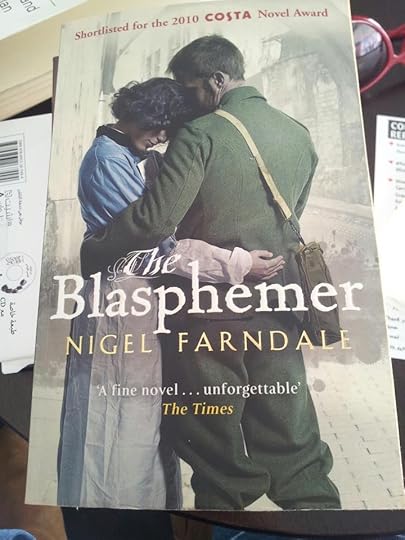
Wie red je eerst: jezelf of je geliefde? Daniel Kennedy wordt geconfronteerd met een onmogelijke keuze: wie red je als eerste bij een ongeluk, je vrouw of jezelf. Na een noodlanding van hun vliegtuig op zee kiest hij voor de laatste optie. Wanneer hij vervolgens naar de kust zwemt om hulp te halen, wordt hij 'geleid' door een visioen. De wetenschapper Daniel kan het niet verklaren.
Nigel Farndale was born in Ripon, North Yorkshire, in 1964. He is the author of six books, including The Blasphemer (shortlisted for the Costa Novel Award) and Haw-Haw: The Tragedy of William and Margaret Joyce (a biography shortlisted for the Whitbread Prize and the James Tait Black Memorial Prize). His latest novel is The Road Between Us.
As a journalist he has interviewed a host of celebrities and public figures from Mick Jagger, Woody Allen, the Dalai Lama and Henry Kissinger to Elton John, Prince Charles, Hillary Clinton, Paul McCartney, George Best, and Stephen Hawking.
He writes for various newspapers and magazines, including The Observer, FT, Spectator and Country Life, and has won a British Press Award for his interviews in the Sunday Telegraph.
His appearances on Radio 4 have included Loose Ends, Broadcasting House and Between Ourselves, a programme in which he and Lynn Barber compared notes on the art of the celebrity interview.
Before becoming a writer, Farndale read philosophy for a Master’s degree at Durham University.
He is the son of a sheep and dairy farmer from Wensleydale, and worked as a farmer there himself for a few years. He now lives on the Hampshire-Sussex border with his wife Mary and their three children.
Real Rating: 3.5* of five, rounded down because it didn't age well in my memory
The Publisher Says: On its way to the Galapagos Islands, a light aircraft ditches into the sea. As the water floods through the cabin, zoologist Daniel Kennedy faces an impossible choice - should he save himself, or Nancy, the woman he loves?
In a parallel narrative, it is 1917 and Daniel's great grandfather Andrew is preparing to go over the top at Passchendaele. He, too, will have his courage tested, and must live with the moral consequences of his actions.
Back in London, the atheistic Daniel is wrestling with something his 'cold philosophy' cannot explain - something unearthly he thought he saw while swimming for help in the Pacific. But before he can make sense of it, the past must collapse into the present, and both he and Andrew must prove themselves capable of altruism, and deserving of forgiveness.
The Blasphemer is a story about conditional love, cowardice and the possibility of redemption - and what happens to a man of science when forced to question his certainties. It is a novel of rare depth, empathy and ambition that sweeps from the trenches of the First World War to the terrorist-besieged streets of London today: a novel that will speak to the head as well as the heart of any reader.
My Review: Of the three books in here, I like the First World War narrative the best, followed by the London story of academic backbiting and relationship angst, and least of the three the underdeveloped metaphysical events connecting those two. One character says in the course of stitching the stories together that Darwin described angels as creations of Man, which "...have been described as the most beautiful conceit in mortal wit, and I would go along with that."
And that, me hearties, is that.
Daniel, our modern main character, sees his great-grandfather Andrew as he swims to safety. The World War One soldier was a deserter, which is a deeply shocking and shaming thing in the context of the day. Daniel's decision to save himself and not his pill of a baby-mama struck me as most tolerant of him, since I'd've taken the chance to shove her deep into the wreckage so as to be shut of the nightmare carping whinging misery-guts once and for all.
What unites these men across the generations is their cowardly self-preservation, a trait that ultimately lets each create a future for himself and for unknown descendants. It's hard to fault the men. It's hard for them to forgive themselves. It's an interesting counterpoint that Farnsdale sets up: Andrew saves himself from mass insanity and all-but-inevitable senseless death, and Daniel saves his own hide from an accident that will imperil few. Are either of the men "correct" or "justified" in their actions/inactions?
I'm still thinking about them a year after reading the book for the second time. That's a damn good sign.
But I can't go over 3.5 stars of five. The messiness of the story lines is just too egregious for me to go up, and the inventiveness and intriguing premise are too involving for me to go down. It felt to me like the subplot of Daniel's dying father needed to be pruned out, and the characters of Hamsi the teacher and the twirling-mustachioed villain Wetherby were so broadly drawn as to be uninteresting. So while not unflawed, the book was a good, solid read with interesting philosophical points jabbing the soft, lazy parts of one's novel-reading brain.
2.5 stars! A dual narrative that doesn't feature two women as the main protagonists! Personally, that is not something I encounter too often as a reader. So when I saw this book in the bargain bin for $4 and read the description it was an easy sale! However, the very limited description didn't prepare me for the heavy topics which lied between its pages.
In the present day, we have Daniel Kennedy, a zoology professor and atheist from London, who travels with his long time partner, Nancy, to the Galapagos Islands. It's here where Daniel has planned the ultimate marriage proposal. A day, which Nancy believes, was never going to happen. But a plane crash takes place and the events that unfold immediately drive a wedge in Daniel and Nancy's relationship. Setting off a whole host of situations involving religion, father-son relationships, the post 9-11 world, bravery vs.cowardice etc.
Then we have the story of Daniel's great grandfather, Private Andrew Kennedy, a member of a British regiment situated on the eve of Passchendaele. As far as Daniel and his father are concerned, Andrew Kennedy became one of the many soldiers whose life was taken by the Great War. Except, Andrew Kennedy didn't die...
But don't get too intrigued by Private Andrew Kennedy because Nigel Farndale is going to FORGET ABOUT HIM FOR ELEVEN CHAPTERS. The biggest problem that I had with the story is that most of the book covers Daniel, Nancy, Daniel's father, their daughter Martha's teacher, Daniel's villainous and backstabbing colleague etc. All of which I felt made the story a bit tedious. Not to mention that my empathy for Nancy soon gave way to muttering "Get a grip, chick" and rolling my eyes at the stereotype way in which her story line turns.
The biggest problem I had with this book is that within the entire story there was never any defining moment. The book is supposedly about a professor who is an atheist, who goes down in a plane crash along with his long-time girlfriend and several other passengers. The professor volunteers to swim to the nearest island (some 14 miles away) to get help. While he's swimming, he sees a man, calmly treading water, always in front of him, urging him on. So now the obvious question arises: Was this a vision? Some kind of divine intervention? Or was it a hallucination, brought on my dehydration and exhaustion?
I think this book would have been a lot better if the professor -- at any point in the story -- would have seriously questioned his atheism. Even if he had decided, in the end, that there still was no God, the internal conflict could have been a fulcrum of the story. Instead, after everyone is rescued, the professor continues on with his regular life, insisting that the man he saw was a hallucination brought on by physical taxation. There is never any moment where he waivers from his atheism. Within the story of course there are other characters and other things happening, but while you get the feeling that they are all supposed to somehow come together, it never actually happens. Even at the very end of the book, with it's explosive climax, nothing is really resolved.
So while I actually really liked the story part of the book and the characters were great, the entire production lacked any cohesiveness and kind of left me wondering what the point had been.
Angels, apes, soldiers, scientists, Mahler, love, relationships, militant atheists, terrorists – phew, I dread to think what Nigel Farndale fits in his man-bag, considering the amount of material he manages to fit into this, his Costa Award shortlisted novel. Thankfully, I am not a minimalist, definitely not in my home and most certainly not in my reading life, so I became quickly engrossed in The Blasphemer.
The novel has multiple layers, it’s a dual time-frame narrative with one story set in war-torn France in 1917 involving the desertion of one Andrew Kennedy from his regiment, the other story set in contemporary England where Andrew’s great-grandson Daniel, a lecturer in Zoology, is perhaps guilty of deserting his wife. Usually, with these split narrative novels, I find myself much more drawn to the historical rather than the contemporary plot but, with The Blasphemer, I found myself enjoying each narrative equally, okay, if pushed, the gripping accounts of life on the front line at Passchendaele, edged it for me, but only slightly… As if the two meaty storylines weren’t enough to carry, Farndale has included many thematic threads such as atheism, duty, what it means to be brave, ever-evolving relationships as well as the mystery of a missing Mahler symphony.
I know that the “busyness” of the different themes/topics has proved irksome for some readers but for me it works as the author’s hand is in firm control at all times yet not so heavy as to seem intrusive. I must admit to being pleasantly surprised by The Blasphemer as I expected a much more superficial story, indeed it was one of the few recent novels I found myself discussing with my husband, particularly the notion of bravery versus cowardice and how quick folk are to judge. So, it’s a most definite thumbs up from me and I look forward to reading more by this author.
This veers from a three to a four star. There is so much going on this book, and it worries me that there were just too many 'big' themes - science versus religion, father. son relationships, cowardice versus bravery and that's just the tip of the iceberg. I gave it four as it had me gripped and I loved the gross figure of Weatherby and how Machiavellian he was - but ultimately I think he tried to put too much in and never really came to any satisfying moral conclusion. Overall a good, gripping read.
The tricky thing with book descriptions is that they tend to give too much away, not as much as movie trailers, but often too much for my liking anyway, but then if you don’t read them, you won’t know what you’re getting into. The thing to do is to read just enough about the book, which usually works or sometimes ends up being a complete surprise. In this instance it was Galapagos Islands that attracted my attention, I’m in the island hopping mood for my summer armchair travels, but the plot actually never gets there. In fact there’s a terrifying plane crash on the way to Galapagos, which serves as a sort of catalyst, but the story takes place in Europe, mostly London, but also some mainland, the sites of WWI. So a complete surprise, yes, but a very peasant one, this turned out to be a powerhouse of a read, albeit neither easy nor quick. Suppose it wasn’t meant to be, some stories are long and heavy on purpose to inspire contemplation. This novel has a lot going on, tons of threads, from late years of WWI to present day, multiple storylines, multiple all sorts of thing, but the subject can be fairly easily summarized as faith and bravery. Recurring dual plot drivers, generation to generation, from war time to peace, this is all about faith and bravery. There are some basic preset juxtapositions for this, mainly between Daniel(staunch atheist) and Wetherby (dedicatedly religious) and Daniel (the self assumed coward) and his great grandfather private Kennedy (presumably a coward due to army desertion). And then the myriad of circumstances and explanations to analyze all of those dynamics. I’m thinking this is coming across inadequately articulate for the complexities of the book, the meditations of faith alone are fascinating and so well crafted as the man who vehemently believes in nothing becomes aware of a personal angel and actually that character is so strikingly ambiguous…it’s that is he or isn’t he thing, insufficient proof for a man who deals in facts, but then of course that’s the very nature of faith, evaluation above proven facts into the ephemeral and ethereal, mind and soul competing for eminence is the very essence of Daniel’s struggle, he wants to be brave, he wants to understand the mysteries, it’s what makes him such a compelling character. Wetherby, on the flip side of that coin, is a comically cartoonish type of antagonist, pure affectation and Machiavellian scheming and pretense, no redeeming qualities, just a loathsome person. Interestingly enough, a devoted man of faith, which seems to make him aware of his shortcomings (if only in confessionals), but not enough to change his ways. Actually I’m still pondering what the author was trying to say about faith and religion and piety with this novel, it’s obvious he doesn’t place much value on piety alone, but faith and ability to accept faith is discussed in the most noble manner as presented by the man who just may be Kennedy’s personal angel. In the end it seems to be all about a moral compass that guides a person through life to a sort of solace or grace, whatever the magnetic north that sets it might be. Not unlike a personal evolution, which brings us right back to the Galapagos Islands after all. Lovely book, interesting book, very well written, good, maybe even almost a great one. Makes you think serious thoughts. Like proper literature should.
Given how obsessed I am with the First World War, this would seem to be a no-brainer. And indeed the plot line involving flashbacks to the grandfather's experience at Passendaele is the strongest material. But the writer just takes on far too much and loses my precious tolerance and suspension of disbelief as he over-lards the pudding with one unlikely twist after another, symbolic effect after symbolic effect. It's tiresome and it all gets a little preposterous after a while, with villains and angels worthy of Snidely Whiplash and Nell. Too bad, because the guy can write and some of it really works.
There’s a lot going on in Nigel Farndale’s new novel, which is good because it keeps the pages turning; but I feel that The Blasphemer ultimately tries to hold more than it can contain.
In the present day, zoologist (and atheist) Daniel Kennedy takes his partner Nancy on a surprise trip to the Galápagos Islands — but, before they get there, their light aircraft crash-lands at sea.At first, instinct leads Daniel to push past Nancy on his way out of the stricken plane, before returning to help her — but he ultimately saves the day by swimming all the way to land and finding help. On his way there, though, Daniel is spurred on by an apparent vision of a familiar-seeming man — a man who turns out to be his daughter’s teacher, Hamdi Said-Ibrahim, whom Daniel meets for the first time on his return to London.
Several months after the crash, Daniel’s relationship with Nancy (which was already precarious) has foundered, because she blames him for saving himself first instead of her. On top of this, Daniel is struggling to rationalise what he saw in the ocean — was he hallucinating or could he have a guardian angel? — and his career is under threat thanks to the machinations of Laurence Wetherby, his college’s vice-provost, who’s spreading rumours that Daniel has a fragile mental state and is consorting with terrorists (Hamdi having been wrongly labelled thus).
Intertwined with this narrative is the story of Daniel’s great-grandfather, Andrew, who fought at Passchendaele, but then deserted and embarked on an affair with a French widow. The full truth of Andrew’s life will emerge by novel’s end.
As I said, there’s a lot going on — and this synopsis by no means covers all of it. What to make of The Blasphemer, then?
I’ve already suggested that I have reservations about the novel, and one of these concerns the characterisatiobn. Some of the characters have quirks that can irritate, such as Nancy’s habit of calling her nine-year-old daughter ‘the baby’; and Daniel’s know-all tendencies — though I must say the latter pays off to great effect when Daniel witnesses an explosion, and Farndale describes the experience in coldly scientific terms.
It’s relatively easy to put up with this sort of thing, though; more problematic are some character issues on which the plot hinges. I had trouble believing that Nancy would hold her grudge against Daniel for so long: I can (just about) believe that she’d resent Daniel for barging past her on the aircraft and leaving her behind momentarily (though it seems a pretty extreme reaction to something she must surely realise was instinctive, especially given that he returned to her shortly after); I find it much harder to accept that she would still hold the same view months later, and not judge Daniel’s actions in the round — he was responsible for everyone being rescued, after all.
The character of Wetherby didn’t ring true for me, either — he abuses the power of his position to a phenomenal extent, spreading lies about anyone to whom he takes a disliking, having a relationship with one of his students (who seems to accept the situation quite happily)… it’s too much for me to be able to take that character seriously — and, since Wetherby’s actions underpin a good proportion of the plot events, that’s a problem.
I’m also unsatisfied with the novel’s treatment of one of its main themes, that of science versus belief. This is exemplified by Daniwel’s vision/hallucination; there are various debates between him, the scientist, and the religious people in his life — but, ultimately, nothing that I haven’t come across before, leading me to conclude that this strand of The Blasphemer doesn’t go anywhere interesting (and, on the level of plot, the implied solution to the mystery of Daniel’s ‘vision’ is telegraphed too early on, and doesn’t stand up to much scrutiny).
Better, I think, is the book’s exploration of cowardice. Here, Farndale sets up a parallel between Daniel and Andrew, both of whom commit acts viewed as cowardly by some within the narrative. There are some interesting contrasts — for example, the judgement of cowardice is institutional in Andrew’s case, but more personal in Daniel’s. The thing is, though, that, as well as the main parallels between the two storylines, Farndale puts in a number of tangential echoes and connections (e.g. Daniel’s profession and the Galápagos Islands link him to Darwin, whose great-nephew. the text reminds us, was Ralph Vaughan Williams, who makes an appearance in Andrew’s narrative) which don’t, to my mind, cohere properly. The effect is not to amplify the parallels but to complicate them needlessly (this is the main reason for my earlier comment about the novel ‘trying to hold more than it can contain’).
I appreciate that’s quite a lot of criticism; so what does The Blasphemer do well? The wartime scenes especially, I think. The passages describing Andrew ’s experiences in the trenches and on the battlefield are superbly vivid; and Farndale is subtle in showing the deleterious effects that warfare could have on a man. (The ending of Andrew’s narrative is also much more satisfactory than that of Daniel’s.)
For me, The Blasphemer falls into the category of ‘flawed but interesting’, which would normally lead me to suggest that it was worth a look. But the book’s flaws are such that I’m not sure how easily I can say that. It’s not bad by any means, and some parts are very fine indeed; but you have to do a fair bit of mental pruning to see them clearly.
There was a lot more in this book than I was expecting. There are two major themes: one centres on War, exploring courage, cowardice and remembrance. This is where the first protagonist, Private Andrew Kennedy, comes in, and it also involves three more generations of his family, a friend or two, and some mysterious people who are either hallucinating or hallucinations themselves, or they might actually be real, but it's rather hard to say. Also starring two people called William and a lot of army acronyms which often makes it hard to remember who did what.
On the whole I loved that part of the book. It was well written and thoughtful, but also full of action and mystery and believable, lovable characters, and a good balanced depiction of the War itself. That was what originally drew me to the book.
The other major theme I enjoyed equally, but have more of an issue with. It's about religion and angels. There are quite a few solid arguments which I never failed to find absorbing between atheists, Christians and Muslims, which is very brave of the writer, and well-written too. The dialogue is good and they are left open-ended, all with big ideas on the table.
But. If you are going to write a novel, go ahead and fill it with characters, good bad and ugly. However, if you are going to write a piece exploring ideas about religion, then represent those religions fairly (same for if you can't make up your mind). The atheist is a rounded character with good intentions at heart. The Muslim is a kind teacher (cum guardian angel) who knows and practices his faith. The Catholic is a little s**t. Look, I have no problem with conniving sleazeballs in literature. Bring them on, give us the satisfaction of a sound slap at the end. But please, I beg you, don't make them the representative of their religion – whether by accident or design. Give that role to someone else. Make it clear that (1) if a Catholic goes to confession with no intention of changing his/her ways, the confession is as invalid and useless as having a shower before bathing in a muddy pool, and (2) Catholics in general are very sceptical indeed about visions and miracles and are usually as unenvious of people having them as you might be of someone getting an ambulance ride to the hospital. Anyway, now you know. Wetherby is a blight on the face of the earth.
And Nancy. Why does loving someone mean there has to be something constantly new and different about them? But that's a character flaw rather than a reflection on the writing.
I did enjoy this book. A good balance of action and discussion. But please, if anyone has a theory on what on earth was going on with Hamdi and the whole angel thing, please explain it to this puzzled reader!
While I thoroughly enjoyed The Blasphemer, I found myself forced to contact the author about one third of the way through when I read a sentence that made my blood boil. In a discussion between two characters, Farndale has one character claim that there exists in Ohio a Creation Museum in which young children are pictured playing with carnivorous dinosaurs. As we in Ohio all know, that infamous, ridiculous museum is not located in Ohio but was constructed south of the Ohio River in Kentucky. We in Ohio are not that stupid! Mr. Farndale responded to my correction with the promise that he will make certain that bit of misinformation is corrected in the next edition...we shall see. Mr. Farndale certainly did not do careful research before writing his book, and that puts into question other details about World War I that appear in the text.
The book tackles the ongoing conflict between science and faith through the stories of a man in the present era and his great-grandfather who fought in WWI and was declared missing in action. I don't believe in angels, and most certainly not in guardian angels, and I lean to the side of science rather than religion. Nevertheless, it was interesting to see Daniel, man of science, attempting to understand what he was unable to explain through science. Blasphemy, in this book, relates not to taking God's name in vain or saying church-described blasphemous things, but rather to such hellish human behavior as trench warfare and terrorism, terrible violence again the innocent. These constitute true blasphemy.
I have just finished reading The Blasphemer. Not for quite some time has a book touched me so much, its characters and their stories lodged in my mind. I was literally glued to the book for the last half of it; I felt as though from chapter 25 onwards, I was on a rollercoaster, the pace was increasing and I didn't want it to stop, eager to learn the fate of Andrew, Adilah, Daniel, Nancy, Wetherby, Philip and Hamdi, and just how much Andrew and Adilah's story intertwined with those in the present day. I have to say how impressive the intricately woven threads and themes of this novel are. The reader is left guessing the whole picture until the very end. It is so remarkable, how the author has brought so many different stories together in one novel, and how well researched the different topics are. Many of the main facets of life are included: religion, existentialism, love, war, betrayal, and today's preoccupation - Islamist extremism and terrorism. I found it comforting and empowering that in this novel, through divine intervention, good had to triumph over evil. Tears were rolling down my cheeks as I read the last third of the book, not caring if I was on a bus or train at the time. This work is an inspiration, not just in literature, but philosophically and existentially.
There is a LOT going on in this book. Religion vs science, bravery vs cowardice, plane crash, WWI, father and son relationships, middle eastern prejudice, amber alert, redemption, dogs and cats living together - mass hysteria! Just when I thought I knew what this book was about (plane crash that tests a couple's relationship paralleled with a WWI storyline) a new character and subplot would be introduced - the middle eastern teacher, car bombs, the counselor, the father, the nasty vice-provost. Did it work? Surprisingly, most of it actually did! I had my doubts. Half way through this book I was wondering if we were just meandering off course a little too much and if I was editing this book I think I would have looked to cut a few sub-subplots but in the end I realized that this is life. There isn't one clean story line - there are complications at work at the same time as complications at home and then your daughter has a crush on her teacher and your father is tracing his grandfather's past etc. This book is interesting. It's thought provoking and it moves quickly with some really good storylines. But its not perfect - the character of Wetherby was very hard to believe or at best hard to figure out what was motivating him. He was intriguing and, at times, fun but not realistic. And why was Nancy constantly described as "terrifying"? And the ending is a little melodramatic. But there are some great scenes in this book that will definitely stay with me - the plane crash is gripping (don't read this on a flight!) and the description of the trenches in Belgium during WWI were vivid and horrific (in a great way). It drew me in and kept me reading all weekend.
Let's get the comparisons over with first. The scenes from the Passchendaele? Birdsong, but even more hard hitting - and the passion amidst it has the same highly charged eroticism - with a touch of Private Peaceful. The modern story? Very reminiscent style-wise of Danny Scheinmann's Random Acts of Heroic Love for me - too reminiscent maybe, remembering that was also a R+J choice a few years ago.
The modern story really is a total hotchpotch - inter-academic back-stabbing, Islamic terrorism, a lost musical score - but some of that gives the link to the WW1 story. Nancy and Daniel are, I'm afraid, quite unlikeable for me - and their child is one of those horrible old-before-her-years ones. There's also a rather strange vice provost who thinks he has a monopoly on faith but shows the most amazing double standards - I'll let you discover that one (he's involved in some of the lengthy pseudo religious, philosophical debates that lost me at times...).
But the wartime story is quite exquisitely told - some of the most harrowing descriptions I've read, beautifully written, and a narrative drive I thought the modern story let slip at times. The tying up of ends at the end was, in all fairness, masterful - all those little side turnings you'd thought "what?!" about made sense. And the ending itself - the last couple of pages - was superb, opening things up again and leaving quite appropriate question marks. In case you doubt it, I really liked it - well, 90% of it. Go on, give it a go..
This was a thought provoking book, introducing a lot of interesting ideas, which I thought worked quite well on the whole. Some of the characters were a bit too close to stereotypes, but there were a lot of characters and some were more rounded than others. Sometimes Wetherby behaved in an unlikely way. I could accept him being petty and spiteful towards his colleagues, but not being quite so vindictive towards Daniel. I liked the parallel narratives, that worked well. The debates about the nature of belief were quite well done, some people do hold conversations as though they are addressing a debating society. The debate about faith versus fact is not quite as clear-cut as the book suggests, there are plenty of scientists who have both, but it was well explored and the book avoided a pat conclusion one way or the other. The ending felt a bit rushed and convoluted, which was a bit of a let down, compared to the rest of the book. The more I thought about "The Blasphemer" the richer it seemed. There are letters which suggest that Mahler considered various different openings to his ninth symphony, but I don't think there are alternative scored versions (unless someone can find evidence otherwise), so it's use in the book is mainly artistic licence. The music is supposed to be about "death in the midst of life", so it is a good piece to choose. (That "death in the midst of life" came from CD sleeve notes, I'm not a Mahler expert).
A man climbs over his girlfriend in the aftermath of a plane crash potentially leaving her to die. The same man's great Grandfather goes over the top of the trenches on the first day of Passchendale, is assumed dead but is really a deserter. The question here, is if we were in either of these men's shoes could we say we would react differently; are we really in a position to judge? In amongst these two moral dilemmas that run parallel throughout the 492 pages of this novel we also have a nine year old with a crush on her teacher; a teacher suspected of terrorism; a counsellor with stalkerish tendencies; a sick and ageing father; a much desired missing symphony and a 'bad guy' so grotesque he's almost a caricature. Yup, there's a lot going on but somehow Farndale pulls it off, for the most part. The book never loses pace and all the characters with the exception of bad guy Wetherby are relatable too. The book moves from the present day to WW1 seamlessly and some of the description is so real it makes your heart race, particularly that of the first day of Passchendale. I do think at times it tried a little too hard to make it's point, was a little preachy and that at other times there was a little too much going on but overall I really liked it. (I also thought Daniel's Dad seemed more like a guy in his 80's than the 60+ he was supposed to be but that's a minor niggle really.)
Well, I was looking forward to this book after loving reading The Road Between Us, but I was disappointed. There was just too much happening in this book and a couple of the characters actually upset me, especially the treachery and the callousness. I liked the First World War part the most but I didn’t enjoy the constant changing to another era, just when something was happening. Overall I’d say it was OK, but I’m pleased to have finished reading it.
Was a compelling and thought-provoking reflection on the interconnectedness of past and present lives and the intersection with supernatural superintendents in the form of angelic (or perhaps demonic) beings - until the last few chapters, then became somewhat of a typical thriller. Nevertheless, enjoyed it very much.
This entire review has been hidden because of spoilers.
Daniel Kennedy möchte seine Langzeitfreundin Nancy nicht nur mit einer Reise auf die Galapagos überraschen, sondern plant ihr dort auch nach Jahren der Partnerschaft inklusive gemeinsamer Tochter einen Heiratsantrag zu machen. Auf dem Weg zum Flughafen setzen die beiden die Kleine bei den Großeltern ab, Daniel macht wie immer mit seinem Vater gestelzte Konversation und spürt wieder einmal, wie wenig ihn emotional mit diesem Mann verbindet und dass er nicht wirklich in diese Familie passt.
Drei Generationen zuvor kämpft Andrew, der einmal Daniels Urgroßvater werden wird, im ersten Weltkrieg an der französischen Front, im Schlamm und Dreck und Blut der Schützengräben ist er schier am Verzweifeln.
Im Klappentext wird angedeutet, dass es buchstäblich zu einem großen Knall kommen wird, nämlich dass das Flugzeug, in dem Daniel und Nancy sitzen, abstürzen wird und Daniel in ein moralisches Dilemma gerät und zunächst sich selbst in Sicherheit zu bringen versucht, statt Nancy zu retten - und dass Andrew desertiert und somit auch zumindest in den Augen mancher feige handelt. Das sind zwar grundsätzlich interessante Fragestellungen, aber ich bin so weit gar nicht mehr gekommen und bin nach etwa 50 Seiten lieber aus dem Buch desertiert.
Das hatte verschiedene Gründe. Dafür, dass ich enttäuscht war, weil die Weltkriegsthematik eine viel geringere Rolle spielt, als ich angekommen habe, kann das Buch natürlich nichts. Das alleine ist ja auch kein Grund für einen Abbruch. Aber es kamen noch einige andere Faktoren hinzu. Die Charaktere waren mir egal bis herzlich unsympathisch, alle ziemlich eindimensional gezeichnet und handelten in meinen Augen viel zu häufig unlogisch oder einfach bescheuert. Von der großen Liebe zwischen Nancy und Daniel war nicht viel zu spüren, Nancy wirkte dauerbeleidigt und die Marotte, die neunjährige Tochter als "the baby" zu bezeichnen (und das ziemlich häufig) führte schon zu heftigem Augenrollen meinerseits. Die Schützengrabenszenen konnten mich genausowenig überzeugen und haben mich nicht mitgenommen in das Geschilderte.
Am allerschlimmsten aber fand ich die Sprache. Da überschlagen sich die Beschreibungen, man hat das Gefühl, dass der Autor bei jedem klitzekleinen Aspekt immer noch eins draufsetzen muss auf seine blumige Schilderung. Ich mag ausschweifendes Beschreiben durchaus gerne, wenn es gut gemacht ist, hier wirkt es aber nur schwafelig und redundant. Das konnte ich ziemlich schnell nicht mehr ertragen, zumal ich (siehe oben) auch die Figuren so gar nicht mochte und mich weder die Gegenwartshandlung noch die Zeitebene des Krieges packen konnte.
Ich habe mir dann noch ein paar Meinungen auf Goodreads angeschaut, es scheint auch nicht wesentlich besser zu werden und mit einem wilden Themenmix überfrachtet zu sein. Gut, dass ich nicht weitergelesen habe.
When a light aircraft crashes into the ocean, Daniel Kennedy (famous nematologist and hardcore atheist) frees himself and swims to the surface, on the way passing Nancy, the mother of his daughter and the woman he is about to propose to, leaving her behind. While he does go back under and eventually manages to save her and some others on the plane, eventually being hailed as a hero, that one moment of betrayal threatens to destroy his relationship. Beyond that, he saw someone in the water, someone who guided him to safety right at the moment he was about to give up. The novel focuses on how he deals with what happened, his moment of cowardice and the mysterious figure in the water.
The other main plot of the novel centres around Daniel's great-grandfather Andrew, a soldier in World War I whose story in many ways mirrors that of his great-grandson.
The novel progresses slowly, focussing on various subplots, such as Daniel's colleague Weatherby who poses as a Christian while attempting to destroy the lives of other people for what mostly seems like no reason at all. Daniel's father tries to find out the truth about Andrew Kennedy. Nancy cannot forgive Daniel and sees a therapist. Their nine-year-old daughter is in love with her teacher. That teacher is being trailed by the police simply because he is a Muslim. Daniel questions whether he had a vision or a hallucination. And then, with forty pages or so to go, everything races to a climax and the story ends. Considering the amount of time taken to set the story up and put all the characters in place (some of which don't actually add anything to the plot) the conclusion feels abrupt.
The story is ok. The writing is, while at times a little too blunt, is ok. The characters, while being mostly unlikeable or irritating people, are for all intents and purposes ok. That's my final word on the novel: it's ok. Just ok.
This book kept my interest, kept me wanting to read on to see how the various plot-lines were resolved, but wasn't as satisfying as it could have been.
There are so many strands and ideas explored in this story that writing a summary is beyond me - Darwinism, angels, courage, post 9/11 hysteria, father/son relationships, betrayal, a plane crash, a crumbling marriage a missing child, WWI, desertion, Mahler's 9th symphony, I could go on and probably should as I'm sure I've missed some out. In fact there are probably too many ideas at work here. In particular the disappearance of the child towards the end of the book felt rushed and implausible.
Despite giving me a sense of deja-vu because of it's similarity to Birdsong, the WWI scenes were the highlight for me, the characters were more sympathetic, although (again like Birdsong) the female character here seemed strangely voiceless. I also enjoyed the portrayal of Daniel's father.
I did not warm to the main character, Daniel which probably coloured my overall view of the book. My other main objection to the book was that it wore it's research ostentatiously. I do not need to know the minutiae of regimental dress for a WWI infantryman, unless it furthers the plot, and that's a history nerd speaking. On the other hand, very little research would be needed to tell an author that a teacher (especially one who suspected that the pupil had a crush on them) would not give that pupil a lift home without anyone else present, would not have given the lift (third party present or not) without speaking to the parents and would not have dropped a nine-year old off at an empty house. Sloppy.
This was a book about four generations of the same family, three of whom served in wars, the fourth of whom was at war with himself.
It’s also a book which tries to take on various philosophical and religious topics; some of the them are academic discussions, others are more mystical; none are particularly complementary to one another.
It’s also a mystery;
There is also an essay on cowardice here; this may or may not have material effect on the development of the relationship between two of the main protagonists.
There is also a little bit of a treatise on terrorism, and how the security forces in the West can react to these perceived threats – there may be a link between these two threads, but I’m not particularly sure.
There are also another half dozen or so topics touched upon, but they just aren’t followed through at all.
And therein lies the problem with this “novel” – it’s probably the outlines or ideas for half a dozen or more novels, none of which are developed properly, none of which are followed through properly. The result is a bit of a confusing mess.
This is a shame, as the writing style is accessible enough; some of the characterizations are quite good; others are hugely underdeveloped, and don’t seem to have amounted to anything once the final page has been turned. The turning of that final page also causes a great deal of frustration, as there was an expectation throughout that all of these diverse topics being developed would come together in some way – but they didn’t. And it is this frustration which is sadly the pervading memory of what might have been a fairly good novel – or maybe, half a dozen or more fairly good novels.
Honestly I wanted to love this book. If books were judged only on the information on the dust jacket and the first 30 pages, then this would be a classic. However as I got more into this book, I regretted ever buying it and eventually only finished it because I had bought it. I have this hidden for spoilers but still must warn any reader thinking of reading this to look away if they want to read this book.
Firstly the book is written well. However that does not cure it of the worst of its problems which was an overly convoluted plot which was not entirely tidied up in the end. It had the feeling that just to add complexity, subplots were added at will and this turned the novel into a malaise.
Secondly the characters seemed very shallow and given over to simple sterotypes too often. Weatherby is the worst of the worst in this regard. I knew he was being recorded because I have seen 50 movies use the same tactic. The other characters all suffer from similar problems.
Overall much promise but poor execution.
This entire review has been hidden because of spoilers.
The reviews call the book thought provoking. I consider that a serious understatement, as it has kept me up at nights, not only reading but also reflecting about the book in itself. It goes through a wide range of human emotions and their expressions, cowardice, love, envy, bravery, fear, faith or lack of it. It develops those feelings into characters that are threedimensional, with whom you can empathize whether you agree or not with their actions.
Most importantly though, it made me look deep inside myself. I have seldom read such a powerful book, and it is also an education on the horrors of the first world war. For all that the second world war was terrible, the deathcount on the battle field on the great war was worse, and the fields of Ypres are certainly worth a visit, ans does the memorial of the Menin gate. If you have not read the book, and have not been to the Ypres fields, I recommend timing them together. I don't need to emphasize that this book is a MUST read, yeah, with capitals.
Present day: A couple goes down in a plane crash on their way to the Galapagos Islands. A split-second reaction in the face of death has far-reaching repercussions on both their lives.
1917: A young soldier faces the horror of the trenches at Passchendaele. The consequences of his actions on his first day of battle will come back to haunt him.
"The Blasphemer" is an ambitious novel, tackling lots of big themes including religion, morality, cowardice, love, terrorism, persecution, self-sacrifice, and more. The author has woven an interesting web of plot threads together, but ultimately I felt like he was just trying to do too much all at once. This interweaving of present and past narratives, connected by family bonds over several generations, was much better done in his later novel The Road Between Us IMO. Additionally, I always have trouble enjoying a book as utterly devoid of likable characters as this one. All in all, somewhat of a disappointment.
I've struggled with articulating why I didn't like this book ... different story - asking some big questions that always seem to be interesting ... nice style - easy to read ... I really enjoyed the parts with the character Phillip - he was understated and real and quite sweet in the end ... what's not to like right?... hmm ... I think maybe there was too much going on ... it felt sensational but in a "oh c'mon, really?" kinda way ... and after all of that activity and hype there was no resolution for the main thread - which I'm cool with when the story is subtle and provokes your own thoughts and conclusions - but when you're lead by the nose from one drama to another you do expect there to be a point ... I do anyway ...
With it's parallel narratives, World War I trench and battle descriptions, and long discussions on faith and religion between characters, "The Blasphemer" is not an easy read. While I enjoyed the novel, the contemporary storyline was not what I thought it would be. A vividly described plane crash leads to a miles long swim toward the Galápagos Islands, which I thought meant an adventure survival story. Instead the plot is in the aftermath, as atheist Daniel Kennedy returns to London and copes with the post-traumatic strain on his common-law relationship, is blithely unaware of the Machiavellian machinations of a colleague, and befriends a man under watch by an anti-terrorist force. Despite some dull bits in the middle, this is a highly satisfactory book, and a great choice for bookclubs.
4.5. While it took me a while to get into the story, once I was about 2/3rds through I couldn't put it down. It has so many levels to it, and is much more than just the two parallel storylines - one in present day, the other in WW1. It asks a lot of questions about human nature and belief, and doesn't answer all of them - but I like that and I find myself still trying to figure things out weeks after I've finished reading it. Those sort of books tend to stay with me for longer, rather than those which tie everything up in a neat bow. I also enjoyed the music subplot about the Mahler symphony.
An exceptionally well written meditation on courage, faith, and science. A stridently atheist biologist has a near-death experience while on a pilgrimage to that Mecca of natural science, the Galapagos Islands. The aftermath of that experience leaves him wrestling with his confident non-belief while trying to save his marriage and his career. Interwoven with this present day account is the vivid and heartbreaking narrative of his great-grandfather's experiences in the first world war. The passages describing the horrors of trench warfare are especially noteworthy.
So well plotted and well written. Good on love, loss, parenthood and war. But most importantly, a non-linear puzzle plot with a good dose of the supernatural. Good breathless page-turning fun. Really enjoyed more than almost anything in ages. Only not a five because some of the conversations on atheism, science and faith were a bit heavy handed and too much tell in a book that is otherwise very much good on showing and feeling. The wonderful bitter irony of how Hamdi is treated in contemporary Britain is almost too much, but ends up working neatly. Bravo.