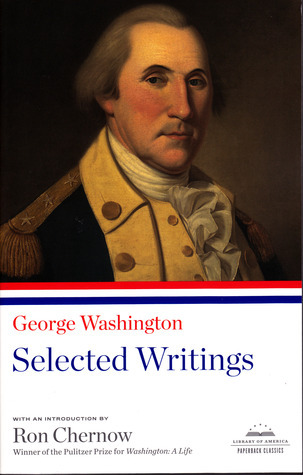
Simultaneously with the release of a paperback edition of his acclaimed biography "Washington: A Life" (Penguin), Ron Chernow presents a revealing portrait of Washington through his own words. A young officer leading an attack that triggered a global struggle for empire. Commander of the ill-equipped and undermanned Continental Army in the War of Independence. Presiding delegate to the Constitutional Convention. First President of the United States. George Washington, the indispensable founder of the American republic, was at the heart of events of worldwide importance. He was also, as revealed in this selection introduced by his Pulitzer Prize-winning biographer, a writer of remarkable clarity, energy, force, and eloquence. This career- spanning selection includes detailed notes, an essay on the selection of texts, and a chronology of Washington's life.
George Washington was an American military leader, statesman, and Founding Father who served as the first President of the United States. He is often referred to as the "Father of His Country" for the central role he played in the founding and early development of the nation. Born into a family of Virginia planters, Washington grew up on the family's estates and received limited formal education. As a young man, he became a land surveyor, which provided him valuable knowledge of the American frontier. He began his military career in the Virginia militia during the French and Indian War, gaining experience that would later serve him during the American Revolution. In 1775, with tensions between the American colonies and Great Britain reaching a breaking point, Washington was appointed Commander-in-Chief of the Continental Army by the Second Continental Congress. Leading a force that was often underfunded, poorly equipped, and inexperienced, Washington faced a series of challenges. Despite suffering early defeats, he demonstrated resilience and strategic skill, securing important victories at Trenton and Princeton. His leadership at the Siege of Yorktown led to the surrender of British forces and ultimately secured American independence. Following the Revolutionary War, Washington voluntarily resigned his commission and returned to private life at Mount Vernon, a move that reinforced the principle of civilian control of the military. However, the weaknesses of the Articles of Confederation soon became evident, and Washington returned to public service as the presiding officer at the Constitutional Convention of 1787. His steady leadership helped facilitate the drafting and ratification of the United States Constitution. Unanimously elected as the first President, Washington took office in 1789 and served two terms. During his presidency, he set many important precedents that would shape the role of the executive branch, including the creation of a Cabinet and the peaceful transfer of power. His leadership style emphasized unity and national identity at a time when political divisions threatened the stability of the new republic. Washington's foreign policy was characterized by neutrality, particularly during the conflicts arising from the French Revolution. He promoted peaceful relations with foreign powers, most notably through the Jay Treaty with Great Britain. Domestically, he dealt with challenges such as the Whiskey Rebellion, asserting the authority of the federal government to maintain order. Although a wealthy plantation owner who held enslaved people throughout his life, Washington's views on slavery evolved over time. In his will, he made arrangements to free the individuals he directly owned, setting a precedent among the Founding Fathers and reflecting his personal conflict over the institution. After completing two terms, Washington declined to seek a third, emphasizing the importance of term limits and setting a lasting example. In his Farewell Address, he warned against the dangers of political factions and entanglements in foreign affairs, advice that influenced American political thought for generations. George Washington's legacy endures in American culture, politics, and national identity. His name and image have been commemorated in countless ways, from the capital city of Washington, D.C., to monuments, currency, and public institutions. Admired for his leadership, character, and devotion to republican ideals, Washington remains one of the most respected figures in United States history.
Outstanding. Washington's greatest aspect was his ability to sustain his efforts despite so many setbacks and lack of support from his countrymen. He knew how to use his men. He could retreat and live to fight another day. He knew this was not about him....but about the birth of a new country. He was a most remarkable man.... I wish another like him would step up for our country now.