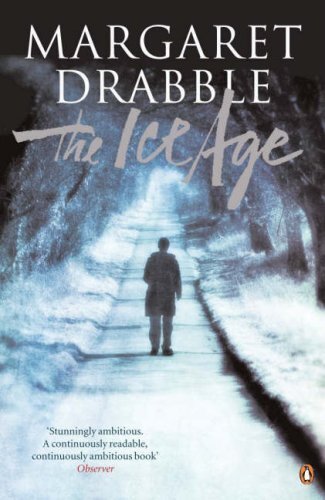
Anthony Keating is a middle-aged property developer in Yorkshire in the mid-seventies. Having escaped London's hustle-bustle and survived a heart attack aged just thirty eight, he awaits the return of his lover Alison, who is trying to help her daughter incarcerated in a draconian Eastern bloc country. With debts spiralling out of control, Anthony realises that he and his friends are bound to the engine driving the society in which they live and that should it falter, so will they. The Ice Age is a portrait of a Britain of boom and bust, and greed - and uncannily predicts the Thatcher years.
Dame Margaret Drabble was born in Sheffield in 1939 and was educated at Newnham College, Cambridge. She is the author of eighteen novels including A Summer Bird-Cage, The Millstone, The Peppered Moth, The Red Queen, The Sea Lady and most recently, the highly acclaimed The Pure Gold Baby. She has also written biographies, screenplays and was the editor of the Oxford Companion to English Literature. She was appointed CBE in 1980, and made DBE in the 2008 Honours list. She was also awarded the 2011 Golden PEN Award for a Lifetime's Distinguished Service to Literature. She is married to the biographer Michael Holroyd.
Drabble famously has a long-running feud with her novelist sister, A.S. Byatt. The pair seldom see each other, and each does not read the books of the other.
This was a somewhat strange book, well-written but unsatisfying.
I was looking in it for a picture of Britain in the late 70's, written contemporaneously, without knowledge of the changes that were to come with the disorder of the end of the Labour government, the radical anti-Union and monetary measures Thatcher's government brought in, relative peace in Northern Ireland, the period of engagement with Europe and the prosperity of the 1992-2007 period. What happened after 1977 to end state monopolies was mixed -- BT mostly successful, British rail success and then failure, privatised water, a disaster, and coal, a painful but necessary change, but badly handled and a disaster for the miners and the communities.
From the perspective of 1977, the way out of a dilapidated Britain was wholly unclear, and the novel reflects this bewilderment. Drabble focuses on real estate developers/destroyers, represented by Anthony, Giles and Len, and the Arts, represented by actors Allison and Mike and the poet/academic Linton. There are many minor characters who also reflect the loss of purpose and hope, corruption, dysfunction and ill health, both physical and mental. In fact, with the exception of the sex-happy Maureen, there isn't a single character who is successfully adapting to the present or the future.
I felt that this novel didn't quite work for me. First, although the picture of England and its citizens as fallen, directionless and hopeless is clear enough, it's too one-sided. Second, whilst I appreciate Drabble's project to use an ensemble of characters to give a broad picture of failure, there is too much dispersion to fully get into the meat of what has gone wrong, too many characters suffering failure, without enough depth to fully understand them. And she doesn't give them any vision, right or wrong of what they might do differently to remedy it, other than one character who wants to buy a watercress farm p.
It's interesting to me that the one character who is closest to the centre of the novel, Anthony, finds meaning and direction only in abstinence from meat and drink and absence from England when . Is this lack of a way forward, this negativism another aspect of life in 1977, or is it a deficiency in Drabble's vision?
Got it at the campus used book sale for 2 Euro. A novel about financial crisis of mid-1970es in Britain, all generation members feeling doomed and unstable, property business crashed, inflation is at 25% and one of the characters is incarcerated in a (fictional) communist country, which seems a fate better than actually staying in Britain and trying to figure out life.
After reading, Wikipedia informed me that Margaret Drabble is a sister of Antonia Bayatt, and they have a decades long feud over the family tea-set that Drabble described in her novel, when Bayatt wanted it for her own writing. And they haven't spoken for 20 years. This random piece of trivia somehow made the book even better.
This would have gotten five stars, and perhaps should have simply for the writing; however, there was a point when I wanted to simply hurl the book out a window, which tended to cause me to think I should, perhaps, award it merely four stars. The copy I have is a nice small hardbound, like new which is wonderful considering the book has been around since 1977. The novel is set in England and has a highly interesting cast of characters. It also describes what would appear to be very realistically the England of the times. It is clearly a very British novel and I almost felt compelled to have tea and crumpets while I was reading. (I did have tea. We are short on crumpets in the US.) Should you desire to read a very British flavored book, this works very nicely.
The 1970s were a difficult decade for the UK and provided much fertile ground for contemporary (and more recent) novelists. The Ice Age, published in 1977, foreshadows the Thatcherite reaction to that era of decline and unrest. Anthony Keating, BBC producer turned property developer takes stock of his life in a cottage in the Yorkshire Dales while family and friends work their way through various Seventies nightmares: IRA bombings, corrupt property deals, unrest behind the iron curtain and so on. Drabble is very good at conjuring up the feel of the period, and particularly the limited opportunities available to women in what was still a very male world. As other reviewers have observed, the first four fifths or so of the book are back story, with the plot only really coming to life in the final fifth. That wasn't a problem for me, as the recreation of the period was so well done and so fascinating in its detail that I was held throughout.
Never Mind the Bollocks, Here's Margaret Drabble! When this novel was first published in 1977 both literary and rock music critics couldn't help but notice the incredible similarity between Drabble's portrait of a broken-down, godforsaken, politically corrupt and morally inert Great Britain and the lyrics of the Sex Pistols ("There is no future in England's dreaming") and the Clash ("They're gonna have to introduce conscription/ they're gonna have to take away my prescription"). You can throw in The Kinks too: ("Out of work executives are killing themselves/ and the IRA is killing everybody else"). Yet, just like the punks's lyrics Drabble's novel is not dated. Hers is a picture of a civilization where time itself has come to a stop, much like the entropy that overwhelms wartime England in Pynchon's GRAVITY'S RAINBOW. Suggested film accompaniment to THE ICE AGE: SUNDAY, BLOODY SUNDAY by John Schlesinger from 1971. See, some terrible things never ever really change.
The Ice Age is about an economic meltdown in Great Britain in the early 1970s precipitated by a real-estate bubble and a banking crisis. Margaret Drabble explores the repercussions of this downturn for several related people and the amount of sympathy that the reader feels for each of them will vary widely. The central character is Anthony Keating, a BBC television producer turned real-estate developer who has pretty nearly lost everything as the book opens.
Drabble constructs The Ice Age in an odd way. Through much of the book various characters are introduced in such a way that we find them in the midst of their present circumstances, but then we are immediately plunged into an extended reverie with them that consists of recounting just how they found themselves in their present predicament. Occasionally, they also ponder how they should go forward, but you get the least about what is actually happening in the present.
The people in this book are all flawed and some of them are despicable, and other merely have despicable moments. You spend the most time with Keating and his girlfriend Alison Murray, but also meet Len Wincobank, Keating's mentor in real estate development, and his girlfriend Maureen Kirby. These four principal characters comment upon the other people in their lives, their ex-spouses, their children, business partners, and other random people that they encounter. Drabble also adds an omniscient voice that comments on events, something that feels old fashioned 40 years on. These days authors have the tendency to create some device along the lines of newspaper extracts or diary entries.
Drabble's writing style is completely unlike that of her sister A.S. Byatt's. Whereas Byatt is endlessly and delightfully allusive and referential, Drabble is more directly poetic, stringing together elegant sentences that manage to impart information and be beautiful at the same time. She is fascinated by the English class system and the way it blinkers individuals to possibilities in their lives. Keating, a clergyman's son, realizes in his early 30s that he had never considered going into business because it was considered a vulgar way to make money. Modern readers will be somewhat scandalized by Maureen's interior monologue regarding her experience being groped by her bosses; she claims not mind a bit of harmless fun.
So, the book is dated in some ways—and therefore historically interesting—and surprisingly relevant in others. The meltdown described very much resembles the 2008 debacle. The events in the book immediately precede Margaret Thatcher's rise to power and the greed-is-good social changes that accompanied it. Writing in 1977, Drabble is remarkably prescient about all that.
What an incredible read! This Dickensian 1977 novel is as 'awake' as anything being written today. True, its characters, a group of affuent, educated white people bear little resemblance to the "new" Britain of today, but their story actually serves as a 'prequel' of sorts as to why that is. Everything -- terrorism, economic calamity, divorce and marriage, love affairs, imprisonment, family life, urban/rural divide -- is covered herein in such an adroit fashion that the ride at times seems breathtaking, especially an ending so full of black humor that the reader could almost be excused for missing its redemptive quality. WARNING: four dogs were killed off in the narrative of this novel!
So, we are in Great Britain at the end of the 70s, the economy is no longer doing so well and as a character says at a certain point, suddenly it seems that every country is angry with Britain and she thinks that "it served it right". People have a bad opinion of themselves and of other people ("He no longer knew any good people"), and the future is full of uncertainties. It seems to me that in this book people do nothing to live better! Of course, sometimes circumstances don't help, but it seems like they do it on purpose to get into trouble or in any case to put themselves in risky situations from which nothing good can come out. Sometimes luckily it ends well, like for Maureen or Kitty who anyway have low expectations from life, other times it doesn't. I find the ending of Anthony's story rather grotesque: it's true that he himself had hoped for a life "in a cell where he could go quietly mad", a life without too much freedom and without too many decisions to make. But how annoying to see him there instead of in High Rook's house with Alison! However, a good book, there are many well-presented characters and the story intrigues enough to motivate you to go on.
Strangely, all I remembered from my first reading, maybe 40 years ago, was the opening incident of Kitty Friedmann losing her husband and her foot in the IRA bombing of a Mayfair restaurant. And I didn’t actually remember the husband, or that Kitty is a minor character. Now I find that the narrative voice, often commenting on the condition of England in the 1970s, really works. Anthony Keating and Alison Murray are the main characters, but readers gain insight into several others, usually physically separated but connected by circumstance. While most of the action is not set in London, and the narrator even comments parenthetically that “Most of the nation does not live in London, though this fact is not often mentioned by novelists and the national press,” the city is still central to the characters’ thoughts. Part 3 is as suspenseful as any thriller, coming after the problems seem to have been satisfactorily resolved. I like this one a lot. (Note: the edition I read is actually the 1977 hardcover US Knopf one, bought new at some point in the distant past.)
On the plus side, the characterisation was good, although none of the characters are particularly likeable, and some of the dialogue and interactions were engaging. But there is very little else to recommend this book. It’s basically a whining rant about the state of Britain before Thatcher. Interestingly, it has lots of similarities to post Brexit Britain: falling pound, strikes, public squalor and and fear for the future. Its plotless, meandering narrative switches between a set of charmless characters all trapped or imprisoned (a few literally imprisoned) by their current situations. We get insights into the minds of the main characters, but they lead to nothing except more inner musings. It’s all just a bit miserable. Forty pages from the end, the author decides it needed a plot and this is quite exciting. But it bears little relationships to the rest of the book, and it feels like an entirely different story. There is also a disturbing amount of undisguised homophobia, which seems to disseminate from the author through her characters. Happily, some things have improved since the 70s. Avoid.
I am trying to be scrupulously honest. By the time I finished The Ice Age, I would have dearly loved to award it one star. But I could not in good conscience do that, because one star means I actively disliked it, and I cannot say that about the entire book. It's only Part 3 (the final 50 pages out of 287) that I loathed. Margaret Drabble stuck an ending on a book that I liked a lot until that point, which was beyond inexplicable. It was a literary criminal act. It has nothing to do with happy or sad. Drabble dreamed up a set of events that were completely, utterly, disconnected from anything in the novel to that point. And then pushed it to such a bizarre conclusion that I do not consider it an exaggeration to say that she kidnapped her own book. To say I feel betrayed and cheated would be grossly inadequate.
I enjoyed reading this book, but it was a bit of a slog. The writing is solid and it's crafted well, but the pacing is really strange to me. There's a little forward motion, then tons of back story. Most of the motion must be in the back story, but it didn't feel like it moved very much at the time. Then, sudden action all at the end. I'm sure it's due to my personal taste in not caring as much for endless lines of detail mashed together, which I recognize is not everyone's taste, but that's where I come out. It's a solid work, but it was quite a slog for me.
Having lived in the UK in the 80’s and 90’s and before that in Germany during the 70’s, I remember distinctly the epithet’The Sick Man of Europe’. It feels like at some point during the 70’s and after the UK started to move away from socialism and to see it as a weaker way to govern and run it’s economy. Ms. Drabble’s book accurately describes the struggles it’s had over whether it wants to be more European or more American. In any case, that’s just some of the background and this book is a magnificent read.
Re-read. Still not one of my favourite Drabbles. However, reminds me that this is not the first time I have lived through the glass falling hour by hour (though I was young and foolish then and the 70s were not so bleak for me).
The Ice Age (1977) is referenced a few times by Dominic Sandbrook in both of his 1970s History of Britain books. He made it sound very enticing.
I went in hoping for a vivid evocation of 1970s Britain, a period which I love revisiting in literature, music, cinema and television. I was a child/teenager during the 1970s and enjoy looking back at the era through my adult eyes and comparing this with my own recollections.
So The Ice Age is apparently, in addition to being a portrait of the 1970s, the first of Drabble's Condition-of-England novels when her focus shifted from the small scale worlds of a protagonist's individual struggle to a broader canvas and was inspired by the terrible news coverage at the time.
It’s a fascinating portrait of some of the worst elements of the era, a really convincing and authentic look at England in the late 1970s, and also clearly anticipates Thatcher’s radical policies. It’s easy to see why Dominic Sandbrook repeatedly referenced it in his historical account as it seems to capture a moment of national stasis and despair. All the characters are stuck often both literally and metaphorically, and every one of these flawed characters is totally credible. I feel I have got to know Anthony, Alison, Jane, Molly, Tim, Len Wincobank, Maureen, Babs, and Giles Peters.
The ending is very unexpected and almost feels like it belongs in a different novel. I need to ponder it some more. Overall though Margaret Drabble brilliantly articulates the anguish of thwarted hopes, the disappointment and spiritual hangover of the late 1970s in Britain with a rare and deft mastery. Consistently readable and frequently surprising. What a book. What a writer
5/5
Anthony Keating is a middle-aged property developer in Yorkshire in the mid-seventies. Having escaped London's hustle-bustle and survived a heart attack aged just thirty eight, he awaits the return of his lover Alison, who is trying to help her daughter incarcerated in a draconian Eastern bloc country. With debts spiralling out of control, Anthony realises that he and his friends are bound to the engine driving the society in which they live and that should it falter, so will they. The Ice Age is a portrait of a Britain of boom and bust, and greed - and uncannily predicts the Thatcher years.
The Ice Age (De IJstijd) is een sleutelroman die de ervaringen van de voormalige televisieproducer, latere projectontwikkelaar Anthony Keating volgt terwijl hij de ups en downs van het leven in de jaren zestig en zeventig ervaart. Helaas kan (of wil) niemand mij de sleutel tot de roman overhandigen, zodat ik op mijn eigen lectuur moet terugvallen en zeker bij de aanvang doet het boek mij enorm denken aan het lied “Ik heb een zwaar leven” van Brigitte Kaandorp. Mens, wat kan jij zàgen, zeg! En dan heb ik het uiteraard over Drabble, want Kaandorp bedoelt het allemaal satirisch. Maar dat zagen laat Drabble dan over aan een mannelijke figuur, die Keating dus. Al kunnen de andere personages (veel te veel eigenlijk) er ook wat van! Ze moeten tenslotte de titel waarmaken.
Maar dan krijgen we plotseling een heel andere wending in het laatste deel. Plots zitten we in een roman van John Le Carré. Ze maakt er trouwens zelf af en toe een allusie op (p.247 en elders). En zo is het boek een illustratie van het terugkerende thema in haar werk, namelijk de correlatie tussen de hedendaagse Engelse maatschappij en de individuen die erin leven. Hoewel haar werken in beginsel niet autobiografisch zijn, zijn sommige karakters en de gebeurtenissen die ze tegenkomen wel geïnspireerd op het leven van Drabble zelf.
Recommended by several of Dominic Sandbrook's modern history of Great Britain books. This tells of how things were for the middle classes in 1970s Britain. When Britain was the sick man of Europe.
A straightforward, slightly blackly humourous account of a 38 year old man, Anthony. He changed a musical/BBC production career for property development. Just as the bottom dropped out of the market. He finds himself away from London, in a huge house in Yorkshire. His friends are either dead or in jail. He is estranged from his ex-wife and 4 kids (Babs has another on the way with her new partner). He is with his former mistress, whose Daughter is being help in a former Soviet Block county after killing a man accidentally with her car.
Three parts - with part 3 taking a rather unexpected turn but adding to the drama. Most of the book was quiet contemplation on art vs. money, relationships ( very dated and from a female writer, very non-feminist), London, parenthood and what brings happiness to a life.
The state of decline in Britain is often commented upon, hence Sandbrooks reputation.
An enjoyable read and a google of Drabble's top works shows this doesnt make the top 5.
Another 2020 re-read. First MD I ever read back in 2002. Its a state of the nation book published in 1977 and captures the seventies in Britain in wonderful detail through the experiences of a few interconnected characters, the uncertainty and financial decline. Never feels like the plot or characters are slaves to this intent. Interesting to read this again in these times. Made me think a lot about how in the 70s things have historically been painted as really bad, the strikes, the three day week etc. But as the general population back then mostly still had strong memories of WW2, the extreme post war austerity that went on for years and for the older generation even the 1930s depression, I'm sure people coped with it far better.
This was a grim read, but a very interesting one as well. Set in the UK's secondary banking crisis, it deals with the feelings of impotence and desolation caused by the sudden switch in the economic situation of characters who were doing well and seemingly out of nowhere find themselves grasping at straws. Drabble is one of my favorite authors and her writing in this novel remains as engaging as ever, shifting through points of views in order to paint a picture that's deeper than one realizes at first. In a 2020 context, the crisis each character goes through seems more relatable than one would like, but there is some hope in it for individual happiness in a collective downfall - but only for a selected few.
This book gives a grim portrait of Britain in the mid-1970's (before the North Sea oil boom, which has since been and almost gone). Whilst the main characterisations are good, the invention of some fictional place names and a fictional country seemed unnecessary. And in order to end the novel, Margaret Drabble steered the story into John Le Carré territory, referencing him in the process, it is if she couldn't find a way to conclude it that fitted in better with the main narrative. Overall the book is still worth reading though.
Against expectations, I enjoyed this. Despite being a late 1970s novel, it felt very contemporary, which is either a praise of Drabble or a condemnation on our current state of affairs. The narrative was highly readable and I liked the semi-omniscient narrator as we floated from character to character. It was much more enjoyable than The History Man or (god help us) High-Rise, so at least one book from my next module will excite me!
A state-of-the-nation novel set in England (and the Balkans) in the mid to late 70s, described in bleak terms that strangely resonate over 40 years later. It follows a large network of characters trying to navigate this chaotic world, circulating around Anthony Keating, a former BBC producer turned property developer. Dark and insightful.
You either love Drabble or you don't. For fans of A. S. Byatt (her sister), Iris Murdoch, Elizabeth Bowen, etc. this is wonderful. Early 1970s Britain, when it takes place and was published, and a cast of characters, rich prose, surprises; you feel you know these people. She is very smart, but the prose is far from bloodless. You miss the characters when you finish.
I read this book because Greil Marcus made intriguing reference to it in Ranters and Crowd Pleasers, his collection of writings in the post-punk era. I'm pleased to report that it's the sort of story whose ending is a dazzling deliverance of the book's themes. I loved it.
Mid 1970s Britain - very reminiscent of today in the gloom, pessimism and uncertainty about the future. Novel revolves around a group of individuals and their families, connected by property development in some way or another. Evocative, but rather depressing.
Extraordinary. Dated (gad, it's 50 years old almost, older than me), eccentric, gloomy and funny (is it a comedy of manners? a tragedy of manners?). I hope Britain after Brexit isn't as awful as the Britain of the mid-70s caught in Drabble's advancing glaciers.
Could someone please explain to me the ending of the novel? What is the meaning of the bird? What did Anthony conclude after reconsidering his past in prison?