Albertus Seba's curious creatures: a most unusual collection of natural specimens Albertus Seba's Cabinet of Natural Curiosities is one of the 18th century's greatest natural history achievements and remains one of the most prized natural history books of all time.Though it was common for men of his profession to collect natural specimens for research purposes, Amsterdambased pharmacist Albertus Seba (1665?1736) had a passion that led him far beyond the call of duty. His amazing, unprecedented collection of animals, plants and insects from all around the world gained international fame during his lifetime. In 1731, after decades of collecting, Seba commissioned illustrations of each and every specimen and arranged the publication of a four-volume catalog detailing his entire collection?from strange and exotic plants to snakes, frogs, crocodiles, shellfish, corals, insects, butterflies and more, as well as fantastic beasts, such as a hydra and a dragon. Seba's scenic illustrations, often mixing plants and animals in a single plate, were unusual even for the time. Many of the stranger and more peculiar creatures from Seba's collection, some of which are now extinct, were as curious to those in Seba's day as they are to us now. This reproduction is taken from a rare, hand-colored original. The introduction offers background information about the fascinating tradition of the cabinet of curiosities to which Seba's curiosities belonged.
This stunningly beautiful Taschen edition of Albertus Seba's Thesaurus is a browser's delight, and has the added bonus of being big enough to club a burglar to death with.
An East Frisian apothecary who set up shop in Amsterdam, Seba amassed a gigantic collection of ‘natural objects’ in the early eighteenth century, which became world famous. A lot of gentlemen had their little Kunstlerkammer, or cabinet of curiosities, in those days, but Seba's was truly vast, and went well beyond what he needed for his work. He had more than a thousand insects, drawers full of shells, and hundreds upon hundreds of jars of animals preserved in alcohol, and he was constantly adding to it – it's said he used to hang around the docks at Amsterdam, buying specimens from the sailors before they'd even disembarked.
Arrow-tailed flying squirrel
This was a time when the whole landscape of ‘science’ (not yet so-called) was changing dramatically, and when natural philosophers were moving away from interpretations based on the Bible, or Classical writers, and instead developing ideas of comparative anatomy and morphology; Linneaus was about to publish his Systema Naturae. What's cool about Seba's collection (which Linnaeus used as a major source) is that you can see how it still has one foot in each camp. The pages of shells, butterflies and insects are meticulously empirical, but he also has an eye for the purely unusual, making space for things like two-headed goats and conjoined twins; and the illustrations of other animals often prioritise ‘lifelike’ dramatic poses at the expense of what we'd now consider important anatomical details. He claims that all the illustrations are taken from his own collection, but there is some reason to doubt this when we come across pictures like the seven-headed hydra:
Such fantasias may be a bother for scrupulous biologists, but for the rest of us, the attention to aesthetic pleasure in the layouts can only be an advantage. I love that Taschen has put something like this out and treated it with such care and attention, even getting a team of scholars to go through it and assign modern taxonomic identification to the pictures where possible. It's a beautiful and awe-inspiring landmark from the history of science; just be careful not to drop it on any household pets, or you'll be on the way to starting a collection of lifeless specimens yourself.
A year ago I picked up a copy of The Codex Seraphinianus, and I can conclusively say that it's the most treasured book I own, possibly the most significant OBJECT that I own. This review isn't about that book, so I won't discuss it further, apart from mentioning that that book changed my life.
I have since been searching for something similar and I stumbled across this item. It's not similar, in fact it's nothing like The Codex. But it's a wonderful book. I have the gigantic heavy hardcover edition. This book was created in the 18th century, before encyclopedias and photography. In these ancient times apothecaries gathered every single animal, vegetable and mineral they could lay their hands on in an effort to discover the medicinal properties of all of God's creations. Seba, being a very wealthy man, seemed to collect & identify innumerable samples for his cabinet apparently for the joy of scientific knowledge. Then, to ensure his samples retain longevity and to capture & expand on the information relating to each piece, Seba commissioned his entire collection to be illustrated by various artists. This beautiful book is the final product.
Although it has no use today as a reference book, at the time it was the closest thing humanity had to an encyclopedia, and it serves as an interesting snapshot of those times. Each illustration is immaculately presented, and perusing the diagrams is such a joyful experience. There are numerous errors throughout the book, however these just add to the charm of the thing. We also see the hydra and various other cryptozoological beasts, as well as a range of "freak of nature" items, like fetuses and various deformed animals.
The text at the start goes over the story behind the book, and gives a brief explanation of each section. It also points out various illustrations of particular interest. But the main reason I purchased this book was as an art reference. Visual art is my chief leisure activity, and books such as this are very important to me for flicking through for inspiration. The curious creatures contained within and the level of detail in the figures makes this the perfect hefty tome for such purposes. This would also make an ideal coffee table book or conversation piece or whatever. And it's quite beautifully-bound, and the thing is a whopper, being much larger and thicker than a phone book. I've enjoyed leafing through it regularly since I got it, and I'm certain to continue gaining much delight and wonder from its pages for years to come. For anyone that's into this strange kind of thing, I'd definitely recommend it for your coffee table/bookshelf.
Another incredible book by Taschen. Albetus Seba meticulously drew thousands of animals, plant and sea life, much of which would have been exotic to Europeans. This book has hardly any discussion. It is thick with countless illustrations.
So many of the pathologies of contemporary life come in through the eyes. It’s only a matter of time before the vile sickness of “screen-gaze” gets a more scientific-sounding name. This gorgeous, almost wordless book is the cure.
Taschen has always published heavy, lush art books, but they've outdone themselves with Cabinet of Natural Curiosities (weighing in at thirteen pounds). Albertus Seba, a pharmacist in eighteenth-century Amsterdam, collected beautiful and strange animals, plants, and insects. After years of collecting, he commissioned illustrators for each specimen. This book is a reproduction of the eighteenth-century four-volume set. These amazing illustrations are works of art, but beware — small children might be frightened by some of the more fanciful renderings of dragons and beasts. Recommended by Carole R., Powell's Technical Books
One of those rare completely awesome and completely random finds at a really cool bookstore (Lucky Comics). This is a reproduction of Albertus Seba's specimen drawings. It weighs about 15 pounds and is written in French, English and German, just in case I'm feeling particularly trilingual on any given day. There are no words for how kickass the illustrations are. This will sit loud and proud on my coffee table for infinite perusing.
A great edition, in big format, to be enjoyed as the great recreation that it is. I'm really happy to have this in my shelves, and it made its own little altar in my small library, since the size of the book forced me to have it face up.
Ok no real reading involved. But this is my favorite coffee table book. Bought for me by my husband for a screaming deal at a San Diego library book sale. One could spend hours pouring over the colour plates of all creatures on earth. If you find a copy, don't hesitate to open it.
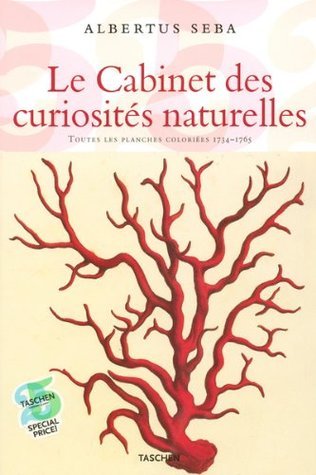
Based on the copy in the Koninklijke Bibliotheek, The Hague. With a precious red coral on the front. With three languages.
In the beginning and the end has information and history of the book. In the middle it has animals to leaves, seeds, plants, rocks, coral, shells, and fossils. Each page either has 1 -4 collections per page, sometimes one collection goes on two page spread. Sometimes I had a hard time finding the numbers on the 4 collection per page. Even though it's mostly Seba's collection there are some others mention and shown in the beginning.
An example of a page or in this case a 2 page spread. Pg 322. One scan of a two page spread with seven corals. Each of the scans has a frame around it. On the left it reads: 1-7 Corallium rubrum 1-7 Precious corals * Edelkorallen * Coraux rouges
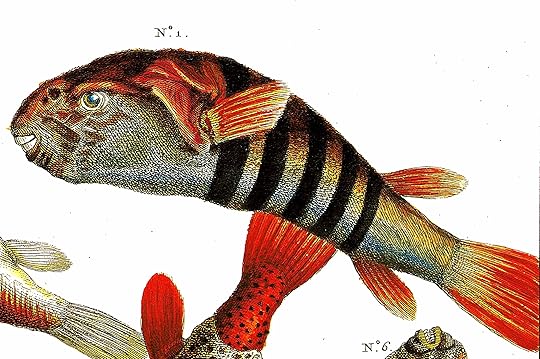
Some interesting ones I like: The ones on pg 77 that they call cheetah, but to me its build seems to be jaguar or more like a Mexican jaguar (Panthera onca hernardesii). On pg 131, there is picture of a skeleton of a chameleon. Pg 141, the hoax Hydra. Pg 150, poor babies (lamb, elephant, human). Pg 161, snake with two barbs on its neck? Pg 254-258,etc. I like how they made designs with the shells. Truthfully the insects always seem to be the most accurate in the older books.
This was quite fun! Taschen's high production values made this a bit of a treat to read - good reproductions of the colour plates (although I will admit I ended up using a magnifying glass to read the labels and capture a bit of detail). A fascinating and comprehensive glimpse into an 18C natural history collection and the mind, as well as the collection, of the 18C natural historian/apothecary/collector Albertus Seba. The range of the collection, and the provenance of the exhibits, is quite extraordinary. I'm intrigued, especially, by the odd mythical/fantasy/fictional beast which makes its appearance in the collection, and this leaves me wondering about the credit for the book. All credit goes (fairly? unfairly?) to the collector and author, none, really, to the illustrators. And I'm left wondering about the fantasy beasts: were these "exhibits" commissioned/described by Seba? I have to admit that I probably enjoyed the tri-lingual (with more than a smattering of Latin) edition as much as the subject matter. Bravo, Taschen: we like those! I might not, otherwise, have been reminded that Germans call a rattlesnake a Klapperschlange: and I sort of think everyone else should too!
Great reference book. That is if you don't mind some inaccuracies in the images and you treat it more as a source of inspiration rather than an encyclopaedia. On that note, it would've been useful if there were notes pointing out which images are erroneous. The life story of Albertus Seba and how he actually managed to make such a collection was so interesting that now I fantasise someone makes a movie out of it. A girl can dream!
What I would have loved is some additional information about the artists. Like who they were, what mediums and techniques they used, etc.
Un lavoro davvero spettacolare per l'epoca. La prefazione è stata molto interessante e ben scritta, ma sono le tavole naturalistiche contenute in questa opera a essere le protagoniste indiscusse. Da collezionisti.
I bought this as a gift for a friend and obviously had to looks through it first. What a beautiful collection of drawings, and I can only imagine how awe-inspiring it must have been in its time.
Completely amazing book. I have actually bought the xxl version for my personal real book library. I have an extensive digital library that is fiction and other assorted mind candy. My shelves are nonfiction. This is a treasure for along time to come. My version has theses great posters that fold out like map books, and they are stunning. The information is brilliant for the time they were produced. It shows the place where alchemy , science and art split into there own classes. The cabinet in their heyday were the height of knowledge and information. To see one you had to be invited in! So come in please come in...
Creative, Inventive, amazing Albertus Seba will have you thinking that every Dutch person coming out of the 18th century was brillian... Hands down one of the most amazing things I have in my library, life. Its spendy but if you have a library near you that has this or are fortunate enough to live near the strand i can say how quickly you should go and take a look at this.
i could go on and on but if you want to read what Taschen (one of the better companies out there who produced this book and did an amazing job with the paper/reproductions) say, I will place it below here.
"Albertus Seba's "Cabinet of Curiosities" is one of the 18th century's greatest natural history achievements and remains one of the most prized natural history books of all time.
Though it was common for men of his profession to collect natural specimens for research purposes, Amsterdam-based pharmacist Albertus Seba (1665-1736) had a passion that led him far beyond the call of duty. His amazing, unprecedented collection of animals, plants and insects from all around the world gained international fame during his lifetime. In 1731, after decades of collecting, Seba commissioned illustrations of each and every specimen and arranged the publication of a four-volume catalog detailing his entire collection-from strange and exotic plants to snakes, frogs, crocodiles, shellfish, corals, insects, butterflies and more, as well as fantastic beasts, such as a hydra and a dragon.
Seba's scenic illustrations, often mixing plants and animals in a single plate, were unusual even for the time. Many of the stranger and more peculiar creatures from Seba's collection, some of which are now extinct, were as curious to those in Seba's day as they are to us now.
Our superb, complete reproduction is taken from a rare, hand-colored original. The introduction offers background information about the fascinating tradition of the cabinet of curiosities to which Seba's curiosities belonged and an additional annex, written by contemporary biologists, provides descriptions of the specimens."
This book is nothing less than something at which one marvels. I happened across it in the oversized section of my library and every thing about it is huge: it's vision, it's scope, and it's actual size (which weighs in at 11.9 pounds).
Here's the product description off of Amazon: Albertus Seba's curious creatures: a most unusual collection of natural specimens Albertus Seba's Cabinet of Natural Curiosities is one of the 18th century's greatest natural history achievements and remains one of the most prized natural history books of all time.Though it was common for men of his profession to collect natural specimens for research purposes, Amsterdambased pharmacist Albertus Seba (1665?1736) had a passion that led him far beyond the call of duty. His amazing, unprecedented collection of animals, plants and insects from all around the world gained international fame during his lifetime. In 1731, after decades of collecting, Seba commissioned illustrations of each and every specimen and arranged the publication of a four-volume catalog detailing his entire collection?from strange and exotic plants to snakes, frogs, crocodiles, shellfish, corals, insects, butterflies and more, as well as fantastic beasts, such as a hydra and a dragon. Seba's scenic illustrations, often mixing plants and animals in a single plate, were unusual even for the time. Many of the stranger and more peculiar creatures from Seba's collection, some of which are now extinct, were as curious to those in Seba's day as they are to us now. This reproduction is taken from a rare, hand-colored original. The introduction offers background information about the fascinating tradition of the cabinet of curiosities to which Seba's curiosities belonged.
I work at Barnes & Noble, and was walking through the bargain section when I saw this book. I'm astonished that so many people have paid close to $200 for this! I paid around twenty, with my discount. It was only $25.00 originally. I think it may be a slightly different version, meant for B&N only, but the content is exactly the same. The only thing I've noticed to be different is the picture on the cover. There are two coral as opposed to one.
Anyway, I was drawn to it because the artwork is fantastic for tattoo ideas. There are some very curious creatures in the book, along with a fantastic biography and explanation of the plates. I'm glad to have added it to my library.
Beautiful Taschen edition of Albertus Seba's book of cataloguing the plants and animals of the world. Collected between 1734 and 1765 many of these plates stand as works of art. Seba apparently took some liberties and created some drawings of animals that may not have existed which was probably what intrigued me in the first place. A lot of these are beautiful and a lot of them very weird. Recommended for folks who like their art a little off the beaten path.
This is a great addition for a collector of hefty coffee table books or anybody fascinated by the Victorians' scientific proclivity to categorize, rank and classify just about everything in the natural world. The book boasts excellent illustrations, not to mention a stature large and heavy enough for braining home intruders. You can't lose.
Mooi boek. Het kleinere formaat ten opzichte van het 8kg wegende origineel maakt het wel minder indrukwekkend. Soms zijn er zoveel slangen en schelpen etc op een kleine pagina geplaatst dat er geen overzicht meer is. Het boek opent met een interessante en korte introductie waarin Seba zijn collectie wordt afgezet tegen de ontwikkelingen en geest van de tijd.
dying to own a copy of this coffeetable beauty, than an a bunch of audobon society guides - to birds, trees, shells, mammals, sea creatures on and on till there are none left. been putting them on xmas lists since i was six. somehow, no one else gets how great it would be to unwrap one. sigh.
Ok so I don't actually own this monsterous marvel....yet! (hint, hint) ...However I think I've pretty much looked at every page while passing through various shops and bookstores since I discovered it. So beautiful and inspiring, it should be free!