Jump to ratings and reviews
Rate this book

The U.S.A. Trilogy #2

1919 (Trilogía USA 2) (Contemporanea)

Rate this book
El estallido de la Primera Guerra Mundial y la participación de Estados Unidos cobran protagonismo en esta novela -segunda parte de la "Trilogía USA"- que conserva parte de los personajes que pululaban por "Paralelo 42", el mismo vigor narrativo y la voz histórica de Woodrow Wilson, Theodore Roosevelt o el Soldado Desconocido para contarnos cómo la avaricia de la sociedad estadounidense de los felices años 20 no se detiene ante nada.

576 pages, Mass Market Paperback

First published January 1, 1932

224 people are currently reading
5824 people want to read

About the author

John Dos Passos

214 books589 followers
John Dos Passos was a prominent American novelist, artist, and political thinker best known for his U.S.A. trilogy—The 42nd Parallel, 1919, and The Big Money—a groundbreaking work of modernist fiction that employed experimental narrative techniques to depict the complexities of early 20th-century American life. Born in Chicago in 1896, he was educated at Harvard and served as an ambulance driver during World War I, experiences that deeply influenced his early literary themes. His first novel, One Man’s Initiation: 1917, and the antiwar Three Soldiers drew on his wartime observations and marked him as a major voice among the Lost Generation.
Dos Passos’s 1925 novel Manhattan Transfer brought him widespread recognition and introduced stylistic innovations that would define his later work. His U.S.A. trilogy fused fiction, biography, newsreel-style reportage, and autobiographical “Camera Eye” sections to explore the impact of capitalism, war, and political disillusionment on the American psyche. Once aligned with leftist politics, Dos Passos grew increasingly disillusioned with Communism, especially after the murder of his friend José Robles during the Spanish Civil War—a turning point that led to a break with Ernest Hemingway and a sharp turn toward conservatism.
Throughout his career, Dos Passos remained politically engaged, writing essays, journalism, and historical studies while also campaigning for right-leaning figures like Barry Goldwater and Richard Nixon in the 1960s. He contributed to publications such as American Heritage, National Review, and The Freeman, and published over forty books including biographies and historical reflections. Despite political shifts, his commitment to liberty and skepticism of authoritarianism remained central themes.
Also a visual artist, Dos Passos created cover art and illustrations for many of his own books, exhibiting a style influenced by modernist European art. Though less acclaimed for his painting, he remained artistically active throughout his life. His multidisciplinary approach and innovations in narrative structure influenced numerous writers and filmmakers, from Jean-Paul Sartre to Norman Mailer and Adam Curtis.
Later recognized with the Antonio Feltrinelli Prize for literature in 1967, Dos Passos’s legacy endures through his literary innovations and sharp commentary on American identity. He died in 1970, leaving behind a vast and diverse body of work that continues to shape the landscape of American fiction.

Ratings & Reviews

What do you think?
Rate this book

Friends & Following

Create a free account to discover what your friends think of this book!

Community Reviews

5 stars
1,047 (31%)
4 stars
1,342 (40%)
3 stars
696 (21%)
2 stars
167 (5%)
1 star
40 (1%)
Displaying 1 - 30 of 270 reviews
Profile Image for Vit Babenco.
1,786 reviews5,800 followers
July 20, 2024
The war dictates its own rules… And these rules make a man so small…
…saw the German troops goose-stepping through Brussels, saw Poincaré visiting the long doomed galleries of Verdun between ranks of bitter half-mutinous soldiers in blue, saw the gangrened wounds, the cholera, the typhus, the little children with their bellies swollen with famine, the maggoty corpses of the Serbian retreat, drunk Allied officers chasing sick naked girls upstairs in the brothels in Saloniki, soldiers looting stores and churches, French and British sailors fighting with beer bottles in the bars…

Such is the fate of the fighters:
“Theirs not to make reply, Theirs not to reason why, Theirs but to do and die.” Alfred TennysonThe Charge of the Light Brigade.
The guys from Chicago said they’d been working in a munitions factory themselves but they were through, goddam it, and that if the working stiffs made a few easy dollars it meant that the war profiteers were making easy millions. They said the Russians had the right idea, make a revolution and shoot the goddam profiteers and that ud happen in this country if they didn’t watch out and a damn good thing too.

And war is a bliss for those who make money on the blood of the fighters: “…you couldn’t do anything without making other people miserable.”
As soon as one becomes happy, the others start feeding on one’s happiness and they keep doing it until one turns unhappy once again.
Profile Image for Luís.
2,375 reviews1,371 followers
August 14, 2025
The second part of the Dos Passos, USA trilogy begins with an approximation. 1919, such as its title, is not a question of it. The characters embody how Americans got involved in the Great War and incorporated them into the Red Cross, the merchant navy, the front, and the rear. The novel is marked by the narrative technique used in 42nd Parallel: fictionalized history, the method of collage of headlines, local chronicles, popular songs, biographies of figures in American history, and autobiographical flashes. Despite the gravity of the historical background, the work takes place on a piano rhythm, less hectic than the first, reflecting a country's incomplete fermentation. The novel is no longer American in that it no longer takes place mainly in the New World; it is the meeting of all these destinies with the Old Continent, its culture, and its art of living. Its primary interest lies in the personal confrontation of individuals with France, Italy, and especially Paris. Some will develop an unfailing love for our country. Some will get lost in it, and others will return, not quite the same, to a country that has changed—dominated by economic forces, trusts, and big business, where the 'We now hunt for pacifists, for reds that we call yellows. This opus is the story of what was called the Lost Generation. We inevitably think of Ernest Hemingway and Francis Scott Fitzgerald; it is also the sublimated experience of the author himself. So lost, we are also a bit lost in front of the proliferation of beings that it is difficult to follow from time to time and whose destinies intersect: this opus is the midpoint of a titanic, original work, which requires a reading diligent, at the risk of getting lost in all this novelistic corpus, of seeing his involvement, his interest, and his understanding weaken significantly—a demanding read.
Profile Image for Quo.
343 reviews
July 19, 2021
1919, #2 in the U.S.A. trilogy by John Dos Passos is a curious mix of literary devices, some of which were fairly experimental when the book first appeared but can now seem rather tiresome.


By the author's own admission, the novel is a collage of styles & approaches to capturing the 2nd decade of the 20th Century, including journal-like entries, quirky observations & listed "newsreels" that serve to introduce chapters. Beyond that, there are occasional lyrics & other passages in French (Dos Passos' first language) & German that go untranslated, a curious use of adjectives and irregular punctuation, some of which may offer a hint of E.E. Cummings, perhaps not surprising since they were close friends while students at Harvard, often traveled together after graduation and remained lifelong friends.

John Dos Passos began life as Jack Madison, his mother having been the mistress of a rich & very well-connected lawyer & financier of Madeiran-Portuguese descent but when his father's wife died, as did his mother's husband, he took refuge as a part of his father's family, while never feeling very close to & often fighting against his father's lifestyle and identifying with the underclass.


Unlike George Orwell for example. Dos Passos did so largely in an intellectual manner & at something of a distance from the poor & dispirited, perhaps owing to his family wealth and his elite education at Choate Academy & at Harvard but identified with the poor nonetheless, railing against what Dos Passos saw as social indifference during the Gilded Age. This shift in personal identity when young seems telling in the life of Dos Passos, someone who frequently viewed himself as an outsider.

Prior to enrolling at Harvard, Dos Passos traveled through Europe + to Greece & Turkey with a tutor, a sort of "gap year" that his father's family fortune allowed for. Beyond that, the author became a fairly accomplished artist after formal training and later served with other Harvard pacifists in an ambulance corps during WWI, enduring gas attacks & frequent bombings on the frontlines between France & Germany. He was also a lifelong traveler, spending time in Paris with the likes of Hemingway & others, visiting Soviet Russia & making a hazardous journey by camel across the desert from Damascus to Baghdad in the 1920s.


1919 intersperses stories about folks like Joe Williams who goes AWOL in Buenos Aires, signing on to a cargo ship bound for Liverpool via Trinidad, a pacifist named Dick Norton (much like the author) who toils as an ambulance driver during WWI and a socialite from Texas who flees to New York & eventually to administrative work with a Methodist group in France, serving the Allied cause. There is much "boozing and wenching", a lingering celebration of things much less possible back home, especially during the prohibition era and several characters who "opt for sin & beauty" while abroad.

There is also a brief mention of Joe Hill's plight as a union organizer for the International Workers of the World later in the book, something that caused his execution but brought him a perpetual martyr's status and an account of the insertion of the assembled remains of the Unknown Soldier as a way of bolstering patriotism in America following the war. Teddy Roosevelt's "bully pulpit" is detailed, as is Woodrow Wilson's struggle to gain a lasting peace through the League of Nations but one senses that Dos Passos has no real sympathy for either man.

All in all, the characters are not extraneous to the period Dos Passos attempts to encapsulate but they form no unified whole and 1919 is not a novel in any particular sense. It is easy to be taken aback by the racist & ethnic slurs mouthed by the characters in this novel, though most likely they were not uncommon during the period Dos Passos portrays in 1919 & the other 2 volumes of his trilogy.


What seems to drive this book and the U.S.A. trilogy by Dos Passos is a sense of blazing new literary ground with phrasing and cadence and a mix of literary formats. If one were to take the author's surname as a charactonym and translate it somewhat loosely from the Portuguese, one has the words "back" & "steps", which isn't half bad because this book takes us to a time & place when the novel did break new ground.

However, while there are 8,000 reviews at this site for A Farewell to Arms and half that many for Hemingway's For Whom the Bell Tolls, there are just 100 for 1919 by Dos Passos, novels that are roughly contemporary & written by authors who were long-time friends prior to an eventual falling out over the death of a close friend of Dos Passos at the hands of a Communist faction during the Spanish Civil War. It would appear that excepting a literary revival for Dos Passos, his time as a popular American author has very much come & gone.


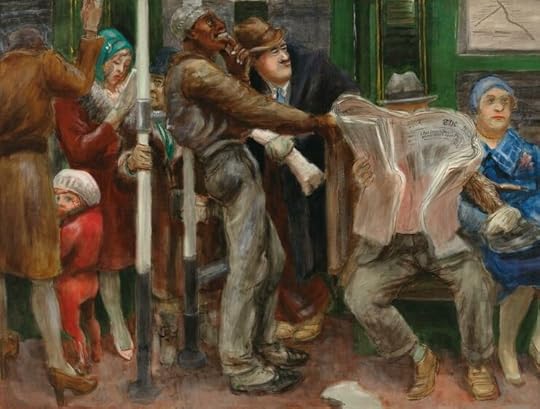
The library version of 1919 that I read included some wonderful sketches by Reginald Marsh, the painter who was a student of John Sloan of the "Ash Can School" & who, like John Dos Passos, identified with the underclass. That said, later in life, Dos Passos became increasingly conservative politically, embracing the likes of Barry Goldwater & Richard Nixon and writing for Wm.F. Buckley's arch-conservative journal.

A biography I read seems to indicate that John Dos Passos was forever changed by the execution of his close friend Jose Robles by fellow red army members as a part of Stalin's purges during the Spanish Civil War, at a time when Dos Passos & Hemingway ended up on opposite sides of a formerly shared struggle in Spain. This is a book with perhaps a somewhat limited appeal today but one I was glad to have spent time reading.

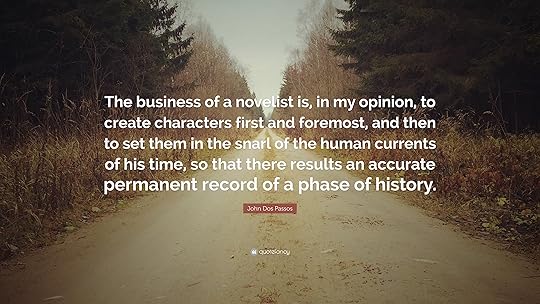
*Within my review are images of: the author, John Dos Passos; a self-portrait of the author reading; Dos Passos (at left) with Hemingway during Spanish Civil War; quote from the author; Reginald Marsh ("Ash Can School") painting.
Profile Image for Clif Hostetler.
1,281 reviews1,035 followers
July 16, 2021
This book is the second part of the USA trilogy, and the comments I made in my review of the first book, The 42nd Parallel, pretty much apply to this book as well. The author continues to use those four narrative modes which provide a wide sweep, but shallow depth, of early 20th century life.

The book may be shallow in its treatment of what's normally considered to be history. But the narrative goes into exhaustive detail with regard to the carnal thoughts and actions of the featured fictional characters. Inconvenient pregnancies continue to be a concern, and one in particular is solved by having the woman be in an airplane when its wing falls off. Only authors of novels have the ability to solve problems in such exotic ways. It's interesting to note that the man responsible for this pregnancy is the fictional character most similar to the author. The story reminds the reader that the people of the early 20th century had human frailties.

The book features multiple examples of the suppression of internal dissent during and immediately after WWI. Once again the book gives ample coverage to members of the Industrial Workers of the World (Wobblies). Most of these individuals considered the Russian Revolution and the overthrow of the Czar as the beginning of a new glorious chapter in world history. Some of them assumed the that spread of Communism was inevitable. One of these Wobblies is lynched near the end of this book. Which reminds the reader of a reoccurring ironic question. Why would a mob made up of working class people lynch a union organizer who advocates for better wages and working conditions for the working class?

This book concludes with an elegiac biography of the body selected to be the "unknown soldier."
Profile Image for Theo Logos.
1,274 reviews288 followers
April 5, 2023
”If they thought the war was lousy, wait till they see the peace!“

The middle section of Dos Passos’s epic USA trilogy, 1919, ironically is mainly staged outside of America. It opens with America at war in Europe, and most of the book’s action happens overseas.

Focus is shifted to a new set of Everyman protagonists, though they often closely interact with those already introduced in The 42nd Parallel. The impact of the Great War and the convoluted peace process that followed it are the major themes. Despite this focus on the war, it’s not really a war novel. Dos Passos’s focus is on non-combatants — Red Cross workers, Ambulance Corp, merchant marine, and back line officers. Ironically, the place where he mostly shows vicious violence is back in the USA where government and business allied to murderously exterminate the Wobblies and hopes and rights of labor.

1919 isn’t a stand alone work, of course. It’s the continuation of Dos Passos’s epic collage-novel. As in The 42nd Parallel, the narrative is constantly broken up with Newsreels, with the author’s stream of consciousness Camera’s Eye, and with the mini bios of prominent figures. (Jack Reed, Theodore Roosevelt, Woodrow Wilson, J.P. Morgan, and Joe Hill are covered here, as is The Unknown Soldier.) Once again, audiobook is the ideal medium to fully appreciate this experimental style.
Profile Image for Michael Finocchiaro.
Author 3 books6,270 followers
March 31, 2021
The middle volume of USA takes us into the European theater of WWI with many of the characters from 42nd Parallel and some new ones. The cynicism of the ambulance drivers and the corridors of the peace discussions reminded me of the way that Heller and Pynchon described WWII in Europe. The echos of anti-Semitism sadly presage the catastrophies that will arrive later in the 20s and 30s as the Nazis rise to power. It is interesting to note that Dos Passos was himself and ambulance driver during this period of the war, and that The Camera Eye sections are usually his own autobiographical memoirs.
I am a bit mystified as to why this book did not win the 1932 Pulitzer given the relatively obscurity of winner Stribling's The Store.
Profile Image for J TC.
235 reviews26 followers
June 10, 2025
John Dos Passos 1919

1919 com os outros dois volumes, “Paralelo 42” e “Capital”, constitui uma obra sequencial sob a forma de trilogia onde John dos Passos nos retrata a história de uma América desde os primórdios do século XX até à grande depressão dos anos 20.
Em 1919, John dos Passos retrata-nos essa América num período situado desde a entrada para a IGM e o seu fim. Este período foi marcado por contradições internas motivadas por uma entrada quase sempre descrita como servindo interesses do capital e a recusa da mesma, influenciada em muito por movimentos marxistas na EUA e na intelectualidade europeia , na internacional socialista e no movimento dos sovietes. Um confronto que se fez sentir nos EUA até à entrada na guerra, se agravou em 06 de abril de 1917 com a entrada desta e se manteve até ao armistício em 11 de novembro de 1918 às 11 horas. Foi um período difícil em que as liberdades individuais e coléticas estavam cerceadas por um esforço de guerra, mas também por algum oportunismo do mundo do capital que aí viu uma oportunidade para limitar, quando não, abolir, os direitos dos trabalhadores.
Neste volume, 1919, John dos Passos conta-nos de que modo diferentes personagens e as suas vidas se interligavam com uma realidade sem qualquer linearidade. Neste exercício, John do Passos intercala figuras ficcionas com outras reais, numa mistura entre a ficção e a biografia histórica. Escrito como um “Almanaque”, o autor vai descrevendo os fios de uma teia, intercalando-a com notas biográfica como que a credibilizar toda uma narrativa complexa, aparentemente desconexa, cuja interligação e perspectiva de malha o autor só ao fim de bastantes páginas consegue descortinar.
Escrito com parágrafos ofegantes, intercala os capítulos com trechos que designa por 0lho-de-Câmara e que se desviam tanto da narrativa como das notas biográficas e que eventualmente podem ser interpretados como a valoração daquela mesma realidade por uma inteligência emocional que frequentemente nos escapa.
Neste segundo volume da trilogia John Dos Passos retrata-nos diferentes personagens e de que forma estas diferentes vidas se entrelaçam com uma realidade histórica fragmentada e sem linearidade. Ao longo do romance, cruzamo-nos com personagens como Ben Compton, um jovem idealista envolvido no movimento operário e nos Wobblies, cuja fé na luta de classes entra em conflito com a repressão do Estado; Eleanor Stoddard, uma decoradora ambiciosa, que representa as ilusões de mobilidade social da mulher na América moderna; Joe Williams, um marinheiro desiludido, que vagueia sem rumo num país onde o heroísmo de guerra cede lugar à alienação civil.
Outros personagens como “Daughter”, a “filha”, uma jovem sem nome próprio definido, cujas experiências refletem a vulnerabilidade feminina numa sociedade em transição. A “Filha” personifica alguém que tenta encontrar um espaço próprio entre a liberdade e a marginalização, alguém ineficaz neste mesmo exercio, numa trajetória que termina tragicamente, com uma morte silenciosa e anónima, após um aborto mal-sucedido. O autor serve-se desta personagem para expor a forma brutal e a hipocrisia social do abandono das mulheres diante da repressão moral e da falta de acesso à saúde e dignidade.
Outra personagem relevante na história é Richard Ellsworth Savage, um jovem piloto americano, cuja morte num acidente de avião durante a Primeira Guerra Mundial adquire uma dimensão simbólica. Savage morre ao lado de uma mulher com quem estava romanticamente envolvido, como se o impulso por liberdade pessoal e amorosa fosse tragicamente engolido pelo caos da guerra. A frieza com que Dos Passos narra o episódio — sem sentimentalismo, sem heroísmo — sublinha a impessoalidade com que vidas e afetos são esmagados pelo maquinismo bélico e social da modernidade.
São múltiplas a personagens narradas nesta história, uma história onde as suas vidas têm trajetórias que raramente se cruzam diretamente, mas constroem, em conjunto, um mosaico de perspetivas sobre uma mesma realidade histórica. É como se Dos Passos colocasse uma lente multifacetada sobre a sociedade americana, revelando as múltiplas formas de viver — e sofrer — os efeitos do poder, da guerra, do dinheiro e da ideologia. A verdade do mundo que nos apresenta não está numa só narrativa, mas na justaposição de todas elas.
Profile Image for Matthew Ted.
1,010 reviews1,042 followers
September 11, 2020
I'm not sure that the essences of each individual novel are worth anything, but rather, the "novel" as a whole, by that I mean, as a trilogy. My review of the trilogy is here.

description

description
Profile Image for Sean.
22 reviews33 followers
January 19, 2014
I'm not really interested in "reviewing" a classic novel but two things stand out for me: the closing chapter on the selection and internment of the Unknown Soldier, which sums up much of the cold anger of the entire book; and how relevant so much of the book remains to today, nearly 100 years later.

Glad I kept this on my list of "assigned college reading I skipped or skimmed but want to finish before I die."
Profile Image for Moshtagh hosein.
469 reviews34 followers
August 20, 2025
سیمای واقعی و مدرن جنگ و تاثیرش بر امت آمریکا.
Profile Image for carl  theaker.
937 reviews53 followers
September 23, 2014

This volume covers up to and through the WWI years. How most folks were gung ho, how the socialists types were against the war, and how oppressive the government can be against those who try to speak against the war.

What I wrote on the style for the Trilogy:

Must admit, don't think I ever heard of Dos Passos until I started reading this trilogy for the ML100, but glad I did. Easy reading format, historical context, and I do like history, about the interesting early part of the century in of course, the USA.

Each chapter is titled with a character's name and each evolves, through their own eyes, and when paths cross, through others. Most characters are carried onto the other books. Supposedly the books can be read on their own, but I think you would always wonder what you missed. For me the stories were compelling and I couldn't stop reading about them.

Between chapters DP sometimes has a couple pages about a famous person of the era. Some stood the test of history & we know them today, Edison, but some are more obscure and those to me were the more interesting ones.

Another item between chapters are bits of text from newsreels of the day. They give the setting of the times
and to me show how the news is totally unrelated to every day life.

Yet another item is the Camera Eye, which shows some activity that is going on with a person, but to me is out of context so doesn't add much to the story.
Profile Image for Cody.
994 reviews304 followers
November 1, 2023
It’s basically, sorta, like this:

“She makes me so unsure of myself
Standing there but never ever talking sense
Just a visitor you see
So much wanting to be seen
She'd open up the doors and vaguely carry us away

It's the customary thing to say or do
To a disappointed proud man in his grief
And on Fridays she'd be there
But on Mondays not at all
Just casually appearing from the clock across the hall

You're a ghost la-la-la-la-la-la-la-la-la
You're a ghost la-la-la-la-la-la-la-la
I'm the church and I've come
To claim you with my iron drum
La-la-la-la-la-la-la-la-la-la

The Continent's just fallen in disgrace
William William William Rogers put it in its place
Blood and tears from old Japan
Caravans and lots of jam and maids of honor
Singing crying singing tediously

You're a ghost la-la-la-la-la-la-la-la-la
Yes, you're a ghost la-la-la-la-la-la-la-la-la
I'm the bishop and I've come
To claim you with my iron drum
La-la-la-la-la-la-la-la-la

Efficiency efficiency they say
Get to know the date and tell the time of day
As the crowds begin complaining
How the Beaujolais is raining
Down on darkened meetings on the Champs Elysées

You're a ghost la-la-la-la-la-la-la-la-la
And I'm the church and I've come
To claim you with my iron drum
La-la-la-la-la-la-la-la-la

You're a ghost la-la-la-la-la-la-la-la-la
I'm the church and I've come
To claim you with my iron drum
La-la-la-la-la-la-la-la-la”
Profile Image for Derek.
1,843 reviews141 followers
June 15, 2024
The second volume of the USA has all of the merits of the first volume in the trilogy. But it’s interesting to see more on America’s new role in Europe. It’s equally fascinating to see the impact of war, socialism, union protests, and the Russian Revolution on the nation.
58 reviews2 followers
February 7, 2018
Perhaps I would have liked this book better if I hadn’t had to write an essay every 70 pages, but I still think I would have remained completely bored regardless. I respect what Passos was trying to do with his narrative style, but it fell flat for me because I was basically numbed by the complete lack of interest I had in this book to the point where I could not appreciate any of the finer qualities that make this work a “classic.” Despite all of its ~deeper meanings~, this novel remained for me 380 pages of absolutely nothing happening. I get that that was kind of the point, but maybe I didn’t need to put myself through a reading experience completely devoid of any sense of enjoyment to understand that. Additionally, while in the 42nd parallel I found that the camera eyes often felt very relevant to the main text and were one of the better parts of the overall reading experience, in this book, especially towards the end, they just became almost meaningless blocks of text. Some of them were mostly in French so maybe there was something I was missing in there, but even the decipherable bits just felt random. They certainly didn’t add anything to my understanding. Also, and maybe it’s just me, but I really don’t feel like I understand the America of 1919 more from reading about the various experiences random twenty-somethings have with prostitutes. Sure it’s a part of how they lived their lives, but does essentially the same scene have to be repeated over and over again? Repetition is fine, just not to the point it was taken to here. Well, I could rant more...but I’ll save my energy for my last (hopefully) essay about this exhausting book.
Profile Image for Elizabeth (Alaska).
1,572 reviews554 followers
April 22, 2023
Despite the title, all of this book takes place during WWI except the last two dozen or so pages which are post war. The construction of this novel is the same as its predecessor, The 42nd Parallel. These novels comprise a series, and should definitely be read in order.

Some of the characters are those from "42nd" and some are introduced in this one. I think the sections with the character headings could be likened to short stories. In some instances these "short stories" were inter-connected, that one character would have a cameo appearance or even a supporting role in another. I believe one of the characters was somewhat autobiographical.

I found Dos Passos leftist politics more prevalent here. Many times I thought he wrote with bitterness and cynicism. For me, this made for hard reading. For enjoyment, I'm hard put to give this more than 3-stars, but because there is more to this series than a relaxing read, I'm willing to find another star. I don't anticipate the next installment will be much easier, but I fully intend to complete the series soon.
Profile Image for Larry Bassett.
1,635 reviews345 followers
June 17, 2020
I hope this isn’t one of those trilogies where each book is a little worse than the one before it. Once again I have done the audible listening. And I did think that the second volume was a little less impressive than the first volume. Maybe that was because I had already gotten the point. I know the third volume and final volume of the trilogy is next in line.

I would have to say that this book is mostly about WW1. With a little bit of IWW thrown in. Most of the IWW was at the very end. But the most compelling story in this book was one of the fictional narratives about a romance between one of our main male characters and a somewhat fascinating woman from Texas. You kind of have to like her but he is a cad. But a cad who is like an awful lot of men in these books. He loves her and dumps her and she of course gets pregnant. Women in these books suffer dependably simply because they are women. They don’t always deserve it.
Profile Image for Mel.
135 reviews25 followers
March 29, 2012
I would have eagerly given this book four stars if the individual stories that comprise the framework weren't so damn repetitive. Passos' voice is unique, seductive, hilarious, stark and powerful. What interested me most was the motif of sexuality in the text. It rules and guides all of the main characters yet (brilliantly?) somehow manages to seem subtle.

I can't help but wonder if Foer gleaned some of his literary style and Cubist text formation from Passos.
Profile Image for Joy D.
3,137 reviews330 followers
November 25, 2024
Published in 1932, this is the second book in the USA Trilogy. The storyline follows a handful of recurring characters, mostly during the Great War, with the last sections related to the post-war period. It reads as a series of interconnected vignettes. Dos Passos weaves together multiple narratives featuring characters from different social backgrounds, including laborers, soldiers, politicians, and activists. We have an American sailor going AWOL to join the merchant marines, a pacifist who serves as ambulance driver, a union organizer for the Industrial Workers of the World (Wobblies), and a woman who ends up as a Red Cross worker in France. It also contains several minibiographies of notable people such as Theodore Roosevelt and Woodrow Wilson.

The author employs an experimental style (especially for the 1930s) that blends fictional narratives, biographical sketches, newsreel fragments, song lyrics, and fragments of speeches. Themes include class tensions, social injustice, suppression of dissent, political radicalism, and disillusionment. I would not call it a novel, exactly. It is more of a pastiche that captures a wide swath of history and the social and political landscape of early 20th-century America. Unfortunately, it has not aged well and contains many terms that will be offensive to modern readers (e.g., racial, ethnic, and misogynistic slurs). This trilogy is considered a classic. So far, I have not loved the first two books. They are a bit too fragmented for my taste, not to mention the terminology. I need to decide whether to proceed with the third book of the trilogy.
Profile Image for Mariann.
817 reviews139 followers
August 11, 2022
http://www.hyperebaaktiivne.ee/2022/0...

Aitäh, Koolibri, raamatu eest!

John Dos Passos "USA triloogia II: 1919" oli teine raamat, mis minuga Ameerikas ringi seikles. Sarja avaosa "USA triloogia I: 42. laiuskraad" (loe blogipostitust) andis aimu suurriigist sajandivahetusel ja mulle meeldis väga, et see enne reisi loetud sai. Järjega alustasin küll alles lennukis tagasiteel Eestisse.

20. sajandi algus, USA ja Euroopa. Joe, Dick, Eveline ja Anne on ameeriklased, kes erineval moel leiavad oma koha Esimeses maailmasõjas. Igaühel on oma roll, kes on eesliinil, kes tagalas, kes seilab merd kaubalaevastikus. Nende kodumaal kogub endiselt hoogu töölisliikumine, kuigi selle juhte karistatakse karmilt, samuti nagu patsifiste. Ben on ameeriklane, kes ei sõida üle Atlandi ookeani, vaid vaimustub revolutsioonijuttudest ning võtab aktiivselt meeleavaldustest osa.

"USA triloogia II: 1919" jätkab sealt, kus eelmine osa pooleli jäi - algab I maailmasõda. Eeldasin millegipärast, et rohkem on juttu sellest, kuidas see mõjutab elu Ameerikas, aga põhitegevus viis hoopis Euroopasse, Pariisi ja Rooma. Kui eelmises raamatus olid tegelased üle Ameerika laiali, siis siin on nad rohkem koos, lubades nende lugudel omavahel põimuda. Euroopasse jõuavad ka juba tuttavad Janey, Ward ja Eleanor, aga nende toimetusi näeb ainult teiste tegelaste pilgu läbi.

Üllatav oli ka see, et sõjategevusele endale teos ei keskendu. See on lihtsalt taustaks. Rindel käib peategelastest vaid üks ja temagi ei lähe sinna sõdima. Rohkem saab lugeda sellest, kuidas ameeriklased rahulepingu allkirjastamist ootavad, kõvasti pidu panevad, armuvalus piinlevad, satuvad sekeldustesse ja rabelevad neist välja. Mul ei tekkinud ühtki lemmikut, kellele ma väga kaasa oleks elanud, aga endiselt oli huvitav lugeda, kuidas erinevad tegelased läbi elu kulgesid. Veidi küll tekitas tülgastust, kui palju oli juttu igaühega voodisse heitmisest, suguhaigustest ja rasedate hülgamisest.

Stiililt on triloogia teine osa täpselt samasugune nagu esimene ehk vahelduvad eri tüüpi peatükid. Mulle küll tundus, et oli rohkem romaaniosa ja vähem pealkirjade, uudisekatkete ja lauluridade ning mõttejoru virrvarri, sekka parajalt ülevaateid tuntud inimeste elulugudest. Kui jutustavad peatükid jälgivad peategelasi Euroopas, siis kontrastiks on pilguheidud töölisliikumisele Ameerikas, kus pea iga punane aktivist trellide taha saadetakse. Toonilt on raamat eelmisest süngem - taustaks olev sõda, jõhkrad kokkupõrked töölisliikumise ja selle vastaste vahel ning mitu peategelast leiavad õudse lõpu.
Profile Image for Jordan Iordanis.
165 reviews8 followers
November 24, 2023
Πολύ καλό και το δεύτερο μέρος της τριλογίας USA, επικεντρωμένο στο μεγαλύτερο μέρος του σε ιστορίες που αφορούν τον Μεγάλο Πόλεμο, και φυσικά στους αγώνες της εργατικής τάξης. Πολλές ιστορίες προσώπων συνδέονται ή αποτελούν συνέχεια ιστοριών του πρώτου βιβλίου, και βλέπουμε έτσι την εξέλιξη διαφόρων χαρακτήρων, πράγμα που βρήκα πολύ ενδιαφέρον.
Βαθμολογία: 4/5
Profile Image for Gaëlle.
171 reviews
February 3, 2021
this book was a pain in my ass (I only cared for Daughter)
Profile Image for Burak Kuscu.
564 reviews125 followers
August 10, 2020
Bir o karakter bir bu karakter derken içimi şişiren kitap.

Okuma hızım Haziran'da çok iyiydi. Bu kitap halletti sağolsun. Tıkandım kaldım. Game of Thrones'un son sezonu gibi herkesin ışınlanmasına ise diyecek söz bulamıyorum. Tek bir sayfada bir karakter New York, Paris, Viyana gibi bir yolu kat edebiliyor. Ne bir paragraf, ne bir ayrım var. Tam o karakterin konumuna, hikayesine ayak uyduruyoruz ki hop! Başka bir karakteri doğumundan itibaren anlatmaya başlıyor. Bir 50-60 sayfa sonra geri ilk karaktere dön. Hatırlamaya çalış falan. Bu metod bir kitabın başlangıç bölümünde kullanılabilecek yenilikçi ve yaratıcı bir metod olabilir bunu kabul ediyorum ama sistemi bu şekilde kurunca kopuk kopuk bir hikaye kalıyor elimize işte.

Joyce benzeri anlatım tercih edilmiş olan "sine-göz" kısımlarını da maalesef beğenmedim. Bunda çevirinin de payı var mı bilemiyorum ama sadece "karışık kuruşuk iç ses cümleleri yazayım da sanat desinler" olmuş. Ben sizin yerinize okudum. Siz okumadan da geçebilirsiniz. Haber-film denilen kısımlar fena değil. Anlatılan dönemin gazete manşetlerinden bir potpori diyebilirim. Oraya da yazar şiir benzeri ilaveler yaparak James Joyce'a selam çakmış.

Bilmiyorum ya..

Amerika'lı olsam belki az da olsa bir şeylet ifade ederdi kitap benim için ama bu haliyle yerel bir eser olmaktan öteye geçemez bana göre.

Çeviriden kaynaklı çok büyük bir sorun daha var. Bazı özel yer adları türkçeye çevrilmiş. Çevrilmemesi gereken şeyler. Çok tuhaf olmul. Örneğin Rio de Jenario demiyor da, Jenario nehri diyor. Daha normal görünen diğer bir örnek ise Maddison Alanı. Allah'tan Yeni York diye bir şey okumadım. Bu kadar özel isim çevirmeye meraklı bir metin okuyunca bu durumun zıttı olmaz diye düşündüm evet. Onda da yanılmışım. Bu kez de "yol boyunca les miserables'ı okudu" gibi cümlelerle karşılaştım. Dip not yok. Sefiller yazmayacak kadar aslına sadık kalınmış bu noktada. Bu nasıl çeviri, nasıl tutarsızlık, nasıl editörlük anlamıyorum. Modern Klasikler serisinde hiç alışık olmadığım bir özensizlik bu.

Her şeyiyle üvey evlat bu seri. Son kitabını basmamaları isabet olmuş. En baştan toparlanması gerekiyor bu metinlerin. Yoksa oldukça başarısız. Ben şimdilik son kitabını okumayı düşünmüyorum. Karakterler zaten karıştı. Yani unuturum diye bir endişem yok. Bir ara belki okurum.

İyi gömdüm farkındayım ama 2020 itibariyle baakısı olmayan, sahaf eline düşmüş bu seriyi çok fazla merak eden olduğunu bildiğim için bu kadar keskin yazdım. Merak etmeyin, bulamadıysanız da fazla bir şey kaybetmiyorsunuz.
Profile Image for Dave Harmon.
709 reviews6 followers
March 10, 2023
DNF - ugh. the first one was ok. i was gonna go through the second and third because the trilogy is supposedly an important classic but i just really dont like it at all.

Profile Image for Illiterate.
2,782 reviews56 followers
August 15, 2022
More American lives. WW1 is a strangely bloodless interlude in the rise of corporations and organized labor.
Profile Image for Ben.
903 reviews59 followers
July 16, 2022
The only problem with 1919, the second installment in John Dos Passos's USA Trilogy is that I had already read The 42nd Parallel, so the literary structure and devices that had blown me away on first having encountered the singular literary style of Dos Passos no longer had the same effect. Stylistically 1919 is a continuation of its predecessor, with interweaving fictional narratives, stream of conscious autobiographical snippets, biographical snapshots of key figures of the day and newsreel sections that read like newspaper headlines and clippings or like the newsreels that would play before a film.

So too in terms of the narrative 1919 in many ways picks up where The 42nd Parallel left off, as we travel with many of the same characters from here to "over there", where the Great War is gaining steam. New characters are also introduced and they find themselves caught up in affairs much bigger than themselves. At home pacifists and other anti-war leftists are thrown in jail without just cause. The labor problem is pushed to the background by focusing on the war. The masses find themselves caught up in a bloody event that is promised to "end all wars" to "make the world safe for democracy."

Much as Gertrude Stein used repetition in Three Women or as Kurosawa would later employ it in Rashomon, Dos Passos makes use of repetition to show us events from the fly on the wall perspective of another character's life. In one fictional narrative the war is over by the end, talks of peace already under way. Then in the next fictional section the war is just getting started. Perhaps the most interesting thing through it all is that the war, or at least the front, is hardly of interest at all. We, as readers, know there is a war on. Americans are in Europe working in public relations, being of service driving ambulances or in the offices of the Red Cross, but combat and death are scarcely mentioned. We're concerned with the lives of the Americans over there, their love lives, their hopes and dreams, the tangled webs they weave while war rages in the background. The characters we follow are affected by the war to be sure, but are not so much its victims. One character, Daughter, loses a brother in aviation training before being sent overseas, but she picks up the pieces and moves on.

The war, like all wars, undoubtedly benefits some - namely bankers and weapons manufacturers - though other ordinary men and women see their stars rise, profiting in some ways from the misery of others. As the peace comes many find that the war was a dream, the peace for them a nightmare. Though for some of modest means, postwar Europe is a cushy place to be. The world made safe for democracy is a world that has opened up new markets for exploitation (which will presumably be the main focus of the third part of the USA Trilogy, The Big Money). And with the crumbling of European economies, the dollar is strong and one can live comfortably abroad.

While the fictional narratives are concerned with the inner lives and future plans of our cast of characters, the headlines and occasional chitter make us aware of the horrors of war, of the death, destruction and devastation which are all around. To the politicians, happy to have quelled the fear of revolution and to have softened their domestic labor problems, the war was a lifesaver. In the States, the agitators, like Eugene Debs, were rounded up and jailed indefinitely; and many a young man who might have been a labor problem at home was sent abroad to risk his life. Many died. Many more were injured. And when all was said and done, the men who sent them to their deaths had many fine things to say about liberty, freedom, service and of making the world safe for democracy. Families were destroyed, economies ruined, cities bombed. Boys died. Many boys died well before their time. And they were acknowledged with flowery speeches and memorials. And "Woodrow Wilson brought a bouquet of poppies."
Profile Image for Samuel Moss.
Author 7 books72 followers
June 7, 2020
Today, John Dos Passos is the sort of writer that you get second hand. He influenced a whole generation of (mostly American) writers who name checked him in essays and interviews. He has fallen out of fashion and is rarely discussed today in the common literary circuits. He worked in the age of ‘modernism’, but in contrast to the ‘high’ modernism of Woolf or Joyce, Dos Passos might be called (and not inaccurately) a ‘low modernist’. ‘1919’ at least is filled with the sort of enfilade of common voices and street level information that would not become terribly popular or common until much later books like ‘J R’, ‘Gravity’s Rainbow’ or ‘Life: A User’s Manual’. To say nothing of their methods or brilliance the philosophical viewpoint and references of a Stephen Dedalus or aristocratic party planning of Mrs. Dalloway could not be further from the day to day grime and toil of Dos Passos’s characters. We get little snippets of lives, lives which tend to the common, tedious, banal.

Dos Passos’s writing is unabashedly of its time. All too often (though with some notable exceptions, such as Eleanor or Daughter) women are reduced to the giggling or nagging love interests of the male leads. They exist solely for the pleasure of men, and when men are not using them they fade into the background. Races other than whites are always at the fringes, side characters made exotic in well known and tired ways. The only exception here is Benny Compton, the agitating socialist intellectual New York Jew, a lesser known but just as overt stereotype. Just short of overt racism Dos Passos may just be able to get a pass for ‘writing from the view of his time’ today. Needless to say, his views of race, and how they are conveyed have aged poorly.

The pace is quick, especially with characters like Joe, who hop from boat to boat, crossing the Atlantic without a thought, getting struck by a German mine or torpedo without so much as a thought. Weeks or months may pass without so much as a note. The stories come off somewhat like the nostalgic tales of old timers: the details forgotten, only the jist coming through. Life passes by and we are left with just the lingering sensation.

Amusingly, a piece of Teddy Roosevelt, encompassing his whole life, from his childhood to his death and only a few pages long, is dropped in between the portraits of the Rabble. The portrayal of T.R. straddles the line between hagiography and the work-a-day style of portraiture in which the rest of the characters are portrayed. The man of greatness is dropped in and, instead of being given a great dose of time, is mostly sketched out with a great deal of his section spent on his somewhat sad and faltering end. Teddy’s section over we drop back into the lives of the other.

The narrative vignettes are broken up by ‘Newsreels’ and ‘The Camera’s Eye’: brief, cut up pieces which flicker before us, setting the tone and laying out the cultural set pieces in which these character’s lives take place. In ‘1919’ the dominant theme is the war, and it is seen in all its jingoistic glory, with the zeal for protection quickly making way for paranoia, fear and self-destruction. We see pacifists fearing for their freedom, officers on shore leave strutting around in their uniforms. Regardless, as war has always been for Americans, except for those characters who seek it out (whether in the Merchant Marine or driving an army ambulance) the fighting is almost entirely an abstraction. Buying war bonds and dealing with shortages. Reading the papers anxiously and waiting for boys to come home. As the novel comes to a close the focus shifts away from the war and toward the labor struggle, the unions and their violent repression.

Perhaps unusual for the time the novel discusses, in not totally veiled terms, the homoerotic. There are the not unexpected gay panics as John is approached by a cruisey American at a Caribbean resort who offers Joe fifty dollars to ‘do the handsome thing’. Burly, pugnacious Joe of course runs off in disgust and horror at this thin, drunk man. But then there is Dick Savage who frankly describes his crush on the captain of his baseball team as a youth, his days spent together with ‘dreamy’ foppish Blake and their wanderings around Cambridge which, on a drunken election night, sees Blake disappear with drunken sailor and friend. Dick frets all night, ostensibly worried that Blake has been rolled by the toughs, but he feels some kind of deeper sadness and longing. Blake comes home the next morning beaming and mentions in an oblique way that they had visited the Turkish baths, ‘a most curious place’.

To an American these stories seem all too familiar, even through the lens of time, though feasibly to a non-American these stories might hold a Mythical weight like that of Scheherazade, building up the US as can only be seen by an American. The day to day banality of each character’s detracts nothing of course, and that is how Dos Passos wrote them. Dos Passos cannot be charged entirely with writing domestic realism. There is something else, a grander vision, at work. Story arcs are there, but they seem secondary at times, even invisible. But there is something else present which grips the reader. Very much like a choral work it is not the individual at the fore, but how all the individuals come together to form a whole. We are never waiting for two of the disparate characters to meet, for their storylines to intersect, for the plot to resolve into something more ‘coherent’. No, the characters very well may never meet, their storylines will likely never touch, any more than the notes of the bass and the contralto will suddenly converge. That is not the point. Rather it is the resonances, the tension and the harmonies of the lives as seen from a distance that take the fore. The fluctuating poverty of Joe, who never feels terribly poor, against the wealth of Eveline who, traveling Europe on a Petit Tour is surprised to find herself being lumped in with ‘the rich girls’. The struggles of one character pale in comparison to the struggles of another, their disparate joys, concerns and relationships. To show the daily lives of Americans, and the beauty that can occur not just on the level of the individual, but in the great strange machine that is this country.
Displaying 1 - 30 of 270 reviews

Can't find what you're looking for?

Get help and learn more about the design.