Fans of the Netflix series Stranger Things who might be unaware of how freely the creators sampled '80s pop culture--right down to the title font--need look no further than three novels by Stephen King: one I've read (Firestarter), one I'm reading this month (It) and one I'll review now. Published in 1983--the same year that Stranger Things takes place--Christine is an often haunting and at times bittersweet tale about growing up; specifically, that time when adulthood threatens to detour cherished friendships and careen others off Dead Man's Curve. Coincidentally, this tale includes an antique car possessed by evil.
Unfolding through the fall of 1978 and into a bitter New Year in the fictional town of Libertyville, Pennsylvania, Christine is divided into three parts, the first and third narrated by Dennis Guilder, a twenty-two year old reflecting on his tragic senior year of high school. Captain of the football and baseball teams and All-Conference swimmer, Dennis is best friend to Arnie Cunningham, a childhood friend whose road detours into oily skin, chess and derision by many of their peers. The meek only child of two academics at Horlicks University, Arnie takes a bold but troubling step toward adulthood while cruising with Dennis in his '75 Plymouth Duster.
Arnie falls in love at first sight with a 1958 Plymouth Fury he spots rusting in a yard. Dennis sees only a lemon, but is unable to convince his friend to walk away from it. With a nest egg built from his summer job with the Penn-DOT on a road crew, Arnie leaves a cash deposit with the car's owner, a nefarious coot with a bad back, lewd disposition and forked tongue named Roland D. LeBay; the old timer refers to the junker as "Christine." Believing his friend is being suckered, Dennis is taken aback by how enamored Arnie--a gifted machinist who has never owned his own wheels--is of the red and white street rod, which Arnie begins calling Christine. Dennis is certain that Arnie's parents, particularly his controlling mother, will scotch the deal.
That's it, I thought, now feeling a little sad as well as upset. They'll beat him down and LeBay will have his twenty-five dollars and that '58 Plymouth will sit there for another thousand years or so. They had done similar things to him before. Because he was a loser. Even his parents knew it. He was intelligent, and when you got past the shy and wary exterior, he was humorous and thoughtful and ... sweet, I guess, is the word I'm fumbling around for.
Sweet, but a loser.
His folks knew it as well as the machine-shop white-soxers who yelled at him in the halls and thumb-rubbed his glasses.
They knew he was a loser and they would beat him down.
That's what I thought. But that time I was wrong.
After witnessing Arnie fire the first shot in a rebellion against his parents, Dennis grows wary of Christine. Returning with Arnie to purchase the rustbucket from LeBay, Dennis climbs behind the wheel and receives a flash of the decaying car restored to new, and speaking to him. (Let's go for a ride, big guy, Christine seemed to whisper in the hot summer silence of LeBay's garage. Let's cruise.) He suddenly finds himself not wanting to walk in front of the car. Watching Arnie drive away in it, Dennis witnesses LeBay break down in tears. Holding firm that the old bastard has ripped his friend off, Dennis is told that he doesn't know half as much as he thinks he does.
With the sun going down, Arnie and Dennis are able to reach Darnell's Do-It-Yourself Garage, where cigar chomping interstate trafficker Will Darnell has cornered the town's automotive needs. He takes advantage of Arnie, overcharging him for the stall and the tools the teen will need to restore his wheels. One of Arnie's classmates, a menacing hulk named Buddy Repperton, works at the garage and starts to harass Arnie, but when Repperton smashes one of Christine's headlights, Arnie fights back and bloodies him. Darnell fires Repperton and realizing he might be able to use a kid like Arnie, offers him a job making deliveries. Dennis warns his friend not to fall into debt with Darnell, but Arnie becomes hostile to any attempts to separate him from Christine.
Dennis begins having bad dreams about Christine. Learning that Roland LeBay has passed away, Dennis accompanies Arnie to the funeral. He introduces himself to LeBay's estranged brother, George, and managing a word in private behind his friend's back, Dennis shares his apprehension over the '58 Plymouth Fury. George later reveals some troubling family history: LeBay's fury was legendary. He entered the Army at a bad time--the 1920s--working in the motor pool where he raged against the "shitters" he felt had it in for him. In 1958, LeBay bought Christine and became obsessed with the car, keeping it even after his six-year-old daughter choked to death in the backseat and his wife committed suicide in it. He believes that Arnie would be better off getting rid of the car.
And as if he had read my thoughts of a few minutes before, he went on: "I don't believe in curses, you know. Not in ghosts or anything precisely supernatural. But I do believe that emotions and events have a certain ... lingering resonance. It may be that emotions can even communicate themselves in certain circumstances. If the circumstances are peculiar enough ... the way a carton of milk will take the flavor of certain strongly spiced foods if it's left open in the refrigerator. Or perhaps that's only a ridiculous fantasy on my part. Possibly it's just that I would feel better knowing the car my niece choked in and my sister-in-law killed herself in had been pressed down into a cube of meaningless metal. Perhaps all I feel is a sense of outraged propriety."
Dennis observes dramatic changes in Arnie. His friend's skin clears up. While none of the girls who've known him as a pizzaface will take a second look at Arnie, a graceful transferring senior named Leigh Cabot is an exception; Dennis watches as the Viking queen he would've gotten around to asking out begins dating his friend instead. At lunch, Dennis comes upon Buddy Repperton circling Arnie with a switchblade while the bully's lackeys Don Vandenberg and Moochie Welch cheer him on. The two-on-three melee is broken up by the shop teacher. Certain that Repperton meant to cut Arnie, Dennis rats him out for the switchblade, resulting in Repperton's expulsion. He vows revenge.
Arnie's transformation has an eerie parallel to the resurrection of Christine. Darnell marvels at how expertly Arnie was able to get his car road-ready without putting in the labor. Introduced by Arnie at a football game, Dennis notices that Leigh is no more comfortable around Christine than he is. Arnie's rebellion against his mother over the car intensifies and his father seems to reach a truce, paying for Arnie to park Christine at an airport garage instead of the house. Repperton finds out where Arnie is garaging his wheels and with the help of Don and Moochie, trashes it. Soon after, the boys are hunted down by the Plymouth Fury, which its victims recognize too late has no driver, or the corpse of Roland LeBay at the wheel.
Leigh, who loves Arnie and would enthusiastically consent to sex if she didn't have to lose her virginity in Christine, is spooked by how precious her boyfriend is of his car. She's saved from choking to death in it only by the grace of a hitchhiker she urged Arnie pick up on their way home from McDonald's. Presenting him with an ultimatum, Arnie chooses Christine over Leigh. Laid up in the hospital with a broken leg, Dennis bonds with his best friend's girl over the disturbing changes she's recognized in Arnie. They connect the tragedy of Roland LeBay and the deaths in their town Christine. They also become romantically entwined, wary that anyone Arnie is angry with has met a gruesome end on the road. When he does find out, the teenage lovers have only one recourse.
The first idea had been Leigh's--Molotov cocktails. We would, she said, fill some wine bottles with gasoline, take them to the Cunningham house in the early-morning hours, light the wicks ("Wicks? What wicks?" I asked. "Kotex ought to do just fine," she answered promptly, causing me to wonder again about her high-cheekboned forebearers), and toss them in through Christine's windows.
The conceit of a 1958 Plymouth cruising the streets of America to the oldie but goodies of Chuck Berry or Richie Valens with a corpse at the wheel is laughable. It doesn't even seem like it'd be scary. King seems to have backed into his plot by wanting to write about teens, rock 'n' roll and cars, and realizing that cursed children or music had been done, reversed into the possessed car idea. What makes Christine a fantastic novel is a quality that King has sustained from his earliest work (Carrie, The Shining, The Dead Zone, Firestarter), which aren't about monsters chasing after characters but characters who realize they are the monster.
I notice more elements that keep drawing me back to King's work. There's the change of seasons, for one. Road conditions under freezing weather play a crucial role in this novel, as do Christmas shopping and New Year's Eve countdowns. There are the characters (often kids) who know that monsters are in the lurk, but unable to convince adults, are forced to confront the threat themselves by improvising a plan, and thus, learning something about themselves and growing up. There is the bittersweet taste of innocence being lost in some way that can never be recovered. I feel myself becoming emotionally attached to the characters and invested in their wages again doom.
As with some of King's doorstoppers (Christine is "only" 120,000 words), the novel took me over a week to finish, but it occurs to me that some of the most memorable road trips are the long ones, the journeys where the destination is earned and felt. I found the pleasure of delayed gratification wonderfully present in a longer novel, at least one with prose and dialogue as intimate as King's. Nothing definitively supernatural occurs until page 238 and rather than spook the reader right off the bat, King writes about childhood--using music, movies, sports, fast food and beverages--and slowly builds the tragic relationships of his characters, ultimately to the point of poignancy.
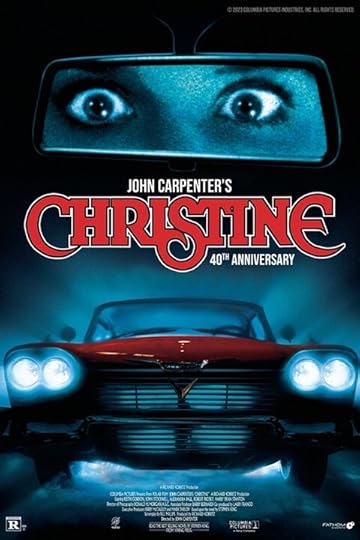
Christine was adapted to film during the Stephen King Land Rush of 1983-1990, when a dozen of his novels, novellas or short stories were dragged to the screen. Featuring Keith Gordon as Arnie, John Stockwell as Dennis, Alexandra Paul as Leigh, the movie was directed by John Carpenter, whose previous thrillers traffic in pulsating doom, but here, as a director for hire, goes through the motions of a killer car movie devoid of the teenage angst or desolate winter of the novel. Its riches are those surrounding the kids and the car, with performances by Robert Prosky, Harry Dean Stanton and Roberts Blossom and the music of George Thorogood and The Destroyers, the best rock 'n' roll ever featured in a Carpenter film.