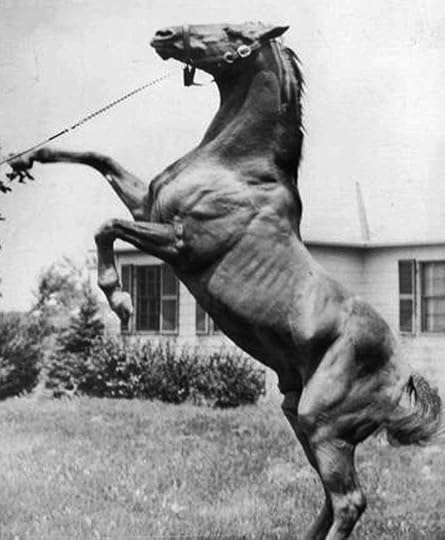
A Biography of the Greatest Racehorse in History Man O' War, or "Big Red" as he was affectionately called, was the greatest racehorse that ever lived. In 1919 and 1920, he won 20 of 21 starts and set eight records, including three world records, while conceding as much as 30 pounds to his rivals and still beating them by large margins. His time in the Belmont Stakes stood for an incredible 50 years. Man O' War's last contest, and greatest achievement, was a match race against Sir Barton, the first Triple Crown winner, where he vanquished the Canadian horse by seven lengths. He was sire to War Admiral, Crusader, and Battleship, and was grandsire to Seabiscuit, who perhaps most of all inherited the indomitable spirit and great heart of the champion. With his distinctive blazing white star on his forehead and deep red coat, Man O' War was a major star in the first half of the twentieth century, and his popularity is credited with reviving the scandal-ridden sport of horseracing. Bought for $5,000 by Pennsylvania horseman Samuel Riddle, Man O' War ended up winning more money than any American horse up to that time. He lost only once, in a controversial race, and was so good that his odds of losing races reached an astronomical 100-1, even though he was heavily handicapped with more weight than any of his challengers. Rather than jeopardize the health of his horse under such enormous weights, Riddle retired him at the age of three. Man O' War lived for 27 more years and sired 379 foals, 61 of which were stakes winners. He became a legend in his lifetime, retired to Kentucky, cared for by his groom, Will Harbut, and visited by millions. In Man O' War , the classic biography by Page Cooper and Roger L. Treat, Big Red emerges as an unforgettable animal full of personality, good looks, and blazing speed. It is a dramatic story, as in race after race, other stables try to beat the magnificent horse with the tremendous stride and determine just how fast he can really run. Page and Cooper present Man O' War vividly and authentically, as he was seen by those who trained and loved him, and whose hearts rode with him as he raced to victory.
Writers claim cold facts...state it in the first page even. Yet if you go and look at newspapers, daily racing form, bloodhorse of the time period youou start to see the perpetuated fantasy of Riddle himself...and quite a bit in Kummer, Feustal and even Loftis. Is it a nice feel good over view of Man o war...sure. Then you get to the history of the bloodline and the author puts "prefered...what ever that means"....uh greatest breeding scandal surrounding the mare Cinderella the preferred means which horse was better and accepted even though likely untrue and most likely blue rain was the truth. Lotta poetic license based on likely contemporary memories of the writers whom lived in the time of Man o War. Does it cast Riddle better then books since, sure...and somewhere between this and newer books is the likely truth. As for Man o War...if you are a die hard fan...eh...Walter Farleys fiction had more truth to it then this did...cold facts not standing up real well to close research and scrutiny...But nice to have a 60+ year old book in print for kindle.
I loved this book. I was about 9 and it was the first horse book I ever read. It's such a classic and goes into the biography of the racehorse. You are brought right to the racetrack and the author makes you feel like the wins on the racetrack are yours also. The horse was practically unbeatable. The author goes into detail about the horses temperament and how the people trained him. Man' O War was the greatest racehorse in history. If you have ever read Secretariat, then Man'O War is a must read!
I like this book. I've read it before. I think the best part may be the exploration of the sire and dam lines of Man O' War in the appendix. This book was published a couple years after MOW died. There is some great information in here and some fun stories. However, the lack of end notes and references makes me wonder if it is fully accurate. Still, a good read for any MOW fan. Lots of great pictures!
The writing style is very much of its time - very rah-rah as far as Man O’War is concerned. I think the information is very good, and the writing is good enough to keep me interested. There are a lot of assumptions as to names (both horses and people) that I should know, but as I am not into racing history I don’t.
Anything on Man O'War I will read and enjoy.....love the history of the the Sires and Dams behind him back to Godolphin Arabian. Thanks to my brother Fred Drachus for sending me this book.
I used to have a heavily damaged hardcover library edition from 1950 but wound up selling it. The cover was missing and someone before me had stolen some of the photos, but I wound up selling it for more than 40 times more than what I paid for it. As years went by, I was amazed that this book was never republished.
Fortunately, this first extensive biography of Big Red was finally republished in 2004 in the wake of the hit movie Seabiscuit (2003). This is much drier and scholarly in tone than Dorothy Ours’ biography, but it does contain many photos and information about Man o’ War’s first foal crops. It also gives a good look at thoroughbred racing in between the wars.
Very enjoyable. Included some pictures that I hadn't seen before - including one of Big Red being exercises at 22 still full of fire. The bit at the back going more indepth into his pedigree was interesting but I wish that the author had added modern color genetics comments to some of the statements (being surprised that a bay or brown can produce a chestnut and what does it mean that 'black has an affinity for chestnut' - not her exact words but similar.) I mean were both parents chestnut? And they produced a black horse? That would be unlikely - although I hesitate to say that anything is impossible.