Two hundred years earlier, a circus starship is stranded on the Planet Momus. Recently discovered by the rest of the galaxy, the population of Momus the remaining descendants of the original circus must deal with interstellar power politics and war, and they do so in their own special way.
I was still trembling when I wrote this review, just a few minutes after finished the book.
It is a collection of linked seven short stories. Some stories has humor and hilarious moments and, surprisingly some stories makes me emotional. Despite the good storytelling, this story has fresh idea: story of a world settled by the survivors of a crashed travelling circus starship.
I admit I had underestimated this book in general. I even underestimated the last story after I had enjoyed 6 earlier stories. I love the last story the most, it is a perfect conclusive story of this collection. I appreciate the last story so much because I had read the previous stories.
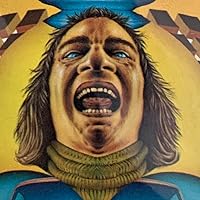
This is one of Longyear's three Circus World books, the first to appear though not the first chronologically. It's a fix-up novel of seven linked stories, all filled with puns and pathos and humor and everything else you could imagine under the Big Top. It's set two-hundred years after an interstellar circus has been stranded on the planet Momus, and shows how the traditions have carried the descendants and how their society has developed. I enjoyed the series immensely. Put on some calliope music and grab a hot dog and some peanuts! I have the hardback book club edition with a very nice Les Katz wrap-around cover painting.
I'm a big science fiction fan, but over the years, pretentious and arrogant, I've let my reading of it slip to the wayside as I held high my Musil and Dostoevsky and what-have-you. A little older now and a little jaded on "serious" (whatever) literature, I've dived back into the jell-o vat of pulp, unlicensed fun. I got "Circus World" on a blind-buy, deciding that if I was going to get back into off-kilter sci-fi, I better go balls-deep and snatch up whatever looked weird and unpromising, the golden age of mass-market dreck, the 70s and 80s, before everything got glossy, over-serialized, and stomach-turningly flat. "Circus World" is wonderful. A circus ship crashes on a back waterworld and, stranded from the rest of organized space, disperses itself across the planet, forming a fully-realized circus society stratified into barkers, newstellers, magicians, clowns, freaks, and so on. The novel is a series of fragments from a time when the planet, Momus, is getting caught up in stupid military, political struggles. Simply put: the circus planet must become a military colony...or else! The stories, linked overall but cozy little snippets of local life being affected by all this bullshit, cover several years of the upheaval. Strangely, there's no war. That's all backdrop. Instead you get dueling clowns, insane storytellers looking for material, and the denouement of a barely-seen guerilla war. And circuses. This is way better storytelling than much recent schlock. I recommend!
Check out my full, spoiler free, video review HERE. This fix up novel is about a circus troupe that crashed landed on a deserted planet long ago and set up a society. Great collection of stories that range from hilarious to deep and meaningful. Way more complex and deeper than I thought and I had to go back and read part to make sense of what was going on. Fantastic read and I’m on to the sequels now.
Cited as book #1 of the 'Circus World' series, this collection of stories occurs last in the timeline for this universe. Here we learn of how the O'Hare Circus descendents fare on the planet where their spaceship met its end, the cultures that developed, and how the communities deal with events as eyes of two competing quadrants turn their eyes to the strategically located but insignificant planet on which they thrive.
Ambassador Allenby, a central character, finds himself immersed in a culture completely foreign to him with nothing but a wreaked escape pod and the clothes on his back. He soon adapts to the local culture in order to simply survive and later to adapt his mission to a delivery acceptable by the locals; a caste or clan system based on the trades of their ancestor circus performers.
Longyear was an award winning writer and tested his stories (or chapters of the whole) in the Asimov periodicals of the 80's with great success. There are many tongue-in-cheek puns throughout that brought out a chuckle.
I was pleased to have stumbled onto a copy of this book although, it was not the one I recalled reading long ago. Rather, book #2, "City of Baraboo" was what my fragmented memory was attempting to recall. And indeed, this will be the next I read to refresh that old memory.
I've found nothing as to why the books are seemingly written out of order aside from the author's funny preface alluding to building out a novel from his first essay sale "Tryouts" which is also the first chapter you will discover in "Circus World" as well as the all to honest admission that dedications in the preface are "an inadequate but cheap way of paying off debts".
Highly recommend to those that enjoy the SciFi genre and have fond childhood memories of going to the circus.
This was great, I really loved this and it was really fun. Sometimes I feel sci-if books can be a bit bland or too much, but this was so different and felt colorful. I’m surprised this has never been picked up for some sort of adaptation because it is so imaginative. The world of Momus and its culture is immensely fascinating. The structure of the narrative being a sequence of short stories loosely strung together was really great too as I struggle to stay on a book to finish. So having a book where it was easier to pick up and put down definitely helped me get through this. Got through one book before the end of December so I’m already doing better than 2024. One more book and I’m finally to my goal for 2025 that I’m feeling I could surpass easily this year. I’ve ordered the other two books now and maybe they’ll be as good as this or at least as easy.
Grabbed this one on an impulse hoping it would get me out of a recent reading slump. It did.
The structure of the book is not unlike that of a circus itself, each chapter focusing on a different performer and building toward a culminating act. But for every high, so too is there a low. For every philosophical musing re a world comprised of all performers and no audience, a world that in many ways resembles the one-way mirror that is digital communication today, so too is there a character named Doctor Shart.
Two hundred years ago, a circus ship crash-landed on the planet Momus and was unable to escape. Its star-travelling circus had to forge a new life and build a new society for themselves. Now, galactic politics infringe on the Moman way of life: with the 10th Quadrant about to invade, the 9th Quadrant sends an ambassador, Lord Allenby, to the world to plead with them to allow them to send their own fleet to defend the world.
This book is similar to Longyear's Manifest Destiny in that it is composed of a collection of linked short stories that together tell a single story and it's just as good. I wasn't entirely impressed with the opening story, The Tryouts, as it felt a little meta-fictional, with the protagonist, a Newsteller, telling the background to Allenby's arrival on the planet to a group of travellers. The issue I had with this story was that the listeners kept interrupting and commenting on both the story and style of telling, offering critique and comment to the Newsteller that stopped me getting involved with the story he was telling. But as you read further, this, and the rest of the strange society that the Momans have built for themselves, is explained and I think that on a re-read, I'd find this much less of an issue.
The other story that didn't work for me was a short one called Dueling Clowns, which mostly revolved around trading puns and a punchline that I didn't get. But mostly I found myself caring for the society that the circus had build on Momus, the clowns and fortune tellers, the magicians and storytellers and acrobats, and wanted to see their world preserved against the external threats.
Longyear is a writer whose writing is warm and friendly and easily draws you into the story and makes you care about his characters and settings. He's definitely joined the list of authors for whom I'll pick up any of their work on byline alone.
Now this is what science fiction is supposed to be. Funny, clever, intelligent stories. They're all too rare these days!
Circus World is a collection of linked short stories in the classic SF style. They share the setting of City of Baraboo and Elephant Song, which were published after it but are set before. This is vintage Longyear, light, amusing, clever, and very enjoyable.
It's the story of a world settled by the survivors of a crashed traveling circus starship. As such, it's particularly recommended for science fiction fans and those who love circuses.
In general, Circus World is somewhat reminiscent of the Hoka stories by Poul Anderson and Gordon R. Dickson - the humor is nowhere near as broad, but the tone, theme, and styles are somewhat similar. If you like Circus World, you'll probably also like the Hoka books (which I'll review later).
The mystery and science fiction writer Fredric Brown also included old-time carny (carnival) themes in some of his stories in both genres (he worked as a carny for a while), so fans of Circus World are likely to enjoy his books as well.
A set of stories originally printed in Asimov's Science Fiction Magazine, gathered into one volume. A world has been colonized by a crash-landed traveling circus spaceship, and the planetary culture is based on circus customs. It is hysterically funny!!! Puns galore. Jokes. Belly rollers. Chucklers. Etc.
The premise is that there was an interstellar traveling circus that was stranded on an uninhabited planet 200 years ago as a result of a malfunctioning starship. The survivors built a simple society based on the circus entertainers' culture. There is no government or law - except that every town can have a public meeting for local issues, or to choose a representative for society-wide issues. There is little crime. Everyone pays anyone who does anything for them, even in cases in which we wouldn't expect it. There are still certain kinds of circus professions, although carried out on smaller scales.
The central thread is that there are different interstellar federations ("quadrants") and the 10th Quadrant is planning to take control of their planet. A broader interstellar system says Quadrants are only allowed to take control of a planet with the inhabitants' permission. The 9th Quadrant expresses willingness to protect the planet's right to self-determination. But the 9th can only do so with the permission of the planet's government, and this planet's only "government" is this system of town meetings that must agree to send representatives to a central meeting to discuss this...
The chapters / short stories that make up the book provide a portrait of the planet's society. Sometimes with minimal reference to the Quadrants or advanced tech. There are complications because having large numbers of the 9th's military on the planet might serious affect the local culture in ways the locals don't want.
In the end, the solution is the circus. If you don't take this as a punchline, you might not find it satisfying. Aside from that, you may find the book an interesting, different and (perhaps in ways) appealing circus society that is described in the various chapters / stories.
The concept and the world-building in this book is incredible. A post-technological human colony organised entirely around the early 20th century big-top circus. Like Pern but with clowns instead of dragons. There are carnival fortune tellers who practice a kind of parody of Asimovian psychohistory, or like the vibes-based Bene Gesserit. The plot is comically contrived space opera, our hero planet finds itself in the path of a proxy war between Space Federation A and Space Empire B, but it keeps the core counterculturalism, at the end when you get to the perspective of the mercenaries brought in to conquer the eponymous circus world there are definite Vietnam echoes. Unfortunately I think the book lacks a strong narrative through-line; at one point early in reading I reached a scene change that was so abrupt I thought, oh, am I starting a new short story? It's hard to latch on to anyone as a central protagonist and I found myself forgetting who certain characters were (even though I'm usually quite good at remembering character names). Overall though, you gotta go to circus world. If there's a circus world, you gotta go there.
This was a shockingly good read. It's only four stars; it's not an exceptionally good book, but by all rights it shoulda been awful and it was, truly, quite good. The thing that sci-fi can do, where it looks at reality sidewise and in so doing makes room to be a real thought experiment on how things COULD be different; it does that. There's a genuinely interesting exploration of how a consensus based government could work on a planet-wide scale. Also: well done on the timing. 200 years isn't that long. The crash landing on the planet is recent enough that it makes sense that the humans would still be using, and working out the changes neededto keep using, the organization system of the original circus. It makes sense that all these people still value their arts so highly. It makes sense that they are still all circus people. A few more generations and that might change, but for now we have this glorious art based economy and I love it.
I've been working on a Dungeons & Dragons adventure for some relatives that is set in a fantasy world based on circus acts, and in researching it I came across this book about a planet where a circus spaceship crash-landed and populated the planet. The book is a series of interlinked short stories of the kind that used to show up in the major magazines, back when there were major SF magazines. It turned out to largely be a political commentary-- that the hippies were actually better suited to run a govt. than the suits, if I understand the metaphor correctly. It only influenced my picture of the D&D world I'm building a little.
Like City of Baraboo (CoB) before it this is a collection of short stories of variable quality. The uniting theme is the story of Allenby, the ambassador sent from Earth who finds he has to become a circus performer of one sort or another to earn the trust of the circus world's people. I found the story lacked the nostalgic circus history that was a big part of the appeal of CoB. The stories tend to the humorous, pretty good for the most part but I felt Dueling Clowns was forced and unnatural and by far the weakest story of the lot. The final story sees the circus back on the star lanes but is also a bit forced, not a greta ending. Still worth reading for the other stories in the book.
It's a little dated, but the concept and idea puts on a show worthy of note! I went in blind, I've always liked the idea of The Circus in general so I was intrigued to see where it might be going when the whole Planet is one! This book if nothing else is subtly thought provoking, there are messages within messages and ironically instead of detracting from the book in this oversaturated messaging time, I found it to do the opposite! There are moments that really stand out! Almost like individual performances to make one whole! A challenging world to write I imagine but I liked it enough to read the sequel!
It's pretty good for an almost 40-year-old fixup novel.
It's also an interesting read for me personally. Longyear's book on writing was a book I read pretty early on in my writing life, and a lot of the stories that were used in this novel were also used as writing examples. Made for a lot of "Oh, so that's how that story went" (the rest of those tales show up in It Came from Schenectady, btw).
These are short stories set in the Baraboo universe. They probably won't make as much sense as a standalone, and I would encourage you to read City of Baraboo first, if you can find it. Just makes it easier to understand the whys of some of the behaviors.
Anyway, these shorts are chronological, which means you should read them from front to back. They're not uniformly great, but The Second Law is one of the best short stories out there.
Two hundred years earlier, a circus starship is stranded on the Planet Momus. Recently discovered by the rest of the galaxy, the population of Momus the remaining descendants of the original circus must deal with interstellar power politics and war, and they do so in their own special way.
Excellent, and even compares favourably to Vance’s Dying Earth, in my opinion. An intriguing but silly-seeming premise blossoms into a carefully built world at the centre of an appropriately minimized geopolitical squabble.
One of my favoirte genres is fantasy and I find a read like this delightful. To backtrack in time, the reader discovers that approximately two hundred years ago, a traveling circus ship crashes. Not unusual, I know, but this one was traveling from planet to planet in a world much different from our own. With their ship damaged beyond repair, the people are stranded on the planet Momus and must build a new life. But life dramatically changes when a stranger arrives.
With this stranger's appearance life on Momus begins to change. There is a war brewing that may soon involve the people of Momus. They are about the be invaded but another force seeks to prevent the invasion but interactions between this isolated society and that force may destroy much of what is good about their life. The stranger is slowing accepted by the population while his views seem absurd to those who wish to use the planet as a base. He is removed from his role and becomes the voice of the people of Momus. This is an engaging and funny tale that lightens the heart and mind. And, if you know little about circus life this story will help you know much more.
I purchased this used, on a whim, expecting little. This novel (actually more a collection of interrelated short stories) is, however, not without its charms. The idea of a planet populated by a shipwrecked circus might seem a weak and unlikely premise, but Longyear avoids most of the pitfalls which might otherwise have rendered the concept cringe-worthy. Not that the book is without its flaws. In particular, the episodic nature of its structure leaves some cohesion to be desired, and the focus on circus culture (which is quite well represented) tends to dominate over the science-fiction elements. However, at no point is the reader left entirely wanting, as a large-scale picture of intergalactic conflict is woven into the fabric of what, in lesser hands, would have been an ill-advised concept. This appears to have been one of Longyear's earlier works, and the first in a series. I must admit that I'm curious as to where he took the concept from here.
This is technically the earlier work in the series in regards to publishing history, its chapters all originally published in the 1970s, but chronologically it is actually the middle book of the Baraboo/Circus World series by the author.
Its the tale of an overwhelming enemy determined to exert control over a heard of cats in the form of a people devoted to the circus that is their homeworld religion.
Look for "City of Baraboo" to better understand whats going on. If you're a fan of circus tales or sf this one is for you.
Such a crazy idea, I had to read this used bookstore surprise. Longyear is a strong writer, and the structure of the narrative (through interconnected story-chapters) is strong, but the book suffers from not being as off the wall as its title and description suggest. Here is an opportunity for a great pulp sci-fi comedy that never really gets off the ground. In short, although it was well-written, it just never gets off the ground. Imagine Jack Vance on anti-depressants and you have Circus World. I won't be reading the other titles in this trilogy.
This sequel to City of Baraboo posits a world with its economy and culture based on the circus. The broad outline of the plot is fairly standard, but, as with the first book in the series, the influence of the circus introduces interesting and entertaining elements and plot lines. The book is structured as a series of interconnected short stories, yet it functions as novel.