Book Review of
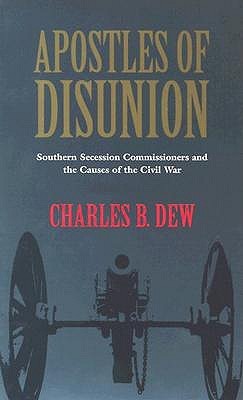
Charles B. Dew, Apostles of Disunion: Southern Secession Commissioners and the Causes of the Civil War (University of Virginia Press, 2002).
Dew states in the introduction of Apostles of Disunion: “I believe deeply that the story these documents tell is one that all of us, northerners and southerners, black and white, need to confront as we try to understand our past and move toward a future in which a fuller commitment to decency and racial justice will be part of our shared experience” (Dew pg. 3). Thus begins the incisive work that discusses one of the most debated issues scholars face with regards to the Civil War: Did slavery or states rights lead to the Civil War? Dew recognizes in Chapter 1 of Apostles of Disunion that the INS “uncertainty” about what caused the Civil War “reflects the deep division and profound ambivalence in contemporary American culture over the Origins of the Civil War” (Dew pg.4), but he focuses on race as the main reasoning behind disunion and the formation of the Confederacy. Dews’ analysis in the ensuing chapters highlights the diction the commissioners utilize in their speeches at important conventions. Dew argues that the “explanations the commissioners offered and the arguments the commissioners made, in short, provide us with extraordinary insight into the secession of the lower South in 1860-1861” (Dew pg.21). Although Dew does not explicitly analyze the speech of every commissioner, he does expand upon a variety of the individuals. In Apostles of Disunion, Dew argues that the commissioner’s speeches, to their assigned states, exemplify the true reasoning for the Southern states disbanding from the Union and forming the Confederacy: the debate or belief over slavery as an institution.
Dew utilizes multiple commissioners to extract the bias or true reasoning for their belief in secession. He starts by discussing the first group of individuals sent out to “advance the cause of secession” (pg. 23). One of these people Dew talks about is William L. Harris, Mississippi’s commissioner to Georgia. Commissioned by Governor John J. Pettus of Mississippi, Harris had to present a speech to the Georgia General Assembly on Monday, December 17, 1860. However, before divulging into the text of Harris’s speech to the state congress, Dew discusses how Harris arrived at the position of commissioner to Georgia. Harris graduated from Georgia’s university in 1825. He moved to Columbus, Mississippi in 1837. Harrison “had an outstanding reputation as a member of the legal profession” (Dew pg.28). He was considered very smart and persuasive. As a result of his history and reputation, he was selected as a “natural choice” by Governor Pettus (Dew pg.28). Dew then proceeds into contextualizing the text of Harris. Harris states how the North is “‘more defiant and more intolerant than ever before’” (Dew pg.29). Harrison continues by stating “‘Our fathers made this a government for the white man, rejecting the negro, as an ignorant, inferior, barbarian race, incapable of self-government, and not, therefore, entitled to be associated with the white man upon terms of civil, political, or social equality.’” Harrison’s comparison between “the white man” and the “negro” through adjectives such as “ignorant,” “inferior,” and “barbarian race”implies for Dew what Harrison’s motivation for secession is: racism or slavery. After all, Dew contends that “it was Judge Harris who set the tone for what was to follow” (Dew pg. 30). Judge Harris’s speech addressed “racial themes” that would “echo” in the “statements of other commissioners as they spread out across the South in the late 1860 and early 1861.”
Dew then addresses South Carolina, the very first state to secede from the Union, and the process it went through assigning commissioners. Isaac W. Hayne, the state attorney general and convention, along with the effort spearheaded by the creator of the Charleston Mercury, Robert Barnwell Rhett, promoted ideas or considerations that the convention “acted swiftly to implement” (Dew, pg.38). As a result, on Dec. 29th, the members of the assembly “endorsed the idea of appointing commissioners.” Dew then transitions into an analysis of Andrew Pickens Calhoun, South Carolina’s commissioner to Alabama. Calhoun arrived at Alabama on January 6th to spread the ideas founded in the South Carolina’s Ordinance of Secession. However, Dew gives quick background information about Andrew Pickens Calhoun: discussing his father, moving to Alabama, working as a farmer, moving back to South Carolina, his important role in the South Carolina Agricultural Society, and his “relative absence from the political arena” (Dew, pg.39-40). However, Dew, as is apparent throughout the text, pays close attention towards the language of the commissioners in their speeches that explain why they favor of succession. Dew provides the context, and then incorporates the actual source to speak for his argument. So, despite his commission to Alabama, Dew showcases the speech that Calhoun gave to the South Carolina Agricultural Society on November 13th, 1860. This speech emphasizes, through comparison, that the speech to the Alabama Convention “lacked some of the rhetorical fireworks of his Agricultural Society address, but the main point he made in Montgomery was the same one he had offered in Columbia eight weeks earlier” (Dew, pg.41). In his speech to the Society, Calhoun mentions, as Dew points out, a relationship between the Republicans and the French Revolution. For example, Dew states how Calhoun propounded the idea that “the effect that the French Revolutionary rhetoric--specifically the slogan ‘liberty, equality and fraternity’--had had on the slave population of Haiti” (Dew, pg.40) would lead to Calhoun’s conclusion that the “‘fury of the beast,’” which “arose” in Haiti against Haitian slave masters, would be the same thing that “‘white fiends [of the North] would delight to see re-enacted now with us’” (Dew, pg.41). Thus, according to Dew, Calhoun believed that the Republican-based Union would ignite revolutionary ideals that would lead to the destruction of the not just the institution of slavery, but the South itself.
Dew incorporates primary sources and secondary sources coherently and intricately throughout his text. Both primary and secondary sources are cited in the back of the work, under the “Notes” section, but he numbers the bits of information that are not his own throughout the text. The Milledgeville Federal Union is a newspaper that re-published the speech William L. Harris gave at the Georgia General Assembly. It is a primary source (a newspaper), and, besides being cited in the back and with an in-text citation, is also identified by a block-quote. Dew utilizes the end of his speech to emphasize the reaction it had on the Georgia legislature. Another example of a primary source Dew uses is the Columbia Daily South Carolinian, published on Nov. 14, 1860. This is another newspaper that re-published the speech Andrew Calhoun gave on Nov. 13, 1860 in an address to the South Carolina Agricultural Society. Dew employs the language from this newspaper to re-construct Calhoun’s argument. Dew’s secondary sources mainly include biographies such as Thomas M. Owen’s History of Alabama and Dictionary of Alabama Biography, four vols. (Chicago, 1921) and Vicki Vaughn Johnson’s The Men and the Vision of the Southern Commercial Conventions, 1845-1871 (Columbia, Mo., 1992) in order to contextualize the background information that helped shape these men’s views. The information for these secondary sources are identified in the same manner as primary sources.
Dew’s argument is that the issue of slavery was the cause that started and stimulated the Civil War. However, The American Journey says slavery “accounted for or played a role in creating distinctions between North and South that transcended their shared heritage” (Goldfield et al., pg.404). Dew does not mention these “distinctions” nor the fact that the North or South had a “shared heritage.” For example, in The American Journey, it mentions how “As the North became increasingly urban and industrial, the South remained primarily rural and agricultural” (Goldfield et al., pg. 404). The North’s economic structure sharply contrasted that of the South, which reflects a growth in different modes of thinking amongst people and could possibly explain the resultant attitudes about the importance of slavery that divided the North and the South. Also, The American Journey mentions how Evangelical Protestantism played a role in the ensuing sectionalism: “In the North, evangelical Protestants viewed social reform as a prerequisite for the Second Coming of Christ. As a result, they were in the forefront of most movements. Southern evangelicals generally defended slavery” (Goldfield et al. pg. 405). This religious defence of slavery is not discussed in the context of the commissioners. Thus, when Dew discusses the religious justification that Stephen Fowler Hale used in Hale’s speech, the reader is not informed about the historical influence religion had on Southerners like Hale during this time; Hale discusses how secession is the only method to safeguard “‘the heaven- ordained superiority of the white over the black race’” (Dew, pg.53), in order to promote the cause of secession. Why does Hale believe white supremacy to be “‘ordained?’” The audience that Dew is attempting to address is: history students, teachers, historians, scholars, Civil War fanatics, and anyone else who questions the causes of the Civil War in America or the impact of the southern secession commissioners. Dew’s book contains an “Appendix” section, from page 83 to page 103, which has two primary source documents: a speech by William L. Harris and a letter from Stephen F. Hale to Governor Beriah Magoffin. Plus, he has a “Notes” section, from page 105 to 118, which is separated into lists of sources used for each part of the book (the introduction, each chapter, and the conclusion), and each list of cited sources is in numerical order to document where sources are used.The “Notes” also list books that Dew recommends himself. He also includes from page 119 to page 124 the “Index,” where the reader can locate specific people, places, or concepts mentioned in the book. According to the Dew’s index, McSweeney, Patrick S., is mentioned on page 7 or Ruffin, Edmund is on both page 41 and page 44. Dew’s books critically examine the text of the commissioners to decipher the true meaning of the Civil War: the issue of slavery. He perfectly weaves together primary and secondary sources to create an astounding work of scholarly merit. Useful is something that is relevant or instructive towards solving a certain problem, completing a study, learning about a subject or topic, answering or pondering a question, or providing a variegate of viewpoints that aid in our understanding about a study, subject, topic or problem. The book is useful because it provides an analytical argument through the usage of insightful and relevant primary sources that are contextualized by secondary sources that immerse you into the world of the secessionists. Dew allows the primary sources, with minor biographical descriptions of the commissioners, concrete dates of important events, and historical interpretation of ideology and values found on the surface level of the texts, to speak for themselves. Overall, it is a book that brings the reader back to the reality of secession and in-depth glimpse into history.
--To be edited--
- Michael Young