Georges Joseph Christian Simenon (1903 – 1989) was a Belgian writer. A prolific author who published nearly 500 novels and numerous short works, Simenon is best known as the creator of the fictional detective Jules Maigret. Although he never resided in Belgium after 1922, he remained a Belgian citizen throughout his life.
Simenon was one of the most prolific writers of the twentieth century, capable of writing 60 to 80 pages per day. His oeuvre includes nearly 200 novels, over 150 novellas, several autobiographical works, numerous articles, and scores of pulp novels written under more than two dozen pseudonyms. Altogether, about 550 million copies of his works have been printed.
He is best known, however, for his 75 novels and 28 short stories featuring Commissaire Maigret. The first novel in the series, Pietr-le-Letton, appeared in 1931; the last one, Maigret et M. Charles, was published in 1972. The Maigret novels were translated into all major languages and several of them were turned into films and radio plays. Two television series (1960-63 and 1992-93) have been made in Great Britain.
During his "American" period, Simenon reached the height of his creative powers, and several novels of those years were inspired by the context in which they were written (Trois chambres à Manhattan (1946), Maigret à New York (1947), Maigret se fâche (1947)).
Simenon also wrote a large number of "psychological novels", such as La neige était sale (1948) or Le fils (1957), as well as several autobiographical works, in particular Je me souviens (1945), Pedigree (1948), Mémoires intimes (1981).
In 1966, Simenon was given the MWA's highest honor, the Grand Master Award.
In 2005 he was nominated for the title of De Grootste Belg (The Greatest Belgian). In the Flemish version he ended 77th place. In the Walloon version he ended 10th place.
You always get a good story from Simenon, the Belgian author who wrote in French and is best known for his Inspector Maigret series. Incredibly, Simenon wrote more than 500 novels. (This book being reviewed is not one of the Maigret novels; it's one of his 'roman durs.')
The main character is physically a large man and he’s even bigger than life in his small town. He runs a business in coastal France going out at low tide to collect mussels and oysters. He has the best oyster beds, the largest house, the most land and the newest truck. He acts as a middleman, buying oysters from others and driving them to out-of-town markets to get the best price.
He’s in a loveless marriage but his wife is loyal to him and does his books. That faithfulness is not reciprocal as everyone in town knows he hangs out at the local brothel, sometimes with several women at a time. Otherwise, he’s such a workaholic that he doesn’t know what to do with himself on his one day off, Sunday. (Maybe the brothels are closed on Sunday? lol)
His sidekick and only friend is a mute, muscular, mentally challenged man who is always at his side. I hate to say it, but in this book, reflecting attitudes of almost 50 years ago (published in 1970), the mentally challenged man is portrayed like a big, loyal dog, ever faithful to his master.
The main character has never been in love, even with his wife. Suddenly their maid/cook leaves and is replaced by a teenage girl who has been abused by her previous male employer. The stage is set for the big man to fall in love.
I wrote that it’s a good story but I have to modify that to say that the tragic, melodramatic ending is farfetched and a bit much. But I guess when you write 500 novels it’s hard to keep coming up with original, reasonable endings. Still it was a good read with a lot of local color of a village in coastal France, probably around the 1950s and 60s.
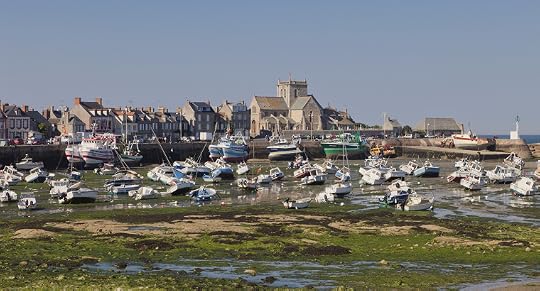
Photo of a French coastal village from slow-chic.com
I am a fan of Georges Simenon's. I particularly like the novels in which Maigret doesn't feature. They have something in common - solitude, isolation, inability to communicate or the feeling of being an outsider - and they are always under 200 pages. Simenon works on psychology and this is his magnificent strength - he writes convincingly; his novels work. This particular one is a novel about love that has come to a man quite late: at the age of 45 when he is married and tied to a routine. I don't want to give away the plot and anyway, not much happens. All the same it's a good novel, even if not one of my favourites. If you have not read Simenon's non-Maigret novels, I urge you to start now (although not many are in print). I very much recommend "The Cat", "The Train" and "The Little Man from Archangel".
Published in 1970, this is one of Simenon’s later novels, noticeable because the novel’s theme is sex. It maybe described as a dark romance, though there isn’t a lot of love involved. In fact, the protagonist, the titular rich man, Victor Lecoin, is an unpleasant piece of work.
He was not born into money, but has done very well for himself from fishing for shellfish. He is 45 years old when the novel begins, and has been in a loveless and childless relationship with his wife for many years. His wife employs a 16 year old maid, Alice, and for the first time in his life, Victor falls for her.
I think even at the time this was published, such a relationship would be shocking, and not just the relationship, but Victor in effect grooming the girl and then taking advantage of her.
Though it has a typical twist in its last few pages, this is different than many of Simenon’s romans-durs, more bold and intentionally antagonising.
I acquired, back in 2009 or 2010, I believe, a 20-volume collection published by the French daily newspaper "Le Monde," titled "Le Monde de Simenon." Each volume is focused on a specific theme (eg. The Riviera, America, Paris, etc.) and contains three novels by Simenon (not all are Maigret stories.) My collection had remained unread on one of my bookshelves for over ten years, when I decided, in June 2021, that I would read one volume per month.
This novel is the first one in Volume 9 of the collection. The common setting in each of its three novels is the Vendée region, located on the Atlantic Coast, south of Brittany.
Victor Lecoin is the "Big Man" in his little village of Marsilly, he is a hard worker who has made a fortune as a mussel and oyster breeder. He is married to Jeanne, a woman who is more of a business partner than a wife, and he satisfies his enormous sexual appetite with prostitutes - often several at a time - at a bar run by Nenette who is a bit of a confidente to him. His wife tolerates his drinking binges and sexual escapades. Then, when she hires a 16-year old maid, Alice, the recent victim of sexual abuse, Victor suddenly becomes obsessed with the young girl - it seems that he has fallen in love with her. But Alice is so broken that she is unable to reciprocate this love (to her "all men are the same"), and has a sexual encounter with Théo, another villager. However, a mute worker named Doudou, who has been Victor's protege since his mother's death when he was only 12 years old, witnesses their tryst, and subsequently chases Théo away and strangles Alice.
This is not, and by far, my favorite Simenon novel among those that I have read so far. For one, Victor Lecoin is a rather despicable character who seems to relish way too much heavy drinking and fornication. Even though I wanted to sympathize with him when he starts falling in love with Alice, I could not get beyond the notion that he was actually not in love, but incredibly infatuated and obsessed with her. Remember that this young girl is a minor, and that she is in terribly sad shape, having lived in dire poverty for her entire life, and having recently been raped by her former employer. My take was well, that Victor was nothing more than Alice's next sex abuser.
Simenon does have a thing with sex. He supposedly bragged at some point about having had sex with some 10,000 women (from the Wikipedia article on Simenon, which also states that, according to his second wife, that number was more realistically close to 1,200 - still....) I do not think that he was a good man; he was an inveterate womanizer, and was even suspected of having collaborated with the German occupant during WWII (which he vehemently denied.)
But he is a fantastic writer, who can bring any landscape and characters to life in a masterful way. The description of Paris in the area by the Seine near Notre-Dame, in the first two pages of "L'Enterrement de Monsieur Bouvet" - the third novel in Volume 3 of "Le Monde de Simenon" - is beyond brilliant - it makes you truly believe that you are right there.
As a result, I am overall very happy with my decision to read three Simenon novels each month for a while. And I may try to find more when I am done with this collection!
Voilà un livre typique des années 70-80. L’âge d’or de David Hamilton et ses photos de toutes jeunes filles dénudées qui excitaient fort les vieux lubriques. L’époque des photos de Eva Ionesco (à 11 ans nue en une du Spiegel) ou, un peu plus tard, du film Noces Blanches avec Vanessa Paradis (alors 16 ans) et Bruno Cremer (58 ans)… Pour ne citer des exemples qui m’ont marqué.
Difficile à lire aujourd’hui mais fort utile. Car Simenon qui, au travers de ses romans durs, « voulait présenter l’homme sans habit, sans cravate, au travers de la composition d’une vaste tragédie humaine » raconte avec grand talent cet homme de plus de 40 ans qui fréquente assidûment les prostituées de chez Nenette et qui s’éprend de sa petite bonne de 16 ans.
Pourtant, s’il présente bien l’homme sans habit dans le sens d’en explorer la psyché, avec les femmes il se contente seulement ici de les déshabiller au sens le plus littéral.
Un roman de son époque (révolue ou mieux cachée ?), témoignage malaisant et éclairant
An engaging character based short novel about Victor Lecoin, a forty five year old, married without children, wealthy, hard working, self made man and his infatuation with a 16 year old house maid. He grew up in poverty and was able to make the best of business opportunities that came his way. He now owns a number of properties and controls the oyster and mussel fishing industry of the seaside village. He has been married to his wife, a school mistress, for a number of years. She is an astute woman who plays a strong role in their business.
This is a very disturbing book to read. I love Simenon, and I want to read everything he wrote, which is a lot. But this book, as well as the follow-up novel “La cage de verre” is different from others. I can’t shake the feeling that these two novels have an auto-biographical depth, and that Simenon refers to the intense relationship he had with his daughter. His daughter who was in love with him and who got so obsessed with her father, that it killed her. I might be wrong, of course. Le riche homme is compelling, it’s disturbing and it is so well written.
I understand that this is a book not written in current days, but nonetheless I'm not able to say I agree to a book which tells a story of a 50y man that falls in love with a 16y girl and forces her to sleep with him saying he's in love. This is rape. I'm shaken, but at least happy that this is bizarre to our current times.
Wildly readable (like to a degree that almost becomes the most and only compelling mystery of the book) but concerning a largely unlikeable unrelatable protagonist. Resolution is also a little meh. Mostly one for completists only.
Um romance que é normalmente classificado de policial mas que, no fundo, é um romance psicológico, um "romance duro" em que ocorre um crime. Não há qualquer mistério a ser resolvido e a polícia só surge nas últimas páginas para tomar conta da ocorrência.
The Rich Man was first published as Le Riche homme in 1970; it was translated by Jean Stewart. It is the story of Victor Lecoin, the big man of his village, Marsilly, where he controls the oyster and mussel fishing. Lecoin has started from nothing, worked hard all his life, invested in land, and become rich. He is an imposing figure, tall, muscular, with enormous endurance, of work and of alcohol, and of enormous sexual stamina as well. His closest companion is the equally enormous deaf mute Doudou. His wife, the village schoolmistress, whom he looks up to, has become his close business partner and nothing more. When a destitute orphan, Alice, is taken on as maid, Lecoin finds himself for the first time in his life falling in love. Somehow detached from all those around him, Lecoin has suppressed a longing for intimacy, and he now tries to establish this with the girl Alice, scarcely sixteen and a previous victim of sexual abuse, behind his wife’s back. It is an attempt doomed to failure. Alice is passive, submissive, unresponsive. Lecoin, mustering all the tenderness he is capable of, tries to arouse her. But Alice has learned that “men are like that” and will do nothing more than allow his caresses. During Lecoin’s absence from his village Alice is approached by another man and submits to him. The deaf mute Doudou, unfailingly loyal to Lecoin, drives the man away and kills Alice. Lecoin is left trying to understand just why his attempt to find love hasn’t worked. This is another portrait of an outwardly successful man with failed relationships, like The Prison of 1968, and again may be the product of self examination on Simenon’s part. I found the climax overly melodramatic, and the process that Lecoin goes through not fully developed. For all its impressive portrait of the village and the people and their way of life, this is another Simenon misfire, even if more interesting than most other authors’.