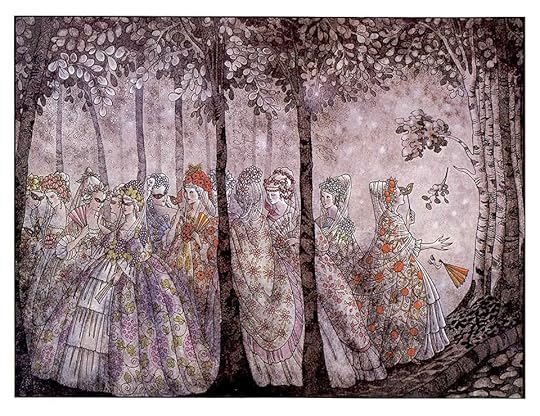
Errol Le Cain was a British animator and children's book illustrator.
He was born 5 March 1941 in Singapore and evacuated with his family next year when Japan invaded. They lived in India for several years before eventually settling in the U.K. after World War II. With no formal art education, his talent was nevertheless evident from an early age. Fascinated by cinema, he made his first animated film, The Enchanted Mouse, with a friend's 8-mm camera at age 11. His next work, The Little Goatherd, was created with a 16-mm camera at age 15. It came to the attention of British film distributor Pearl & Dean and he moved to London that year (1956) to pursue a career in animation.
In 1965, Le Cain joined Richard Williams's animation studio and worked on a wide range of animation projects. Le Cain turned freelance in 1969, working on sets for BBC television productions, continuing with animation projects, and beginning his career as a children's book illustrator.
Le Cain's first children's illustrations were published by Faber and Faber in King Arthur's Sword (1968), which began a long association with Faber that continued to his death. Le Cain illustrated 48 children's books during his lifetime, noted for their richly decorative watercolours and masterful command of design and colour.
He was commended for the 1969, 1975, and 1978 Kate Greenaway Medal from the Library Association, - recognising the year's best children's book illustration by a British subject - before winning the 1984 Medal and was commended again for 1987. The winning book was Hiawatha's Childhood, based on "a very short extract" from Henry Wadsworth Longfellow's 1855 epic poem The Song of Hiawatha. The four commended books were The Cabbage Princess, which he wrote himself; Thorn Rose, or the Sleeping Beauty from Brothers Grimm; Twelve Dancing Princesses, which he retold from Brothers Grimm; and The Enchanter's Daughter by Antonia Barber.
It's wonderful to discover new old books. The story is simply told but it is the illustrations that are the star here. Evoking renaissance art and tapestries. Each princess gets a unique dress pattern and hair and the warm colours of are perfect for an evening read. There is so much to take in with each individual picture. I don't know how long each one took but you can tell the artist put a lot of care and passion into each panel. Even the rtext boxes have sumptuous surrounds a mix of the medieval and art nouveau. Looking forward to discovering more Errol le Cain's work. :)
Genre: Traditional Literature- Fairy Tale Awards: Audience: K-5th grade A. The 12 princesses are rarely addressed as individuals. At certain points, the youngest and eldest daughter are given a couple traits. This story relies heavily on illustrations to give readers information about the characters. The text focuses on the plot. B. I read a variation of this story when I was younger, but I wasn't able to find the edition I read. It told the same story but it was a more modern version with simpler illustrations. C. I think I would use this book when I was teaching about fairytales because it isn't one of the better known stories. Because of this, I would be able to do more with the book because students haven't heard it dozens of times. D. Describe the forests the princesses traveled through. Answer: The princesses traveled through a forest with silver, diamonds, and gold.
In this story the twelve nameless princesses are tricked. The soldier is the most memorable and likable character in the story. Overall, this book seems to be intended for an older audience. However, the teasing that the soldier does to the princesses (especially the youngest), makes the story more appealing to the young. The characters in the book are not very well developed, but that may make the book more interesting to some who like to draw their own conclusions. The artwork is detailed but the drab colors and small scale makes could make it more appealing to adults. This version is German, rather than French. It could be well used as a study in the art of storytelling, especially Grimm’s tales.
This is one of my favourite children's stories, and I'm buying a new copy now because I remembered how much I love it. It's stunning, and the ending always stuck with me.
The retelling of the story is a good one, with the unfolding of something that seems like a remnant of ancient myth or ritual left as a matter of fact, literal set of details, although with diamonds and twigs of silver, etc. to bedeck the narrative. Le Cain preserves the wonder of the tale even with the characters portrayed in an eighteenth century setting. The pictures could twist me around their little finger.
I read the text only so I cant judge the ilustrations, although for what I seen for other reviews they are gorgeous . I actually thought there would be more to the story - while reading a retelling (Wildwood Dancing) I was curious about the original, but its quite simple and the ending is somewhat abrupt. I like the concept though.
it is my first time reading the original story but i think i prefer the barbie version. it is more beautiful with the dance and the steps they have to do to enter the magical realm. also i prefer that Genevive is the main character, even though the others are nice and i like Derek. he is cool :) i remember when i was younger i would try to dance like them XD nice childhood :)
Wonderfully illustrated, and definitely my favorite book as a child! Unfortunately it is out of print, however it is well worth tracking down through a book seller.