Jump to ratings and reviews
Rate this book

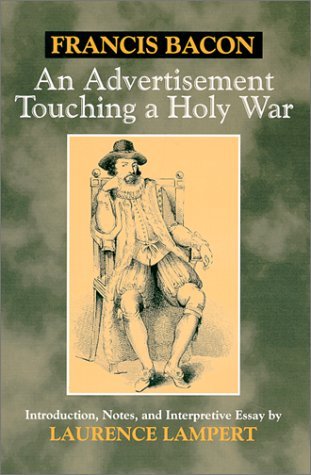
An Advertisement Touching a Holy War

Rate this book
Francis Bacon is rightly celebrated as one of the founders of the scientific and technological revolution that transformed Western civilization. His chief works argue that a society dedicated to science and technology would relieve the human estate, providing a longer, healthier, more informed, and more ennobling life for everyone. Bacon s remarkable An Advertisement Touching a Holy War stands as a document of major historical importance and intense current relevance because it offers an additional reason for the modern revolution. In it Bacon dares to suggest that a revolution in thinking and acting is necessary because European intellectual and spiritual life as well as European politics had been captured by religious fanaticism that threatened to plunge Renaissance Europe into another dark age. Bacon chose the old literary device of dialogue to present his argument for wholesale change indirectly. In the conversation of his characters he allows readers to see the reasons for kindling spiritual warfare against the spiritual rulers of European civilization. An Advertisement Touching a Holy War gives a great philosopher s reasons for initiating the war between science and religion that was actually fought in the coming centuries in Western civilization and of which we are the heirs.

93 pages, Paperback

First published April 6, 1628

52 people want to read

About the author

Francis Bacon

2,504 books911 followers
Not to confuse with collateral descendant and artist Francis Bacon

English philosopher, essayist, courtier, jurist, and statesman Francis Bacon, first viscount Saint Albans, in writings, which include The Advancement of Learning (1605) and the Novum Organum (1620), proposed a theory of scientific knowledge, based on observation and experiment, which people came as the inductive method.

A Baconian follows the doctrines of the philosopher Francis Bacon or believes in the theory of, relating to, or characteristic of his works or thought that he authored the plays, attributed to William Shakespeare.

This Queen's Counsel, an orator, authored. He served as Attorney General and Lord Chancellor of England. After his death, his works extremely influenced especially as advocate and practitioner during the revolution.

People called Bacon the creator of empiricism. His works established and popularized simple Baconian inquiry, often called. His demand for a planned procedure of investigating all natural things marked a new turn in much of the rhetorical framework, which still surrounds proper conceptions today.

Bacon received a knighthood in 1603, and people created him baron Verulam in 1618 and promoted him in 1621.

Ideas of Bacon in the 1630s and 1650s influenced scholars; Sir Thomas Browne in his Encyclopaedia Pseudodoxia Epidemica (1646–72) frequently adheres to an approach to his inquiries. During the Restoration, the royal society founded under Charles II in 1660, commonly invoked Bacon as a guiding spirit.

During the 18th-century Enlightenment of France, criticism of the ancien regime associated more influential non-metaphysical approach of Bacon than the dualism of his French contemporary René Descartes. In 1733, Voltaire "introduced him as the ''father," a widespread understanding before 1750, to a French audience.

In the 19th century, William Whewell revived and developed his emphasis. People reputed him as the "father."

Because Bacon introduced the influence behind the dawning of the Industrial age in England, people also consider him. In works, Bacon,

"the explanation of which things, and of the true relation between the nature of things and the nature of the mind, is as the strewing and decoration of the bridal chamber of the mind and the universe, out of which marriage let us hope there may spring helps to man, and a line and race of inventions that may in some degree subdue and overcome the necessities and miseries of humanity,"


meaning he expected that through the understanding of use of mechanics, society creates more inventions that to an extent solves the problems. This idea, found in medieval ages, changed the course in history to inventive that eventually led to the mechanical inventions that made possible the Industrial Revolutions of the following centuries.

He also a long treatise on Medicine, History of Life and Death , with the natural prolongation.

For the historian William Hepworth Dixon of biographers, so great influence of Bacon in modern world proceeds to owe to who rides in a train, sends a telegram, follows a steam plough, sits in an easy chair, crosses the channel or the Atlantic, eats a good dinner, enjoys a beautiful garden, or undergoes a painless surgical operation

Francis Bacon's left the vast and varied that dispaly and that divided in three great branches:

Works present his ideas for an universal reform into the use of the improvement.

In literary works, he presents his morals.

Works reform in law.

Librarian Note: There is more than one author in the Goodreads database with thi

Ratings & Reviews

What do you think?
Rate this book

Friends & Following

Create a free account to discover what your friends think of this book!

Community Reviews

5 stars
5 (62%)
4 stars
1 (12%)
3 stars
1 (12%)
2 stars
1 (12%)
1 star
0 (0%)
No one has reviewed this book yet.

Can't find what you're looking for?

Get help and learn more about the design.