

What do you think?

She-Wolves: The Women Who Ruled England Before Elizabeth
When Edward VI - Henry VIII’s longed-for son - died in 1553, extraordinarily, there was no one left to claim the title King of England. For the first time, all the contenders for the crown were female.
In 1553, England was about to experience the ‘monstrous regiment’ - the unnatural rule - of a woman. But female rule in England also had a past. Four hundred years before Edward’s death, Matilda, daughter of Henry I and granddaughter of William the Conquerer, came tantalisingly close to securing her hold on the power of the crown. And between the 12th and the 15th centuries three more exceptional women - Eleanor of Aquitaine, Isabella of France, and Margaret of Anjou - discovered, as queens consort and dowager, how much was possible if the presumptions of male rule were not confronted so explicitly.
The stories of these women - told here in all their vivid humanity - illustrate the paradox which the female heirs to the Tudor throne had no choice but to negotiate. Man was the head of woman; and the king was the head of all. How, then, could a woman be king, how could royal power lie in female hands?
In 1553, England was about to experience the ‘monstrous regiment’ - the unnatural rule - of a woman. But female rule in England also had a past. Four hundred years before Edward’s death, Matilda, daughter of Henry I and granddaughter of William the Conquerer, came tantalisingly close to securing her hold on the power of the crown. And between the 12th and the 15th centuries three more exceptional women - Eleanor of Aquitaine, Isabella of France, and Margaret of Anjou - discovered, as queens consort and dowager, how much was possible if the presumptions of male rule were not confronted so explicitly.
The stories of these women - told here in all their vivid humanity - illustrate the paradox which the female heirs to the Tudor throne had no choice but to negotiate. Man was the head of woman; and the king was the head of all. How, then, could a woman be king, how could royal power lie in female hands?
474 pages, Paperback
First published January 1, 2010
About the author
Helen Castor
7 books523 followersHelen Castor is a historian of medieval England and a Fellow of Sidney Sussex College, Cambridge. She directed studies in History at Sidney for eight years before deciding to concentrate on writing history for a wider readership.
Her book Blood & Roses (Faber, 2004, published in revised form in the US by HarperCollins, 2006) is a biography of the fifteenth-century Paston family, whose letters are the earliest great collection of private correspondence surviving in the English language. Blood & Roses was longlisted for the Samuel Johnson Prize for Non-Fiction in 2005, and was awarded the Beatrice White Prize (for outstandingly scholarly work in the field of English Literature before 1590) by the English Association in 2006.
Her next book, She-Wolves: The Women Who Ruled England Before Elizabeth, will be published in the UK by Faber and in the US by HarperCollins.
She lives in London with her husband and son.
Her book Blood & Roses (Faber, 2004, published in revised form in the US by HarperCollins, 2006) is a biography of the fifteenth-century Paston family, whose letters are the earliest great collection of private correspondence surviving in the English language. Blood & Roses was longlisted for the Samuel Johnson Prize for Non-Fiction in 2005, and was awarded the Beatrice White Prize (for outstandingly scholarly work in the field of English Literature before 1590) by the English Association in 2006.
Her next book, She-Wolves: The Women Who Ruled England Before Elizabeth, will be published in the UK by Faber and in the US by HarperCollins.
She lives in London with her husband and son.
Ratings & Reviews
Friends & Following
Create a free account to discover what your friends think of this book!
Community Reviews
Displaying 1 - 30 of 691 reviews

March 25, 2013
NERD ALERT: This is the yardstick by which I measure all nonfiction. Historians often sacrifice the human aspect their subject to detail dates, times, economics, etc. They often overload you with information for no clear reason, maybe to validate their amount of research. Or they can go the opposite tack and leave you desperate for a year, a town, a battle, (dear god anything!) you can use as a frame of reference.
Helen Castor is not that type of historian. She is a consummate storyteller who supplies her nerds with their fix of dates, names, and places.
Say Simon Schama is at one end of the nonfiction spectrum --the modern-day chronicler who relies on the beauty of English language to tell the story of the English people, but often ignores specific dates and places--and a McGraw-Hill history textbook--dry and matter of fact--is on the other. Castor falls right in the middle.
Her work is captivating, with a compassion for her subjects and a flair for the dramatic. It flows like a novel but is unmistakably scholarly. And like Schama, she has such a knack for putting subjects, events, and people into modern contexts. I just love when an historian uses the phrase "It would be as if . . ."
"She-Wolves" tells the story of forgotten queens, fleshing out their lives and explaining their motivations without recasting them as self-conscious feminists. Here again, Castor does a great job of avoiding the cliches many other writers of female history repeat. These were flawed people and they made decisions based on power, survival, greed--you know, like men--not to prove the merits of their gender.
In all, this is just a fantastic book that balances facts with flair, the medieval with the modern, and therefore is satisfying on several levels.
Helen Castor is not that type of historian. She is a consummate storyteller who supplies her nerds with their fix of dates, names, and places.
Say Simon Schama is at one end of the nonfiction spectrum --the modern-day chronicler who relies on the beauty of English language to tell the story of the English people, but often ignores specific dates and places--and a McGraw-Hill history textbook--dry and matter of fact--is on the other. Castor falls right in the middle.
Her work is captivating, with a compassion for her subjects and a flair for the dramatic. It flows like a novel but is unmistakably scholarly. And like Schama, she has such a knack for putting subjects, events, and people into modern contexts. I just love when an historian uses the phrase "It would be as if . . ."
"She-Wolves" tells the story of forgotten queens, fleshing out their lives and explaining their motivations without recasting them as self-conscious feminists. Here again, Castor does a great job of avoiding the cliches many other writers of female history repeat. These were flawed people and they made decisions based on power, survival, greed--you know, like men--not to prove the merits of their gender.
In all, this is just a fantastic book that balances facts with flair, the medieval with the modern, and therefore is satisfying on several levels.

November 3, 2015
4.5* History buffs won’t come across a finer book written as it captures the very essence of four strong minded women, Matilda, Eleanor of Aquitaine, Isabella of France, and Margaret of Anjou. Brilliantly told with a considerable amount of detail, Helen Castor relies heavily on well documented records to tell the story of how these exceptional women came forth by taking control to ensure the crown for their offspring. Patience is required in several of the chapters as periodically there are too many characters introduced which have no real bearing on the actual stories. But be prepared to be in awe of these four Queens and the strategies they undertake throughout their lives to achieve their goals, and to take their well earned, and much deserved place in history. Highly recommended.

September 7, 2019
If I had to sum up the thesis of Helen Castor’s book in one sentence, it would be this: Elizabeth I didn’t come out of nowhere.
Elizabeth Tudor was the first woman to rule England in her own right, but as Castor’s book makes clear, she was only able to wear the crown thanks to the efforts of several other women in England’s history who each, in her own way, paved the way for one of the most successful rulers in her country’s history.
Castor takes us through the stories of several royal women, starting in the Middle Ages, and shows us how they successively got a little bit closer to the crown, with Elizabeth I as the end result. Of course the heavy hitters, like Eleanor of Aquitaine and Mary I, get lots of page space, but Castor also takes time to delve into the lives and lasting influences of women who frequently get overlooked and dismissed by history as merely “wife of [insert historical man here].”
In addition to the fascinating stories of how these women tried to gain power (with mixed results), Castor is also exploring the concept of queenship – what it means to be queen as opposed to king, and how that role grew and evolved over time. One of the most interesting parts for me was the discussion of how it was the queen’s job to publicly plead to the king for mercy on someone’s behalf – the king couldn’t be viewed as weak, so by indulging the queen’s feminine weakness, he could pardon someone without losing face. I also appreciated how Castor is not pulling her punches when it comes to showing just how badly the deck was stacked against women in power. One of the funniest parts of the book, while discussing two royal women fighting for control of the crown, Castor quotes a commentator from the time who heavily criticized one woman for going against her feminine nature by seeking power, while that same guy complimented her rival on how brave and tough and strong she was.
Elizabeth I is often held up as an example of a strong independent woman who revolutionized the English monarchy (and often lazy historians present her as the “good sister” in contrast to Bloody Mary, which…ugh), but Castor’s book makes it clear that Elizabeth was standing on the shoulders of dozens of women who came before her – women who are often overshadowed by the stories of their husbands, fathers, brothers, and sons. By collecting their stories and presenting them as a long-term effort to change the way the English monarchy operated, She-Wolves shines a light on some key background players in England’s history.
Elizabeth Tudor was the first woman to rule England in her own right, but as Castor’s book makes clear, she was only able to wear the crown thanks to the efforts of several other women in England’s history who each, in her own way, paved the way for one of the most successful rulers in her country’s history.
Castor takes us through the stories of several royal women, starting in the Middle Ages, and shows us how they successively got a little bit closer to the crown, with Elizabeth I as the end result. Of course the heavy hitters, like Eleanor of Aquitaine and Mary I, get lots of page space, but Castor also takes time to delve into the lives and lasting influences of women who frequently get overlooked and dismissed by history as merely “wife of [insert historical man here].”
In addition to the fascinating stories of how these women tried to gain power (with mixed results), Castor is also exploring the concept of queenship – what it means to be queen as opposed to king, and how that role grew and evolved over time. One of the most interesting parts for me was the discussion of how it was the queen’s job to publicly plead to the king for mercy on someone’s behalf – the king couldn’t be viewed as weak, so by indulging the queen’s feminine weakness, he could pardon someone without losing face. I also appreciated how Castor is not pulling her punches when it comes to showing just how badly the deck was stacked against women in power. One of the funniest parts of the book, while discussing two royal women fighting for control of the crown, Castor quotes a commentator from the time who heavily criticized one woman for going against her feminine nature by seeking power, while that same guy complimented her rival on how brave and tough and strong she was.
Elizabeth I is often held up as an example of a strong independent woman who revolutionized the English monarchy (and often lazy historians present her as the “good sister” in contrast to Bloody Mary, which…ugh), but Castor’s book makes it clear that Elizabeth was standing on the shoulders of dozens of women who came before her – women who are often overshadowed by the stories of their husbands, fathers, brothers, and sons. By collecting their stories and presenting them as a long-term effort to change the way the English monarchy operated, She-Wolves shines a light on some key background players in England’s history.

June 21, 2020
An intelligent, and compelling book by Dr Helen Castor who demonstrates a passion, understanding and deep knowledge of her subject. She focuses on the reigns of 7 phenomenal women, Queens of England. In a time when power was seen as the prerogative of men, the exercise of power by a woman was seen as unnatural, unfeminine and even monstrous and the early queens such as Empress Matilda, Eleanor of Aquitaine , Isabel of France and Margaret of Anjou were vilified as she-wolves, often demonstrating power and waging war, and certainly displaying ruthlessness but no differently from many kings of the same time.
All of these women were certainly multi-faceted, all , with the exception of the ill fated Lady Jane Grey, were capable of great ruthlessness. But perhaps Dr Castor if incorrect when she insinuates that Matilda was driven out of London because the people because the people did not want a woman ruler , when it was in fact because of the steep taxes she had imposed on the citizens of London, much as Margaret Thatcher finally lost power in 1990 after planning to impose a poll tax on the poorest in British society.
This collection focuses on relationships, and politics and war as well as religion and society. We get an understanding of what shaped a naive twelve year old child bride , Isabel of France into a ruthless power player dubbed the 'she-wolf' who seized England together with her lover Roger Mortimer, and possibly had her spouse, Edward II put to death. Of Isabel it was said "No man ever excited her resentment who did not perish under its effect; the king himself forming no exception to this fact."
Margaret of Anjou was one of the key and most aggressive players of the War of the Roses who would stop at nothing and cut down anything that stood in the way of the interests of her husband, the timid and half-mad Henry VI and her son Edouard, Prince of Wales.
Mary I (Bloody Mary) had hundreds of Protestants burned to try to reimpose Roman Catholicism back on England, while Elizabeth I, perhaps one of England's greatest monarchs engineered a religious settlement on England that was acceptable to most and led England against the invasion by Spain of the Spanish Armada. "I know I have the body of a weak and feeble woman, but I have the heart of a king and king of England too'
Magnificent footage of castles, palaces, churches and landscapes in France and England. Dr Castor is not only knowledgeable, but is an excellent narrator and presenter, making this valuable insight for anyone with an interest in the history of the period. At a time when English history is being down scaled in schools and universities in order not to offend certain groups, the English children and young people are being robbed of a central part of their heritage and identity. Series like these are welcome and refreshing.
All of these women were certainly multi-faceted, all , with the exception of the ill fated Lady Jane Grey, were capable of great ruthlessness. But perhaps Dr Castor if incorrect when she insinuates that Matilda was driven out of London because the people because the people did not want a woman ruler , when it was in fact because of the steep taxes she had imposed on the citizens of London, much as Margaret Thatcher finally lost power in 1990 after planning to impose a poll tax on the poorest in British society.
This collection focuses on relationships, and politics and war as well as religion and society. We get an understanding of what shaped a naive twelve year old child bride , Isabel of France into a ruthless power player dubbed the 'she-wolf' who seized England together with her lover Roger Mortimer, and possibly had her spouse, Edward II put to death. Of Isabel it was said "No man ever excited her resentment who did not perish under its effect; the king himself forming no exception to this fact."
Margaret of Anjou was one of the key and most aggressive players of the War of the Roses who would stop at nothing and cut down anything that stood in the way of the interests of her husband, the timid and half-mad Henry VI and her son Edouard, Prince of Wales.
Mary I (Bloody Mary) had hundreds of Protestants burned to try to reimpose Roman Catholicism back on England, while Elizabeth I, perhaps one of England's greatest monarchs engineered a religious settlement on England that was acceptable to most and led England against the invasion by Spain of the Spanish Armada. "I know I have the body of a weak and feeble woman, but I have the heart of a king and king of England too'
Magnificent footage of castles, palaces, churches and landscapes in France and England. Dr Castor is not only knowledgeable, but is an excellent narrator and presenter, making this valuable insight for anyone with an interest in the history of the period. At a time when English history is being down scaled in schools and universities in order not to offend certain groups, the English children and young people are being robbed of a central part of their heritage and identity. Series like these are welcome and refreshing.

September 12, 2015
Description: When Edward VI - Henry VIII’s longed-for son - died in 1553, extraordinarily, there was no one left to claim the title King of England. For the first time, all the contenders for the crown were female.
In 1553, England was about to experience the ‘monstrous regiment’ - the unnatural rule - of a woman. But female rule in England also had a past. Four hundred years before Edward’s death, Matilda, daughter of Henry I and granddaughter of William the Conquerer, came tantalisingly close to securing her hold on the power of the crown. And between the 12th and the 15th centuries three more exceptional women - Eleanor of Aquitaine, Isabella of France, and Margaret of Anjou - discovered, as queens consort and dowager, how much was possible if the presumptions of male rule were not confronted so explicitly.
The stories of these women - told here in all their vivid humanity - illustrate the paradox which the female heirs to the Tudor throne had no choice but to negotiate. Man was the head of woman; and the king was the head of all. How, then, could a woman be king, how could royal power lie in female hands?
Opening: The boy in the bed was just fifteen years old. He had been handsome, perhaps even recently; but now his face was swollen and disfigured by disease, and by the treatments his doctors had prescribed in the attempt to ward off its ravages. Their failure could no longer be mistaken. The hollow grey eyes were ringed with red, and the livid skin, once fashionably translucent, was blotched with sores. The harrowing, bloody cough, which for months had been exhaustingly relentless, suddenly seemed more frightening still by its absence: each shallow breath now exacted a perceptible physical cost.
PART I: MATILDA: Lady of England 1102–1167: On 1 December 1135, another king of England lay dying. Not a boy but a man of nearly seventy, Henry I had ruled the English people for more than half his lifetime. A bull-like figure, stocky and powerfully muscular, Henry was a commanding leader, ‘the greatest of kings’, according to the chronicler Orderic Vitalis, who observed his rule admiringly from the cloisters of a Norman monastery.
A Surfeit of Lampreys
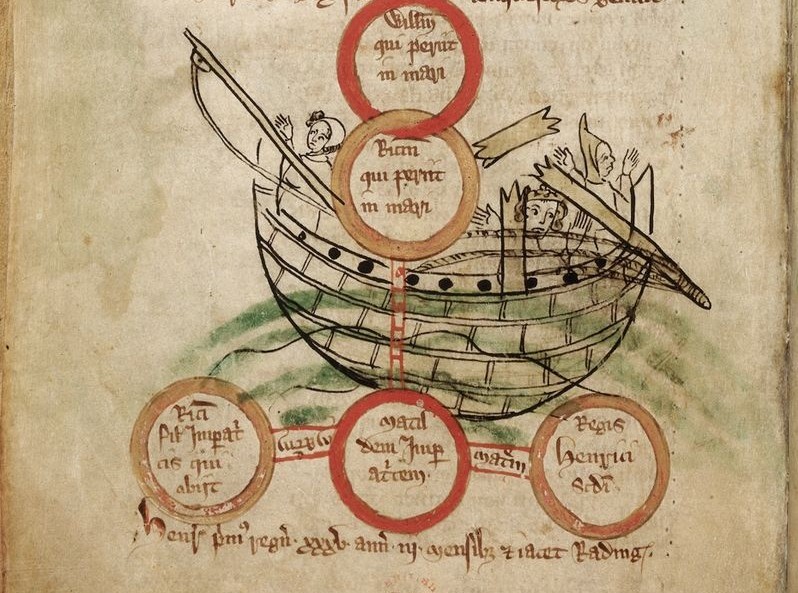 The White Ship: Henry I's son and heir William drowned.
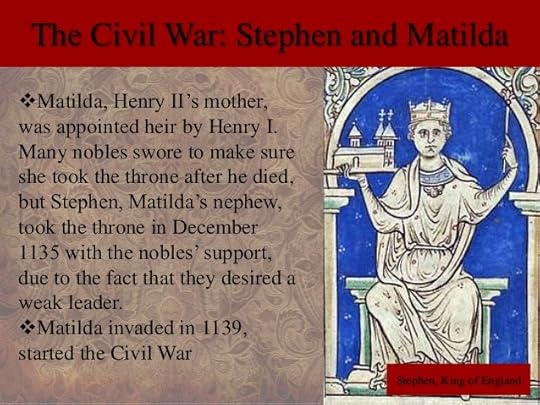
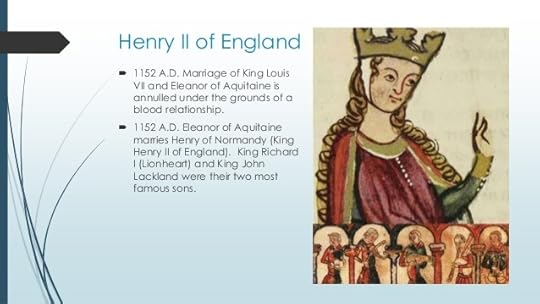
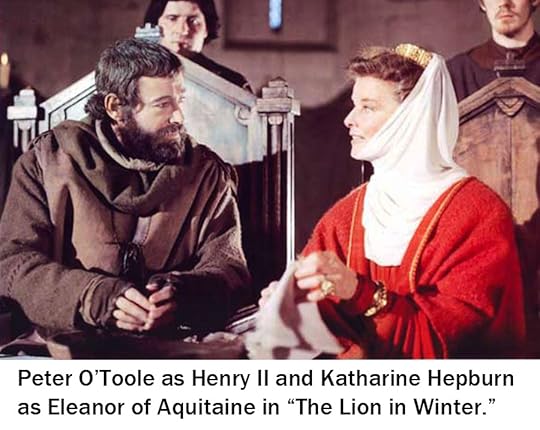
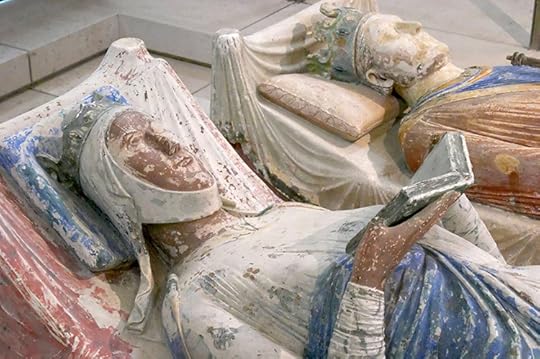
PART 2: ELEANOR: An Incomparable Woman 1124–1204: A casual observer at Henry II’s court in September 1166 might have been forgiven for thinking that Eleanor of Aquitaine was the most conventional of queens. A great heiress, famed for her beauty and her agile mind, she had brought her royal husband a rich inheritance that stretched from the green valleys of the Vienne river, where soft light danced on stately water as it flowed toward the Loire, to the foothills of the Pyrenees, where a stronger sun struck towering crags of granite and limestone.
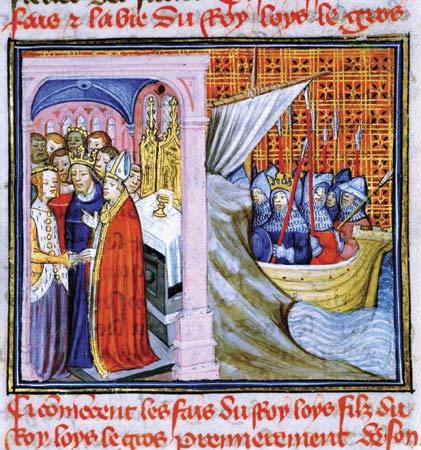 At left, a 14th-century representation of the wedding of Louis and Eleanor; at right, Louis leaving on Crusade.
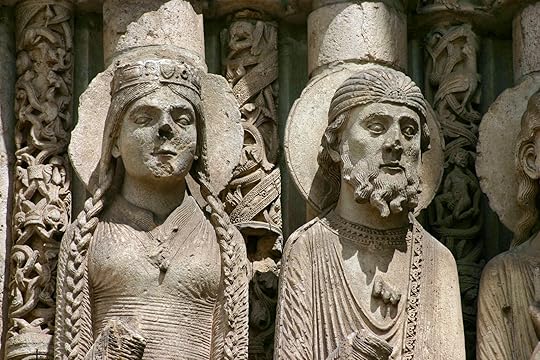 One of the most significant acts for political history was the divorce of Louis VII of France and Eleanor of Aquitaine in the 1150s.
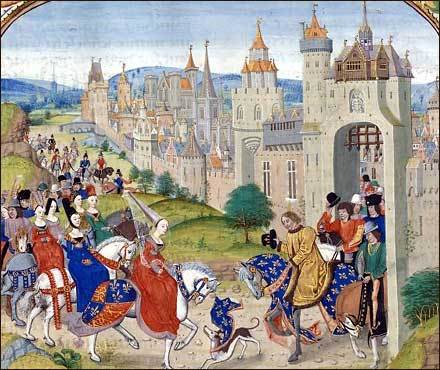
PART 3: ISABELLA: Iron Lady 1295–1358: It was a cold day in Boulogne, 25 January 1308, when two of Eleanor’s descendants met in the cathedral church of Our Lady to exchange their wedding vows. The bridegroom, King Edward II of England, great-grandson of Eleanor’s son John, was a tall and handsome figure, powerfully built and gorgeously dressed.
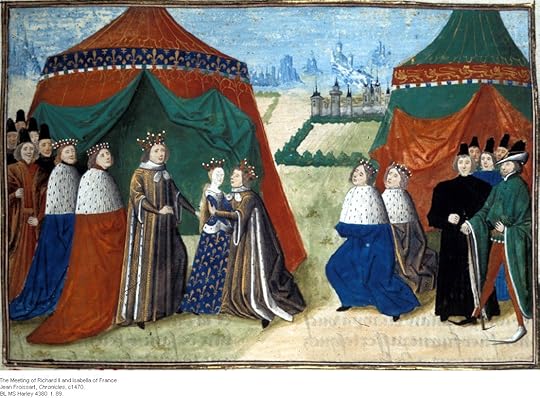

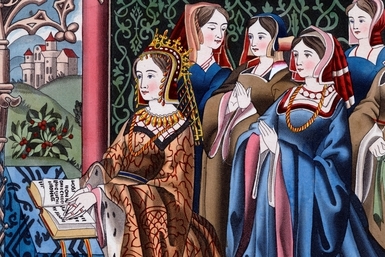
PART IV: MARGARET: A Great and Strong Laboured Woman 1430-1482: Margaret of Anjou was not born to be a queen. It was not that she lacked royal blood flowing through her veins: she was directly descended, after all, from Philippe of Valois, the king who had succeeded to the French throne after the deaths of Isabella’s brothers. Like Isabella herself, she could trace her line back to Eleanor of Aquitaine and the Empress Matilda.



NONFIC NOVEMBER 2015:
CR White Mughals
5* A History of England from the Tudors to the Stuarts
3* Rome and the Barbarians
4* Field Notes From A Hidden City
3* The King's Jews: Money, Massacre and Exodus in Medieval England
CR A History of Palestine 634-1099
3* Charlotte Brontë: A Life
3* The Alhambra
5* A Long Walk in the Himalaya: A Trek from the Ganges to Kashmir
3* Buddhist Warfare
4* A Gathering of Spoons
AB A Brief History of Roman Britain - Conquest and Civilization
4* Victorian Glassworlds: Glass Culture and the Imagination, 1830-1880
3* Food Safari
4* She-Wolves
3* India: A Portrait
2* The Archaeology of Ancient Sicily
In 1553, England was about to experience the ‘monstrous regiment’ - the unnatural rule - of a woman. But female rule in England also had a past. Four hundred years before Edward’s death, Matilda, daughter of Henry I and granddaughter of William the Conquerer, came tantalisingly close to securing her hold on the power of the crown. And between the 12th and the 15th centuries three more exceptional women - Eleanor of Aquitaine, Isabella of France, and Margaret of Anjou - discovered, as queens consort and dowager, how much was possible if the presumptions of male rule were not confronted so explicitly.
The stories of these women - told here in all their vivid humanity - illustrate the paradox which the female heirs to the Tudor throne had no choice but to negotiate. Man was the head of woman; and the king was the head of all. How, then, could a woman be king, how could royal power lie in female hands?
Opening: The boy in the bed was just fifteen years old. He had been handsome, perhaps even recently; but now his face was swollen and disfigured by disease, and by the treatments his doctors had prescribed in the attempt to ward off its ravages. Their failure could no longer be mistaken. The hollow grey eyes were ringed with red, and the livid skin, once fashionably translucent, was blotched with sores. The harrowing, bloody cough, which for months had been exhaustingly relentless, suddenly seemed more frightening still by its absence: each shallow breath now exacted a perceptible physical cost.
PART I: MATILDA: Lady of England 1102–1167: On 1 December 1135, another king of England lay dying. Not a boy but a man of nearly seventy, Henry I had ruled the English people for more than half his lifetime. A bull-like figure, stocky and powerfully muscular, Henry was a commanding leader, ‘the greatest of kings’, according to the chronicler Orderic Vitalis, who observed his rule admiringly from the cloisters of a Norman monastery.
A Surfeit of Lampreys
The White Ship: Henry I's son and heir William drowned.PART 2: ELEANOR: An Incomparable Woman 1124–1204: A casual observer at Henry II’s court in September 1166 might have been forgiven for thinking that Eleanor of Aquitaine was the most conventional of queens. A great heiress, famed for her beauty and her agile mind, she had brought her royal husband a rich inheritance that stretched from the green valleys of the Vienne river, where soft light danced on stately water as it flowed toward the Loire, to the foothills of the Pyrenees, where a stronger sun struck towering crags of granite and limestone.
At left, a 14th-century representation of the wedding of Louis and Eleanor; at right, Louis leaving on Crusade.One of the most significant acts for political history was the divorce of Louis VII of France and Eleanor of Aquitaine in the 1150s.PART 3: ISABELLA: Iron Lady 1295–1358: It was a cold day in Boulogne, 25 January 1308, when two of Eleanor’s descendants met in the cathedral church of Our Lady to exchange their wedding vows. The bridegroom, King Edward II of England, great-grandson of Eleanor’s son John, was a tall and handsome figure, powerfully built and gorgeously dressed.
PART IV: MARGARET: A Great and Strong Laboured Woman 1430-1482: Margaret of Anjou was not born to be a queen. It was not that she lacked royal blood flowing through her veins: she was directly descended, after all, from Philippe of Valois, the king who had succeeded to the French throne after the deaths of Isabella’s brothers. Like Isabella herself, she could trace her line back to Eleanor of Aquitaine and the Empress Matilda.
NONFIC NOVEMBER 2015:
CR White Mughals
5* A History of England from the Tudors to the Stuarts
3* Rome and the Barbarians
4* Field Notes From A Hidden City
3* The King's Jews: Money, Massacre and Exodus in Medieval England
CR A History of Palestine 634-1099
3* Charlotte Brontë: A Life
3* The Alhambra
5* A Long Walk in the Himalaya: A Trek from the Ganges to Kashmir
3* Buddhist Warfare
4* A Gathering of Spoons
AB A Brief History of Roman Britain - Conquest and Civilization
4* Victorian Glassworlds: Glass Culture and the Imagination, 1830-1880
3* Food Safari
4* She-Wolves
3* India: A Portrait
2* The Archaeology of Ancient Sicily
November 30, 2011
4.5/5
Over the years, for one reason or another, I've picked up a hell of a lot of English history through inadvertent measures. The Tudors and the Borgias are the two families I've studied on an amateur level since grade school, and a systematic repetition of Shakespeare at various levels of education and varied modes of entertainment has built up an instinctive recognition of names and plots that, for all the 16th-17th century fanfiction treatment, still serves me well. My story is not unusual for one born and bred in the military industrial complex inheritor of the most ubiquitous colonial monstrosity, and the fact that everyone in the stories looks like me only explains the sticking of stories to my inherent recall even more. Individual bits of truth, then, are not the pieces of worth in this field of knowledge, although the histories this work churns through has been such a fortuitous boon in my hardcore current study of Chaucer/Shakespearean Tragedy/Austen/Eliot(/Evans) that fickle fortune must indeed be contemplated.
The English Queen is dead. Long live the Queen. What's to be done now is to look at all this prescriptive junk that's built up over centuries of land, murder, betrayal, popularity contests, drowning, heterosexual fertility, non-heteronormativity, the word of God, the word of Fate, and plain and simple incompetence. We could've had a golden age far closer to Henry I and II than Henry VIII had a certain uncle not thrust his way into the limelight. There may have been a line of names that drowned Shakespeare's she-wolf in its own fear of backlash had a certain fool son not gone and gotten himself killed. The King is always male because that is how the dice happened to fall. That's it. Add in a little superstition, always the driving force of bigotry when sanctity of rule is made to hinge on color and skin and what lies between a person's legs, and of course you're going to get a certain type of malodorous conspiracy that demands incestuous begetting by reason of its previously successful incestuous history. It's not actually that successful of course when one looks at the sheer number of Henrys that just sat on the throne and failed, but that's not what they're going to teach you in school.
With regards to the more narratological aspects of this work, I like Castor's style. Between the mounds of unavoidably androcentric history, there's a very keen picking apart of just what was keeping Matilda and Eleanor and Isabella and Margaret from that Elizabeth-level undeniable proof in the history books. In some lives, the gynephobic rules of ruling had not yet firmly established themselves in the sociopolitical and religious contests, and what ultimately decided the fallout was a matter of speed and ease of conformity. In others, female despots are still despots, and the only difference between one successful revolution and the other is how nasty the historians are going to be about the usurper who had a womb. Looking back on the facts and the formulas that are the cause and consequence of any history of power, I can now appreciate just how much unorthodox spitting in the patriarchal eye had to go on before Elizabeth could become Elizabeth the First. If she didn't closely analyze the previous English histories of women coming to power and learn from every one, I'll eat my hat.
This is why history is so much fun. Between the learn-or-you-are-doomed-to-repeat and those on top wanting exactly that, you have the liminal realm where seemingly irrefutable states of being haven't yet had the time to become established. The King rules because of this. The Queen doesn't rule because of that. We do this because of this. We don't do this because of that. All very cute, those ways of following, but time waits for no indoctrination for the sake of inoculation. To those who disagree: I'll see you on the other side.
Over the years, for one reason or another, I've picked up a hell of a lot of English history through inadvertent measures. The Tudors and the Borgias are the two families I've studied on an amateur level since grade school, and a systematic repetition of Shakespeare at various levels of education and varied modes of entertainment has built up an instinctive recognition of names and plots that, for all the 16th-17th century fanfiction treatment, still serves me well. My story is not unusual for one born and bred in the military industrial complex inheritor of the most ubiquitous colonial monstrosity, and the fact that everyone in the stories looks like me only explains the sticking of stories to my inherent recall even more. Individual bits of truth, then, are not the pieces of worth in this field of knowledge, although the histories this work churns through has been such a fortuitous boon in my hardcore current study of Chaucer/Shakespearean Tragedy/Austen/Eliot(/Evans) that fickle fortune must indeed be contemplated.
The English Queen is dead. Long live the Queen. What's to be done now is to look at all this prescriptive junk that's built up over centuries of land, murder, betrayal, popularity contests, drowning, heterosexual fertility, non-heteronormativity, the word of God, the word of Fate, and plain and simple incompetence. We could've had a golden age far closer to Henry I and II than Henry VIII had a certain uncle not thrust his way into the limelight. There may have been a line of names that drowned Shakespeare's she-wolf in its own fear of backlash had a certain fool son not gone and gotten himself killed. The King is always male because that is how the dice happened to fall. That's it. Add in a little superstition, always the driving force of bigotry when sanctity of rule is made to hinge on color and skin and what lies between a person's legs, and of course you're going to get a certain type of malodorous conspiracy that demands incestuous begetting by reason of its previously successful incestuous history. It's not actually that successful of course when one looks at the sheer number of Henrys that just sat on the throne and failed, but that's not what they're going to teach you in school.
With regards to the more narratological aspects of this work, I like Castor's style. Between the mounds of unavoidably androcentric history, there's a very keen picking apart of just what was keeping Matilda and Eleanor and Isabella and Margaret from that Elizabeth-level undeniable proof in the history books. In some lives, the gynephobic rules of ruling had not yet firmly established themselves in the sociopolitical and religious contests, and what ultimately decided the fallout was a matter of speed and ease of conformity. In others, female despots are still despots, and the only difference between one successful revolution and the other is how nasty the historians are going to be about the usurper who had a womb. Looking back on the facts and the formulas that are the cause and consequence of any history of power, I can now appreciate just how much unorthodox spitting in the patriarchal eye had to go on before Elizabeth could become Elizabeth the First. If she didn't closely analyze the previous English histories of women coming to power and learn from every one, I'll eat my hat.
This is why history is so much fun. Between the learn-or-you-are-doomed-to-repeat and those on top wanting exactly that, you have the liminal realm where seemingly irrefutable states of being haven't yet had the time to become established. The King rules because of this. The Queen doesn't rule because of that. We do this because of this. We don't do this because of that. All very cute, those ways of following, but time waits for no indoctrination for the sake of inoculation. To those who disagree: I'll see you on the other side.
She was not bound, they said, by any of England's laws since the Conquest—and could therefore choose to sweep away the entire apparatus of the Reformation at will—because all previous statutes had been made in the name of England's king, while its queen was nowhere mentioned.

November 11, 2011
I borrowed this book from the library about a lifetime ago. So I really should be taking it back. But once you reach the max fine...really, what's the incentive?
The hold up was that I couldn't get into it. It's not that the subject isn't interesting, because I dare you to find something boring about Eleanor of Aquitaine. Double Dog Dare! The problem was the writing.
The first parts of the book were pretty much recitations of facts and happenings, with very little analysis. She covers Matilda, Eleanor of Aquitaine, Isabella of France, Margaret of Anjou, and Mary Tudor. And wow, did she skimp on Mary Tudor. I admit she wasn't Queen for long, but she deserved a few more pages at least.
It wasn't until she started comparing and explaining how these women fit together and set the stage for Elizabeth, perhaps influencing her that the author's passion came out. But those few pages simply can't make a book that drags along like a barge through muddy water.
It's a fine read if you have nothing better, but you'd be better off just picking out five biographies--and then reading a good one on Elizabeth.
The hold up was that I couldn't get into it. It's not that the subject isn't interesting, because I dare you to find something boring about Eleanor of Aquitaine. Double Dog Dare! The problem was the writing.
The first parts of the book were pretty much recitations of facts and happenings, with very little analysis. She covers Matilda, Eleanor of Aquitaine, Isabella of France, Margaret of Anjou, and Mary Tudor. And wow, did she skimp on Mary Tudor. I admit she wasn't Queen for long, but she deserved a few more pages at least.
It wasn't until she started comparing and explaining how these women fit together and set the stage for Elizabeth, perhaps influencing her that the author's passion came out. But those few pages simply can't make a book that drags along like a barge through muddy water.
It's a fine read if you have nothing better, but you'd be better off just picking out five biographies--and then reading a good one on Elizabeth.
April 15, 2014
This was supposed to be a quick note of thanks to the author, but it morphed into a review/fangirl squee/overshare. Enjoy! Or not.
* * *
Dear Dr. Castor,
I just finished your wonderful book, SHE-WOLVES: The Women Who Ruled England Before Elizabeth, and had to write you to rave. Also, I'm pretty annoyed at you because my book bill is about to go sky-high(er) and frankly, you might want to think about starting fundraisers for your readers, because I doubt I'm the only one with this problem.
I've been into the Tudors for years, especially Henry VIII and his wives, long before Showtime cast a slender brunette of medium height to play Henry. I read everything about them I could find and eventually started to get Tudor-ed out (there were only so many takes on Ann Boleyn's fall, and Henry's growing sociopathy and waistline, before I needed a break). So I started reading about the gang who came before (Henry VI, Edward IV, Richard III) and the Wars of the Roses, which is how I discovered Margaret of Anjou. In a word: whoa! (It's wrong that I want to see her and Elizabeth I in a cage match, right?) I couldn't believe the woman's courage, audacity, determination, and focus. So I started reading books about the Wars specifically to find out more about Margaret, though I also loved reading about Warwick losing his *hit when King Edward had the audacity to a) choose his own queen and b) be king. Which is how I ended up with SHE-WOLVES.
I'm embarrassed to say it sat in my TBR pile for a year. It wasn't entirely my fault--my eldest started college which I dealt with by re-reading all her favorite YA novels ("Remember reading the last Harry Potter book?" "I remember you wouldn't let me near it until you finished it, Mom, you harpy." "Oh the memories!"), and I got hooked on WORKAHOLICS, which is a terrible American comedy that is my walk of shame. Then I went through a graphic novel phase. (All right: another graphic novel phase. I go through about four a year. Don't judge me.) Then Philippa Gregory's THE WHITE QUEEN hit TV and reminded me how much I loved learning about the House of York, whose tenacity and courage was only exceeded by their inability to not devour each other.
Once the TV show had run its course, I remembered there was another kind of TV: books! And there was SHE-WOLVES, where it had held pride of place on my bookshelf for a year, nestled snugly beside Stephen King's DR. SLEEP and back issues of Fine Cooking magazine (I highly recommend the grilling issue!). When I picked up SHE-WOLVES, I was tempted to start at the end: with Margaret's story, since she was the reason I bought the book in the first place. Then I thought, well, Dr. Castor is probably going somewhere with Matilda and Eleanor of Aquitaine and Isabella of France. (I'm embarrassed to admit I only knew of Eleanor from being played by Glenn Close in a remake, and the only royal Isabella I knew of was Catherine of Aragon's mother, and the only famous Matilda I knew of was from Roald Dahl's book. I've got to stop telling you things I'm embarrassed about. I need to keep my humiliation to myself.) Their stories, I figured, might be relevant to Margaret's, or why else would you include them? On the other hand, why would you do any of the things you do? I don't know you. You could be an enigma. Or a Tory. (They still have those in England, right?) So maybe you had a plan when you included queens who weren't Margaret. Or maybe you didn't. I had nothing to go on, and in the end, I figured if their stories didn't grab me I'd just skip to Margaret.
Which brings me to my increasing book budget, since of course you made Matilda and Eleanor and Isabella pretty much leap off the page (a good trick in those medieval gowns). By the time you got to the White Ship disaster I was hooked--and that was only page 26! Of all the dumb ways for Henry I to lose his heir! The guy conquered Normandy but lost his son when a bunch of drunks tried to steer a ship through a rock, which was probably the twelfth century equivalent of losing your kid to a party bus crash. All that before we even got to Matilda, who proved that her father didn't just pass the badass gene to his son.
And then Eleanor of Aquitaine! History should just rename her Eleanor, Never To Be Messed With, and get it over with. She makes pretty much everyone who wasn't queen of at least two countries look like a slack-ass. Queen of France? Sure, but not enough of a challenge. Also, the king of France was great if you like amiable eunuchs, which she didn't, so buh-bye, King Louis. Queen of England? Sure, why not, she got all her queen practice out of the way in France. Oh, the king of England would like his line to continue? Sure, Eleanor says, here are five sons and three daughters. Go nuts. Eleanor was on board with pretty much everything King Henry II needed done, as long as she didn't have to choose between her sons and her husband. Oh. Whoops. Well, at least she didn't have to pay the price by being imprisoned for over a…oh. Whoops.
But then! Henry, known throughout history as King Grouchypants, was kind enough to die of a fever, leaving his son Richard in charge. King Richard made Son Of The Century by basically saying, "Mom, I gotta go force my religion on people I've never met who've never done me any harm, so: heeeeere's England! Have fun running the place." The Crusade thing was annoying, but as a mom, I appreciated his "no, really, my mom can have whatever she wants, including England, so stop bugging me because I have to go repress another culture" attitude. Eleanor did more in her last decade than I've done in three, which I should resent, but mostly I just admire.
Then: Isabella, married to a paranoid crybaby who held grudges like dragons store treasure, a guy who had no interest in letting his wife into his man cave (figuratively as well as literally). Nightmare. Isabella of France should be studied and admired solely for not strangling Edward II before their first anniversary. I know the movie BRAVEHEART is riddled with inaccuracy, but whenever I picture Edward II, I picture the weasel-face actor who played him, and I just want to punch things. Things like his face. Also, Isabella of France should be renamed Isabella of Awesome. So: Isabella of Awesome got to watch her husband/king do the medieval equivalent of passing notes in class to a guy he had a crush on, except instead of passing notes he was passing tons of land and money and titles. But at least Piers Gaveston, King Weasel-Face's man-crush, was mature and dignified and didn't use his influence to…yeah, I can't finish that sentence without giggling. But then Piers bit the big one, courtesy of the medieval equivalent of high school teachers cracking down on kids passing notes: they ran him through and cut off his head. That would teach King Edward II to pass notes! Except it didn't.
Queen Isabella decided deja vu all over again wasn't acceptable, so she put on the medieval equivalent of big girl panties and deposed King Weasel-Face and arranged a nasty death for Hugh Despenser (or as I call him, Piers Gaveston 2.0), and if she'd stopped there it would have been terrific but if she'd stopped there, she wouldn't be Isabella, Stomper of Weasel-Face. She went too far and had her ass handed to her (politely), but lived to tell the tale. The worst thing I can say about her is that she shouldn't have been surprised to find Edward III was his mother's son.
Finally, the reason I bought your book, Margaret of Anjou. By then, my Amazon wish list had increased by 12 books (damn you, Dr. Castor!) and I hadn't even finished SHE-WOLVES. And yep, by then I'd realized you had a plan when you told Matilda, Eleanor, and Isabella's stories first, because even I, with my American high school education, lack of college, and gross amount of TV watching (Do they have Game of Thrones in England? It's terrific.), could see the parallels in their lives. As a fan of watching medieval royal houses pretty much eat each other, I loved Margaret's story. As a mom, I ached for her when the one time she let her son leave her side and fight, he died. In battle, fighting for his father's crown, if that comforted her. It wouldn't have comforted me, but I wouldn't have lasted a week in any of their courts. There's a reason there isn't a book called SHE-BITCH: Why MaryJanice Davidson Should Never Have Been Allowed To Write.
Which brings me to…well, me. I'm fortunate enough to be published; most of my books are romantic comedy and paranormal chick-lit, and I threw some YA books in there, too, for the heck of it. When I'm on deadline I like to read the opposite of what I'm writing. So I'd ask myself, what is the literary opposite of a fluffy romantic comedy where everything works out perfectly for the feisty heroine…medieval English history! Emphasis on queens in a primitive patriarchy where you could get put to death for picking your nose in church! Where often nothing worked out and if you got a splinter it sometimes killed you! Perfect. Which is how I started with the Tudors and, a decade later, found SHE-WOLVES.
All that to say your book was wonderful and I'm assuming you are, too. I've got BLOOD AND ROSES on the way via Amazon, and I have my fingers crossed you're taking a break from writing another wonderful book to read this. Scratch that: I hope you're taking a break from finishing another wonderful book. Like, reading the galleys finished. It's about to be published finished. Because I'm hooked, and I've got to have more. You showed me an entire area of history I'd willfully ignored for years; I'm kind of hoping you'll be able to teach me trigonometry next. Many, many, many thanks.
Warmest regards,
MaryJanice Davidson
www.maryjanicedavidson.net
UNDEAD AND UNWARY, October 2014
* * *
Dear Dr. Castor,
I just finished your wonderful book, SHE-WOLVES: The Women Who Ruled England Before Elizabeth, and had to write you to rave. Also, I'm pretty annoyed at you because my book bill is about to go sky-high(er) and frankly, you might want to think about starting fundraisers for your readers, because I doubt I'm the only one with this problem.
I've been into the Tudors for years, especially Henry VIII and his wives, long before Showtime cast a slender brunette of medium height to play Henry. I read everything about them I could find and eventually started to get Tudor-ed out (there were only so many takes on Ann Boleyn's fall, and Henry's growing sociopathy and waistline, before I needed a break). So I started reading about the gang who came before (Henry VI, Edward IV, Richard III) and the Wars of the Roses, which is how I discovered Margaret of Anjou. In a word: whoa! (It's wrong that I want to see her and Elizabeth I in a cage match, right?) I couldn't believe the woman's courage, audacity, determination, and focus. So I started reading books about the Wars specifically to find out more about Margaret, though I also loved reading about Warwick losing his *hit when King Edward had the audacity to a) choose his own queen and b) be king. Which is how I ended up with SHE-WOLVES.
I'm embarrassed to say it sat in my TBR pile for a year. It wasn't entirely my fault--my eldest started college which I dealt with by re-reading all her favorite YA novels ("Remember reading the last Harry Potter book?" "I remember you wouldn't let me near it until you finished it, Mom, you harpy." "Oh the memories!"), and I got hooked on WORKAHOLICS, which is a terrible American comedy that is my walk of shame. Then I went through a graphic novel phase. (All right: another graphic novel phase. I go through about four a year. Don't judge me.) Then Philippa Gregory's THE WHITE QUEEN hit TV and reminded me how much I loved learning about the House of York, whose tenacity and courage was only exceeded by their inability to not devour each other.
Once the TV show had run its course, I remembered there was another kind of TV: books! And there was SHE-WOLVES, where it had held pride of place on my bookshelf for a year, nestled snugly beside Stephen King's DR. SLEEP and back issues of Fine Cooking magazine (I highly recommend the grilling issue!). When I picked up SHE-WOLVES, I was tempted to start at the end: with Margaret's story, since she was the reason I bought the book in the first place. Then I thought, well, Dr. Castor is probably going somewhere with Matilda and Eleanor of Aquitaine and Isabella of France. (I'm embarrassed to admit I only knew of Eleanor from being played by Glenn Close in a remake, and the only royal Isabella I knew of was Catherine of Aragon's mother, and the only famous Matilda I knew of was from Roald Dahl's book. I've got to stop telling you things I'm embarrassed about. I need to keep my humiliation to myself.) Their stories, I figured, might be relevant to Margaret's, or why else would you include them? On the other hand, why would you do any of the things you do? I don't know you. You could be an enigma. Or a Tory. (They still have those in England, right?) So maybe you had a plan when you included queens who weren't Margaret. Or maybe you didn't. I had nothing to go on, and in the end, I figured if their stories didn't grab me I'd just skip to Margaret.
Which brings me to my increasing book budget, since of course you made Matilda and Eleanor and Isabella pretty much leap off the page (a good trick in those medieval gowns). By the time you got to the White Ship disaster I was hooked--and that was only page 26! Of all the dumb ways for Henry I to lose his heir! The guy conquered Normandy but lost his son when a bunch of drunks tried to steer a ship through a rock, which was probably the twelfth century equivalent of losing your kid to a party bus crash. All that before we even got to Matilda, who proved that her father didn't just pass the badass gene to his son.
And then Eleanor of Aquitaine! History should just rename her Eleanor, Never To Be Messed With, and get it over with. She makes pretty much everyone who wasn't queen of at least two countries look like a slack-ass. Queen of France? Sure, but not enough of a challenge. Also, the king of France was great if you like amiable eunuchs, which she didn't, so buh-bye, King Louis. Queen of England? Sure, why not, she got all her queen practice out of the way in France. Oh, the king of England would like his line to continue? Sure, Eleanor says, here are five sons and three daughters. Go nuts. Eleanor was on board with pretty much everything King Henry II needed done, as long as she didn't have to choose between her sons and her husband. Oh. Whoops. Well, at least she didn't have to pay the price by being imprisoned for over a…oh. Whoops.
But then! Henry, known throughout history as King Grouchypants, was kind enough to die of a fever, leaving his son Richard in charge. King Richard made Son Of The Century by basically saying, "Mom, I gotta go force my religion on people I've never met who've never done me any harm, so: heeeeere's England! Have fun running the place." The Crusade thing was annoying, but as a mom, I appreciated his "no, really, my mom can have whatever she wants, including England, so stop bugging me because I have to go repress another culture" attitude. Eleanor did more in her last decade than I've done in three, which I should resent, but mostly I just admire.
Then: Isabella, married to a paranoid crybaby who held grudges like dragons store treasure, a guy who had no interest in letting his wife into his man cave (figuratively as well as literally). Nightmare. Isabella of France should be studied and admired solely for not strangling Edward II before their first anniversary. I know the movie BRAVEHEART is riddled with inaccuracy, but whenever I picture Edward II, I picture the weasel-face actor who played him, and I just want to punch things. Things like his face. Also, Isabella of France should be renamed Isabella of Awesome. So: Isabella of Awesome got to watch her husband/king do the medieval equivalent of passing notes in class to a guy he had a crush on, except instead of passing notes he was passing tons of land and money and titles. But at least Piers Gaveston, King Weasel-Face's man-crush, was mature and dignified and didn't use his influence to…yeah, I can't finish that sentence without giggling. But then Piers bit the big one, courtesy of the medieval equivalent of high school teachers cracking down on kids passing notes: they ran him through and cut off his head. That would teach King Edward II to pass notes! Except it didn't.
Queen Isabella decided deja vu all over again wasn't acceptable, so she put on the medieval equivalent of big girl panties and deposed King Weasel-Face and arranged a nasty death for Hugh Despenser (or as I call him, Piers Gaveston 2.0), and if she'd stopped there it would have been terrific but if she'd stopped there, she wouldn't be Isabella, Stomper of Weasel-Face. She went too far and had her ass handed to her (politely), but lived to tell the tale. The worst thing I can say about her is that she shouldn't have been surprised to find Edward III was his mother's son.
Finally, the reason I bought your book, Margaret of Anjou. By then, my Amazon wish list had increased by 12 books (damn you, Dr. Castor!) and I hadn't even finished SHE-WOLVES. And yep, by then I'd realized you had a plan when you told Matilda, Eleanor, and Isabella's stories first, because even I, with my American high school education, lack of college, and gross amount of TV watching (Do they have Game of Thrones in England? It's terrific.), could see the parallels in their lives. As a fan of watching medieval royal houses pretty much eat each other, I loved Margaret's story. As a mom, I ached for her when the one time she let her son leave her side and fight, he died. In battle, fighting for his father's crown, if that comforted her. It wouldn't have comforted me, but I wouldn't have lasted a week in any of their courts. There's a reason there isn't a book called SHE-BITCH: Why MaryJanice Davidson Should Never Have Been Allowed To Write.
Which brings me to…well, me. I'm fortunate enough to be published; most of my books are romantic comedy and paranormal chick-lit, and I threw some YA books in there, too, for the heck of it. When I'm on deadline I like to read the opposite of what I'm writing. So I'd ask myself, what is the literary opposite of a fluffy romantic comedy where everything works out perfectly for the feisty heroine…medieval English history! Emphasis on queens in a primitive patriarchy where you could get put to death for picking your nose in church! Where often nothing worked out and if you got a splinter it sometimes killed you! Perfect. Which is how I started with the Tudors and, a decade later, found SHE-WOLVES.
All that to say your book was wonderful and I'm assuming you are, too. I've got BLOOD AND ROSES on the way via Amazon, and I have my fingers crossed you're taking a break from writing another wonderful book to read this. Scratch that: I hope you're taking a break from finishing another wonderful book. Like, reading the galleys finished. It's about to be published finished. Because I'm hooked, and I've got to have more. You showed me an entire area of history I'd willfully ignored for years; I'm kind of hoping you'll be able to teach me trigonometry next. Many, many, many thanks.
Warmest regards,
MaryJanice Davidson
www.maryjanicedavidson.net
UNDEAD AND UNWARY, October 2014

September 3, 2011
Maybe it’s because I’m already at least somewhat familiar with all the historical figures explored within, but I devoured Helen Castor’s latest historical non-fiction in two days flat. I enjoyed the dual experience of uncovering new snippets of information or a fresh interpretation of the reigns of figures familiar to me, and also learning a whole lot more about other historical personages who I had previously known only the real basics about. Castor painted a real picture of the times these women lived in, setting the scene and really adding to the reader’s understanding of the social mores of the day and perhaps just why some of these ladies could not achieve rule in their own right. More than that, the read was enjoyable and easy; I was practically tearing through the pages, and encountered no stumbling blocks along the way. It’s worth keeping in mind that as a book with a multi-period focus, She-Wolves does not present an intensive focus on any one of the historical figures covered, but rather it pulls together the disparate strands of history to answer the questions of the book’s theme and show us a valuable insight into the bigger picture. Worth reading.
8 out of 10.
8 out of 10.

November 21, 2020
Empress Matilda: I knew nothing about her, so this section was fascinating.
Eleanor of Aquitaine: I knew the most about her, but Castor's writing kept me fully engaged and it was exciting to remember and learn new things.
Isabella of France: Zoned out a bit because a lot of her section seemed to focus more on her husband, Edward, which was unfortunate.
Margaret of Anjou: I've heard of her (thanks, Shakespeare!) although I remain unfamiliar with the tetralogy of plays where he depicts her. This grabbed my attention after the disappointment of Isabella.
Jane Grey: A quick mention prior to Mary, and old territory for me as far as Tudor history.
Mary I: I always mix up Mary Tudor and Mary, Queen of Scots. No idea why. But this was a good refresher that this is Elizabeth I's elder sister, first daughter of Henry VIII by Catherine of Aragon. Again, Tudor History 101.
This was a great book, especially if you're at all interested in a) any of these women or b) women rulers, period. The audiobook was well narrated by Esther Wane.
Eleanor of Aquitaine: I knew the most about her, but Castor's writing kept me fully engaged and it was exciting to remember and learn new things.
Isabella of France: Zoned out a bit because a lot of her section seemed to focus more on her husband, Edward, which was unfortunate.
Margaret of Anjou: I've heard of her (thanks, Shakespeare!) although I remain unfamiliar with the tetralogy of plays where he depicts her. This grabbed my attention after the disappointment of Isabella.
Jane Grey: A quick mention prior to Mary, and old territory for me as far as Tudor history.
Mary I: I always mix up Mary Tudor and Mary, Queen of Scots. No idea why. But this was a good refresher that this is Elizabeth I's elder sister, first daughter of Henry VIII by Catherine of Aragon. Again, Tudor History 101.
This was a great book, especially if you're at all interested in a) any of these women or b) women rulers, period. The audiobook was well narrated by Esther Wane.

January 9, 2012
Had to re-Read...to get who is who straight again..geez..
4 1/2 Stars.. again
Normally, I will only read historical-biographies when I'm reading a book about a historical figure that I really don't know much about their background...only that they fit in a certain period of time between such and such Queen or such and such King.
I find some of them ( historical figures ) very confusing and I still get them mixed up...what can I say *shrugs*
Now if the names back then weren't all the same it be a piece of cake, at least for me.
So, I will pick up a book at the library that usually helps me out...but they are SO dry, and I always skim just to get what I need :)
But with Helen Castor's "She Wolves" I did not find it dry at all, and I actually understood what was being said without still being confused.
No skimming..the author not only filled in the blanks for me but she made it understandable AND interesting.
This is a keeper for me to refer back to... which I had to do again this month.
Now I look forward to reading further books on the other women who ruled before Elizabeth I .
The Tutors I'm ok with there, I have them down pact.
No issues there.
Now....if Helen Castor could write about the "Richards" I may just get the hang of "who was who." And where and when.
There is hope for me yet. :)
4 1/2 Stars.. again
Normally, I will only read historical-biographies when I'm reading a book about a historical figure that I really don't know much about their background...only that they fit in a certain period of time between such and such Queen or such and such King.
I find some of them ( historical figures ) very confusing and I still get them mixed up...what can I say *shrugs*
Now if the names back then weren't all the same it be a piece of cake, at least for me.
So, I will pick up a book at the library that usually helps me out...but they are SO dry, and I always skim just to get what I need :)
But with Helen Castor's "She Wolves" I did not find it dry at all, and I actually understood what was being said without still being confused.
No skimming..the author not only filled in the blanks for me but she made it understandable AND interesting.
This is a keeper for me to refer back to... which I had to do again this month.
Now I look forward to reading further books on the other women who ruled before Elizabeth I .
The Tutors I'm ok with there, I have them down pact.
No issues there.
Now....if Helen Castor could write about the "Richards" I may just get the hang of "who was who." And where and when.
There is hope for me yet. :)

September 16, 2016
Really excellent history and an easy and compelling read. I had been involved in a discussion on the subjects of this book with a fellow GR reviewer and friend which inspired me to read it myself and I am glad that I did. For myself, the most interesting sections were on Isabelle and Margaret of Anjou, simply because they were less well known to me but I enjoyed this so much that I have every intention of reading anything and everything that Helen Castor writes.
NB Forgot to say I was sorry to see Ms Castor state in the last page of the Margaret of Anjou section that Richard III went on to usurp the throne and murder his nephews. There really is no excuse these days for making a statement like that as if it is fact.
NB Forgot to say I was sorry to see Ms Castor state in the last page of the Margaret of Anjou section that Richard III went on to usurp the throne and murder his nephews. There really is no excuse these days for making a statement like that as if it is fact.

May 19, 2022
This was delightful and wonderfully well researched.
I thoroughly enjoyed this
I thoroughly enjoyed this

September 22, 2021
This is a well-researched and highly readable book. Recently, more scholarship has been focused on women who impacted the time time in which they lived and this is part of that. Helen Caster, a professor at Cambridge, has made some great contributions to the history of the Middle Ages and has made it enjoyable to read. She has re-written the verdict on Matilda, the woman who should have been king following Henry I. Previously written off as a she-wolf who, because she was a woman was judged by a different set of standards than men by historians throughout the ages. On the eve of her coronation, she was chased out of London by an angry mob. There are several other women whose attempts to exercise power were thwarted by men and they are profiled in the book. From Eleanor of Acquitaine to the other remarkable women profiled, this book is well worth the time spent reading it.

February 25, 2011
I can't remember the last time I spent three-plus weeks reading a book straight through. In retrospect, maybe I should have alternated queenly chapters with lighter reading, but I found this fascinating on the whole and was highly motivated by wanting to see what happened next. I found this very dense, rather than dry, and actually a lot of fun. But it was slow going keeping all the Edwards and Isabellas straight, making sure I was following which faction was on which side at any given time -- allegiances were constantly shifting, trusted allies double-crossing each other, loyalties formed and broken. The reward for paying such close attention was a truly gripping set of stories.
I wish I'd read this before Niccolò Rising, just to have a more solid understanding of the intrigues gripping Europe at the time -- I've been pretty history-impaired most of my life and catching up now, with an adult's knowledge of the world's workings, is a lot of fun. And it's got me craving the next installment of Wolf Hall.
Recommended for fans of history and politics and patient, attentive readers.
I wish I'd read this before Niccolò Rising, just to have a more solid understanding of the intrigues gripping Europe at the time -- I've been pretty history-impaired most of my life and catching up now, with an adult's knowledge of the world's workings, is a lot of fun. And it's got me craving the next installment of Wolf Hall.
Recommended for fans of history and politics and patient, attentive readers.

July 25, 2020
I read this because I had enjoyed the documentary shown on public television years ago, and thought it would fit a reading challenge in the Book for All Seasons group to read “a book that shows things from the perspective of those who lost or were kept from controlling their destiny.”
First off, Castor is a very good writer, but as an American not very well-versed in British history, I was lost a few times among all the titles, especially in the section on Margaret of Anjou and the War of the Roses.
I did, however, learn much more about Henry VI, Margaret’s husband, that I did not know - he was mentally weak and even catatonic at one point. This made him a weak and easily manipulated king, and made it clear how Margaret, as both the wife of a king and mother of a future king, would have a great deal at stake in the quest for power.
Indeed, all of the “she-wolves” profiled - Matilda, Eleanor of Aquitaine, Margaret, Isabella, Jane Grey, Mary - were handicapped by being women seeking to wield power, unless they were seen as doing so as a protective mother or wife. I thought that was particularly important, especially now, as America grapples with yet another very divisive presidential election. In 2016, Hilary Clinton won the popular vote but lost the Electoral College, and was pummeled throughout the election for not being “likable” enough - a standard not so frequently applied to male candidates. Although much of the world is comfortable with women in leadership positions, Americans still have a ways to go.
The queens in this book were held back also, because at the time, it was expected a king would be a warrior also, able to lead armies and fight for territory or power. Also, if like Isabella or Margaret, they were foreign-born princesses who married the English king, they were suspected of trying to gain personal power illegitimately unless it was to preserve the royal rights of a son.
I found this very interesting and would like to read more especially about Eleanor of Aquitaine, and the War of the Roses. Luckily, Castor has a very helpful end chapter on notes and further sources for reading.
First off, Castor is a very good writer, but as an American not very well-versed in British history, I was lost a few times among all the titles, especially in the section on Margaret of Anjou and the War of the Roses.
I did, however, learn much more about Henry VI, Margaret’s husband, that I did not know - he was mentally weak and even catatonic at one point. This made him a weak and easily manipulated king, and made it clear how Margaret, as both the wife of a king and mother of a future king, would have a great deal at stake in the quest for power.
Indeed, all of the “she-wolves” profiled - Matilda, Eleanor of Aquitaine, Margaret, Isabella, Jane Grey, Mary - were handicapped by being women seeking to wield power, unless they were seen as doing so as a protective mother or wife. I thought that was particularly important, especially now, as America grapples with yet another very divisive presidential election. In 2016, Hilary Clinton won the popular vote but lost the Electoral College, and was pummeled throughout the election for not being “likable” enough - a standard not so frequently applied to male candidates. Although much of the world is comfortable with women in leadership positions, Americans still have a ways to go.
The queens in this book were held back also, because at the time, it was expected a king would be a warrior also, able to lead armies and fight for territory or power. Also, if like Isabella or Margaret, they were foreign-born princesses who married the English king, they were suspected of trying to gain personal power illegitimately unless it was to preserve the royal rights of a son.
I found this very interesting and would like to read more especially about Eleanor of Aquitaine, and the War of the Roses. Luckily, Castor has a very helpful end chapter on notes and further sources for reading.

August 21, 2020
I've always loved medieval history, and especially about the women of the period, so this book is right up my alley. This book is essentially about all of the women who laid the groundwork for Mary I and Elizabeth I to be able to rule in their own right. What's especially great about this book is that it is too easy at times for people to come up with this retroactively feminist story and noble actions that didn't fit what actually happened, and I felt that Castor was fair when it came to saying when the judgments of the time were harsh, and when the women actually made flawed and poor decisions. It was also really interesting to read about the roles of queens vs kings, like how queens could beg for mercy for subjects to the king, so the king would be seen as merciful, without the queen asking for mercy they would be seen as weak. Elizabeth I and Mary I might have the title of queens, but they saw themselves more like kings, so they had to be both king and queen.
That being said, this is not a good introductory book for people who don't know much about the topic. A lot of names and information is thrown at you very quickly, and especially since this book hops between a few time periods. Particularly Margaret of Anjou's section skimmed over the Wars of the Roses very quickly, with the last paragraph quickly talking about Edward IV's fall, the princes in the tower, Richard III's fall and Henry VII's rise to the throne which of course is important for how the Tudors got into power. There were plenty of instances where you could tell events were important but were mentioned very briefly, even when they led to Jane Grey's execution and Elizabeth I's imprisonment. This is understandable since a very large time period is being covered within a certain amount of pages, but I would suggest looking up some information about these women and the time period on wikipedia or something beforehand to get more of a foundation.
I got a degree in medieval history so none of the big events were new to me, but even so I felt like I learned some new information and gained a new appreciation and perspective.
That being said, this is not a good introductory book for people who don't know much about the topic. A lot of names and information is thrown at you very quickly, and especially since this book hops between a few time periods. Particularly Margaret of Anjou's section skimmed over the Wars of the Roses very quickly, with the last paragraph quickly talking about Edward IV's fall, the princes in the tower, Richard III's fall and Henry VII's rise to the throne which of course is important for how the Tudors got into power. There were plenty of instances where you could tell events were important but were mentioned very briefly, even when they led to Jane Grey's execution and Elizabeth I's imprisonment. This is understandable since a very large time period is being covered within a certain amount of pages, but I would suggest looking up some information about these women and the time period on wikipedia or something beforehand to get more of a foundation.
I got a degree in medieval history so none of the big events were new to me, but even so I felt like I learned some new information and gained a new appreciation and perspective.

June 6, 2011
I found myself choosing this book over my current fiction reads when I sat down at home and had a choice of things to pick up. Now THAT'S saying something about the style of writing and the stories told.
I love that this book spans so many years of the English monarchy, and that as I was reading I could think of the historical fiction and movies that were set in the same time. We start with Matilda (this is the era of the Brother Cadfael Mysteries if you've read or seen those), who was daughter to King Henry but lost her throne to her cousin Stephen. I kept thinking that if only Matilda had known how to negotiate the nobles the way Elizabeth I seemed to, she may yet have changed the course of history by being the first queen to reign in her own right. Instead, the crown passes to her son and she must be content with that.
Next up was Eleanor of Aquitaine, who was married to both the king of France and the king of England in her lifetime. If you've read Sharan Newman's Catherine LeVendeur series you'll know this period of time, and I recognized the names of many of the French courtiers. Eleanor was also mother of two kings--Richard (the Lionhearted) and John, and she ruled while Richard was away at the crusades. Yes, folks, this is the time of Robin Hood. Although, the real version of events doesn't quite match the Disney version (though, what does match a Disney version of events?). Let's just say it wasn't John who raised the taxes in the Shire of Nottingham, and Richard basically bankrupted the country by getting himself kidnapped and ransomed by the Holy Roman Emperor. That being said, he was still a much better king than his brother John, who managed to lose most of the territory his father had won on the continent.
On to the era of Braveheart and Queen Isabella who had to put up with her (apparently) bisexual husband King Edward II whose fondness for men of his court became such a distraction that he either neglected his ruling duties or used them only to get revenge on those who opposed him. Unlike in Braveheart, however, Edward II was not effeminate and most likely would have been a fine king if he didn't have unchecked royal ADD. (I'm the king and you better not tell me what to do and oh, look! Someone in a shiny coat to distract me!) Instead, Isabella went and swiped their son as basically a hostage while she plotted Edward II's overthrow with her new lover. Too bad that her son didn't like the way his mother ruled in his place and eventually overthrew HER to become Edward III. Mother got sent off to live in some remote castle while her lover was beheaded.
Now we come to Margaret, queen to King Henry VI the Bemused. This is the era of Shakespeare's histories, and as the Wars of the Roses unfolded on paper, all I could think of was the famous Richard III speech, "Now is the winter of our discontent made glorious summer by the son of York." (Hope I got that quote right because that's what I've been thinking of this whole time!) Poor poor Margaret, who was dealt the worst hand of all the women in this book because she was paralyzed by the youth of her son and the incapacity of her husband. There was a history of mental illness on his mother's side, and this was ultimately what inhibited his ability to rule. He failed to understand the fundamental principals of authority and let everyone walk all over him.
Finally, we come to the death of Edward VI and the ascension of Mary Tudor and, eventually, Elizabeth I to the throne. In this format you can really see how the other queens influenced the way that Mary and Elizabeth were ultimately able to gain power in their own right. I am a bit of an Elizabeth fanatic, but I have always read her biographies and so only knew the background of her father's reign and how that influenced her. This was very telling.
Also, the book's format makes it so much easier to see the intertwined nature of European politics and how the countries became more distinct and more distrustful of each other as time went on. Actually reading about the territories lost and one and the rise of one power at the expense of another really gives you an idea of the politics that led to so many historical events. So often in school we are treated to a version of history that follows a straight line through time, but books like this show you that history is really an interconnected web with many strands crossing each other over time. I highly recommend this book to anyone interested in English history or in the history of Western Europe in general.
I love that this book spans so many years of the English monarchy, and that as I was reading I could think of the historical fiction and movies that were set in the same time. We start with Matilda (this is the era of the Brother Cadfael Mysteries if you've read or seen those), who was daughter to King Henry but lost her throne to her cousin Stephen. I kept thinking that if only Matilda had known how to negotiate the nobles the way Elizabeth I seemed to, she may yet have changed the course of history by being the first queen to reign in her own right. Instead, the crown passes to her son and she must be content with that.
Next up was Eleanor of Aquitaine, who was married to both the king of France and the king of England in her lifetime. If you've read Sharan Newman's Catherine LeVendeur series you'll know this period of time, and I recognized the names of many of the French courtiers. Eleanor was also mother of two kings--Richard (the Lionhearted) and John, and she ruled while Richard was away at the crusades. Yes, folks, this is the time of Robin Hood. Although, the real version of events doesn't quite match the Disney version (though, what does match a Disney version of events?). Let's just say it wasn't John who raised the taxes in the Shire of Nottingham, and Richard basically bankrupted the country by getting himself kidnapped and ransomed by the Holy Roman Emperor. That being said, he was still a much better king than his brother John, who managed to lose most of the territory his father had won on the continent.
On to the era of Braveheart and Queen Isabella who had to put up with her (apparently) bisexual husband King Edward II whose fondness for men of his court became such a distraction that he either neglected his ruling duties or used them only to get revenge on those who opposed him. Unlike in Braveheart, however, Edward II was not effeminate and most likely would have been a fine king if he didn't have unchecked royal ADD. (I'm the king and you better not tell me what to do and oh, look! Someone in a shiny coat to distract me!) Instead, Isabella went and swiped their son as basically a hostage while she plotted Edward II's overthrow with her new lover. Too bad that her son didn't like the way his mother ruled in his place and eventually overthrew HER to become Edward III. Mother got sent off to live in some remote castle while her lover was beheaded.
Now we come to Margaret, queen to King Henry VI the Bemused. This is the era of Shakespeare's histories, and as the Wars of the Roses unfolded on paper, all I could think of was the famous Richard III speech, "Now is the winter of our discontent made glorious summer by the son of York." (Hope I got that quote right because that's what I've been thinking of this whole time!) Poor poor Margaret, who was dealt the worst hand of all the women in this book because she was paralyzed by the youth of her son and the incapacity of her husband. There was a history of mental illness on his mother's side, and this was ultimately what inhibited his ability to rule. He failed to understand the fundamental principals of authority and let everyone walk all over him.
Finally, we come to the death of Edward VI and the ascension of Mary Tudor and, eventually, Elizabeth I to the throne. In this format you can really see how the other queens influenced the way that Mary and Elizabeth were ultimately able to gain power in their own right. I am a bit of an Elizabeth fanatic, but I have always read her biographies and so only knew the background of her father's reign and how that influenced her. This was very telling.
Also, the book's format makes it so much easier to see the intertwined nature of European politics and how the countries became more distinct and more distrustful of each other as time went on. Actually reading about the territories lost and one and the rise of one power at the expense of another really gives you an idea of the politics that led to so many historical events. So often in school we are treated to a version of history that follows a straight line through time, but books like this show you that history is really an interconnected web with many strands crossing each other over time. I highly recommend this book to anyone interested in English history or in the history of Western Europe in general.

March 5, 2012
She-Wolves is a much more dynamic and pacey work on some of the strong-willed and powerful queens that ruled England, compared to Lisa Hilton's Queens Consort -- though that, covering the entire medieval period rather than selected queens, is more complete. Helen Castor's writing is better, though, and her selection of queens makes her work more interesting because they're the queens who wielded real power.
She discusses Empress Matilda, Eleanor of Acquitaine, Isabella of France, and Marguerite of Anjou, and the way their reigns over England (mostly as Queens Consort) shaped the situation which allowed Lady Jane Grey, Mary Tudor and Elizabeth I to rule. Her idea that those four queens were the instrumental ones seems sound to me, and she enquires into their lives with care, showing the queens' qualities that made them perfect for their roles (and the qualities which let them down).
The fact that history is driven, in that period, mostly by the male sex is unfortunate: though the book is intended to focus on the 'She-Wolves', inevitably they're seen in relation to their fathers, husbands and sons, and much of the action described involves the actions of men. Still, considering the period of history, Castor manages to shine a satisfying light on the actions of women as well.
She discusses Empress Matilda, Eleanor of Acquitaine, Isabella of France, and Marguerite of Anjou, and the way their reigns over England (mostly as Queens Consort) shaped the situation which allowed Lady Jane Grey, Mary Tudor and Elizabeth I to rule. Her idea that those four queens were the instrumental ones seems sound to me, and she enquires into their lives with care, showing the queens' qualities that made them perfect for their roles (and the qualities which let them down).
The fact that history is driven, in that period, mostly by the male sex is unfortunate: though the book is intended to focus on the 'She-Wolves', inevitably they're seen in relation to their fathers, husbands and sons, and much of the action described involves the actions of men. Still, considering the period of history, Castor manages to shine a satisfying light on the actions of women as well.

September 15, 2020
The title sums it up exactly: Helen Castor writes about five formidable Queens of England who came before Elizabeth and held power in their own hands. She tells their remarkable stories, while finding the great limits a man’s world was putting on their power as “a weak vessel”.
The Queens, in order, are:
1. The Empress Mathilda of the 12th century, who inherited the throne from her father, Henry I, but it was usurped by her cousin, Stephen. When she tried to rule like a man, she was denounced as haughty and unnatural, and wanting to do what she see fit. Something no male ruler had to apologize for. At the end she could only secure the throne for her son, not herself.
2. Eleanor of Aquitane, wife of Henry II, Mathilda’s son. This heiress to the richest Duchy in France divorced the French King when she did not like her husband - something only men did at the time - and married the English King right away, bearing him eight children. Her rebelliousness came when she took the side of her sons in a dispute between them and their father. In old age she tirelessly worked for her sons as queen regent when they were away, and as royal envoy.
3. Queen Isabella, she-wolf of France, wife of Edward II, mother of Edward III, daughter of the French King Philip the Fair, and the most kingly of all of them - had she been not barred from inheriting the throne by her sex. Edward II terribly mismanaged the country and allowed his favorites to rule and hoard the treasure of the country. So when Isabella rebelled, she found that the country joined her. She was the only person in history to lead a successful invasion of England. She deposed her husband and installed her son as King, and ruled in his name.
4. Margaret of Anjou, Henry VI’s wife, who single-handedly kept the Lancastrian side of the War of the Roses afloat, as her husband was a useless half-wit.
5. Mary Tudor, who, among these illustrious ladies, was the first proclaimed queen in her own right. (Jane Gray was only 9 days, and did not want it). She displayed considerable courage and defined the role of a ruling queen: she was king as well as queen, the slogan that her sister and much more famous heir, Elizabeth, has adopted.
There are too many queens and too many stories to tell, which result in often rushed telling, sidelining of major events like the murder of Thomas Beckett or the War of the Roses to a mere byline. I have already read books about all of these events and queens by my go-to historian, Alison Weir. Castor and Weir have very different approaches: Weir is slower, more methodical, and dwelves more into the character of these historical figures. Castor is focused on telling a coherent story, which makes it more fluid and without tedious details; at the same time, the lack of those details makes the story too vague, rushed, and the characters flat.
Castor is interested in feminist themes of these stories: how female rule was perceived, the very real conplications of a queen’s marriage and children, the acceptance of female authority. She is concerned with the legitimacy of rule: the blood right, the sanctity of coronation, and how a woman could reconcile ruling in her own right with owing obedience as wife to her husband. We had different solutions here: Isabella got rid of her husband; Mary married a foreigner and did not crown him; and Elizabeth did not marry at all, preferring to avoid the issue and establishing absolute, unquestioned power. She was married to her subjects, and was the most beloved English monarch of all time.
The Queens, in order, are:
1. The Empress Mathilda of the 12th century, who inherited the throne from her father, Henry I, but it was usurped by her cousin, Stephen. When she tried to rule like a man, she was denounced as haughty and unnatural, and wanting to do what she see fit. Something no male ruler had to apologize for. At the end she could only secure the throne for her son, not herself.
2. Eleanor of Aquitane, wife of Henry II, Mathilda’s son. This heiress to the richest Duchy in France divorced the French King when she did not like her husband - something only men did at the time - and married the English King right away, bearing him eight children. Her rebelliousness came when she took the side of her sons in a dispute between them and their father. In old age she tirelessly worked for her sons as queen regent when they were away, and as royal envoy.
3. Queen Isabella, she-wolf of France, wife of Edward II, mother of Edward III, daughter of the French King Philip the Fair, and the most kingly of all of them - had she been not barred from inheriting the throne by her sex. Edward II terribly mismanaged the country and allowed his favorites to rule and hoard the treasure of the country. So when Isabella rebelled, she found that the country joined her. She was the only person in history to lead a successful invasion of England. She deposed her husband and installed her son as King, and ruled in his name.
4. Margaret of Anjou, Henry VI’s wife, who single-handedly kept the Lancastrian side of the War of the Roses afloat, as her husband was a useless half-wit.
5. Mary Tudor, who, among these illustrious ladies, was the first proclaimed queen in her own right. (Jane Gray was only 9 days, and did not want it). She displayed considerable courage and defined the role of a ruling queen: she was king as well as queen, the slogan that her sister and much more famous heir, Elizabeth, has adopted.
There are too many queens and too many stories to tell, which result in often rushed telling, sidelining of major events like the murder of Thomas Beckett or the War of the Roses to a mere byline. I have already read books about all of these events and queens by my go-to historian, Alison Weir. Castor and Weir have very different approaches: Weir is slower, more methodical, and dwelves more into the character of these historical figures. Castor is focused on telling a coherent story, which makes it more fluid and without tedious details; at the same time, the lack of those details makes the story too vague, rushed, and the characters flat.
Castor is interested in feminist themes of these stories: how female rule was perceived, the very real conplications of a queen’s marriage and children, the acceptance of female authority. She is concerned with the legitimacy of rule: the blood right, the sanctity of coronation, and how a woman could reconcile ruling in her own right with owing obedience as wife to her husband. We had different solutions here: Isabella got rid of her husband; Mary married a foreigner and did not crown him; and Elizabeth did not marry at all, preferring to avoid the issue and establishing absolute, unquestioned power. She was married to her subjects, and was the most beloved English monarch of all time.

February 13, 2019
Rounded up from 2.5 stars. This is a fascinating topic but Castor is a dreadfully dull writer. This should not have taken me so long to get through.

April 9, 2014
A few months ago, I was channel-surfing for something to watch while ironing, and one of the local channels had a series called She-Wolves about the queens who fought for their right to rule. The first queen of England whose name meant anything to me was Mary, and I watched out of curiosity, intending to switch channels when the show became boring. My ironing wasn't done that night.
Considering that the overwhelming majority of the historical record springs from the pens of men, Helen Castor has a sizable task before her. (In fact, she frequently laments that the historical record is silent when the story is just getting good.) But she is far more of a scholar than I am, and she writes fascinating histories of the four women who preceded Henry VIII's daughters (and Jane Grey): Matilda, Eleanor, Isabella, and Margaret.
She frequently quotes her sources, and her sources were contemporaneous to her subjects, so I knew I wasn't just taking her word for it. And, somehow, she turns what could have been dry narratives into riveting adventure stories with love, lust, scheming, betrayals . . . enough to rival any HBO series.
I have to say, though, that Margaret (the she-wolf herself) bored me. After the battles waged by Matilda, Eleanor, and Isabella, court intrigue didn't satisfy me.
Considering that the overwhelming majority of the historical record springs from the pens of men, Helen Castor has a sizable task before her. (In fact, she frequently laments that the historical record is silent when the story is just getting good.) But she is far more of a scholar than I am, and she writes fascinating histories of the four women who preceded Henry VIII's daughters (and Jane Grey): Matilda, Eleanor, Isabella, and Margaret.
She frequently quotes her sources, and her sources were contemporaneous to her subjects, so I knew I wasn't just taking her word for it. And, somehow, she turns what could have been dry narratives into riveting adventure stories with love, lust, scheming, betrayals . . . enough to rival any HBO series.
I have to say, though, that Margaret (the she-wolf herself) bored me. After the battles waged by Matilda, Eleanor, and Isabella, court intrigue didn't satisfy me.

December 2, 2014
While each of the women covered in She-Wolves was fascinating and Helen Castor did an admirable job writing this book, the unfortunate truth is that there isn't enough in the historical record on many of these women to write in-depth on them and them alone. As a result, the book often ends up reciting the history of the men around these women, with occasional commentary on what the women were probably feeling or doing shoe-horned in.
The result is a large amount of history condensed to roughly 100 pages for each woman, with a good amount of interpretation by the author.
Matilda's section felt like it had been stretched to better match the length of the other three primary subjects.
Margaret of Anjou's section felt as though it had been condensed severely. Were I unfamiliar with the Wars of the Roses, I doubt I could keep the nobles and their loyalties straight. (This section also has a poorly designed family tree for the Wars of the Roses, where generations aren't all on one line and various branches cross over one another. They didn't want minute writing, but it ends up being terribly confusing to look at).
I feel as though the final section of the book, when Castor brings us back to the first women to act as Queen regnant, was the most enjoyable and interesting section. I wish this part had been expanded upon.
The result is a large amount of history condensed to roughly 100 pages for each woman, with a good amount of interpretation by the author.
Matilda's section felt like it had been stretched to better match the length of the other three primary subjects.
Margaret of Anjou's section felt as though it had been condensed severely. Were I unfamiliar with the Wars of the Roses, I doubt I could keep the nobles and their loyalties straight. (This section also has a poorly designed family tree for the Wars of the Roses, where generations aren't all on one line and various branches cross over one another. They didn't want minute writing, but it ends up being terribly confusing to look at).
I feel as though the final section of the book, when Castor brings us back to the first women to act as Queen regnant, was the most enjoyable and interesting section. I wish this part had been expanded upon.

August 16, 2020
She-Wolves: The Women Who Ruled England Before Elizabeth by Helen Castor is absolutely fascinating look into the lives of royal women in English history. It took me a little bit to get into the style of this book, but once I did I realized just how intriguing and gripping each segment was. My favorite section was the first part on Matilda. I knew a little about the other women going in, but I knew nothing at all about her. As it turns out that what we know about her life was quite interesting. How her life ties into all of the other figures presented in one way or another is something else. Finally, I'm glad there were family trees at the beginning of each section so we could see how they're all connected and that we got to see how they and their families were represented in art at the time. If you enjoyed Wolf Hall by Hilary Mantel, I have a feeling you'll want to pick up She-Wolves as well.

July 21, 2021
rounded up from 2.5. super interesting thesis and topic but it was just pretty dull

May 8, 2011
This is an enormous banquet of fascinating information about about women who made big history. These were the girls who INSPIRED the saying that well behaved women DON'T make history. I truly thought I knew a lot about these particular royal rebels, but LO! Helen Castor has a lot to teach us all! This book is probably not for the casual reader, but for anyone with a real interest in English History, it is a treasure.
Almost everyone has some familiarity with Elizabeth I, you know, the Virgin Queen, Gloriana, yada yada, yada. However, she had some seriously aggressive ladies opening the show for her. The first female contender for the throne was Matilda, the last surviving child of Henry I. Her paternal grandfather was William the Conqueror. Her maternal grandmother was St. Margaret of Scotland. Wow! The butcher and the beatified---really big shoes to fill. Matilda definitely showed some style at an early age. She was eight years old when she was sent to Germany to marry the Holy Roman Emperor. She literally grew up in the most glittering formal court in Western Europe, learning to play power politics before she cut her adult molars. In her mid-twenties, she was widowed, and at the same time her father recalled her to England because he had lost his male heir in a shipwreck. Henry I did not take no for an answer, and he made his nobles swear to accept Matilda, still known as "the Empress" as his heir to the throne. He made Matilda accept a new husband in Geoffrey Plantagenet, the Comte d'Anjou. Geoffrey was still a teenager, but he was a serious contender as a war-leader. Matilda and Geoffrey could hardly stand each other, but he could lead her troops and she gave him a legitimate claim to tons of loot; clearly a marriage made in heaven. Unfortunately for woman's rights, Matilda's cousin Stephen of Blois, (pronounced Blwah, great name, huh?) had streaked in, grabbed the treasury and crown at Winchester and had himself crowned, tout de suite. Matilda was tied down in the last heavy months of pregnancy, and Geoffrey was busy conquering Normandy, so Stephen's coup was a temporary success. For the next decade, Matilda and Stephen rode the wheel of fortune, now up, now down, now captured, now escaped, now censured by the Pope, now the darling of fate. A really bad time was had by all. Finally both exhausted parties agreed to allow Stephen to retain the crown for his lifetime and for Matilda's son Henry to rule after him. This son was to put together an Empire that dominated Western Europe. Popes and princes shook in their silk slippers at his frown. He was called many names, but to the end of his life he called himself Henry Fitz-Empress.
One would perhaps think that Henry Fitz-Empress had a sufficient acquaintance with alpha females after his redoubtable Mom, but think again! He married a beauty out of legend, Duchess in her own right of the richest territory in Europe, patroness of poets and troubadours, crusader to the Holy Land and ex-Queen of France. Yes, folks he married Eleanor of Aquitaine, a woman so vital, so fabulous that they had to get Katherine Hepburn to play her in the movie. (Yeah, The Lion in Winter!) Eleanor gave Henry eight children, all beautiful, intelligent and rebellious. She lead a rebellion against her husband that came so close to succeeding that he kept her locked up the rest of his life. She was a wise counselor to her son Richard Couer de Leon, and ruled England for him while he was on Crusade. She lived long enough to see her grandchildren on every major throne in Europe. She was the top, the real deal, the cat's pajamas and the bee's knees. She was also the ancestress of all the rest of the she-wolves. (It's in the DNA.)
Isabella of France was also a legendary beauty, married at age twelve to the first Prince of Wales to seal a peace treaty between England and France. She ran into trouble, because, as a later Princess of Wales was to say, there was a third party in the bed. Her handsome husband was obsessed with a pretty, vain, arrogant, witty young man named Piers de Gaveston. Her father-in-law, Edward I, banished Gaveston, but as soon as Edward passed away and his son was enthroned as Edward II, Gaveston was back, shinier than ever. Gaveston had a nasty tongue and a unique ability to make enemies. Very soon, the English nobility became convinced that Isabella's husband would never get down to the business of being king as long as Gaveston took all his time and interest. Various factions among the nobility came to armed rebellion to convince the king to moderate his obsession. Besides giving birth to four children and carrying out all her domestic duties, Isabella spent a lot of time on her knees, pleading for mercy for this or that faction, or going back and forth between parties pleading for peace. It was a futile employment, as Edward would promise anything to get what he wanted and then break his word as soon as he could. Finally, the nobles led by the Duke of Lancaster, captured Gaveston and executed him. This had the effect of fixing Edward's attention on business, but unfortunately, the business was revenge. Edward had the cunning to lie low and gather new allies before attempting his vengeance, but sadly, his new favorites, a father and son team both named Hugh DeSpenser, were even more rapacious and self-serving than Gaveston had been. The nobles were rumbling and grumbling, the commons were starving, the perennial wars with Scotland were going badly and suddenly the peace with France was threatened. Edward couldn't leave England without his schemes unraveling, so he sent his number one diplomat, his most accomplished kneeler, his wife. Edward was sure that his obedient, complaisant wife would make all well with her brother, the king of France. Just to add to his "really dumb" quotient, we learn that Edward had achieved the execution of the Duke of Lancaster who was the queen's uncle. Not only did he present most of Lancaster's cash and lands to the DeSpensers, but to round up the total, he stripped the queen of a chunk of her revenues to sweeten the Despensers' pot. Needless to say this annoyed Isabella a lot. Once in France, at her brother's court, she didn't display much complaiscence. Edward compounded his blunders by sending their oldest son to France to do homage for their French holdings. Once her son was in her hands, she was able to invade England and depose her husband in favor of her son. (Oh yeah, she also had a hot affair with her most powerful supporter, Roger de Mortimer.) Sadly, boy kings do grow up and Young Edward dispensed with Mortimer and sent Mom off to live in the countryside.
The saddest of the almost kingly queens was Margaret of Anjou. She was another princess sent off to be a living peace bond. She was able, energetic, intelligent and pretty. Henry VI, her husband was amiable, pious and fond of cultural pursuits. What he was not was decisive, strong minded or kingly. He was a pleasant, absent weathervane, blowing with the prevailing wind. When serious trouble arose, he fell into a sort of pathological fugue state, unable to speak or move. Clearly someone else must mind the store and Margaret was accustomed to the example of her strong-minded mother and grandmother.
She was all set to run the family business. This set her up for a head on collision with the greatest magnate in England, the Duke of York. As the nearest adult MALE relative of the king, York expected to be declared regent. By some reckonings of succession, York might have had a better claim to the throne than Henry did. The resulting family spat is called the Wars of the Roses. What a pretty name for a dirty, savage, vicious bloodbath. Margaret was strong, resilient, inventive, untiring and relentless in pursuit of the rights of her husband and her son. Her reward was to lose her throne, her husband and then her precious son. Following her last loss, she retired to France, broken and drained and beggared. She died young, forgotten and penniless.
The shortest reign in England's history was that of a skinny, freckled bookworm named Lady Jane Grey. She derived her somewhat tenuous claim to reign from her descent from Henry VIII's youngest sister Mary. Her claims were pushed to advance the causes of Protestant faith,(she was devout and totally committed) and political expediency. (She was the daughter-in-law of a politician whose only hope to remain in power was her.)The actual heir, according to primogenitur and the will of Henry VIII,was Mary Tudor, the eldest daughter of Henry VIII. She was Roman Catholic,as devout and committed as Jane.
Someone had to draw the short straw and Queen Jane ruled only nine days. Mary was inclined to show Jane mercy until a new rebellion broke out. Jane was a focus for future strife and so she met her end on the scaffold.
Mary might have been the most pathetic poor soul to ever rule England. Her first twelve years were spent as the petted and beloved daughter of her golden father and her doting mother. Her world imploded when her father cast off her mother and abandoned her beloved church in search of a male heir and some hot nooky.(Did I SAY THAT? Nooooo, I meant a clever and charismatic lady in waiting named Anne Boleyn.) Mary clung to her religious rites and her love and respect for her mother, sustained by her ties to the Holy Roman Emperor and his ambassadors. (The HRE was her cousin Charles.) Mary's goal was to return England to the Papal fold and save all the souls of her subjects. Sadly, not all of her subjects wanted to be saved, at least not as Catholics. Mary acquired her "Bloody Mary" moniker with the best of intentions. She married her cousin Philip of Spain in the hope of conceiving a Catholic heir. Philip was blond, devoutly Catholic and connected to all the things that meant love and safety to Mary. But he had married her out of duty, and when it became apparent that there would be no heir, he abandoned ship. Poor Mary died childless and among her pathetic last words, she told her ladies that she heard choirs of children singing.
Obviously, the deck was stacked against women wielding regal power. It certainly doesn't seem to have brought them much happiness. Helen Castor tells their stories with vigor and panache, just as these ladies lived, but she gives the reader a lot to think about. Power has a high price tag for us girls, even now. But if you don't play, it don't pay, so you go, Sisters!
Almost everyone has some familiarity with Elizabeth I, you know, the Virgin Queen, Gloriana, yada yada, yada. However, she had some seriously aggressive ladies opening the show for her. The first female contender for the throne was Matilda, the last surviving child of Henry I. Her paternal grandfather was William the Conqueror. Her maternal grandmother was St. Margaret of Scotland. Wow! The butcher and the beatified---really big shoes to fill. Matilda definitely showed some style at an early age. She was eight years old when she was sent to Germany to marry the Holy Roman Emperor. She literally grew up in the most glittering formal court in Western Europe, learning to play power politics before she cut her adult molars. In her mid-twenties, she was widowed, and at the same time her father recalled her to England because he had lost his male heir in a shipwreck. Henry I did not take no for an answer, and he made his nobles swear to accept Matilda, still known as "the Empress" as his heir to the throne. He made Matilda accept a new husband in Geoffrey Plantagenet, the Comte d'Anjou. Geoffrey was still a teenager, but he was a serious contender as a war-leader. Matilda and Geoffrey could hardly stand each other, but he could lead her troops and she gave him a legitimate claim to tons of loot; clearly a marriage made in heaven. Unfortunately for woman's rights, Matilda's cousin Stephen of Blois, (pronounced Blwah, great name, huh?) had streaked in, grabbed the treasury and crown at Winchester and had himself crowned, tout de suite. Matilda was tied down in the last heavy months of pregnancy, and Geoffrey was busy conquering Normandy, so Stephen's coup was a temporary success. For the next decade, Matilda and Stephen rode the wheel of fortune, now up, now down, now captured, now escaped, now censured by the Pope, now the darling of fate. A really bad time was had by all. Finally both exhausted parties agreed to allow Stephen to retain the crown for his lifetime and for Matilda's son Henry to rule after him. This son was to put together an Empire that dominated Western Europe. Popes and princes shook in their silk slippers at his frown. He was called many names, but to the end of his life he called himself Henry Fitz-Empress.
One would perhaps think that Henry Fitz-Empress had a sufficient acquaintance with alpha females after his redoubtable Mom, but think again! He married a beauty out of legend, Duchess in her own right of the richest territory in Europe, patroness of poets and troubadours, crusader to the Holy Land and ex-Queen of France. Yes, folks he married Eleanor of Aquitaine, a woman so vital, so fabulous that they had to get Katherine Hepburn to play her in the movie. (Yeah, The Lion in Winter!) Eleanor gave Henry eight children, all beautiful, intelligent and rebellious. She lead a rebellion against her husband that came so close to succeeding that he kept her locked up the rest of his life. She was a wise counselor to her son Richard Couer de Leon, and ruled England for him while he was on Crusade. She lived long enough to see her grandchildren on every major throne in Europe. She was the top, the real deal, the cat's pajamas and the bee's knees. She was also the ancestress of all the rest of the she-wolves. (It's in the DNA.)
Isabella of France was also a legendary beauty, married at age twelve to the first Prince of Wales to seal a peace treaty between England and France. She ran into trouble, because, as a later Princess of Wales was to say, there was a third party in the bed. Her handsome husband was obsessed with a pretty, vain, arrogant, witty young man named Piers de Gaveston. Her father-in-law, Edward I, banished Gaveston, but as soon as Edward passed away and his son was enthroned as Edward II, Gaveston was back, shinier than ever. Gaveston had a nasty tongue and a unique ability to make enemies. Very soon, the English nobility became convinced that Isabella's husband would never get down to the business of being king as long as Gaveston took all his time and interest. Various factions among the nobility came to armed rebellion to convince the king to moderate his obsession. Besides giving birth to four children and carrying out all her domestic duties, Isabella spent a lot of time on her knees, pleading for mercy for this or that faction, or going back and forth between parties pleading for peace. It was a futile employment, as Edward would promise anything to get what he wanted and then break his word as soon as he could. Finally, the nobles led by the Duke of Lancaster, captured Gaveston and executed him. This had the effect of fixing Edward's attention on business, but unfortunately, the business was revenge. Edward had the cunning to lie low and gather new allies before attempting his vengeance, but sadly, his new favorites, a father and son team both named Hugh DeSpenser, were even more rapacious and self-serving than Gaveston had been. The nobles were rumbling and grumbling, the commons were starving, the perennial wars with Scotland were going badly and suddenly the peace with France was threatened. Edward couldn't leave England without his schemes unraveling, so he sent his number one diplomat, his most accomplished kneeler, his wife. Edward was sure that his obedient, complaisant wife would make all well with her brother, the king of France. Just to add to his "really dumb" quotient, we learn that Edward had achieved the execution of the Duke of Lancaster who was the queen's uncle. Not only did he present most of Lancaster's cash and lands to the DeSpensers, but to round up the total, he stripped the queen of a chunk of her revenues to sweeten the Despensers' pot. Needless to say this annoyed Isabella a lot. Once in France, at her brother's court, she didn't display much complaiscence. Edward compounded his blunders by sending their oldest son to France to do homage for their French holdings. Once her son was in her hands, she was able to invade England and depose her husband in favor of her son. (Oh yeah, she also had a hot affair with her most powerful supporter, Roger de Mortimer.) Sadly, boy kings do grow up and Young Edward dispensed with Mortimer and sent Mom off to live in the countryside.
The saddest of the almost kingly queens was Margaret of Anjou. She was another princess sent off to be a living peace bond. She was able, energetic, intelligent and pretty. Henry VI, her husband was amiable, pious and fond of cultural pursuits. What he was not was decisive, strong minded or kingly. He was a pleasant, absent weathervane, blowing with the prevailing wind. When serious trouble arose, he fell into a sort of pathological fugue state, unable to speak or move. Clearly someone else must mind the store and Margaret was accustomed to the example of her strong-minded mother and grandmother.
She was all set to run the family business. This set her up for a head on collision with the greatest magnate in England, the Duke of York. As the nearest adult MALE relative of the king, York expected to be declared regent. By some reckonings of succession, York might have had a better claim to the throne than Henry did. The resulting family spat is called the Wars of the Roses. What a pretty name for a dirty, savage, vicious bloodbath. Margaret was strong, resilient, inventive, untiring and relentless in pursuit of the rights of her husband and her son. Her reward was to lose her throne, her husband and then her precious son. Following her last loss, she retired to France, broken and drained and beggared. She died young, forgotten and penniless.
The shortest reign in England's history was that of a skinny, freckled bookworm named Lady Jane Grey. She derived her somewhat tenuous claim to reign from her descent from Henry VIII's youngest sister Mary. Her claims were pushed to advance the causes of Protestant faith,(she was devout and totally committed) and political expediency. (She was the daughter-in-law of a politician whose only hope to remain in power was her.)The actual heir, according to primogenitur and the will of Henry VIII,was Mary Tudor, the eldest daughter of Henry VIII. She was Roman Catholic,as devout and committed as Jane.
Someone had to draw the short straw and Queen Jane ruled only nine days. Mary was inclined to show Jane mercy until a new rebellion broke out. Jane was a focus for future strife and so she met her end on the scaffold.
Mary might have been the most pathetic poor soul to ever rule England. Her first twelve years were spent as the petted and beloved daughter of her golden father and her doting mother. Her world imploded when her father cast off her mother and abandoned her beloved church in search of a male heir and some hot nooky.(Did I SAY THAT? Nooooo, I meant a clever and charismatic lady in waiting named Anne Boleyn.) Mary clung to her religious rites and her love and respect for her mother, sustained by her ties to the Holy Roman Emperor and his ambassadors. (The HRE was her cousin Charles.) Mary's goal was to return England to the Papal fold and save all the souls of her subjects. Sadly, not all of her subjects wanted to be saved, at least not as Catholics. Mary acquired her "Bloody Mary" moniker with the best of intentions. She married her cousin Philip of Spain in the hope of conceiving a Catholic heir. Philip was blond, devoutly Catholic and connected to all the things that meant love and safety to Mary. But he had married her out of duty, and when it became apparent that there would be no heir, he abandoned ship. Poor Mary died childless and among her pathetic last words, she told her ladies that she heard choirs of children singing.
Obviously, the deck was stacked against women wielding regal power. It certainly doesn't seem to have brought them much happiness. Helen Castor tells their stories with vigor and panache, just as these ladies lived, but she gives the reader a lot to think about. Power has a high price tag for us girls, even now. But if you don't play, it don't pay, so you go, Sisters!

September 25, 2026
She-Wolves has detailed bios of Empress Matilda, Eleanor of Aquitaine, Isabella of France and Margaret of Anjou. Reading this makes me want to revisit The Lion in Winter and the plays by Shakespeare that covers the period in history known as The Wars of the Roses, but I did manage to read Marlowe’s Edward II, works that bring these women to life, though I think not shown in a fair light that they deserve with maybe the exception of Eleanor.
I kind of enjoyed reading this, in places it was vivid and vibrant but other times less so, so I was in quandary of how to rate it as it’s not a reflection of what this book shows and proposes, which is actually a fascinating read. I did think that Helen Castor set-up a very difficult challenge for herself when, broadly speaking, European historical records had a tendency to be male-centric; so, there were moments where these women got hidden, but these chain of events were needed to show a continuity of how things changed.
Overall, as I write this, I'm thinking: okay, maybe this is not perfect but it was definitely worth reading.
I kind of enjoyed reading this, in places it was vivid and vibrant but other times less so, so I was in quandary of how to rate it as it’s not a reflection of what this book shows and proposes, which is actually a fascinating read. I did think that Helen Castor set-up a very difficult challenge for herself when, broadly speaking, European historical records had a tendency to be male-centric; so, there were moments where these women got hidden, but these chain of events were needed to show a continuity of how things changed.
Overall, as I write this, I'm thinking: okay, maybe this is not perfect but it was definitely worth reading.

September 6, 2025
I was really absorbed in this book and found the perspective (the history of women rulers in England prior to Elizabeth I) really helped highlight aspects of the culture and political system in England that other perspectives (especially those that focus on the kings and their dukes and earls and barons) tend to lack. This isn't dissing these other perspectives, which are valid, but this one makes the eras covered in these pages so fresh, because we tend to look at the battles and not at the women hiding in the towers away from battles and their strategems, mistakes, fears and successful machinations. Fascinating take and extremely readable.

March 16, 2021
Loved this book! I listened to it, and the narrator and the book itself were both wonderful. The book included sections on Empress Matilda, Eleanor of Aquitaine, Isabella of France (wife of Edward II), Margaret of Anjou (wife of Henry VI), and little bits about Jane Grey and Queen Mary I.
Their stories and the times they lived through were fascinating. Castor spend enough time on each woman that I felt the stories were adequately told, but the fact that the book covered many women kept the narrative focused.
One pattern I noticed was that for most of these women, they had to step up because England needed a ruler and the king wasn’t cutting it. Either he was off on crusade (King Richard, so his mother Eleanor ran things instead) or he was stuck in prison (also King Richard), or he was a nincompoop (King John—who also relied on his mother, Eleanor), or he was a tyrant (Isabella’s husband), or he was incompetent (Margaret’s husband).
This one is a great choice for readers interested in Medieval History.
Their stories and the times they lived through were fascinating. Castor spend enough time on each woman that I felt the stories were adequately told, but the fact that the book covered many women kept the narrative focused.
One pattern I noticed was that for most of these women, they had to step up because England needed a ruler and the king wasn’t cutting it. Either he was off on crusade (King Richard, so his mother Eleanor ran things instead) or he was stuck in prison (also King Richard), or he was a nincompoop (King John—who also relied on his mother, Eleanor), or he was a tyrant (Isabella’s husband), or he was incompetent (Margaret’s husband).
This one is a great choice for readers interested in Medieval History.
December 2, 2018
Castor's lucid prose, historical acuity, and affection for her subjects make this book so engaging that when I encountered it in the course of my research I read it in full rather than skimming it for just the information I needed. I'm grateful to Castor; my project, however, is not.
Displaying 1 - 30 of 691 reviews