A specifically German artistic revolution In six chapters - The Brücke Group of Artists, Northern German Expressionism, The Blaue Reiter, Rhenish Expressionism, The City and Expressionism in Vienna - this publication deals with a specifically German artistic revolution, a phenomenon that has quite accurately been described as "the most significant German contribution to 20th century European art". Beside a number of famous names - Beckmann, Heckel, Kandinsky, Kirchner, Kokoschka, Macke, Marc, Mueller, Nolde, Schiele and Schmidt-Rottluff - the author also introduces several lesser-known artists, such as Campendonk, Felixmüller, Meidner, Morgner, Münter and von Werefkin, with some representative works.
I would highly recommend this for layperson wanting a reasonably comprehensive introduction to Expressionist art and its historical and cultural context. This book presents a fairly thorough sampling of the major artists and groups, and can be understood without much background in art theory. The author occasionally lapses into jargonish phrases such as "autonomous colors" but for the most part technical elements are clearly explained. The art reproductions are numerous and of high quality.
After the introduction, the chapters are arranged by groups or cities. Each begins with an overview and is followed by detailed treatments of the major artists, with a small amount of pertinent biographical information. Thus, we have
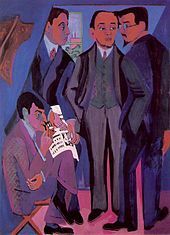
Die Brücke Group: Ernst Ludwig Kirchner, Erich Heckel, Karl Schmidt-Rottluff, Max Pechstein, Otto Mueller.
Kirchner's portrait of the group
Northern German Expressionism: Emil Nolde, Paula Modersohn-Becker, Christian Rohlfs
Paula Modersohn-Becker - Pram, children and goat
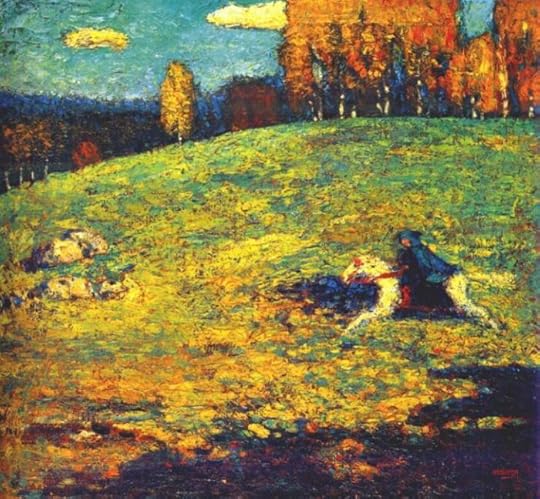
The Blaue Reiter: Wassily Kandinsky, Franz Marc, Alexei von Jawlensky, Gabriele Munter, Marianne von Werefkin
Wassily Kandinsky, The Blue Rider
Rhenish Expressionism: August Macke, Heinrich Campendonk, Wilhelm Morgner
Campendonk, Bucolic Landscape
The Subject of the City: Max Beckmann, Otto Dix, George Grosz, Conrad Felixmuller, Ludwig Meidner, Lyonel Feininger
Meidner, Burning City
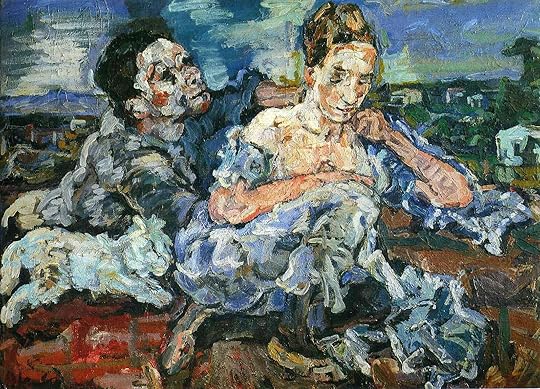
Expressionism in Vienna: Oskar Kokoschka, Egon Schiele
Kokoschka, Lovers with cat
Obviously some of these individuals belonged to more than one group or location. And some who are grouped together had no contact with one another. Elger explains in the text which people influenced each other and when.
An outstanding introduction to the early years (1905-1920) of German Expressionism, esp. the Brücke School, the Blaue Reiter, and with shorter sections on Dix, Grosz, Kokoschka, Schiele, and many others.
The prints are clear and highly selective, and the text is generally quite informative. A biographical/bibliographical sketch of each artist concludes this well-produced and well-priced volume.
Taschen uitgave met prachtige illustraties . Het Duits Expressionisme wordt beknopt maar zeer overzichtelijk behandeld. Het Frans Expressionisme oftewel het Fauvisme wordt zijdelings aangeroerd, met name Matisse wordt regelmatig als referentiekader genoemd. Dit boek is echter een puur Duitse aangelegenheid, met 2 Oostenrijkse uitstapjes: Kokoschka en Schiele. Het interessante aan deze stroming wordt door Dietmar Elger goed beschreven, de ontwikkeling van de moderne kunst wordt in sterke mate door het Expressionisme gevormd. Het zoeken naar nieuwe vormen, kleurgebruik en techniek breekt drastisch met het verleden. Van Gogh en Gauguin gelden als de belangrijkste overgangs figuren. De twee belangrijkste scholen en hun exponenten, Die Brücke en Der Blaue Reiter worden uitvoerig behandeld. Een andere rode draad door dit boek is de Eerste Wereld Oorlog, door vele kunstenaars omarmt als de oplossing om met de oude wereld af te rekenen. Met groot enthousiasme meldt men zich voor het front, de overlevende getekend voor het leven (Otto Dix, Max Beckmann, Ernst Ludwig Kirchner), de gesneuvelde een veelbelovend leven ontnomen ( Franz Marc, August Macke, Wilhelm Morgner, Egon Schiele). Zeer mooie uitgave.
This book contains alot of art concepts that can reveal alot about what life was like during the early 19's and what they expected life to be like in our time. Althought the art was particulary simple, the concepts were extremely intelligent and I think that art today should continue to be inspired by these concepts. One particular theme that caught my interest was the fictionalization of life periods. I have always been particularly curious about their use in media and have always improvised off them. Looking at the negative side, I found that some of the themes were sexist. Most of this appears to be irrelevant to our time; but it could be possible that some of these beliefs still influence us. I also found abstaction to be an interesting topic however! That is were the artist enchances the idealize shape in depicting objects. In this way, form is used to commincate the theme. In my opinion, I found the use of form to be a more sophistiated technique than the use of color.
This entire review has been hidden because of spoilers.
Enlightening coffee book, great for whiling away the hours with the explosion of creativity, almost predominantly from Germany in the early to mid 20th century. The term expressionism encompasses a quality of the inner as opposed to the outer world. Multiple schools of thought such as Die Brücke and Der Blaue Reiter came about, providing their own take on the expressionist movement. Often the artists within these circles are quite different from one another. This book takes us through the idealised bucolic representations of some to the politically-charged cityscape works of others during the turmoil of the First World War. We see the influence (and seminal works in some cases) of post-Impressionism, Dadaism, Verism, Cubism, Orphism, and Abstract art amongst other styles, which diversifies the art of that which is dubbed expressionism. Not only has it been interesting to view such a wide range of representational and non representational art (as well as impartial objectivism and overtly political works) but this book gives you a sense of places and times and the events that influenced these artists and their movements. There are a small handful of errors in typing and directions to painting on the wrong pages. This aside, it's mostly well written and devoid of artistic jargon. More information could have been allotted to some of the artists. I enjoyed reading this and shall give it 4 out of 5