Jump to ratings and reviews
Rate this book

The Mother and Other Unsavory Plays: Including The Shoemakers and They

Rate this book
Edited and translated by Daniel Gerould and C.S. Durer, foreword by Jan Kott. Painter, playwrights, novelist, aesthetician, philosopher, and expert on drugs, Stanislaw Ignacy Witkiewicz – or Witkacy, as he called himself – remains Poland's outstanding figure in the arts between the two world wars. This volume brings together three of Witkiewicz's best works for the stage as well as a selection from his critical writing. The plays deal with the author's principal themes and the dilemma of the artist in the twentieth century; the revolutions in science and politics; and the bankruptcy of all ideology, the decline of western civilization, and the coming of totalitarianism. Yet, far from being solemn or even serious in tone, these apocalyptic dramas are permeated with grotesque humor and characterized by a wild theatricality that particularly appeals to contemporary sensibility.

258 pages, Paperback

First published May 1, 2000

2 people are currently reading
59 people want to read

About the author

Stanisław Ignacy Witkiewicz

112 books235 followers
Stanisław Ignacy Witkiewicz (24 February 1885 – 18 September 1939), commonly known as Witkacy, was a Polish writer, painter, philosopher, playwright, novelist, and photographer active in the interwar period.
Born in Warsaw, Stanisław Ignacy Witkiewicz was a son of the painter, architect and an art critic Stanisław Witkiewicz. His mother was Maria Pietrzkiewicz Witkiewiczowa. Both of his parents were born in the Samogitian region of Lithuania. His godmother was the internationally famous actress Helena Modrzejewska.
Stanisław Ignacy Witkiewicz – a writer, playwright, poet, painter, photographer, philosopher and an art theoretician. Witkacy was a visionary ahead of his times, and yet a concretely pungent prankster, whose cutting-egde judgement and catastrophic prophesies allow new generations to rediscover his work time and again. One of the few Polish artists whose significance for world art history endures the test of time.
He died by commiting suicide upon learning of the Red Army’s attack on Poland, on the 18th of September, 1939 in the village of Jeziory, Polesie region (present-day Ukraine).

Ratings & Reviews

What do you think?
Rate this book

Friends & Following

Create a free account to discover what your friends think of this book!

Community Reviews

5 stars
18 (43%)
4 stars
12 (29%)
3 stars
10 (24%)
2 stars
0 (0%)
1 star
1 (2%)
Displaying 1 - 4 of 4 reviews
Profile Image for Nate D.
1,663 reviews1,260 followers
March 25, 2011
Existence is hateful, try to get that through your head. It's only thanks to the illusions of a small segment of society in the total life of our species that anyone believes that there's any sense to life at all. It all comes down to the different classes eating one another up. The balance of power between fighting microbes makes our existence possible -- if there were no struggle, as long as the food held out, a single species would have covered the entire surface of the earth in a few days with a layer forty miles thick.
Nihilism, anarchy, hysteria, rabid individualism, hallucinatory anti-realism, apocalyptic clairvoyance, pure distilled vitriol. These are the traits of Witkacy's theater of Pure Forms.


Stanislaw Ignacy Witkiewicz* (1885 - 1939) was a prolific Polish painter, playwrite, novelist, and philosopher, who lived his life as a game or performance, a friend of Bruno Schulz, early pharmaceutical experimenter, prophet of doom who declared that modern life between the rising specters of totalitarian communism and fascism was soon to become one big concentration camp and killed himself just after the fall of Warsaw to the Nazis from the west and the invasion of the Soviets from the east. Crushed between these dueling totalitarianisms just like so many of his characters and unwilling to face what he assumed would be the end of the world (for Poland, it nearly was), Witkiewicz headed out into the woods, poisoned himself, awoke anyway hours later, alive, and finally slashed his wrists.

[image error]
Stanislaw Ignacy Witkiewicz, Autoportrait, 1913 (he was also an early photographer)

Three of his thirty plays are collected here, along with various highly useful essays and biographic information to give some kind of context (although in an inexplicably ugly volume**). Highly dissatisfied with the current trends in naturalism and social melodrama predominant in the drama of his day, Witkacy (his self-chosen name, designed to distinguish him from his realism-minded painter-father) sought to deal with social problems through a heightened theater of abstraction, unreality, and chaos. The three plays collected here, prone to extremes as described above, full of contradictions and intellectual convolutions, falling into implausible philosophical monologues so cumbersome that the characters actually begin to remark on them and on the boredom of the audience, utterly misanthropic -- these plays can be maddening, exhausting to read, but must have been amazing spectacles to see executed live, shocking and unpredictable and endlessly full of ideas and bizarre visual developments. I don't actually attend much theater or read many dramas, though -- perhaps others would visualize even more readily. For me, though, the translators' introductions to each play are invaluable in highlighting both the convoluted presentations of the themes, and the sheer insanity of the presentation.


(some of the little annotations indicate which drugs he was on while painting -- he was nothing if not scientific)

I'll tell you what it is -- it's a machine for sucking dry what's left of mothers' corpses that haven't been completely sucked dry by their only sons.

The first work, "The Mother" sees an old women slaving to support her philosopher son so that he can advance his revolutionary ideas, first in the melodramatic naturalism of the Mother's favorite playwrights, Ibsen and Strindberg, then in gradually disintegrating reality. First a kind of raving intensity takes over, full of rapid reveals of lurid details, general turmoil, drugs; soon after any trace of reality is stripped away into a stylized theater-as-theater, Witkacy's Pure Forms in pure state, perhaps. Actually, the whole thing must have been highly stylized: the entire play would have been staged, but for a few notable details like the mother's knitting, in black and white.


"Them" involves a secret government bent on "total automation" of all of society, and to those ends, the abolishment of the individualism of modern art. As is typical for Witkacy, it's not immediately clear which side really stands which ideals and everyone on any side is pretty compromised in general. A smart, confusing, very angry play of politics and ideas.

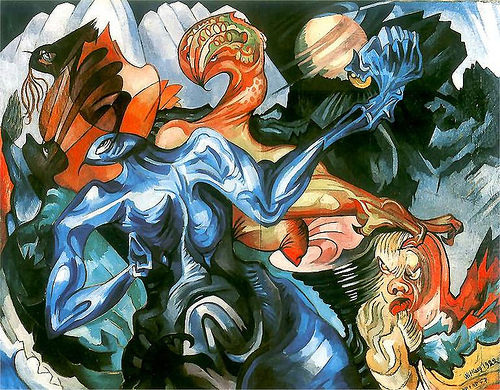
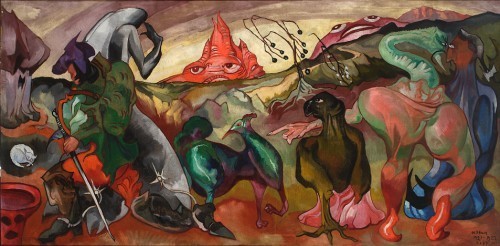
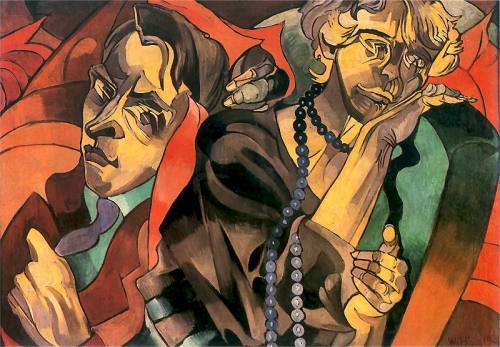
11 Witkacy, Azot, Fosfor and Arsen, 1918, watercolour, gouache, crayon on paper
Stanislaw Ignacy Witkiewicz, Azot, Fosfor and Arsen, 1918

TERRIBLE VOICE (through a hypersupermegaphonopump): THEY HAVE ABSOLUTE POWER NOW!

Following out the progression, Witkacy's final play, "The Shoemakers" (1934) is perhaps most philosophically dense and the most seethingly furious. As a shoemaker and his apprentices are subjected to one revolution and lead another only to bear witness to the destruction of the world as they knew it, the characters spout crazedly disgusting invented obscenities ("you greasy ball of rancid bitch lard!"), bizarre personifications like the DREADFUL HYPERWORKOID and the MULCH-ABOUT-TOWN appear, repetitions of the stage directions invade the dialog, signs appear to chart the mounting apathy of the audience, a duchess becomes a bat-winged bird of paradise, the dead speak, and the action builds up into a miasma of tension -- sex, violence, and political theory pressure-cook without proper release. And finally, after a progression that sees a dying capitalism taken over by an empty fascism and then a briefly utopian communism that quickly collapses into the eradication of the individual in favor of mechanized society, after this progression, much of which hadn't actually happened to Poland yet, but soon would, after all of this the play ends with the stage direction that "all of the sudden, like lightning, the iron curtain falls down. Oh strange seer, how true.


(I'm giving this 4 stars because Witkacy is a fascinating figure and I bet these would be insane 5-star productions even if they can occasionally be 3-star messes to wade through in print. I know, a dubious recommendation, but I just want you to know about this guy, even if you don't run out and get his plays.)

*originally brought to my attention by Writers No One Reads.

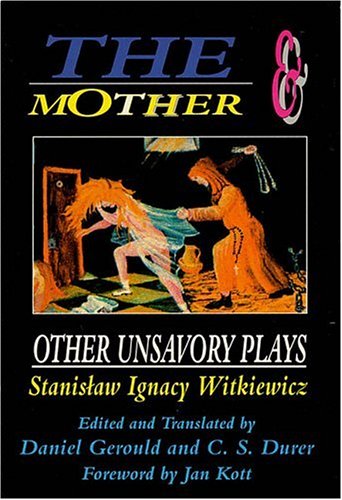
**Let's just consider how unnecessarily ugly, especially given the vision of Witkacy's own art, this cover is:


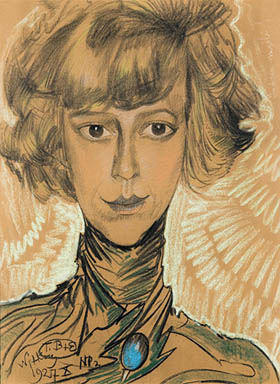
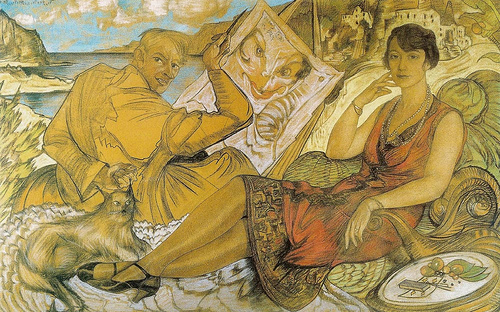
Ugh, yeah. Lest we end on that dreadful note, here's another of his paintings:


Profile Image for Richard Newton.
Author 27 books595 followers
July 30, 2019
This books contains a translation of 3 of Witkiewicz’s plays and a short biography. Each play also has a separate introduction. Generally the book can be summed up in the words from the introduction to the third play: “At times it seems less a play than the chaotic outpourings of a man’s obsessions and sense of horror in the face of a ghastly world”. The author was known to paint and write after a cocktail of alcohol and drugs - and the surreality of these plays reflect that! Still I got through them and they have a weirdly engrossing nature to them. Half the time they made no sense, but the general sense of menace and the loss of individuality in the face of totalitarianism comes across loud and clear.
Profile Image for Christopher.
306 reviews28 followers
August 31, 2012
A very interesting set of plays.

THE MOTHER starts out fairly realisticly. The mother loves Ibsen and wants her life (and the show we are watching) to be based on his dramatic approach. Her son undermines this. It's fun. It is the Epilogue however that stylisticly exciting and surreal.

THEM is about a secret government that decides to destroy all art to save humanity (because art in any state corrupts our souls). The idea is fantastic, seeing the effect of the futurist manifesto taken very wrong (destroy all the libraries!) and is certainly relevant today.

THE SHOEMAKERS is an alternative take on the secret government, but this time it is fought against and . . . beaten? The workers revolt, fighting for their right to manual labor, to working with their hands. But in the end it is decided that the ideas and symbols of figures are more important than the actual people who inspire them.

All these plays are exciting: surreal, visceral, and playful; but there are some issues. The biggest issue is the writing style, which might very well work in performance, doesn't work as well on the page and I would need to see it to see if it works. Of course there are some antiquated politics and also some awkward women-hating.

Definitely worth the read, but I'm holding off my final judgment until I see them performed.
Displaying 1 - 4 of 4 reviews

Can't find what you're looking for?

Get help and learn more about the design.