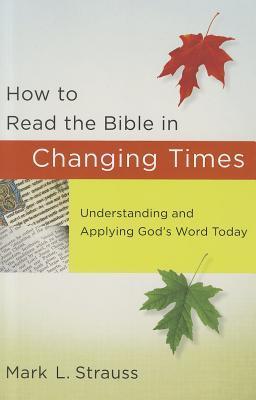
Many find it difficult to take words that were written thousands of years ago and apply them to twenty-first-century life in the Western world. How do we read God's unchanging Word in a world that is increasingly defined by change?
How to Read the Bible in Changing Times shows everyday Christians how to interpret and apply the Scriptures regardless of time and culture. Rather than seeing the Bible as a magic answer book, a list of commands to obey, or a series of promises to claim, this insightful book allows the Bible to retain its identity as a complex, inspired document while showing that the truth it contains is relevant and life-changing. It shows the reader how to
determine the meaning of the text in its original context identify culturally relative features understand what the text teaches about God, his will, and his purposes apply the truths discovered to contemporary life situations
It even shows readers how to discern God's will on the many modern issues that the Bible does not directly address.
Mark Lehman Strauss is an American biblical scholar and professor of the New Testament at Bethel Seminary San Diego, which is part of Bethel University, Minnesota. His areas of expertise include New Testament Gospels and Bible translation.
How to Read the Bible in Changing Times is an introductory volume on hermeneutics that seems to be written for laymen who want to do a better job at teaching or preaching. Yet, I find it a difficult book to review. In the first chapter, the author presents a case for understanding every Scripture in context. He warns against teaching or applying the Bible piecemeal, using the Scriptures to say whatever we want it to say. Instead, he advocates that we are to read the Bible to "discern the heart of God and the mind of Christ," the we might "determine his truth and his purpose in the changing world around us." The premise is sound, but the presentation in the following chapters was often unsettling. Instead of instilling confidence in the Bible, I felt as if he often undermined it. For example, I believe it is acceptable to think of the Bible as a "book," a single volume with one divine Author. Although God used men as the instruments with which He wrote, and invested 1500 years in completing His work, it is still His work. In 2 Peter 1:19, it is lifted up as a unified "word of prophecy" (singular), not a "library" of prophecies. Yet, that is the first premise the author undermines in Chapter two, and it sets the tone for much of the book.
Throughout the book, I found the author's theology sound. His intent is to help the reader become more skillful at rightly dividing the scriptures. He asserts that the Bible speaks to all men for all of time, while acknowledging that it was written in different genres, to different audiences, reflecting the culture and customs that are often very different from our own world today. All very true. However, instead of building a hermeneutic for understanding the scriptures from the scriptures themselves, he presents a hermeneutic that, in my opinion, is much more subjective. Basic bible themes are omitted because one of the early premises of the author's "heart of God" approach to the Bible is that the Bible is "not a textbook of systematic theology, or comprehensive guide to Christian doctrine and practice." Instead, the theology of the bible is "progressive, contextual, and situational." While neither statement is patently false, they serve the purpose of the author far better than they present the authority, accuracy, and clarity of the Scriptures.
Although there are strengths to this book, the hermeneutic it presents opens the door to dismiss large portions of the Bible as culturally irrelevant. It is just orthodox enough to have widespread, even conservative appeal. However, it better serves the purposes of those who are looking for a more progressive view of "the faith" than those who hold to "the faith once delivered to the saints."
This book is ideal for people who want to learn how to read the Bible skillfully and understand how to apply it fully, even when the text is complex and provocative. The author offers guidance on how to adopt a balanced approach to reading the Bible. I did not feel like I was reading the text of a man with a personal agenda, which is too common these days. Rather, I felt like I was reading the text of a spirit led, emotionally intelligent, spiritually mature, and intellectual man who is skilled at meeting diverse believers where they are in their faith journey and guiding them toward developing a focus on the heart of God rather than continuing to promote or justify their agendas with Scripture. Overall, the book is easy to read, practical and well-balanced. I’m going to read it again now!
I liked stories about how people tried to take Bible commandments literally. Emphasized that the Bible isn’t a book of commandments where believers choose to obey, but a story of God’s redemption. Looking at God’s purpose for commandments and promises was encouraged. Pay attention to cultural context. We can apply Bible to current issues through an intimate relationship with God. If we know God, we know His character and His will
Really good source for beginning to think through hermeneutics. Strauss really highlights reading scripture with the correct context—narrative purpose and theology, authorship and audience, and it’s literary context. He talks a lot about the metanarrative between promise (OT) and fulfillment (NT) and defines the four gospels as historical narrative motivated by theological concerns.
Aside from some small, occasional disagreements, I must confess that this is a phenomenal book on biblical exegesis and application. I definitely recommend this for new students and for those more advanced in the studies of hermeneutics and applied theology.
A basic book on hermeneutical principles for reading Scripture well. Only 3 stars for me, because I feel it didn't add much to toools that I already had, but it would be a good introduction for those who are unsure how to understand and apply the Bible to their lives. Especially helpful were for questions that he suggests using as a frame for understanding any passage. He spends two chapters going through the various genres of both the OT and NT and answering those for questions. I read it for a short course I am taking.
A few weeks later I edited the rating to 4 stars because I find myself using the four questions that he suggests in order to interpret passages. It is a helpful and easy framework that when applied is a solid beginning to interpreting a Biblical passage well.
Concentrating on a basic premise--understanding the Bible is about knowing God, not knowing more about God--sets this book aside. Strauss calls it a "heart of God hermeneutic." He successfully sets forth a means of keeping that focus in our study of Scripture.
But, at the same time, he speaks to and illustrates, basic principles of interpretation and genre specific concerns. In addition there is helpful direction to additional resources.
D. A. Carson's blurb captures an important distinction concerning Strauss's book. "...weaves his way between these two extremes (technical vis-a-vis popularity level) to give us a book that is careful, understated and filled with a great deal of good sense." I concur.
This book had a lot of great information about studying the Bible. I completely disagree with some of his final conclusions (namely on what the Bible has to say about homosexuality - an issue I've studied and continue to study pretty thoroughly), but overall I found it thought provoking, informative, and a very useful tool.
I think this is the best concise hermeneutics text on the popular level I have read in a long while. There are very notable chapters on what the Bible is NOT, when cultures collide, and finding the heart of God in the diverse genres of OT and NT. Clear examples provided throughout along with an analysis of some other approaches to cultural analysis in Bible interpretation.
More of a foundational bible reading guide for pastors or lay ministers, this book is a must-read for those interested in relevant bible truth and ethical application in today's world of highly niche and personal theology.