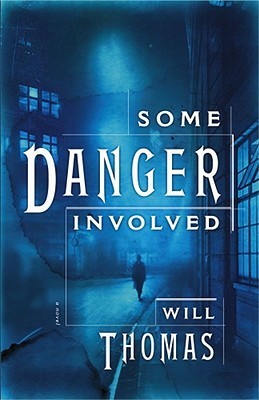
Stop me if you’ve heard this one before: “The Jews are making things hot for themselves, here, flooding in like a Mongol horde from Eastern Europe. I fear the citizenry has grown tired of the steady influx of foreigners, and taken matters into their own hands.” (p. 131) This is a statement from well-known anti-Semitic minister, the Very Reverend Algernon Painsley, in Some Danger Involved. It summarizes the broth coming to boil, plot-wise, in Some Danger Involved, Will Thomas’ first mystery involving his Victorian London-era Personal Enquiry Agent, Clyde Barker, and his Welsh assistant and chronicler, Thomas Llewelyn. In this mystery, a young Jewish rabbi bearing an interesting resemblance to a popularized representation of Jesus’ image, has been crucified by an anti-Semitic group. So, naturally, a portion of the investigation comes to the church building where the “Reverend” Painsley presides.
One wonders if Painsley represents another form of prejudice closer to our day. After all, a Protestant minister named Ian Paisley was the leader of the Unionist movement in Northern Ireland during the latter part of “The Troubles” and made such statements of Irish Catholics as, "They breed like rabbits and multiply like vermin." Although Algernon contains more syllables than Ian, one must note that the last syllable rhymes somewhat. Of course, the fictional minister’s rant against immigrant Jews sounds painfully like some anti-immigrant rants, both in the U.S. and in the Brexit movement.
But that’s only one interesting aspect of Some Danger Involved. Thomas also surprised me by not being antagonistic toward Christianity. Don’t get me wrong. Not everyone who professes to be a Christian in this novel is Christ-like. But Barker himself is a Baptist who attends Charles Spurgeon’s famous tabernacle of the era and Llewelyn is himself from a Methodist background. To be sure, the aforementioned Jew-hater used some of the verbiage of the Christian, but Barker dismisses Painsley with, “He wants to make Christ over in his likeness, not the other way round.” (p. 134) When Barker is asked how these twisted ministers can get away with it, he answers, “My dear Llewelyn, you have a naïve side, if I may say it. People don’t read their Bibles. They hire pastors to preach to them. And some pastors will preach total nonsense if it will tickle the congregations’ ears enough to open their purses.” (p. 136) An important portion of a penultimate scene is compared in our narrator’s mind to Gideon’s deception played on the Midianites (p. 259) and even the first page of the Author’s Note had a line from Paul’s sermon in Athens embedded in the second paragraph.
In terms of other historical interest in Some Danger Involved, Thomas draws a nice distinction between the syndicates of protection (and crime) brought to London with Italian immigrants. In the U.S., we use the term “Mafia” to aggregate all Italian criminals involved with organized crime (as well as some other nationalities), but don’t usually realize that the Neopolitan version of this “society” would be “Camorra.” Barker explains about the “Camorra,” “It, or rather they are one of the crime families of Naples. Like their rivals, the ‘Ndrangheta of Calabria and the Mafia of Sicily, they rode into power on the coattails of Garibaldi. They’ve divided the country into personal city-states, concentrating power like the Medicis.” (p. 162)
So, plenty of period detail, plenty of unexpected action (at times, more pulp adventure than mystery, but too well-crafted to tie that comparison too closely), interesting characters, and a mystery which completely fooled me (not a typical experience for me) make Some Danger Involved both an incredible first novel by the author, but a hearty recommendation