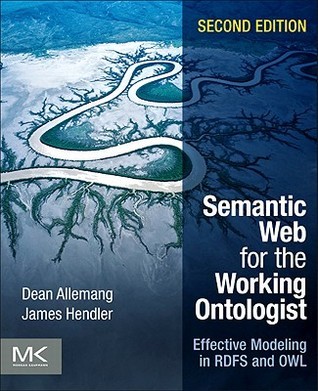
Semantic Web models and technologies provide information in machine-readable languages that enable computers to access the Web more intelligently and perform tasks automatically without the direction of users. These technologies are relatively recent and advancing rapidly, creating a set of unique challenges for those developing applications.
"Semantic Web for the Working Ontologist" is the essential, comprehensive resource on semantic modeling, for practitioners in health care, artificial intelligence, finance, engineering, military intelligence, enterprise architecture, and more. Focused on developing useful and reusable models, this market-leading book explains how to build semantic content (ontologies) and how to build applications that access that content.
New in this edition:
Coverage of the latest Semantic Web tools for organizing, querying, and processing information - see details in TOC below
Detailed information on the latest ontologies used in key web applications including ecommerce, social networking, data mining, using government data, and more Updated with the latest developments and advances in Semantic Web technologies for organizing, querying, and processing information, including SPARQL, RDF and RDFS, OWL 2.0, and SKOS Detailed information on the ontologies used in today's key web applications, including ecommerce, social networking, data mining, using government data, and more Even more illustrative examples and case studies that demonstrate what semantic technologies are and how they work together to solve real-world problems
Out of all of my books on the subject, this is the one you want to read first and read twice.
Unlike the other books, it takes you through real examples and is very hands on. If you had the Protoge editor in hand, this book, and a pot of coffee, you would rock in a day or two.
Useful, but not perfect. Not great for beginners. Thorough without feeling complete.
Chapters 14 and 15 on Modeling processes and best practices are the most useful bits -- this is what I was looking for when I bought the book!
I love Semantics, RDF, RDFS, OWL, SKOS, and use them at work, but finishing this book was a real chore. The text is fine, but could be 1/3 the size with some prose refactoring. I think more graphs and better graphs would have helped as well.
I first came across ontology while working on a graph-based knowledge representation for an agentic chat. The idea struck me as amazing: connect scattered ideas through semantic links, made possible by a well-curated dataset and the reasoning power of an LLM. However, the definition of ontology is not universal among the big tech companies that brand it as the next big thing, and some of that branding is probably biased. So I traced it back to its root, and Semantic Web for the Working Ontologist is widely considered a good reference.
As I read, I realized that ontology was originally built for a different purpose: to unify knowledge from multiple sources and gather it with ease, amid the chaos of “anyone can say anything.” The idea sounds great, but I am not ambitious enough to model a whole network, and I don’t feel very motivated by that goal. I am more curious about how to curate domain knowledge and formulate it into an ontology for consumption, so I mostly care about modeling a certain group of knowledge. OWL also promises the exploration of new knowledge, but I think that idea is not ready yet, if you approach it in an automatic way.
If your goal is to be practical about constructing and representing knowledge, the first five chapters are good enough. Inferencing still takes a large effort to build into your ontology, so I would only go deep on it if you are serious about learning all of the semantic modeling here.
That said, the whole book is worth a look to see how everything comes together: why the Web needs modeling, the foundations of RDF and SPARQL, inferencing, vocabulary handling with RDFS-Plus and SKOS, and OWL as the ultimate model.
PART 1. WHY THE WEB NEEDS MODELING
Chapter 1: What is the Semantic Web The Semantic Web supports a distributed Web at the level of data rather than presentation. One data item points to another through global URIs, so information about a single entity can be spread across the Web yet still form one shared model. The challenge is the AAA slogan: Anyone can say Anything about Any topic. Web data is therefore valuable but tangled, we must assume an open world, and names are nonunique. The working ontologist’s job is to turn this mess into usable, durable information resources, with RDF, RDFS, SPARQL, SKOS and OWL as the tools and modeling as the craft.
Chapter 2: Semantic modeling Modeling is the answer to the unconstrained Web: organizing information for community use, so people can share a picture of a situation, explain and predict, and mediate between viewpoints. Structured and messy knowledge will always coexist, so the challenge is a continuous process of distilling communal knowledge without forcing agreement up front or a uniform level of formality. The book’s response is a family of layered languages: RDF for simple statements, RDFS for classes and properties, RDFS-Plus (the book’s own subset of OWL) as a middle step, and OWL for the expressivity of logic. Expressivity is a dial to be set per problem.
PART 2. THE FOUNDATIONS: RDF, ARCHITECTURE AND SPARQL
Chapter 3: RDF, the basis of the Semantic Web Data in a table can be distributed by row, by column or by cell, and only cell-by-cell distribution fully honors AAA. RDF takes that route: every cell becomes a triple of subject, predicate and object, which forms a directed graph, and merging sources reduces to taking the union of their triples. The price is identity: merging only works if we can say when two nodes are the same. RDF borrows the Web’s own answer, URIs with namespaces, so two nodes are the same exactly when they share a URI. Built-in terms such as rdf:type give a minimal typing system, and blank nodes stand in for entities with no global identifier.
Chapter 4: Semantic Web application architecture An application is built from an RDF parser and serializer, an RDF store, an RDF query engine (SPARQL) and application code. The store’s distinguishing capability is merging, and the application reaches the data only through queries. These components handle the mechanics of combining data but say nothing about meaning, which comes from semantic models held in the same store, since RDFS and OWL are themselves RDF. Data federation follows: every source is converted to triples and merged before any querying, so queries span sources and are unaffected when a new one is added. Typical uses are calendar and map integration, annotation and content management.
Chapter 5: Querying the Semantic Web with SPARQL RDF works as a tell-and-ask system, and SPARQL, which borrows from SQL and Turtle, is the standard way to ask. The difficulty is asking precise questions of data whose structure you may not know in advance. The answer is the graph pattern: a small graph mixing known resources and variables, matched against the data graph. Because patterns can be as large as needed, a question’s complexity is limited only by the data’s, and since variables can match predicates too, the same mechanism lets you explore an unfamiliar data set. SELECT returns variable bindings, CONSTRUCT builds a new graph from a template, and federated queries span several sources.
PART 3. MEANING THROUGH INFERENCE: INFERENCING, RDFS AND RDFS-PLUS
Chapter 6: RDF and inferencing In the Semantic Web, the meaning of a modeling term is defined by the inferences it licenses. The central example is subClassOf: if A is a subclass of B and something is of type A, then it is also of type B. This type propagation rule is an IF/THEN construct and the entire meaning of subClassOf in RDFS. Federation alone leaves sources describing things differently, and informal definitions leave unforeseen combinations of terms to consensus. Inference patterns resolve them by applying the rules together. Asserted and inferred triples differ only in provenance, and inferences can be cached or computed just in time. The remaining languages differ only in which rules they include, so expressivity is a choice of how much inference the integration needs.
Chapter 7: RDF schema RDFS is itself written in RDF, so schema information is as open to AAA as data. Its keywords are ordinary resources whose meaning comes from inference patterns, not validation. That is what separates it from schemas in object modeling or XML: it describes sets and how data can flow between them. Domain and range are the hardest terms because they look like OO-style declarations but never reject data; they infer class membership. With no union or intersection, small patterns of subClassOf and subPropertyOf do the work, for example mapping personName and movieTitle to rdfs:label. Use these instead of a global find-and-replace on merged data.
Chapter 8: RDFS-Plus RDFS-Plus is a subset of OWL, a small step up from RDFS and the part of OWL that turns up most in practical integration projects. Its main addition is handling sameness when stakeholders use different URIs for the same entity: equivalentClass and equivalentProperty align classes and properties, sameAs declares two individuals one, and FunctionalProperty and InverseFunctionalProperty let the engine compute sameness instead of requiring it to be asserted.
PART 4. VOCABULARIES IN THE WILD: RDFS-PLUS AND SKOS
Chapter 9: Using RDFS-Plus in the wild Data.gov shows mashups: government datasets released as RDF can be mixed with each other and with other web data, with SPARQL doing most of the work. FOAF describes people spread across many sites and lets individuals own their data; its terms can start informal and be tightened with RDFS-Plus over time. Facebook’s Open Graph Protocol is deliberately small and reinvents some FOAF terms, but links to them with rdfs:seeAlso rather than owl:equivalentProperty, which commits to less yet keeps it from becoming another silo.
Chapter 10: SKOS, managing vocabularies with RDFS-Plus SKOS is the W3C Recommendation for publishing controlled vocabularies, thesauri, taxonomies and folksonomies in a linkable form. It gives every concept a URI, turning local identifiers into global ones, and matching properties such as exactMatch, closeMatch, broadMatch and narrowMatch relate terms across vocabularies. Broader and narrower resemble subClassOf, but the user chooses whether they are transitive. Adoption comes from simplicity: any vocabulary that can be queried for its broader, narrower and related terms can be converted by recording each answer as a triple.
PART 5. OWL AND ONTOLOGIES AT WORK
Chapter 11: Basic OWL OWL adds owl:Restriction, which defines a class by the values its members have for a property. Because a restriction is itself a class, it can build further classes, which is how one source’s definitions get reused and extended by others. RDFS cannot do this, and layered restrictions let complex relationships be modeled formally and processed automatically.
Chapter 12: Counting and sets in OWL OWL adds unions, intersections, complements, cardinality restrictions and disjointness, so a model can rule things out as well as in. Counting is hard under the open world and nonunique names, so OWL is cautious; the way around it is to close off part of the world on purpose by stating exactly which members a class has and that they are all different. OWL can also reason about classes themselves, spotting contradictions or classes that could never have members.
Chapter 13: Ontologies on the Web, putting it all together Good Relations, QUDT and the OBO ontologies show OWL at work, all giving standard entities globally unambiguous names. Good Relations lets businesses describe offerings in RDFa and improved search results. QUDT, built by NASA, gives units of measure global URIs, conversion and dimensional analysis. OBO ontologies such as CHEBI give references to tens of thousands of biological concepts and act as a Rosetta Stone across naming schemes.
PART 6. MODELING WELL: PRACTICES AND EXPERT OWL
Chapter 14: Good and bad modeling practices Under AAA no antipattern is strictly an error, but each defeats the goal of sharing. The guidelines: start from competency questions and model no further than needed; say what you mean, because wishful naming gives a class a name its contents do not earn; model for reuse with labels and comments; and test the inferences, not just the questions. For classes versus individuals, if you cannot imagine instances it should not be a class, and if you know specific property values it is probably an instance. The antipatterns are rampant classism, exclusivity, objectification and creeping conceptualization, which confuses “design for reuse” with “say everything you can.”
Chapter 15: Expert modeling in OWL OWL comes in subsets because people model for two reasons: some want provable answers, others treat a model like a program that merges and reshapes messy data and accept good answers most of the time. OWL 2 offers four profiles: DL (most expressive while still provable), QL (on top of databases), EL (very large ontologies) and RL (rule-based software). It adds chained relationships such as “uncle is brother of a parent” and keys made of several details, and lets a name be both a class and an individual, which the book advises against. Rules fill the remaining gaps, but large rule systems are hard to maintain, so the practical answer is to combine the two.
PART 7. CONCLUSIONS
Chapter 16: Conclusions Classes, subclasses and properties are decades old; what is new is the Web itself. The Semantic Web is part of the Web’s infrastructure, and it wins by borrowing the Web’s design: global URIs let separately built models merge, inferencing stays conservative under the open world, and no store needs to hold the whole Web. The craft is combining RDF, RDFS and OWL into a system through which this data can flow.
A very helpful introduction to RDF, which was especially helpful for someone like me who learns best from books. Lots of information that experienced practitioners might take for granted is presented in an accessible style that doesn't assume the reader is already familiar, which was much appreciated.
Books about web technology are a dangerous game, since the landscape shifts so quickly and there are so many variables and dependencies to local systems infrastructure, but all in all this is a great guide for someone who is trying to get a handle on the many technologies that support linked data for libraries, such as RDF. Anyone who is doing data modeling in RDF will need to also read the up-to-date W3C documentation on RDF and RDFS, as well as the documentation for whichever RDF serialization they locally implement and the namespaces/schemas they use, in order to have a workable knowledge base. As a foundation textbook for RDF core principles and modeling best practices in a variety of use cases, one could do much worse than this.
(This review applies to the 2nd printing of the 1st edition.) It is not easy to take a discussion of a potentially dry and technical subjects such as RDF, RDFS or OWL, and make them clear, interesting and engaging, but this book manages it (well, mostly in the case of OWL). This is a very high level of technical writing!
The place it falls down is in it examples it never actually shows any of how the resulting ontologies are used. The single most important thing about building any model is that it be useful for the purpose for which it is built, and without showing that final step, building ontologies looks like an intellectual game with no real world use. This book discusses various common modeling error, but leaves off what I suspect is one the most common -- the model is not actually useful to the organization building it.
A bit dated. An Ontology, a way to describe a knowledge domain - a sort-of cross between a database schema and an ER diagram - is one of the mechanisms of the semantic web, the goal of which is to provide data standards for disparate domains such that queries in a language syntactically like SQL can span different originators of data. What is less clear is how the minefields of proprietary information are to be crossed.
I've wanted to read this for a while, so when some semantic web stuff came up at work, I was happy for the excuse to pick it up. It does a good job of explaining many common RDFS and OWL constructs - a few patterns and the terms that these standards define, with their meaning. It works through examples and shows how particular predicates can be used and what they should be interpreted as meaning.
However, I think this book wasn't quite what I had been looking for. It's nice to know that this particular predicate enables this sort of inference, but how well are those inferences supported in actuality? I know it's system dependent, and therefore not in the scope of this book, but that's useful information. I guess there's just a lot of freedom inherent in these semantic web standards about how to actually represent information, and that's awesome. Knowing predicates to use, and how to set up OWL classes, is very useful, and described by this book, but I still feel like there are open questions, for me, about how, in practice to set up "my data". Maybe I'll find a way to make it part of work, so I can get paid while looking at it :)
If you're interested in the semantic web, but are struggling to piece together the alphabet soup of acronyms and standards, then this is the book for you. I was in that position until I devoured this book. All my questions were answered (I now have twice as many questions, but they're new questions).
Overall, it's rare to find a 'text book' that is also a page turner, but this comes pretty close. The writing style is fluid and informative without being dry. The examples are understandable and sufficiently demonstrative to convey the concepts being discussed and the book is organized in a very progressive manner.
The only downside was the number of typos and grammar errors in the book. The rate seemed to increase from one every seven or eight pages in the first few chapters to almost every page in the last few chapters.
As I said, if this topic is something you want to learn about, then this book is definitely worth reading cover to cover.
This book is excellent for any kind of beginners in Semantic Web even though the book title claims to be for the Ontologists. A decent amount of text is contributed in explaining about the elements in the Semantic Web stack. The sequential approach of introducing concepts with real world examples, makes it so very easy for the reader to build on his existing knowledge. It doesn't frighten you at any stage with the complexity of OWL constructs and I think that's where this book succeeds. You get the confidence to start on with your first ontology. Highly recommended for beginners and also for experienced professionals.
This is an excellent book to get started with the concepts of semantic web, not just for ontologists but anyone. Every other page has an example that help readers to comprehend the concepts with ease. The flow of topics is natural (Intro->RDF->Inferencing and querying->RDF-Plus->OWL), and the chapters like ch. 4 (Semantic Web application architecture), ch. 9 (Using RDFS-Plus in the wild) give a bird's eye view of the topics which help the reader to know which part of it is being discussed and how it fits in the whole picture. All in all, it is a very useful read.
Allemang has written precisely the book I needed to begin doing ontology modeling. He provides more detail than most shorter-format pieces (and excluding the all-too-familiar Pizza modeling exercise), while writing in prose that does not get lost in the technospeak that many standards documents employ. This book will be kept close at hand over the next few years, I'm sure, so that I can consult it as new subtleties of semantic modeling occur to me and I need more detail.
Very recommended book on this topic. Oriented on explain and not on write a tons of dumb notions.
Useful the "challenges" parts where the author propose and solve some typical problems in semantic modeling with standard modeling patterns. The main example are available on the book site: http://workingontologist.org/
I read by now this book as a reference book reading specific chapters on the specific area I needed to study but I will read it cover to cover since I got a very good impression.
During the first few chapters I was thinking modeling in OWL would be like writing to a relational database. Not so much. By the end of the book I became convinced that graph storage is a huge missing piece in our data storage needs, along with relational stored, big table, inverted indexes and key value stores.
This book really "gets it" in terms of relationship based modeling and constructing a model with inferencing in mind. Anyone who is modeling to leverage to true power of a graph model using W3C standards should read this.
I love the practical orientation of this book. Like any good example of this type, it covers many counter-intuitive colloquialisms that will make modeling in RDFS/OWL easier, including common patterns that will provide unexpected results.
The first couple chapters are the best introduction to the Semantic Web and Linked Data that I've read. The rest is essential reading for anyone doing this professionally.
I'm not a working ontologist, but I found this to be one of the most clearly written introductions to the semantic web and data modeling with RDF that I've read to date.
This is a good starting point for people interested in learning about the Semantic Web, and covers the major topics in a way that makes you think clearly about them.,