Jump to ratings and reviews
Rate this book

Literature and the Gods

Rate this book
Brilliant, inspired, and gloriously erudite, Literature and the Gods is the culmination of Roberto Calasso's lifelong study of the gods in the human imagination. By uncovering the divine whisper that lies behind the best poetry and prose from across the centuries, Calasso gives us a renewed sense of the mystery and enchantment of great literature.

From the banishment of the classical divinities during the Age of Reason to their emancipation by the Romantics and their place in the literature of our own time, the history of the gods can also be read as a ciphered and splendid history of literary inspiration. Rewriting that story, Calasso carves out a sacred space for literature where the presence of the gods is discernible. His inquiry into the nature of "absolute literature" transports us to the realms of Dionysus and Orpheus, Baudelaire and Mallarm�, and prompts a lucid and impassioned defense of poetic form, even when apparently severed from any social function. Lyrical and assured, Literature and the Gods is an intensely engaging work of literary affirmation that deserves to be read alongside the masterpieces it celebrates.

224 pages, Hardcover

First published February 1, 2001

72 people are currently reading
1914 people want to read

About the author

Roberto Calasso

66 books679 followers
Roberto Calasso (1941 – 2021) was an Italian writer and publisher.

Calasso was born in Florence in 1941, into a family of the Tuscan upper class, well connected with some of the great Italian intellectuals of their time.

Calasso worked for the publishing firm of Adelphi Edizioni since its founding by Roberto Bazlen in 1962 and became its Chairman in 1999. In 2015, he bought out the company to prevent it from being acquired by a larger publishing firm. His books have been translated into more than 20 languages.

He was the author of an unnamed ongoing work reflecting on the culture of modernity, which began with The Ruin of Kasch in 1983, a book admired by Italo Calvino. Dedicated to the French statesman Charles Maurice de Talleyrand-Périgord or, Talleyrand, it was followed in 1988 by The Marriage of Cadmus and Harmony, in which the tale of Cadmus and his wife Harmonia becomes a pretext for re-telling the great tales of Greek mythology and reflecting on the reception of Greek culture for a contemporary readership. Another world civilization is surveyed in Ka (1996, where the subject of the re-telling is Hindu mythology). K restricts the focus to a single author, Franz Kafka; this trend continues with Il rosa Tiepolo (Tiepolo Pink), inspired by an adjective used by Marcel Proust to describe a shade of pink used by Venetian artist Giambattista Tiepolo in his paintings. With La folie Baudelaire, Calasso once more broadens his scope from fresco to a whole civilisation, that of Paris in the latter half of the 19th century, reconsidering the lives and works of the post-romantic generation of writers and artists from Baudelaire to Valéry. In one of his more recent works, Ardore (2010), the author returns to India for an exhaustive analysis of the theory and practice of Vedic sacrifice and its significance for post-modern epistemology.

Along with his status as a major analyst specifically of the works of Kafka, Calasso was, more broadly, active in many essays in retrieving and re-invigorating the notion of a Central European literary culture. He also served as the president of the International Alexander Lernet-Holenia Society, which promotes the publication, translation and study of this multi-genre Austrian writer and his focus on the identity crisis of his characters at odds with postimperial Austria and Central Europe.

Ratings & Reviews

What do you think?
Rate this book

Friends & Following

Create a free account to discover what your friends think of this book!

Community Reviews

5 stars
159 (34%)
4 stars
163 (35%)
3 stars
108 (23%)
2 stars
27 (5%)
1 star
6 (1%)
Displaying 1 - 30 of 56 reviews
Profile Image for Jonfaith.
2,146 reviews1,746 followers
November 11, 2016
This is a knitted and knotted exegesis on the role and symbolism of the divine in the literary arts, largely poetry in the 19th century. Like the rest of Calasso, that thesis is but a point of departure to a sinuous journey which broaches a kaleidoscope of concepts and figures.

Whether the pretexts spoke of race or class, the one sufficient reason for killing your enemies was always the same: these people were harmful to society. Society becomes the subject above all subjects.

There is much to marvel: the notes on Mallarme and Nietzsche. The sections glossing over links with the Vedas lost me.
Profile Image for Stephen.
99 reviews103 followers
February 6, 2015
"What are writers talking about when they name the gods?" An important question, though Calasso comes obnoxiously close to answering "they are talking about themselves." Poet Stéphane Mallarmé plays a central part in these essays. It is assumed the gods of antiquity were "pagan" gods and to this Calasso barely tries to distinguish what 19th century poets and philosophers like Baudelaire and Mallarmé were trying to preserve by bringing them back alive from Athens and Rome. A pagan god and a Christian God do not come from separate planets, which Calasso implies by limiting his search to the literary side of the equation.

Mallarmé is so expansive in his mythic abstractions that his poetry is as close to an expression of pure democracy we are ever likely to receive in a poet. It is not that his poetry is too difficult; it is that democracy has yet to find a way to teach its citizens to think as broadly as it has conceived itself. Religions like Judaism and Christianity do not have this problem. Mallarmé's Catholicism should never be discounted.

description

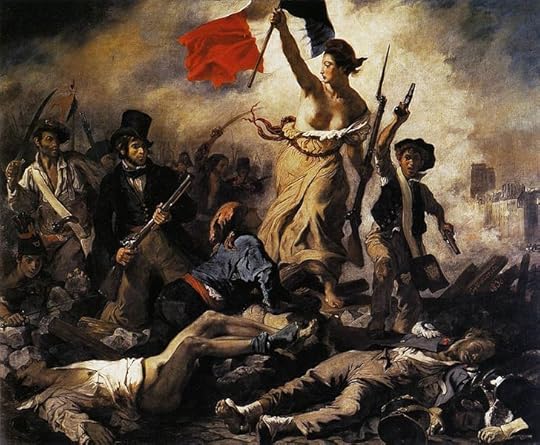
Which is more important to consider when we look at Delacroix's vision of Liberty, bare-breasted, female, as it leads the people homeward: that it's a lie, a falsehood, an illusion, because women didn't have the right to vote and lacked power when he painted this, or that he painted liberty as a mental image (i.e. a myth) so that that image of power could lead the way to greater liberty for all?

Apparently in 1879 Mallarmé set out to translate and adapt a handbook of mythology by the reverend George W. Cox called Manual of Mythology. Calasso initially guesses that Mallarmé did this because he needed the money (ridiculous) but also that he was spurred on by "the same privately esoteric propensities that a few years before had prompted him to produce and edit every word of a frivolous magazine called La Dernière Mode." First of all it wasn't frivolous to Mallarmé, in the way women's tastes in fashion, which is what the magazine was about, isn't frivolous to those who wear it. Not to mention that Baudelaire was seen carrying around a similar volume, one that inspired him to discover signs and symbols that tapped the mythological vein for the poems he was writing. Anyway, Calasso highlights an example of one of the liberal translations Mallarmé made to Reverend Cox's text:

Si les dieux ne font rien d'inconvenant, c'est alors qu'ils ne sont plus dieux du tout.
-If the gods do nothing unseemly, then they are no longer gods at all.

With his focus on artists only and not what they meant by the gods Calasso uses this quote to support his idea that the top shelf artists since Baudelaire have all been engaged in acts of irreverence toward mass entertainment culture. The point of Mallarmé however is more interestingly taken from the religious side. There are things gods must do, transfer evil among them, for instance, otherwise a covenant might lead us directly to a god and then what purpose are the gods if they are knowable? They elude us for important reasons, as Ovid had plenty of fun demonstrating with his Metamorphoses.
Profile Image for Teresa.
1,492 reviews
December 31, 2017
"Podemos ser justos se não formos humanos. "
— Isidore Ducasse

Estes textos são baseados "nas prestigiosas Weindenfeld Lectures feitas por Roberto Calasso em Oxford em Maio de 2000".
Não percebi nem metade. Dezenas de palavras e nomes que não faço ideia do que significam ou quem são. Muitas referências a autores que não li, ou li pouco: Lautréamont, Hölderlin, Mallarmé, Nietzsche, Novalis e muitos outros (qualquer mania que eu tivesse de ser grande leitora, já me passou - quanto mais leio, mais me convenço que nada li).
Roberto Calasso tem um conhecimento impressionante sobre literatura e mitologia mas, ao contrário de As Núpcias de Cadmo e Harmonia, estes ensaios são difíceis de tragar por alguém que não aprecia a "matemática" da literatura. Algumas partes li com muito sacrifício (embora eu seja pouco dada a isso - a parte da métrica da poesia até me fez suores frios) e a conclusão final a que chego é de que estes textos são bons mas não para mim.
Profile Image for John Pistelli.
Author 9 books360 followers
February 14, 2016
Literature and the Gods is a short, dense essay rather than the more literary-historical or conspective account the title might lead one to expect. In fact, Calasso has a refined Continental theorists’s contempt for mere literary history, which he seems to regard as a vast exercise in missing the point of what has happened over the last two hundred years: western literature has broken free of all received forms and historical determinants; it has become “absolute literature,” and “absolute literature”—imaginative writing’s simultaneous turn from and incorporation of the world, even the universe—turns out to be this brilliant, beautiful book’s real theme:
But are we quite sure we know what “literature” means? When we pronounce the word today, we are immediately aware that it is immeasurably distant from anything an eighteenth-century writer would have meant by it, while at the beginning of the nineteenth century it was already taking on connotations we quickly recognize: notably the most audacious and demanding, those that leave the ancient pattern of genres and prescribed styles far behind, like some kind of kindergarten forever abandoned in a flight toward a knowledge grounded only in itself and expanding everywhere like a cloud, cloaking every shape, overstepping every boundary. This new creature that appeared we don’t know quite when and that still lives among us may be defined as “absolute literature.” “Literature” because it is a knowledge that claims to be accessible only and exclusively by way of literary composition; “absolute” because it is a knowledge that one assimilates while in search of an absolute, and that thus draws in no less than everything; and at the same time, it is something absolutum, unbound, freed from any duty or common cause, from any social utility.
But what does this have to do with the gods? According to Calasso, the gods burst from their confines with Romanticism. Before the nineteenth century, they were either repressed as demonic under Christianity, dismissed as superstition by the Enlightenment, or tamed as ornament by Neoclassicism; whereas the German Romantics—Novalis and Hölderlin are the heroes here—evoked the gods only to seek behind or beyond them for the law governing them (as the Greeks insisted):
It is the immediate that escapes not only men but the gods too: “The immediate, strictly speaking, is as impossible for the gods as it is for men.” Hölderlin is referring here to the lines where Pindar speaks of the nómos basileús, the “law that reigns over all, mortals and immortals alike.” Whatever else it might be, the divine is certainly the thing that imposes with maximum intensity the sensation of being alive. This is the immediate: but pure intensity, as a continuous experience, is “impossible,” overwhelming. To preserve its sovereignty, the immediate must come across to us through the law.
In other words, the rediscovery of the gods discloses the divine force that binds even them, which can only be transmitted through form: hence, literature’s turn from mimesis and the object to form and the subject.

The scene shifts to the later nineteenth century, when Mallarmé dissolves the boundaries between prose and poetry and reconceives the most proper subject matter of literature as the universe observing itself as mind through the medium of the poet:
In Mallarmé the material of poetry is brought back, with unprecedented and as yet unrepeated determination, to mental experience. Shut away in an invisible templum, the word evokes, one after another, simulacra, mutations, events, all of which issue and disperse in the sealed chamber of the mind, where the primordial crucible burns.
Calasso firmly rejects any postmodern interpretation of Mallarmé to the effect that he turns everything into language, into words, as if he were merely anticipating the likes of Saussure:
But we do not think in words. Or rather, we sometimes think in words. Words are scattered archipelagoes, drifting, sporadic. The mind is the sea. To recognize this sea in the mind seems to have become something forbidden, something that the presiding orthodoxies, in their various manifestations, whether scientistic or merely commonsensical, instinctively avoid.
The gods, then, become the sponsors of literature’s attempt to match itself to the world beyond the world, to weave the continuity of breath that staves off dissolution—hence, Calasso proves with a lengthy excursus on ancient Sanskrit scriptures that is well beyond my competence, the necessity of rhythm and meter to all literary composition, including prose. He quotes the Śatapatha Brāhmaṇa: “Meters are the cattle of the gods.”

A certain kind of Anglophone reader, or several different kinds of Anglophone readers, will become impatient with this. Calasso is not an empiricist, not a sociologist, not a Christian, not a humanitarian, not a liberal, not a feminist; he is a very late Late Romantic. His brief, extraordinary reading of Lolita has the benefit of actually attending to the details of the text, though it flies in the face of the twenty-first century’s dominant moralistic approaches to the novel, either neoconservative or liberal-feminist:
Although the word “nymphet” was to enjoy an astonishing future, mainly in the ecumenical community of pornography, not many readers realized that in those few lines Nabokov was actually offering the key to his novel’s enigma. Lolita is a Nymph who wanders among the motels of the Midwest, an “immortal daemon disguised as a female child” in a world where the nymphóleptoi will, like Humbert Humbert, have to choose between being though of as criminals or psychopaths.
A bitter pill, no doubt. It is not hard, by the way, to think of feminist ripostes worthy of this reading, but they would necessarily have to come from the more visionary type of critic, such as Gilbert/Gubar or Kristeva; today’s Sunday-school blather about “empathy,” to say nothing of sociology, will not do it. It takes a work of the imagination to counter a work of the imagination.

With the question of politics or morality, we come to the reason for literature’s absolutization of itself, in Calasso’s account. It was necessary for literature to become absolute because technology has made it possible for the first time for society to become absolute, to extend its dominion totally over the human mind and soul:
Of the ideas that were to fashion the twentieth century in ways for the most part disastrous, one that stands out above the others, so far-reaching and indeed immense were its consequences, is the idea of the good community, where relationships between individuals are strong and a powerful solidarity is founded on common feeling. Nazi Germany was the most drastic manifestation of this idea, Soviet Russia the most long-lived and territorially vast. And the world is still full of those who will champion this idea. Why is the phenomenon so tenacious? On what does it depend? First and most crucially, as is ever the way, on a desire: many still feel that a community, any community, in the sense of a group—be it the merest criminal association—where much is held in common and where ties between individuals are meaningful, is the ideal place to live. So intense is their desire to live in such a community that the reasons for and nature of those ties hardly seem important. What matters is that they be strong and close-knit. And this when all the evidence before us should at least prompt us to inquire: might there not be something pernicious in the very idea of community, at least when it manifests itself, as has frequently been the case, in a world where technology has extended its grip over the whole planet? This is the crux of the matter: are community and technology somehow incompatible? Not in the sense that community cannot be established in a technology-driven world—we know all too well that it can—but in the sense that once established, such a community can only lead to results that are radically different from those originally intended.
What is the difference, though, between absolute society and absolute literature? Calasso argues that, in the recovery of pagan divinity, when, to quote Nietzsche, the world becomes a fable again, our total lack of certitude as to the meaning of our lives causes a veil of parody to drop over all literature: everything is said, along with its opposite; the truth may be stated, but it carries its provenance with it. Absolute parody, one imagines, prevents absolute literature from swallowing us whole, as absolute society does. (Calasso is a very oblique writer, so this—this whole review, really—should be taken a provisional reconstruction of an impossibly sophisticated European argument by a mere American naïf.)

Speaking of American naïveté, this essay’s canon is rather narrow—more or less limited to the French and Germans among the moderns, as Calasso sees the Continental nineteenth century, the period between Hölderlin and Mallarmé, as the high period of “absolute literature,” after which even modernism was rather too insistent and brittle, protesting too much and so, I assume, entering the social trap (he complains of the manifestoes, understandably—to whom is a manifesto directed if not to the public or the state?). Ancient Greece and India are in the background, as the first discoverers of the truths the Romantics will recover and use to escape the inescapable social snare of the modern; Calasso’s deep love of Sanskrit literature is evident. Calasso allows the odd Russian, Italian, Argentine, or Irish writer into the mix, but ignores England and North America utterly; this is a shame, as a few of the original ideas he attributes to Mallarmé or Nietzsche can be found first in Wordsworth, Shelley, and Emerson (indeed, Nietzsche probably found them in Emerson!). Though he does pay tribute to Henry Vaughan, who writes in a poem that he saw eternity “the other night”—a casual theophany in which Calasso finds the essence of what he follows Hölderlin in calling “Western sobriety.” On the other hand, I am baffled by the total absence of Joyce from these pages, not only because of his Greek myth motif, but also because he is the supreme artist of universal parody.

I am cheered by Calasso’s polemic against society (hey, when I was a kid, being anti-social was thought a virtue among all the most interesting people); and more cheered than I have any right to be by his polemic against literary criticism in its academic or journalistic (i.e., inartistic) guises, the note on which I will end:
Only the writers are able to open up their secret laboratories for us. Capricious and elusive guides as they are, they are the only ones who know the territory well: when we read the essays of Baudelaire or Proust, of Hofmannsthal or Benn, Valéry or Auden, Brodsky or Mandelstam, Marina Tsvetayeva or Karl Kraus, Yeats or Montale, Borges or Nabokov, Manganelli, Calvino, Canetti, Kundera, we immediately sense—even though each may have hated, or ignored, or even opposed the other—that they are all talking about the same thing.
P.S. Despite seeming differences in subject matter and style, Literature and the Gods would pair very well with J.F. Martel's Reclaiming Art in the Age of Artifice.
Profile Image for Genevieve.
186 reviews54 followers
January 27, 2011
I've tagged this as lit-crit ("criticism") but I'm not sure that's really the right way to describe this book. Criticism is usually more sober and this book is ecstatic--maybe a little too much at times. Not as much as The White Goddess, certainly. This is a scholarly work of sorts, but what on earth is it saying? It's really about a specific transformation in literature in the 19th century rather than a tracing of the gods in literature throughout the ages, as the cover copy might imply. What he means by 'the gods' is not really what I would mean. But what exactly is this 'absolute literature' that Calasso sees appearing? Anyway, it's a perplexing, wild-eyed book and I don't know if I agree with it at all--but fascinating, and somehow reading this book made me feel the incredible importance of literature, the vitality of the big questions, keenly.
Profile Image for Lily.
664 reviews74 followers
October 31, 2014
Wanted to read this for many years. Typical of Calasso, it is heavy going. Turn to it from time to time, read a little over half in a year and a half. Finally have "finished," at least reading the words a first time from beginning to end. Reminds me a bit of Calvino's Six Memos For The Next Millennium. Our book club read his The Marriage of Cadmus and Harmony a number of years ago.

Worth the struggle for the challenging ideas and the enthusiasm. Like the passage on nymphs -- "To approach a Nymph is to be seized, possessed by something, to immerse oneself in an element at once soft and unstable, that may be thrilling or may equally well prove fatal." p. 31.

From the final pages, where Calasso draws an analogy between literature and an Attic vase dating back to the Peloponnesian Wars, suggesting literature is a triangulation of three aspects, a talking head (which may be severed), a recording hand, and an overseeing and compelling divinity:

"Literature is never the product of a single subject. There are always at least three actors: the hand that writes, the voice that speaks, the god who watches over and compels. Not that they look very different; all three are young, all have thick, snaky hair. They might easily be taken for three manifestations of the same person. But that is hardly the point. We could call them the I, the Self, and the Divine. A continuous process of triangulation is at work between them. Every sentence, every form, is a variation within that force field. Hence the ambiguity of literature: because its point of view is incessantly shifting between these three extremes, without warning us, and sometimes without warning the author.....Was it a murder? Was it a sacrifice? It isn't clear, but the word will never cease to tell of it...."
Profile Image for Marius Ghencea.
91 reviews18 followers
February 12, 2018
Calasso non me sbaglia una.

"Ninfa è il medium dove gli dèi e gli uomini avventurosi si incontrano. Quanto agli dèi, come riconoscerli ? In questo, gli scrittori sono sempre stati felicemente spregiudicati. Hanno sempre agito come se sottintendessero una illuminata osservazione di Erza Pound: <>. Scrittore è colui che vede quei <>.

Quanto alla verità esoterica di Lolita, Nabokov questa volta la addensò in una minuscola frase celata come una scheggia di diamante nell'intrico del romanzo: <>. Tacque soltanto che tale <> era quella che aveva da sempre praticato, ancor più che l'entomologia: la letteratura."
Profile Image for Jenny Webb.
1,308 reviews38 followers
March 22, 2020
Calasso's careful consideration of the rise of what he terms "absolute literature". Calasso is someone who has found the things he loves (mythology, particularly Greek and Hindu, and literature, particularly poetry, and even more particularly Romanticism) and in loving them, has consumed them in their entirety. His ability to navigate and connect texts in illuminating ways is simply brilliant. The book is well worth reading.
Profile Image for Scott.
695 reviews132 followers
February 17, 2021
Calasso has this way of lyrically meandering through thoughts in such a way that they pass through my head and leave a strong impression of coherence and weight even if I don't fully grasp the text. I lack a background in most of the literary touchstones he relies on and couldn't for the life of me give you more than a 3-sentence summary. But like with The Marriage of Cadmus and Harmony, I found this lovely to read and want to come back to it when I've fine-tuned my knowledge a bit.
Profile Image for Alysha.
176 reviews1 follower
April 10, 2019
Roberto Calasso's writing is beautiful and poetic. It feels like he's talking directly to you in some rundown old bar. And, like bar talk, I often don't understand what he's musing about but it is interesting to listen too. Though perhaps not absorb much of it.
Profile Image for Pao Campo.
64 reviews
February 27, 2024
Este libro me cogió completamente por sorpresa, no era en absoluto lo que esperaba. La primera mitad me atrapó mucho más que la segunda. Se sentía como estar en casa, junto a la chimenea con una manta, escuchando a alguien contar historias que al principio parecían no tener nada que ver entre sí, pero al final todo encajaba de alguna manera.

Lo que realmente me intrigó fue la manera en que exploró la relación entre la literatura y conceptos como dioses y la religión. Era como presenciar cómo se derrumbaban las barreras entre lo divino y lo terrenal mientras las historias antiguas y los dioses se entremezclaban en la narrativa(revelándose, burlándose?). Todo se sentía tanto revelado como oculto al mismo tiempo, lo cual resultaba extrañamente adecuado considerando el tema de la incertidumbre que rodea a la “literatura absoluta”.Fue fascinante ver cómo el autor jugaba con estas ideas y cómo, a medida que avanzaba el libro, se desdibujaban las líneas entre lo que conocemos y lo que no sabemos acerca de la literatura y su conexión con lo trascendental.


Ah, sí, la parte sobre "Les Chants de Maldoror" ¿Alguna vez lo he leído? No, esta fue la primera vez que incluso oí hablar de él. Basta con decir que el autor original realmente logró su objetivo. Realmente capturó la esencia de lo que quería lograr con esa escritura, porque los únicos extractos de la historia que leí en este libro fueron absolutamente horribles, de una manera buena. No en el sentido de que esté mal escrito, sino de que es perturbador, pero nuevamente, ese era el punto de la historia. Y me encantan las cosas de crimen, novelas y crimen verdadero, etc. pero eso simplemente me afectó más? No fue tanto lo que escribió sino cómo lo articuló, lo cual, nuevamente, entiendo que era el punto, así que realmente felicito al autor. Porque sí, entiendo por qué el editor original no quiso publicarlo.
Profile Image for riley.
92 reviews8 followers
August 6, 2024
He cooked with this one by the end, but there were too many French people in here for my liking.

In all honesty though this was very much like his The Celestial Hunter , in style if not exactly in subject. This book is more crystallized in its ideas and thus more specific and less meandering, however I think Calasso’s ideas really shine when they are broader and he is meandering. The last couple pages really bring home the cumulus of the book, and you can read only the last chapter and get a pretty firm grasp of the entire thing. That’s not to say the rest isn’t interesting and worthwhile, but it is to say some parts are more worthwhile than others.

I stand by my criticism that it was too French, though. His analysis of the Romantics and their relationship to the idea of the Divine was confined almost entirely to the French poets, which made the conclusions he came to feel quite lacking in universality. I also just don’t really like French literature, which is my problem, but even if I did it feels wrong to assume the most important people worth thinking about when it comes to the Divine’s connection to Romantic literature in the eighteenth and nineteenth centuries is the French.

Honestly, I guess I just expected a little more.
Profile Image for Matt McCormick.
242 reviews24 followers
June 23, 2019
Having read Calasso’s The Marriage of Cadmus and Harmony and having been thoroughly enchanted, I rushed to read Literature and the Gods. One shouldn’t rush. I assumed it dealt with well, literature AND the gods. It was a dissertation on romantic literature, mostly French and mostly for me, obscure. More frustrating was being lost in the erudite language on a topic for which I had not interest .
Profile Image for Marcel.
85 reviews17 followers
Read
February 26, 2024
No spoko, ale dało się napisać to ciut zwięźlej i bez ciągłego flexowania cytatami (serio, rozumiem gościu, czytałeś rzeczy, super, mega, ale na bogów, czy ty widziałeś ile stron ma indeks do tego co piszesz???). Część tematów opisana jest w dość mętny sposób, nie zachęcający, żeby w ogóle próbować cokolwiek tam odmętniać

Profile Image for S..
434 reviews39 followers
July 9, 2019
There's a lot to chew on this book, but I'm afraid that much of it was over my head, since I hadn't ever heard of several authors whom Calasso discusses at great length.
Profile Image for Guillermo Castro.
174 reviews87 followers
March 3, 2024
Fue a partir del siglo XVIII «El siglo de las luces» cuando la secularización de la sociedad occidental influyó de manera determinante en la forma de contar historias. Desde entonces la temática dejó de apegarse a la estricta moral religiosa y en su lugar se dedicó a reflejar las pasiones y los imperfecciones humanas (romanticismo, realismo) pasando por alto posibles nexos con las cosmogonías y las mitologías. El ensayo «La literatura y los dioses» -escrito por el autor italiano Roberto Calasso en el año 2001- detalla cómo este largo proceso ha afectado a las obras literarias.

Es preciso señalar que Calasso no se refiere al desplazamiento de los lineamientos del cristianismo, sino que alude más bien al olvido u omisión de la mitología más importante de nuestra cultura occidental; la mitología griega. Además el autor cuestiona la dinámica secular mediante paralelismos con una de las cosmogonías más antiguas de oriente; el hinduísmo y los Vedas. Ante todo, la poesía y la ficción literaria son descritas como el último reducto en el cual los dioses (griegos) han podido manifestarse de manera más o menos discreta hasta llegar al casi absoluto silencio que tenemos en la actualidad. De esta manera -más reivindicativa que nostálgica- Calasso rememora momentos históricos que considera claves para la evolución de la literatura moderna; una literatura que llamó «literatura absoluta» porque pretende bastarse a sí misma. Veamos:

Efectivamente, dentro de una transformación lenta pero progresiva -que abarca el renacimiento, la ilustración, la revolución francesa y las diferentes fases de la revolución industrial- se fue imponiendo una visión artística en la cual nuestros grandes mitos fueron relegados en pro del humanismo, la política, la productividad y una nueva idea de ciencia. En este proceso, pensadores franceses como Diderot, Rousseau y sobre todo Voltaire, lograron poner un freno a la solemnidad religiosa y a la exaltación mitológica, y con ello terminaron creando un vacío que sólo puede ser solventado con las ideas y la estética misma de los textos.

Sin embargo, en disciplinas ligadas al arte como la pintura y la literatura, los dioses griegos, los patriarcas hebreos y las creencias abstractas continuaban operando -al menos de manera fantasmal- sin que sus autores fueran considerados místicos trasnochados o seres afectados de alguna patología clínica. (dijo Jung: «los dioses se han vuelto enfermedades«). En ese sentido, poetas alemanes como Hölderlin y Novalis encabezaron una reacción destinada a confrontar el avance de esas tendencias que desacralizaban las formas literarias. De tal suerte que Alemania -con su escuela gótica y romántica- conforma un primer frente en contra de la secularización. El Siglo XIX será testigo de esta resistencia.

Paradójicamente Francia -el país más secular del momento- será la cuna del movimiento poético que dará continuidad al arrojo metafísico del romanticismo alemán y que será encabezado por los «poetas malditos». Contrario a lo que pudiera suponerse, Baudelaire es uno de los grandes defensores de la mitología (por lo que en ocasiones es llamado «el último de los paganos»). Calasso cita el texto «La escuela pagana» (1852) en donde el poeta francés expresa su preocupación en torno a la poesía que se complace a sí misma y a las disciplinas artísticas que se basan exclusivamente en la estética. Así pues, Baudelaire, en su condición de primer poeta de la modernidad, logra visualizar una revolución que si bien no le agradaba del todo, estimaba imparable.

Roberto Calasso considera que -al menos en la literatura- resulta contraproducente ignorar conceptos tan arraigados como el mito fundacional -que da lugar a la civilización- y la siempre presente idea de lo sobrenatural. Sin esos elementos el arte literario pierde gran parte de su alma. Por lo tanto, la única manera posible de secularizar los textos literarios será parodiando lo antiguo y profanando lo sagrado; de esta manera se solventará el vacío, en tanto los dioses -aunque ridiculizados- siguen presentes.

Aquí es donde surge la figura infame -pero al mismo tiempo fascinante- del Conde de Lautréamont, quien escribirá uno de los libros más repudiados de la historia: «Los cantos de Maldoror» (1869); texto repleto de infamias (calificada por Calasso como «el primer texto que se sustenta en el principio de someterlo todo al sarcasmo«). En un arranque de frialdad absoluta -o demencial cinismo- Lautréamont parodia mordazmente todo lo que hasta el momento era considerado moderno en la literatura ( dice Calasso que ni siquiera Baudelaire se salva de su feroz ataque). Desafortunadamente, la revolución de «Maldoror» pasaría totalmente inadvertida y su autor moriría un año después por causas naturales no precisadas.

Sin embargo, este extraño personaje tendría el tiempo suficiente parar legar una segunda parodia que será titulada simplemente «Poesías» (1870) y que tendrá un sentido inverso a la primera; es decir exaltará al punto del ridículo la bondad, el deber y los valores patrióticos. Aún sufriendo el rechazo o la completa indiferencia de su época, el Conde de Lautréamont terminaría dándole vida a lo que Calasso ha dado en nombrar «la literatura absoluta».

Entonces entra en escena otro de los poetas malditos; Stephane Mallarmé; pero su aporte aquí no es en absoluto malévolo -como el de Lautréamont– sino involuntario. Mire usted: cuenta la historia que bastó una pequeña errata en la traducción de un manual de mitología para desatar una acalorada discusión en los círculos literarios e incluso los teológicos. La supuesta insolencia -que se atribuye a Mallarmé pero que pudo haber sido un descuido del trabajador que formateó el texto para la imprenta- rompe con la idea de que la mitología griega era un conjunto de tragedias y perversiones que se corrigieron con la llegada del cristianismo. Siglos de convencimiento moral eran borrados de tajo por un poeta que -a su manera- era uno de los más espirituales de su época.

En efecto, Mallarmé tenía un concepto muy potente sobre la divinidad, pero esa idea se identificaba más con la kaballah, el hinduísmo y el paganismo que con el cristianismo. Calasso explica en su libro que la propuesta profundamente mística de Mallarmé le llevó «al limite de la poesía» hasta el punto de «encontrarse con la nada» y con ello lograría el descubrimiento de «la belleza total». En realidad, esta suerte de revelación representa una segunda aproximación al concepto de «literatura absoluta» de Calasso, en donde la forma por la forma -es decir la estética desprovista de todo significado- será la clave de la nueva literatura. En todo caso, la insolencia (o la errata) de Mallarmé desata una nueva andanada en contra de los dioses.

Con esto llegamos a 1894, año en que muere Victor Hugo «el ultimo gran poeta» (divinamente poeta, quiero decir) y comienza a tomar auge el verso libre. Al mismo tiempo en la Universidad de Oxford Mallarmé hace una declaración inaudita: «La poesía no existe» y con ello anuncia el dominio prosaico que la literatura habría de experimentar en el siglo venidero. Clamaba Mallamé frente su escéptico auditorio: «después de lo que escribió Verlaine y lo que pintó Gustave Moreau ¿qué más puede hacerse?». En este punto la literatura ingresa a un territorio totalmente inexplorado: el de los llamados por Calasso «nudos rítmicos» (¿qué son los textos de Joyce y Proust si no «nudos rítmicos«?). Ciertamente lo que consideramos como vanguardia, es únicamente la preponderancia de la forma por encima de cualquier otra consideración literaria.

Por eso resulta fundamental entender lo que Calasso llama «los metros» (La métrica, el estilo, la técnica) cuya efectividad asocia con la tradición hindú. Verá usted: la cosmogonía védica adjudica todo acto de creación al poder de la palabra, o -mejor aun- al poder de la fonética (mantras) la cual opera incidiendo sobre el tiempo y evitando que «el devenir de la creación se interrumpa» (en los Vedas la fonética sagrada es el OM que permite al practicante entrar en sintonía con la fuente misma de la creación). En ese sentido, dentro del concepto de «literatura absoluta» de Calasso, la palabra se subordina totalmente al estilo, la técnica o la métrica, para dar legitimidad a la creación literaria en un mundo en el que los conceptos abstractos son ignorados y hasta aborrecidos. Qué mejor ejemplo que el estilo meticuloso y musical de Flaubert.

Y como todo en la vida (y en el arte) está sujeto a la paradoja, Alemania -nación responsable del movimiento de resistencia a los efectos de la secularización- ahora mostrará un peligroso sectarismo laico en torno a la idea del nacionalismo cultural (presente en la filosofía de Nietzsche y en la música de Wagner). Como consecuencia, el siglo XX será testigo de una deformación de la idea de «comunidad». Mire usted, al ser erradicada la forma eclesiástica (iglesia significa «asamblea») la moral será secuestrada por la política, sustituyendo mitología por ideología y generando las atrocidades de los años de 1930 y 1940. En pocas palabras, los líderes políticos se apoderaron de las ideas de los literatos para convertirlas en instrumentos de odio.

Finalmente, intentos aislados -pero célebres- por sortear la «literatura absoluta» tendrán lugar en el siglo XX: Rilke, Hesse, Nabokob, Lispector, Calvino, y en ocasiones el mismo Borges, pero sus notables esfuerzos sólo confirmaron la regla de la modernidad literaria: que la forma (el metro) es más importante que el fondo (la trascendencia, lo abstracto y las cosmogonías con sus dioses griegos). Así se completa el circulo de secularización del arte escrito, o bien la construcción de la literatura que se basta a sí misma.

De esto se trata el libro «La literatura y los dioses» de Roberto Calasso.
Profile Image for Nandini Pradeep J.
83 reviews31 followers
September 24, 2015
It's a very interesting read; very lucidly written and the prose is beautiful. But I have serious reservations about some of the ideas and the congruence of some of with the rest of the text as well... But yes, very well written.
Profile Image for Mason.
99 reviews6 followers
February 22, 2008
loses one star for being perhaps too brilliant at times.
Profile Image for Cristiana Casagrande.
112 reviews10 followers
January 18, 2022
A questo induce la poesia: a vedere ciò che altrimenti non si vedrebbe, attraverso ciò che mai prima si era udito.

Lo stesso fa questo libro.
Profile Image for Raquel C. Arco.
155 reviews1 follower
February 25, 2025
Calasso, Roberto. La literatura y los dioses (La letteratura e gli dèi Trad.: Edgardo Dobry). Anagrama (Col. Argumentos, 287), Barcelona, 2002.
Despedirse de la pasión y de la razón significa matar la literatura. Renegar de los esfuerzos de la sociedad precedente, cristiana y filosófica, es suicidarse, es rechazar la fuerza y los medios de perfeccionamiento. Rodearse exclusivamente de las seducciones del arte físico es crear grandes probabilidades de perdición. Durante largo, larguísimo tiempo, no seréis capaces de ver, amar, sentir otra cosa que la belleza, nada más que la belleza. Tomo la palabra en su sentido estricto. El mundo no se os presentará sino bajo su forma material. Los resortes que lo mueven permanecerán escondidos por largo tiempo...

Este libro de Calasso, uno de los intelectuales esenciales de la literatura europea, reúne ocho conferencias pronunciadas en la Universidad de Oxford en las que el autor dibuja con erudición y agudeza extraordinarias el eje fundamental de la poesía europea desde el romanticismo alemán hasta el simbolismo francés, y muestra cómo en los textos de los grandes poetas (Hölderlin, Baudelaire, Lautréamont) van reapareciendo en el mundo los dioses paganos, cifrados en esta ocasión en lo más perdurable de la poesía moderna.

Nacido en Florencia, en 1941, en una familia de intelectuales de tradición liberal, el erudito Roberto Calasso -hombre de letras, figura imprescindible de la cultura italiana y europea- supo afirmar su personalidad ejerciendo un doble magisterio, como escritor, y como editor, al frente de la editorial Adelphi, fundada en 1962.

Edgardo Dobry (Rosario, Argentina, 1962). Poeta, ensayista y traductor argentino (profesor de la Facultad de Filología de la Universidad de Barcelona), tradujo a Calasso, Agamben y Ferrante entre otros.
Profile Image for James Henderson.
2,224 reviews159 followers
August 27, 2023
This brief book is one to read, reread, and consult when reading the great literature with ancient beginnings since it provides an extraordinary and perceptive analysis of the nature of the literature of classical mythology. The Weidenfeld Lectures Calasso delivered at Oxford in 2000 represent Calasso's lifetime investigation into the gods providing the basis for Literature and the Gods. The book follows the reemergence of paganism in Western literature from the early modern period to the present.

This is a brilliant, imaginative, and beautifully scholarly work. Calasso gives us a renewed understanding of the mystique and magic of great literature by revealing the divine whisper that lurks underneath the greatest poetry and prose from throughout history. Even though it is a brief yet deep essay, it takes the reader on a personal tour of contemporary European literature and philosophy. I found it was not only smart, but inspired and intellectual as well.

The history of the gods can also be interpreted as a ciphered and magnificent history of creative inspiration, from the exile of the classical divinities during the Age of Reason to their release by the Romantics and their role in the literature of our own day. By rewriting that tale, Calasso creates a hallowed literary realm where the gods' influence can be felt. His investigation into "absolute literature" takes us to the worlds of Dionysus and Orpheus, Baudelaire and Mallarme, and inspires a clear-eyed and passionate defense of poetic form, even when it appears to be detached from any social role. Literature and the Gods, a lyrical and confident work of literary affirmation, is deserving of reading among the greats.
Profile Image for Renato Garín.
Author 7 books105 followers
April 29, 2025
"La literatura y los dioses" reúne ocho conferencias pronunciadas en el año 2000 por Roberto Calasso dentro del prestigioso ciclo de las Weidenfeld Lectures de la Universidad de Oxford. En ellas, Calasso despliega un doble movimiento que da forma a un ensayo tan erudito como fascinante. Por un lado, traza con precisión el eje que vertebra la poesía europea, desde el romanticismo alemán hasta el simbolismo francés, combinando rigor filológico y destreza interpretativa. Por otro, ofrece una lectura profunda de autores como Hölderlin, Baudelaire, Lautréamont y Mallarmé, revelando cómo, en sus textos, los dioses antiguos resurgen bajo nuevas máscaras literarias.

Calasso muestra que en gestos mínimos —una carta de Hölderlin que narra un viaje, un artículo poco citado de Baudelaire, la brutalidad de Los cantos de Maldoror, o un soneto hermético de Mallarmé— se cifra un retorno velado de las divinidades paganas. A través de su idea de la "literatura absoluta", describe un ciclo poético que comienza con los románticos alemanes y culmina con la crisis del verso mallarmeana, abriendo así un espacio donde Zeus, Apolo y las ninfas, junto a Agni, Prajapati y Krishna, vuelven a habitar la sensibilidad moderna.

La sombra tutelar de Nietzsche y la audacia conceptual de Jung atraviesan estas páginas, en las que Calasso demuestra que es posible iluminar territorios olvidados allí donde la crítica académica convencional se limita a repetir fórmulas gastadas.

Le otorgo una calificación de 4/5. Es un ensayo exigente pero de una riqueza inagotable, que invita a repensar la relación entre literatura, mito y modernidad con una profundidad poco común.
Profile Image for Amir.
23 reviews23 followers
January 26, 2024
Roberto Calasso explores the rise and fall of gods in literature—those divine entities that inspire poets and writers. The book is an inquiry into the essence of inspiration, poetics, form, and meter. While some essays did not resonate with me, I found remarkable the ones on Mallarmé, and the final essay titled "Absolute Literature." A notable quote from the final essay:

"Literature is never the product of a single subject. There are always at least three actors: the hand that writes, the voice that speaks, the god who watches over and compels. Not that they look very different: all three are young; all have thick, snaky hair. They might easily be taken for three manifestations of the same person. But that is hardly the point. What matters is the division into three self-sufficient beings. We could call them the I, the Self, and the Divine. A continuous process of triangulation is at work between them. Every sentence, every form, is a variation within that force field. Hence the ambiguity of literature: because its point of view is incessantly shifting between these three extremes, without warning us, and sometimes without warning the author. The young man writing is absorbed at his tablet; it's as if he didn't see anything of what is around him. And perhaps he doesn't. Perhaps he has no idea who is beside him."
Profile Image for Mia Ruefenacht.
90 reviews
August 14, 2025
I find the title and description for this book a little misleading—it is much more about literature than it is about the gods. In the manner of Calasso's other books, it consists of a diverse array of essays on different topics which by the end are revealed to all be related to a single thesis. In this case the real of subject of this book is what Calasso terms "absolute literature"— a kind of literature which originated in the nineteenth century and which is characterized by its isolation from traditional literary forms and conventions. This is a literature which is unbound by anything external to itself, and which does not exist for any outside purpose. The classical gods serve as a potent symbol for this kind of literature because, especially since their cults have gone extinct, they seem to embody all that which is superfluous to ordinary life. I find this notion fascinating and I think it has a lot of explanatory power, not just for literature but for the modern age in general, with its overwhelming sense of 'anything goes'. Yet it seems curiously under-explored in this rather short volume. Still, it's an enjoyable read which gave me plenty of food for thought.
1 review8 followers
May 9, 2020
Two stars for Calasso's erudition. But that's perhaps being generous, because in the end, this book is a molehill pretending to be a mountain, where that erudition serves mainly, together with convoluted and hyperbolic prose and entirely bogus references to geometry and mathematics ("we realize we have been abruptly introduced into that geometrical locus called Mallarme"), to help Calasso pull-off the illusion. Take away the name-dropping and literary trivia ("we can safely say that ever since Ficino, Poliziano, and Boticelli frequented the Orti Oricelli of early-fifteenth-century Florence..."), the frenzied untruths fobbed-off as so much profundity ("the esoteric truth of Lolita [is] crammed into a tiny sentence buried like a splinter into the overall mass of the novel"), the tortured sentences (and sentence fragments), and the pseudo science, and what's left is a little heap of declarations that are, with few exceptions, either banal or absurd.
Profile Image for Davis.
148 reviews8 followers
July 14, 2017
I absolutely loved this book, and have benefited immensely from returning to it twice. In contrast to some of my fellow reviewers, I didn't think it was a slog, but I do think it's fair to say that this is not the kind of book that drills its thesis into you. After reading it for the first time I felt some vibrations of inspiration, but wasn't able to paraphrase the main points coherently. Calasso remarks somewhere in the book the the only viable form of paraphrasing a work of literature is the kind that attains an artistry of its own - if that's true, then it's no wonder I couldn't do so on my first go around. I'm pretty sure I still can't, and I'm certainly not going to try here. But despite my own failings on this point, I can't recommend this short book enough. I hope it gives at least a few other readers as much joy as it has given me.
Profile Image for Michael Berens.
Author 2 books13 followers
September 27, 2021
Much ado about nothing, it seemed to me. Calasso wants to make a case for the invention of what he calls "absolute literature" in the 19th and 20th centuries--literature which is sui generis and essentially presents a world created by and primarily about language itself. I'm not sure it adds much to our understanding of literature, and one could certainly make the case for some earlier works that they meet the standard for absolute literature. So, too, the argument about the gods being essential to real literature and their having been reintroduced in modern literature after a hiatus felt a bit forced. Given the authors most cited throughout, it could have some value for students of French literature and/or philosophy.
439 reviews
August 24, 2019
Since I can't decide if this short book—only 38,000 words—deserves one or three stars, I'm giving it two-and-a-half.

My complaint is that it often falls off-track or launches into speculations that are so abstract, so high-flying that I became confused or too disinterested to ponder the possibilities of his musings.

That said, I enjoyed & was intrigued by his riffs on Nietzsche (chapt. 3) & on Lautréamont (chapt. 4). Chapters 6 & 7 went completely over my head. Chapter 5's musings on Mallarmé struck me as trippy.

Perhaps a third rereading might get this book a third star, but my sense that another reading will not repay my effort is why I'm giving it only two-and-a-half stars.
Displaying 1 - 30 of 56 reviews

Can't find what you're looking for?

Get help and learn more about the design.