Here is the complete guide to a skill that may be mysterious to some, written by Monte Burch, an authority who practices many of the traditions of tanning and hiding. Starting at the beginning, Butch introduces the hunter to the tools of a tanner, and even gives complete plans for making many of these implements. Instructions are given for making fleshing beams, stretchers for pelts, fleshing knives, and many others. He also covers tanning formulas and materials, both traditional and modern.Other topics include:
Skinning small game
Stretching and drying pelts
Tanning small-game pelts
Skinning big game
Tanning big game
Making buckskin
Tanning domestic hides
Skinning and tanning reptiles
Skinning and tanning birds
From the oldest method to the newest twist, Burch's guide will be indispensable to the modern hunter.
What Leather Forgets We Remember: A Practical Manual That Becomes a Philosophy of Making By Demetris Papadimitropoulos | March 4th, 2026
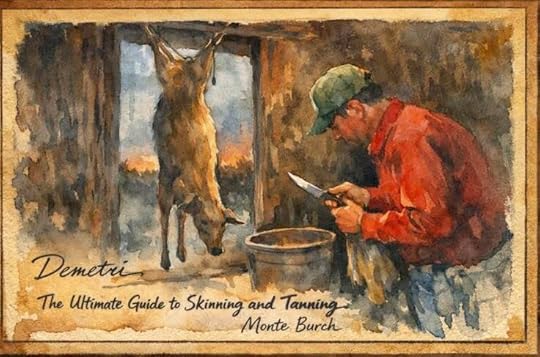
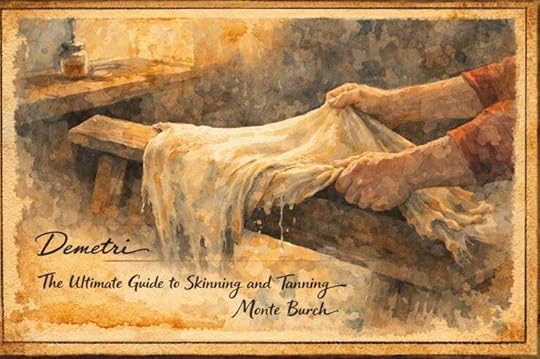
Watercolor Piece by Demetris Papadimitropoulos “The First Cut” – Dawn in a dim shed, the knife flashes once, and the race against decay begins.
There are books that want to be underlined, and books that want to be used. “The Ultimate Guide to Skinning and Tanning” belongs to the second category, the category of spines that crease, pages that ripple from damp air, margins that acquire the faint grit of salt. Monte Burch writes as if he expects you to have a bucket nearby. He does not seduce the reader with romance or myth. He offers a steadier promise: if you do the work in the right order, and you do not lie to yourself about time, rot, or effort, you can turn something perishable into something that lasts.
Burch is an outdoor writer by temperament, and the book carries that lineage in its bones. The sentences have the clean directness of camp instruction. The voice is calm, practical, sometimes gently admonishing – the voice of someone who has seen a lot of hides ruined by the same avoidable mistakes and would prefer not to watch you repeat them. He does not waste many words on aesthetics. Yet the cumulative effect is curiously aesthetic anyway, because the book is ultimately about attention: the attentive cut, the attentive scrape, the attentive waiting. In a cultural moment that trains us to outsource friction – the delivery app, the instant replacement, the invisible supply chain that lets us live as if materials appear by magic – Burch’s manual reads like a contrarian text, though it never declares itself one. It simply insists, again and again, that matter has rules.
The opening chapters establish those rules in the tone of a man setting tools on a bench. Tanning, Burch makes clear, is not merely drying. A hide can be dried into rawhide, yes, but rawhide is its own thing – hard, stiff, reactive to water, useful in certain applications precisely because it behaves like a natural plastic. Leather is different: a chemically stabilized skin, able to be wetted and dried without collapsing into decay or rigidity. This distinction, basic as it sounds, becomes one of the book’s quiet moral lessons. You cannot call something finished because you are tired of it. The material does not care what you call it.
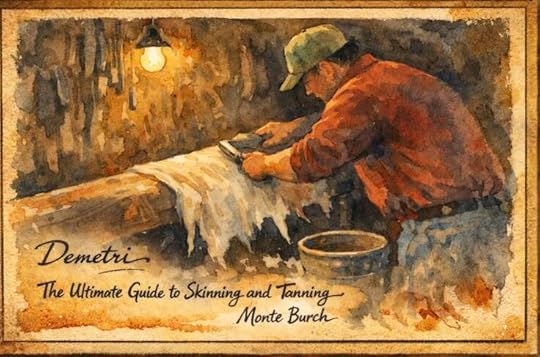
Watercolor Piece by Demetris Papadimitropoulos “The Beam” – Under a single bulb, the real labor shows itself: scrape by scrape, the hide is earned.
Burch’s practical genius is his insistence that the most important steps happen before the steps beginners want to talk about. The romance word is tanning, the satisfying reveal; the real hinge is preparation. Skinning, fleshing, preserving: these are the acts that determine whether the later chemistry has anything to work with. A cut made too deep in the first ten minutes becomes a hole you will stare at for the next ten days. A greasy membrane left on the flesh side becomes a future failure you will blame on a formula, when the truth is simpler: you didn’t finish the job you were doing.
This is why the chapter on tools and workplace feels, in its own way, like a philosophy chapter. Burch is not interested in fetish gear; he is interested in set-up. He wants you to think about where the mess goes, where the water runs, where the hide will hang, what the sun will do to it, how you will keep children and animals away from chemicals, how you will avoid working bent over until your back becomes the limiting factor. The fleshing beam, the workbench, the tubs, the stakes – the objects are presented as extensions of posture and repetition. The craft, he implies, is not one heroic day but a sequence of manageable days. Set yourself up so you can return.
If you read “The Ultimate Guide to Skinning and Tanning” purely as a manual, you will appreciate its thoroughness. If you read it, as I did, partly for research – the kind of research that asks not only what people do but how they talk about what they do – you begin to hear the book’s deeper rhythm. It is a book of processes, and processes are a kind of narrative. The plot is always the same: time is the antagonist; attention is the protagonist. Burch’s recurring villains are heat, bacteria, moisture, hurry, and what he might call laziness but what the modern reader recognizes as distraction. You can almost map the manual’s steps onto the emotional logic of any difficult project: do the hard parts early, don’t postpone the unglamorous, keep your standards where the material can feel them.
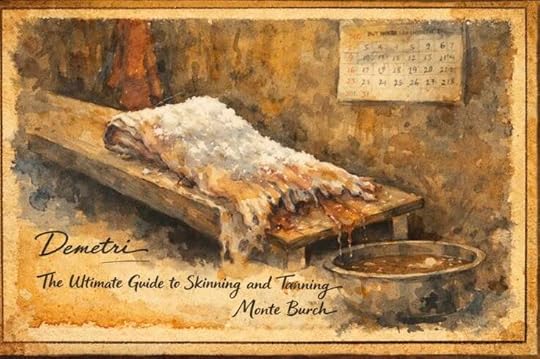
Watercolor Piece by Demetris Papadimitropoulos “Salt and Time” – A hide folded and snowed with salt, brine dripping into a pan while the calendar blurs on the wall.
The middle of the book, devoted to skinning different animals, is where Burch’s practical eye becomes almost cinematic. He divides the world into methods – case skinning versus open skinning, hair-on versus hair-off – and each choice has consequences. Small game and furbearers often come off like sleeves, turned, stretched, dried. Deer and domestic animals open wider, heavier, more like sheets you have to manage. Bear becomes its own category of urgency and bulk, a reminder that the animal’s biology is not an abstraction. Even when you disagree with a detail, you recognize the value of his frame: decide what you want the finished thing to be, then choose the method that serves it. Too many beginners choose the method first and hope the finished thing will cooperate.
Chapter 6, on preserving and storing hides and pelts, may be the most quietly modern chapter in the book. Preservation is where the craft admits reality: you don’t always have time to tan immediately; life interrupts; weather changes; freezers fill; the season brings more hides than your hands can handle. Burch’s solutions – salting, drying, freezing – are not glamorous, but they are the reason the craft can fit into ordinary lives. A hide folded flesh-to-flesh under a mound of salt, brine draining into a pan, is a kind of still life of postponement done correctly. It is also, if you want to read the moment against our present, a small meditation on supply and timing. In a culture newly attuned to disruption – to shortages, delays, the sudden revelation that “two-day shipping” is not a law of nature – preservation reads like an ethic: you stabilize what you can’t finish, you protect your future self from your present constraints.
The tanning chapters themselves are where Burch’s breadth becomes both his appeal and his limitation. He offers multiple methods, and he does so with a pragmatist’s lack of ideology. Brains, bark, alum, acids, commercial formulas: the book is a toolbox, not a creed. This makes it unusually welcoming. A reader who wants to stay “traditional” can follow the buckskin route; a reader who wants predictable results can follow modern systems; a reader who wants hair-on pelts can choose accordingly. The manual does not shame you for wanting a product you can buy, nor does it pretend that buying a product replaces work. It simply hands you options and keeps repeating the same truth: whatever you choose, you still have to soften the hide as it dries. You still have to do the labor.
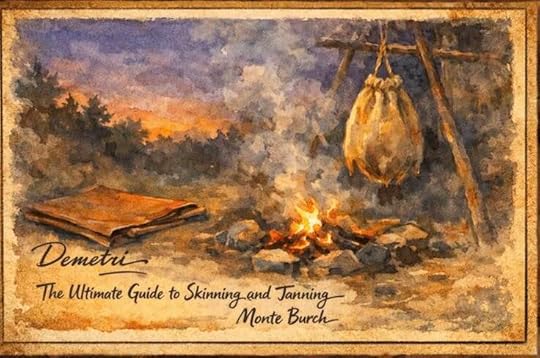
If buckskin is the mythic leather in American imagination – soft, breathable, wearable, associated with the long story of Indigenous craft and frontier reinvention – then Burch treats it with the appropriate respect without turning it into spiritual theater. The brain-tanning method is presented as a sequence of tasks: dehair, membrane, apply the solution, work it in, wring it out, break it as it dries, smoke it to set it. The smoking step, especially, reads like a final blessing, the point where the material crosses from fragile to durable. Smoke here is not just atmosphere; it is chemistry, protection, history. It is one of those moments in the book where the craft’s antiquity rises to the surface. You feel, in the smoke, the lineage of hands before you.
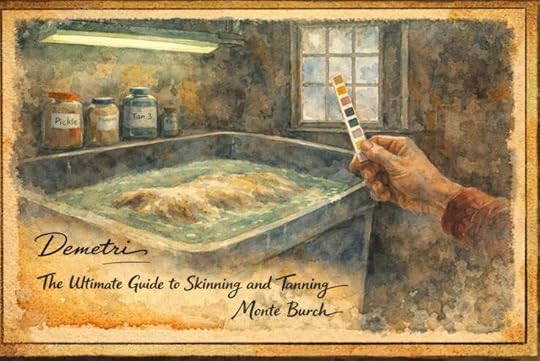
Watercolor Piece by Demetris Papadimitropoulos “The Chemical Bath” – Plastic tubs and pH strips replace brute force as the hide turns, degree by measured degree, into leather.
Burch’s chapter on vegetable tanning carries a different mood: slower, darker, more patient. Bark tanning is the method of time and steeping, of moving through baths and waiting for tannins to penetrate. It yields a firmer leather, suited to structure – belts, harness, the objects that hold other objects together. In an era of “slow fashion” and renewed interest in durable goods, vegetable tanning has become a kind of moral signifier in some circles: the leather that ages, that develops patina, that tells the truth about use. Burch is not chasing trends, but his attention to these older methods feels newly legible now, when the language of sustainability has become both marketing and genuine longing.
Rawhide, too, reads with fresh resonance. It is the book’s reminder that not every transformation needs chemistry, that sometimes drying is the point, that rigidity can be a feature, that the material world contains multiple forms of usefulness. Burch’s discussion of rawhide’s shrink-and-harden behavior – its natural clamp, its ability to bind – offers a small corrective to our modern assumption that “soft” always means “better.” There is a tough-mindedness here, the outdoorsman’s willingness to accept that materials have different virtues. Not everything needs to be comfortable. Sometimes it needs to hold.
Later chapters on birds and reptiles expand the manual’s remit into a kind of cabinet of curiosities. Here the book’s breadth is impressive, though some readers will feel the shift away from the more central, fully developed hide-work sections. Still, it’s hard not to admire the ambition: a single volume that wants to shepherd the reader through pelts, fur, leather, rawhide, feathers, scales. It is a book for the person who doesn’t want to waste what they have, who wants to know how far the knowledge extends.
If you are looking for a comp shelf – and any serious reader is, consciously or not – Burch’s manual sits in interesting relation to a handful of classics. “The Complete Book of Tanning Skins and Furs” has a similar all-in-one reach, though with a different personality. “Tan Your Hide!” speaks with a more explicitly beginner-friendly encouragement. Buckskin-focused works like “Deerskins into Buckskins” and “Blue Mountain Buckskin” go deeper into one tradition, offering a level of nuance and troubleshooting that a generalist manual cannot always provide. And the Foxfire books – “Foxfire 3” in particular – share Burch’s commitment to plainspoken knowledge transfer, the belief that traditional competence can be recorded and passed on without becoming a performance. Burch’s book belongs among these not because it is the most poetic or the most comprehensive, but because it is sturdy, approachable, and unashamedly practical.
Watercolor Piece by Demetris Papadimitropoulos “Breaking the Hide” – Late light cuts through dust as hands pull and return, again and again, until stiffness becomes softness.
That practicality, though, comes with the unavoidable downsides of a wide-ranging field guide. Some sections feel like they are inviting you into a room and then leaving you to explore. Certain chemical discussions carry the aura of their era; modern readers who want stronger emphasis on disposal, environmental impact, and updated safety framing may find themselves wishing for a more contemporary overlay. The book’s posture is often “here’s how” rather than “here’s why, historically, ethically, ecologically.” In a moment when the ethics of animal products are argued loudly – leather versus synthetics, local craft versus industrial scale, transparency versus distance – Burch does not take the podium. He stays at the bench. Depending on your taste, that restraint will feel either refreshing or insufficient.
And yet, for all that, the book’s best quality remains its fundamental honesty about labor. Burch refuses to pretend this is easy. He repeatedly returns to softening – breaking the hide, pulling it over a stake, working it as it dries – because he knows this is where the novice gives up. This is where the leather becomes leather. The repeated return, the constant pull, the willingness to do it again when it stiffens, is the craft’s true threshold. There is something almost allegorical in that insistence. The world does not yield softness for free. You earn it through repetition.
Reading the book while working on my own writing, I found myself unexpectedly moved by its refusal of frictionless fantasy. The book is not aspirational content; it is competence content. It makes a quiet claim: if you want a different relationship to materials, you have to accept the cost – time, attention, mess, learning. That claim, modest as it seems, is one of the more radical propositions a craft book can make now. It doesn’t matter whether you ever tan a hide. The message still lands: the world is made, and making has steps.
So where does that leave “The Ultimate Guide to Skinning and Tanning” as a book – not only as a manual, but as an artifact of writing? It is not a literary performance, and it does not try to be. Its prose is functional, its organization purposeful, its authority earned through the calm repetition of fundamentals. Its breadth occasionally outpaces its depth, and a more modern edition might benefit from sharper contextual framing. But as a working guide, it is sturdy and generous. It offers options without snobbery, warns without melodrama, and teaches the reader to respect sequence. That’s a serious achievement. On the scale of books meant to be lived with, dirtied, returned to, and gradually absorbed, I’d place it at 80/100.
Watercolor Piece by Demetris Papadimitropoulos “Smoke / Finished Piece” – At dusk, smoke lifts into violet air and the finished leather lies quiet, sealed into its new life.