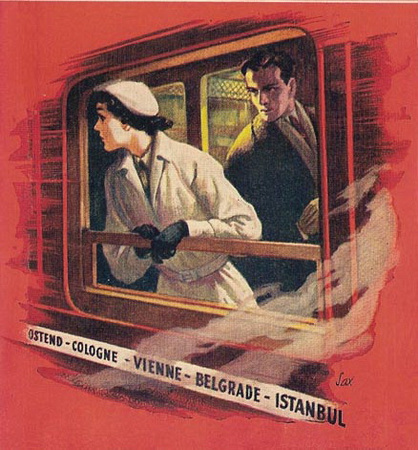
A train departs Ostend and carries businessmen, journalists, criminals, dancers, and revolutionaries toward Istanbul on a journey that's sure to railroad them into disaster. They quarrel, fall ill, fall in love, betray each other, and lose everything in border towns and courtrooms, their lives completely derailed. The businessman tries to help the dancer stay on track, the journalist conducts a betrayal of the revolutionary, the thief shoots his way toward freedom without missing a station, and the train continues toward its terminus with passengers who've clearly gone off the rails.
Carleton Myatt, a wealthy Jewish businessman, climbs aboard the Orient Express with contracts in his briefcase and a head full of commerce, ready to make deals at full steam. He meets Coral Musker, a delicate English dancer who faints before Cologne and declares, "I'm in the chorus", though she's clearly not used to this locomotive lifestyle. Their uneasy companionship gains traction when he buys her a sleeper ticket and tells her, "You must have my compartment," an offer that really moves her.
At the same time Dr. Czinner returns from exile, chugging along while muttering of "my proper work," while Mabel Warren, gin-sodden journalist, conducts herself poorly as she bullies her younger companion Janet Pardoe with threats and insults that hit like a freight train. Josef Grünlich, murderer and thief, carries a pistol in his pocket and dreams of escape, hoping to make a clean getaway without getting railroaded by the law.
Scenes flow like signals flashing past: Coral collapses in her berth (clearly not built for this track), Myatt stares out at "a wilderness of allotments" while his business plans gather steam, Mabel throws herself at a chance for headlines with locomotive determination, and Czinner confesses to Coral, "Your heart's bad. You've been overstraining it for years," a diagnosis that really hits the buffers. Soldiers board at Subotica like unwelcome passengers, travelers are herded into cold official rooms where their fates get switched onto different tracks, and the tension thickens with every station stop.
I read the book as a portrait of Europe rushing toward disaster at express speed, painted inside a moving carriage where strangers reveal themselves with a candor that borders on cruelty, no need for a ticket to ride this emotional roller coaster.
Coral pleads, "One can't tell, can one?" and the innocence of her question delivers more impact than a runaway locomotive, stinging harder than Czinner's speech to the tribunal. Greene builds comedy into tragedy with the precision of a master conductor, as when Grünlich flatters a guard with lies while staying right on schedule, and Myatt negotiates both contracts and affection without missing a beat.
The book struck me as a cousin to Dostoevsky's fables of guilt (both authors expert at keeping readers on the right track emotionally) and as a precursor to Hitchcock's thrillers where compartments conceal guns, lovers, and spies like so much dangerous cargo. Greene himself described these early thrillers as "entertainments," though the entertainment here carries executions, betrayals, and heartbreak inside a sleeping car. Passengers definitely not getting their money's worth for this ticket to ride.
The writing moves through each compartment with the efficiency of a well-oiled engine, featuring brisk dialogue and carefully planted images that stick like Coral's "white mackintosh," Czinner's "shabby overcoat," and Myatt's currants that carry both money and metaphor, freight both literal and literary. I sense how the book signals a continent divided between commerce and ideology, and I admire the audacity of a young author who could compress politics, passion, and crime into the sealed world of a train without the whole thing jumping the tracks.
Greene manages to pull me into the corridor with the force of a powerful locomotive, where doors slam like coupling cars, soldiers bark orders like stationmasters, and passengers vanish into custody while their plans completely derail. Meanwhile, the wheels hammer out a rhythm that carries me on toward Istanbul and beyond, a journey where every passenger's story reaches its final destination, whether they bought a ticket for it or not.