

What do you think?

The War for the Union
The War for the Union: The Improvised War, 1861-62
An account of the first year of the war that studies the transformation of a nation.
436 pages, Hardcover
First published January 1, 1940
About the author
Allan Nevins
513 books30 followersAllan Nevins was an American historian and journalist, renowned for his extensive work on the history of the Civil War and his biographies of such figures as President Grover Cleveland, Hamilton Fish, Henry Ford, and John D. Rockefeller.
Ratings & Reviews
Friends & Following
Create a free account to discover what your friends think of this book!
Community Reviews
Displaying 1 - 13 of 13 reviews

Read
July 23, 2015
Union infantry regiment in camp, American Civil War
The Democratic population meanwhile suspected that what had begun as a national war to save the Union had become a Republican war to destroy slavery, create a strong centralized government and hold the South in permanent subjection.
Most of the dozens of books I have read about the American Civil War, an event that looms in my mind as the most significant in American history, have been military histories. Certainly, there is much military history in Allan Nevins' (1890-1971) four volume War for the Union (*), but War for the Union is primarily a political, social, economic and administrative history of those most fateful four years, 1861-1865.
And is it ever thorough! Though Nevins' treatment of the Confederate sources is extensive, it pales before his examination of the Union sources, for it appears that Nevins read everything written by the players on the Union side of the conflict, even the most obscure, and much of the production of contemporary journalists and diarists in order to keep the reader abreast of what was going on in the minds of those players at every critical juncture in his essentially chronological account.
I am certainly not going to try to summarize these two thousand pages of vividly and exhaustively drawn history, but I do want to discuss briefly one of his main points, one that supports my view of the significance of the Civil War in American history. In 1860 the United States of America had already stretched across the continent, but it was a nation of individualists, of men and women who abhorred any suggestion from another that a collective effort or goal might be a good idea. The Federal government was unspeakably weak, without funds or power, but there weren't even any collectives, organizations, or Societies that organized the efforts of more than a handful of people. Even businesses were small operations of limited extent, capital and ambition, each doing their own thing their own way in their own tiny little corner. A massive collective effort for any purpose was simply inconceivable. And then Fort Sumter was fired upon.
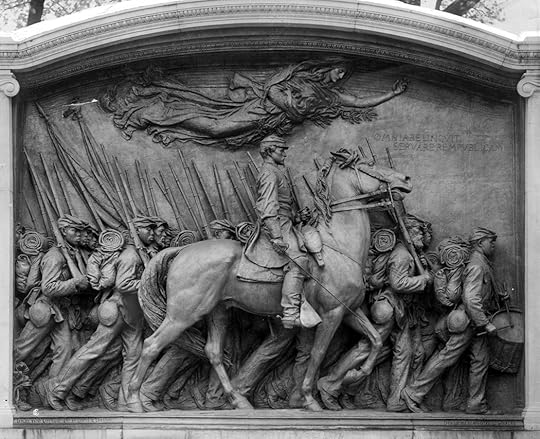
Augustus Saint-Gaudens' 1897 monument to the 54th Massachusetts Volunteer Infantry Regiment (one of the earliest African-American units) and its commander, Col. Robert Gould Shaw, most of whom died in service.
Nevins emphasizes that the incredible new tasks of organizing, funding and focusing the efforts required for Total War, for transitioning from a federal military totalling less than 20,000 in 1861 to well over 1,000,000 two years later, for supplying them, transporting them, funding them, caused a radical change in the nature of the American economy, society and government, one without which, in my view, the American involvement in Europe in 1914-1918 would have been negligible, if it had taken place at all, with all the concomitant changes in European history that would have entailed. And then one must wonder about 1939-1945 and its consequences even had the French and British been able to hold out in 1917-1918 by themselves, for what would have motivated the Americans to change everything in their society unless it were the direst necessity; but America had weak, pacific neighbors and two huge oceans to keep everyone else at a distance, so where would this necessity have arisen?
The first eighteen or so months of the Civil War was a clown's parade of frantic, unorganized efforts colliding with each other, negating each other; it was a panoply of desperate improvisation as sheer and immediate necessity forced larger and larger scaled organization and focus upon American society, economy and government. This resulted in an efflorescence of civil, governmental and business organizations that socialized the American individualists to collective effort, as well as the development of centers of capital, business and industry that were expanding, coalescing and acquiring horizons and ambitions going far beyond the county or city line of the pre-war years. Without the Civil War the "American Century" may never have occurred, for better or for worse, and the world would be a very different place now.
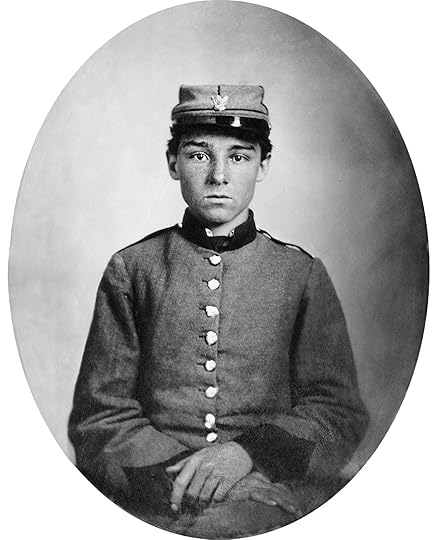
An image that has haunted me since I first saw it over forty years ago: Seventeen-year-old Confederate soldier Private Edwin Francis Jemison, killed in action on July 1, 1862.
Another matter I'd like to touch upon: There is a never ending argument concerning whether the Civil War was about states' rights or about slavery, with certain political positions associated with each view. Both are oversimplifications, because the views of the populaces of both North and South were anything but monolithic, and Nevins provides a glimpse of the wide variety of these views within each section of the country. I'd like to draw out some of the points made in these four volumes that are of direct relevance to this tiresome argument.
The states that seceded first were those in which cotton was king and thus were heavily reliant upon slave labor.(**) The northern tier of the South, including Virginia, North Carolina and Tennessee, left the Union later. In some of these states, like Virginia and North Carolina, initial referenda brought by secessionists went down to defeat. One of the main claims of pro-slavery advocates was that if slavery did not continue to expand, it would die.(***) Concomitant with that were plans made by influential Confederates just before and after Secession - after they would have "taken care of" the Yankees - to invade the Caribbean, Central America and the tropical and semi-tropical portions of South America to set up a slaveholding empire. Mexico was to be annexed and divided into seven new slaveholding states. None of that has anything to do with states' rights.
Nonetheless, there were numerous Southerners who disliked slavery and for whom states' rights, old resentments towards the Yankees and, above all, loyalty to "home" were their prime motivations for secession. In the North there were those, like Lincoln, for whom maintaining the Union was the highest goal and others, like Horace Greeley (not to mention the many Abolitionists), for whom the purpose of the war was the liberation of the slaves and the permanent end of slavery. And this is just part of the wide spectrum of attitudes and positions adopted in both sections, attitudes and positions that continued to evolve during the conflict. The "either/or" argument has no historical basis at all.
The Civil War was the extreme circumstance that changed American society in every aspect, from stem to stern, and the War for the Union recalls for us both the admirable and the disgraceful, the self-sacrificing and the self-obsessed, the incredibly brave and the abysmally cowardly, the noble and the truly horrific acts that together resulted in a total transformation of American society, at the cost of hundreds of thousands of lives.
(*) Itself the culmination of his eight volume Ordeal of the Union (1947-1971) which begins the story in 1847.
(**) Not only did the big slaveholders, wealthy and influential owners of great plantations who sat in the state legislatures of the cotton growing states, drag the poor, hardscrabble whites into the war, but they also saw to it that the Confederate Conscription Law exempted all owners of at least 20 slaves from the conscription.
(***) This is one of the main reasons why it was held that slavery had to be admitted into the West and even the Southwest, where there was no role for slave labor at all. I don't understand the grounds for the claim, nor do I understand why if slavery died out naturally - which is what these advocates feared - it would be a bad thing, even for them (unless they were slave traders). But Nevins makes clear that this was an important pillar in the edifice of pro-slavery ideology.
Early in the war Lincoln offered to buy (and then free) all the slaves in the Border States; the proposal was firmly and emotionally rejected. Nevins adduces solid evidence that one of the primary reasons the prospect of the liberation of the slaves aroused such strong emotions was that the people of the slaveholding states were petrified by a future in which they would no longer have the Law, the Power of the State to keep the Blacks in line. Of course, as we know, after the valiant efforts to enforce equality during Reconstruction failed, white Southerners did find ways to keep them in line and ultimately succeeded in redirecting the power of the states, if not quite the (federal) State, against the Blacks. In the North there were many (a minority) who feared the liberation of the slaves because they would then face competition with them for jobs. We also know how racial tension played itself out later in the North.

January 17, 2013
The pinnacle of narrative history on the U.S. Civil War. The entire Ordeal For The Union series is a must read for Civil War buffs.

December 22, 2025
It was a conflict that seemed to be destined to occur for years, but neither side was particularly ready for when it happened even though one side had been preaching for while to be independent and didn’t prepare. The War for the Union, Volume I: The Improvised War, 1861-1862 is the fifth book of Allan Nevin’s Ordeal of the Union series as the war that appeared inevitable after secession start but in a haphazard fashion that leaves both sides scrambling to raise, arm, and supply men while fighting one another.
Through 416 pages of text, Nevins details the lead up to and the fallout of the firing of Ft. Sumter that resulted in Lincoln’s call for volunteers which sent almost half of the border states into the Confederacy and how both sides figured out how to fight a war. As Nevins expertly relates while contemporary feeling—from both sides—demanded fighting, logistically it wasn’t so simple as arming men and getting them arms to fight with and supplies to live on were a challenge early on. The challenges, especially with political considerations for Lincoln, to getting raised troops to where they were needed and how state governments more than the underdeveloped U.S. government were essential early on. Nevins focuses on fighting when it needs to, but this volume is dedicated to revealing about how unorganized either side was to even fight and thus why 1861 is comparatively bloodless. The struggle to get arms and supplies leading to both sides contracting foreign contractors is enlightening and Nevins analysis on how both sides did was very informative. Besides the arming and logistics information, Nevins goes into the political maneuvering that was new to me especially in Missouri and how the Blair family cost the Federal war effort three-years of guerilla warfare due to their machinations when the state could have been firmly pacified by the end of the year. Nevins also goes into how each side, though mainly the Federals, squandered opportunities to get easy victories that would quiet public demand for action and improved strategic lines for defense of important areas even if the lines moved a few miles. Overall, this volume while “light” on fighting shows the forgotten importance of supplies and logistics when it comes to warfare in this period.
The War for the Union, Volume I: The Improvised War, 1861-1862 reveals how two political factions switched from talking to fighting and Allan Nevins reveals the complicated transition that took place to bring it about.
Through 416 pages of text, Nevins details the lead up to and the fallout of the firing of Ft. Sumter that resulted in Lincoln’s call for volunteers which sent almost half of the border states into the Confederacy and how both sides figured out how to fight a war. As Nevins expertly relates while contemporary feeling—from both sides—demanded fighting, logistically it wasn’t so simple as arming men and getting them arms to fight with and supplies to live on were a challenge early on. The challenges, especially with political considerations for Lincoln, to getting raised troops to where they were needed and how state governments more than the underdeveloped U.S. government were essential early on. Nevins focuses on fighting when it needs to, but this volume is dedicated to revealing about how unorganized either side was to even fight and thus why 1861 is comparatively bloodless. The struggle to get arms and supplies leading to both sides contracting foreign contractors is enlightening and Nevins analysis on how both sides did was very informative. Besides the arming and logistics information, Nevins goes into the political maneuvering that was new to me especially in Missouri and how the Blair family cost the Federal war effort three-years of guerilla warfare due to their machinations when the state could have been firmly pacified by the end of the year. Nevins also goes into how each side, though mainly the Federals, squandered opportunities to get easy victories that would quiet public demand for action and improved strategic lines for defense of important areas even if the lines moved a few miles. Overall, this volume while “light” on fighting shows the forgotten importance of supplies and logistics when it comes to warfare in this period.
The War for the Union, Volume I: The Improvised War, 1861-1862 reveals how two political factions switched from talking to fighting and Allan Nevins reveals the complicated transition that took place to bring it about.

April 9, 2013
Surprisingly, one of my favorite books about the Civil War! Going into this book, the first of four volumes covering the entire Civil War, I thought it would be a dry read that would spend too much time on small details. However, I found the narrative to be outstanding, and was fascinated by the many levels the author covers in the book. From studies of resources and the capacity to make weapons and ammunition to the politics and battles, every chapter had something for me that I did not know and was interested to learn.
I am looking forward to the next three volumes and hope to tackle them during my off time in the summer.
I am looking forward to the next three volumes and hope to tackle them during my off time in the summer.

July 9, 2011
A great read. Nevins is an essential part of Civil War literature. He provides a useful contrast to Shelby Foote's romantic, pro-Southern view of the war and James McPherson's single volume standard history "Battle Cry of Freedom."
Nevins delves deeper into the political history of the Northern and Southern war efforts. His critiques of the leaders, North and South, do much to dispel the conventional popular history (and myths). A highly recommended read for serious students of American Civil War history.
Nevins delves deeper into the political history of the Northern and Southern war efforts. His critiques of the leaders, North and South, do much to dispel the conventional popular history (and myths). A highly recommended read for serious students of American Civil War history.
September 19, 2023
Allan Nevins begins Volume V of his "Ordeal of the Union" series, the first of four about the war itself after four terrific volumes on the causes, with a disclaimer. His narrative, while incredibly detailed and vast in scope, intentionally neglects two things: 1) a focus on military history and 2) the vantage point of the Confederacy. Since I, personally, find military history dull, this made for an exciting read (for those interested in that, read Shelby Foote). The lack of focus on Confederate affairs is disappointing, but there are plenty of focused studies on that topic, and Nevins' grasp of Union feeling during the first year of the war is a testament to his (and his team)'s depth of research.
The subtitle to this volume, the Improvised War, is quite apt, and describes what the majority of this book discusses. Starting with the lead-up to Fort Sumter and continuing through the turn of the calendar into 1862 and the crisis in the Lincoln cabinet at that time, Nevins chronicles a year in which the Union was a mess in many ways. Initially, many hoped and expected a short war. War fever was high, and initial recruitment efforts were successful, but as the Confederates earned victories at Bull Run, Wilson's Creek, and Ball's Bluff, the reality began to set in that a long conflict was ahead. This volume stops short of the moment where the war truly becomes a revolution (that will come in the next volume), but we get a good overview of how expansive the war effort was for the North in the first few months of the conflict.
The bottom line is that the Union was unprepared for a large-scale conflict on all phases. Chapters of this volume deal with the discombobulation of camps, generals, arms, uniforms, and whatever other military necessity you could think of. Nevins illustrates how a country that had not engaged in a major war in decades and was, due its geography, not expecting another one, had to quickly raise the army up to a useable state, particularly after initial war fever passed and recruitment efforts became more difficult. But beyond this, the major theme of this volume is how the American government, moreso than the military, was not prepared to handle a major conflict. Congress still saw itself as the arbiter of decisions, Lincoln had yet to assert himself in a cabinet mired in conflict and personal vitriol amongst members, and the jumbled decisions of state Governments made cooperation difficult. The war would eventually lead to a major overhaul in how the American government functioned, and Nevins lays the seeds of that transformation here.
The two generals with whom Lincoln engaged the most in 1861 were McClellan and Fremont, and his relationships and conflicts with both are covered at length. Particularly interesting are the chapters on Fremont, his campaign in the West, and how Lincoln reacted to his emancipation edict - something to consider given how radically Lincoln's views on emancipation would change in the next 18 months. Nevins wrote a biography of Fremont and knows the man's psyche in detail, and the sections on McClellan's personality and how he harmed the early war effort with his stalling tactics are also interesting.
I didn't love this volume quite as much as some of the earlier ones just because some of the sections drag on about uninteresting topics, such as the chapter on the production of artillery and the minutiae of the bureaucratic infighting in the Lincoln cabinet. Where this volume shines is where Nevins considers the earliest roots of the massive societal change that took place throughout the war. The major battles are discussed, but more interesting is how those actions on the battlefield intersected with the war's cause. For the first year, it was still clear that restoration of the Union, perhaps even with slavery, was the main goal. But things were quickly changing, and thanks to Fremont, slavery and emancipation are becoming a leading goal for many radicals in how the war should be pursued. For more on that, we must continue on to Volume VI.
The subtitle to this volume, the Improvised War, is quite apt, and describes what the majority of this book discusses. Starting with the lead-up to Fort Sumter and continuing through the turn of the calendar into 1862 and the crisis in the Lincoln cabinet at that time, Nevins chronicles a year in which the Union was a mess in many ways. Initially, many hoped and expected a short war. War fever was high, and initial recruitment efforts were successful, but as the Confederates earned victories at Bull Run, Wilson's Creek, and Ball's Bluff, the reality began to set in that a long conflict was ahead. This volume stops short of the moment where the war truly becomes a revolution (that will come in the next volume), but we get a good overview of how expansive the war effort was for the North in the first few months of the conflict.
The bottom line is that the Union was unprepared for a large-scale conflict on all phases. Chapters of this volume deal with the discombobulation of camps, generals, arms, uniforms, and whatever other military necessity you could think of. Nevins illustrates how a country that had not engaged in a major war in decades and was, due its geography, not expecting another one, had to quickly raise the army up to a useable state, particularly after initial war fever passed and recruitment efforts became more difficult. But beyond this, the major theme of this volume is how the American government, moreso than the military, was not prepared to handle a major conflict. Congress still saw itself as the arbiter of decisions, Lincoln had yet to assert himself in a cabinet mired in conflict and personal vitriol amongst members, and the jumbled decisions of state Governments made cooperation difficult. The war would eventually lead to a major overhaul in how the American government functioned, and Nevins lays the seeds of that transformation here.
The two generals with whom Lincoln engaged the most in 1861 were McClellan and Fremont, and his relationships and conflicts with both are covered at length. Particularly interesting are the chapters on Fremont, his campaign in the West, and how Lincoln reacted to his emancipation edict - something to consider given how radically Lincoln's views on emancipation would change in the next 18 months. Nevins wrote a biography of Fremont and knows the man's psyche in detail, and the sections on McClellan's personality and how he harmed the early war effort with his stalling tactics are also interesting.
I didn't love this volume quite as much as some of the earlier ones just because some of the sections drag on about uninteresting topics, such as the chapter on the production of artillery and the minutiae of the bureaucratic infighting in the Lincoln cabinet. Where this volume shines is where Nevins considers the earliest roots of the massive societal change that took place throughout the war. The major battles are discussed, but more interesting is how those actions on the battlefield intersected with the war's cause. For the first year, it was still clear that restoration of the Union, perhaps even with slavery, was the main goal. But things were quickly changing, and thanks to Fremont, slavery and emancipation are becoming a leading goal for many radicals in how the war should be pursued. For more on that, we must continue on to Volume VI.
November 26, 2021
Nevins's series on the civil war is a classic but he struggles in this first volume on the war to put together a coherent picture of what was going on. He is trying to cover so much detail (and he does) that things seem jumbled including the pivotal moment of the First Battle of Bull Run. Perhaps that fits with his theme of an "Improvised War" but it results in a more challenging read than the other books in the series. Still highly recommended though for Civil War buffs and anyone looking for an encyclopedic survey of this period
October 25, 2022
Another eye-opening volume in the series. A very good job describing the difficulties gearing up for war. US was a country of small manufacturers and a country unaccustomed to the federal government taking much of an active role in life. This ends at the end of 1861, a year with little activity especially compared to the next few years.
October 12, 2018
Covers the time from Lincoln’s Inauguration through New Year’s Day, 1862. Shows the challenges associated with going from a peacetime to a wartime economy, as well as the struggle to find effective civilian and military leaders for the war effort.

November 10, 2022
This book, the fifth in Allan Nevins's "Ordeal of the Union" series, covers the first year of the Civil War. Nevins captures the scattershot, ad hoc preparations of the early days of the war. Other writers spend more time detailing the military movements and activities, but only Nevins gets into other key factors like how the North and South armed themselves. Sometimes it was preferable to use inferior weapons because it was easier to replace parts.
I also gained better perspective on some of the personalities of the early war, such as John C. Fremont and Winfield Scott. Nevins delves much deeper into the political considerations that influenced military decisions than other historians I have read.
As with the earlier volumes in this series, this is outstanding history, and I guarantee even the most knowledgeable Civil War buff will learn much from reading this book.
I also gained better perspective on some of the personalities of the early war, such as John C. Fremont and Winfield Scott. Nevins delves much deeper into the political considerations that influenced military decisions than other historians I have read.
As with the earlier volumes in this series, this is outstanding history, and I guarantee even the most knowledgeable Civil War buff will learn much from reading this book.

December 11, 2011
Very detailed analysis of events.
Displaying 1 - 13 of 13 reviews