In sweep, color & grandeur, the conquest & settlement of Siberia compares with the winning of the American West. It's the greatest pioneering story in history, uniquely combining the heroic colonization of an intractable virgin land, the ghastly dangers & high adventure of Arctic exploration, & the grimmest saga of penal servitude. 400 years of continual human striving chart its course, a drama of unremitting extremes & elemental confrontations, pitting man against nature, & man against man. East of the Sun, a work of panoramic scope, is the 1st complete account of this strange & terrible story. To most Westerners, Siberia is a vast & mysterious place. The richest resource area on the face of the earth, its land mass covers 5 million square miles-7.5% of the total land surface of the globe. From the 1st foray in 1581 across the Ural Mountains by a band of Cossack outlaws to the fall of Gorbachev, East of the Sun is history on a grand scale. With vivid immediacy, Bobrick describes the often brutal subjugation of Siberia's aboriginal tribes & the cultures that were destroyed; the great 18th-century explorations that defined Siberia's borders & Russia's attempt to "extend" Siberia further with settlements in Alaska, California & Hawaii; & the transformation of Siberia into a penal colony for criminal & political exiles, an experiment more terrible than Australia's Botany Bay. There's the building of the stupendous Trans-Siberian Railway across 7 time zones; Siberia's key role in the bloody aftermath of the October Revolution in 1917; & Stalin's dreaded Gulag, which corrupted its very soil. Today, Siberia is the hope of Russia's future, now that all her appended republic have broken away. Its story has never been more timely.
Benson Bobrick earned his doctorate from Columbia University and is the author of several critically acclaimed works. In 2002, he received the Literature Award of the American Academy and Institute of Arts and Letters. He and his wife, Hilary, live in Vermont.
Siberia! "The name itself is a mystical term, derived from the Mongolian siber ('beautiful', 'wonderful' and 'pure') and the Tartar sibir, which means 'the sleeping land'."
Large mountain ranges and deserts cut across it to the south.
To the west lie the Urals, the boundary between Europe and Asia.
Majestic volcanoes on its far eastern horizons form part of the Pacific rim of fire.
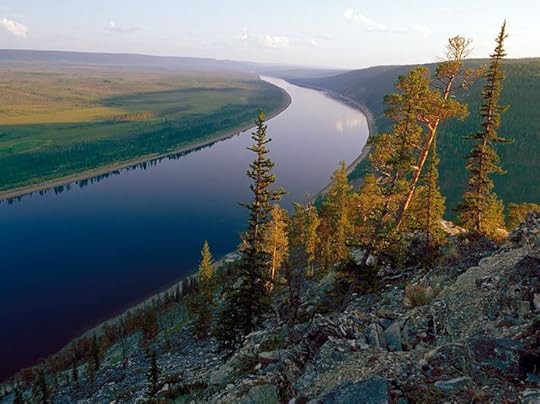
Its mighty rivers rival the Mississippi and Nile; each of its three major river basins are larger than the whole of Western Europe.
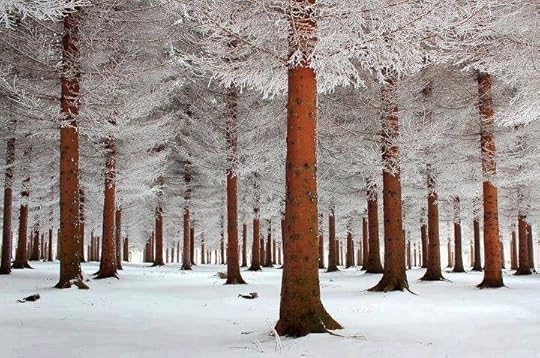
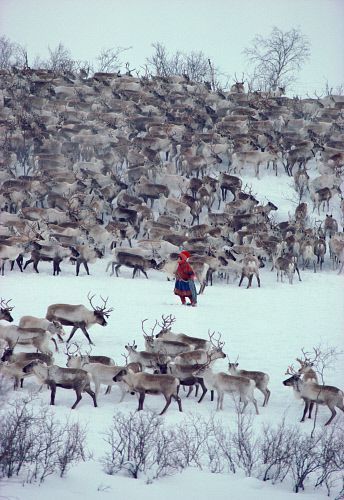
On the fringe of the tundra begins the primeval coniferous forest, the taiga.
"Only migrating birds, wrote Chekhov, "know where it ends."
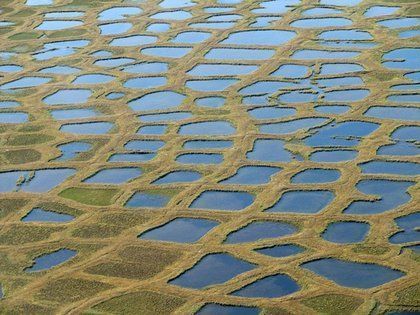
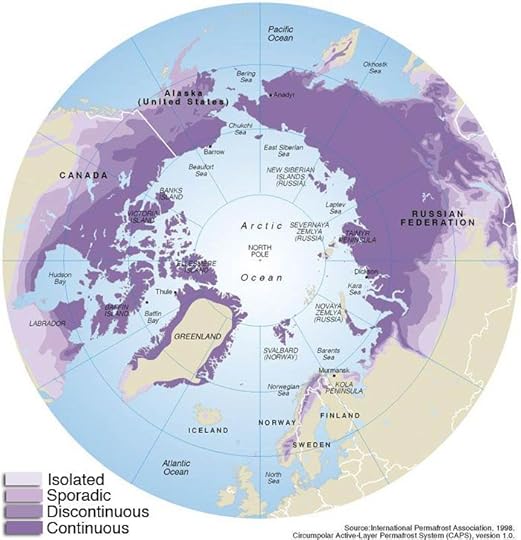
But strangest of all is the world of Siberian tundra. "Inhospitable and desolate, the desert-dry tundra was covered for most of the year by trackless wastes of snow. Nothing grew upon it but tufts of coarse grass or swards of moss and lichen...underneath was a thick substratum of geological ice or permafrost--eternally frozen ground--that was so deep in places as to be defeated only by the heat from the earth's hot core.
In summer, the ground thawed to a depth of just a few feet, and below that was impervious to water and hard as iron. In a sense, each spring it rained upward since evaporation was the only way water could escape. As melting snow saturated the topsoil, over time it had become covered with a dense luxuriant growth of grey Arctic moss...until the whole tundra had become one vast spongy bog."
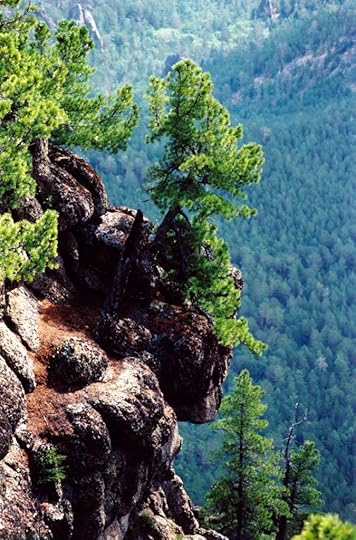
Much of Siberia's soil is locked in permafrost (shown in purple). Towards the south, some larch can dwell in the boglike soil above the permafrost, but the deepest pine taiga occurs where the permafrost is discontinuous:
Can humans find a place in this wild, beautiful and terrible land?
From the first human migrations out of Africa, some wandered across the tundra and through the taiga and found ways to survive.
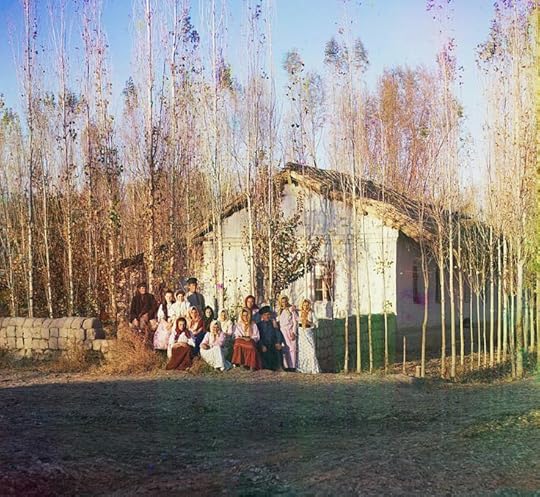
By the 19th century, pioneers had learned to farm the land and call it home.
For many Siberia became place of hope and freedom, for others a land of exile. And then came Stalin and the Soviets, the death of millions and deep scars carved in the heart of the once pure land.
This is a magnificent story, brilliantly told; full of insights into Russian and world history and by no means as bleak as you might expect. Four and a half stars, with a half star off for the woeful lack of detailed maps. For more quotes and some maps to fill the gaps in the text, click through to the updates and comments section.
This is a solid enough account of Russian Imperial acquisition of the wastes and resources of Siberia albeit one marred by a decline (it was written in 1992) into anti-Soviet and very incomplete history once the brutal and chaotic Russian Civil War is over.
My cynical side notes that the British Edition simply refers in the sub-heading to the conquest and settlement of Siberia but the American edition suddenly makes this an 'epic conquest' and 'tragic'. One senses two chapters tagged on to give Americans what they want to hear - an evil empire.
Having said that, the previous fourteen chapters give us a pretty sound and interesting account of Russian Siberia from Yermak's first incursion until 1921. This is good old-fashioned narrative history and can be read as such.
Brobrick is mostly relying on English language sources throughout, sometimes over-relying. Certainly he over-relies on dissident accounts in the last two chapters so this is a best effort at bringing together what we knew about Siberian history in the West in 1992 into one volume.
Until things go a bit pearshaped towards the end - how on earth does he completely fail to mention the Nomonhan incident in 1939 when he is so adroit at explaining the complicated geo-politics of the Russian Far East before 1921? - he tells a good and readable story.
The detailed account of the Bering Expeditions is downright exciting and Bobrik is good at explaining the circumstances that led to particular decisions. The sale of Alaska now seems like a highly rational act where once it seemed a giveaway.
In that case, Russia solved a financial problem arising out of the Crimean War, and accepted the reality of an aggressive expanding US market economy coming up against what amounted to little more than a line of fairly primitive trading posts, in order to concentrate on the Amur valley.
Similarly, until it misjudged Japan in 1904, Russia was quite skilled at getting control of the bits of the Far East that it wanted. It even managed to get a surprisingly good deal out of its own defeat in 1905. Russian resilience is a remarkable phenomenon.
The Russia of the Tsars is the Russia of today. An under-capitalised country of immense scale with a population too small for its aspirations which yet made impressive imperial strides through something close to the exercise of pure political will by successive administrations.
Looking at it from outside, you can see modern sanctions as a deliberate strategy of containment by one dominant Western faction in an attempt to bend this nation to its will and perhaps avert what might happen if the country did get sufficient external capital for its needs.
The news from inside Russia today is of severe economic strains but if Neo-Cold Warriors think that this nation will fall apart again and become available for plunder, I suspect they will be wrong-footed. It may fall apart for a while but it will never be plundered.
Siberia is now an essential part of this story. Bobrick's weak last two chapters (you can tell I was irritated by them) fails to discuss adequately its role in supplying a Plan B to survive the destruction in 1941/42 of its industrial capacity in the West or as a reserve of trained troops.
So, I can recommend the book up to the end of Chapter 14 but that you go to other more measured and more inclusive sources (albeit that he is entirely right about the grim Stalinist horrors of the Gulag) for the full story of Siberia under the Soviets (and of course since 1991).
This is a comprehensive look at the Russian history in Siberia. If you think Native Americans were treated unfairly, you will discover how poorly the Russians treated the native population in Siberia. Bobrick details the history in a somewhat cursory fashion, but this is a general overview and his treatment is proper. He has significant research that backs him up, there is no ground breaking revelations, but I chose the book because I knew nothing about Siberia. It created enough interest for me to want to look into the Gulag system more deeply. If you are interested in the old Soviet Union, this may be a good start.
I bought this book on a whim after learning an insane statistic regarding Siberia's enormous size: its population density of about 7.8 people per square mile makes it one of the most sparsely populated areas on the planet, yet some 33 million people live there. Bored and forced into COVID/unemployment seclusion, I bought Mr. Bobrick's book wanting to know more about the people who lived there and their story. It was the best decision of my pandemic experience.
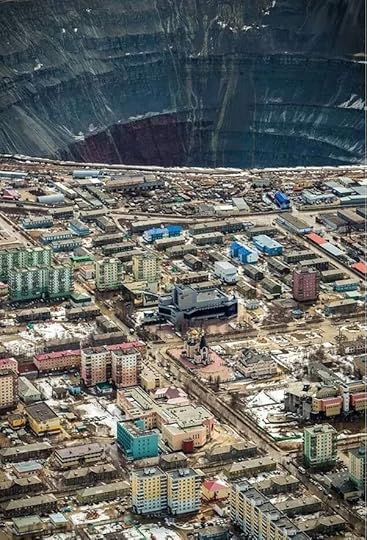
Siberia is both overwhelming and fascinating as a subject, and Bobrick tells the story of the land and the people who came to it—from the time of Ivan the Terrible through the Tsars' empire and the Soviet Union and into the modern age—through painstaking research and enlightening and entertaining snippets and anecdotes. You will learn about Russia's gradual eastward expansion, a long trek that mirrors America's westward adventure in near-mythical scale, storied ruggedness and pluck of participants, and tragic consequence to native peoples; the explorers and scientists who sought to map and document the enormous new frontier for the motherland, and Vitus Bering's "Great Northern Expedition" that puts Lewis and Clarke to shame; The fur business that swept from the Urals to Alaska and northern California, the untold riches it provided, and the rough Cossacks and criminals who engaged in it; the establishment of a horrid exile, punishment, and labor camp system that, developed over hundreds of years, led to Solzhenitsyn's "Gulag Archipelago" and the deaths of millions, and the enormous state projects and cities erected out of permafrost and in absolute wilderness using a system of slave labor that became almost a state unto itself; the building of the Trans-Siberian Railroad, a wonder of the modern world; and much more.
I would absolutely read anything else written by Bobrick, who paints an epic picture of conquest, adventure, and tragedy that is filled with astounding episodes and confounding statistics. I thoroughly enjoyed this book and would recommend it to anyone interested in the surprises that delving into a less-travelled area of history can provide.
This was such a deeply satisfying book. I knew absolutely nothing of Siberia's history and this book answered all questions that I had prior to and while reading this book. The chapters cover chronological periods in the conquest of Siberia but somehow, the author also manages to tie each chapter to a theme - from the fur hunting craze of the initial period to the dynamics of the eastward expansion to the Alaskan venture and so on and so forth. The chapters on exploration are extremely thrilling and we are imbibed with a grudging respect for the (mostly reprehensible) adventures who traversed this difficult land. Page after page of the difficulties encountered by all types of people leave a bone-chilling cold in the reader.
The author also keeps the focus on Siberia while balancing the need to explain European Russia's politics, which, after all, had a great impact on Siberia. Case in point- Siberia's role as an industrial base in World War II is explained in detail but the author skims over the military developments in the "far west" since they clearly had no direct impact on Siberia.
This is a mammoth book for a mammoth-sized land. I would definitely recommend this as The authoritative history of Siberia.
A grand an entertaining history of Russia's conquest and colonization of Siberia, from Ivan the Great to Stalin (chronologically if not morally distant). I learned some things I didn't know, I got some ideas for a sort of magical western novel that I might someday write, after I write about five other books and assuming I don't get hit by a car crossing the street this afternoon. A worthwhile read, all around. Were there sword fights: I mean, there aren't any literal descriptions of anyone going at it, but there's a fair bit of violence in the conquest of Siberia, as you might imagine, and the book doesn't stint. Speaking strictly, though, no, there weren't any sword fights.
Decent account of the Russian exploration and expansion into Siberia and the writing style was very fluid and engaging. You can tell it was written in 1992 and the bits towards the end felt a bit more questionable (“With Siberia Russia will continue to be potentially the richest city on earth”) but overall was a compelling introduction to the topic
Siberia ~ yuh, mysterious, but more to the point: wretched, century after century. I lived on Baranof Island in Alaska and now I know Alexandr Baranov . . . and Vitus Bering. This researcher spared no sentiment and the history of Siberia is brutal, cruel, freezing and then the midges. Americans should read this piece of history -- book published in 1992 -- somewhat dated.
The place of Siberia in Russian history is undeniably multifaceted. The initial expansion was based upon the lucrative fur industry, bearing some resemblance to the early colonies in Canada. As the Russians continued to push Eastwards, the colonization took on an exploratory nature, similar to the experience of other European states exploring the uncharted corners of the world. Empress Catherine the Great explicitly compared her desired relationship between Siberia and European Russia in terms of the relationship between India and Britain; being a self-sufficient colony that's also able to provide for the Mother State. Finally, beginning during the reign of the Tsars, Siberia took on an almost Australian identity, being turned into a vast prison colony, being developed by forced punitive labor.
This volume of Siberian history is well researched and organized, beginning in prehistoric times and carrying on all the way to the Russian Federation; though the main downside is that it largely skips over the post-Stalin history of the region and deals very briefly with the post-Soviet history.
a fascinating overview of the history of Siberia from prehistoric times through the present, now about 20 % of Russian population. Its remarkably rapid conquest and settlement, the role of the trans-Siberian railway in its development around 1900, its important role during world war II when over 300 Russian industries were moved east away from invading Germans, the gulags' appalling history starting in 1930, and how it all related to the turbulent political history of Russia including the Russian revolution and Stalin's appalling 30 + year rule.
Fascinating stuff! I stayed up late into the night reading the story of Steller's expedition, and that's just one chapter!
Quite a few typos in the edition that I read, however, and although it was good on the native peoples of Siberia, there was nothing on throat singing! Still, it doesn't deserve less than five stars.
Who knew the history of Siberia could be so engaging? I read this long before I ended up in a job that actually dealt with Siberian history. This was actually an enjoyable read, which is saying something given the subject matter.
Very detailed coverage of the Russian "conquest," exploration and settlement of Siberia starting in the 1500's. The coverage of the Stalin years is extremely depressing to read.
Interesting book, a little dry in places and kind of slow towards the beginning. The biggest sin, though, is how it approaches the Soviet years. This section is far less history than it is a kneejerk anti-communist screed that unquestioningly cites actual fascists (Solzhenitsyn) and uncritically regurgitates propaganda written by ideological anti-communists (Robert Conquest). Claims in this section are made with literally zero citation whatsoever, as long as they conform to the author’s anti-communist bias. In at least one instance, the author goes back on a claim made (and cited) earlier about the Tsarist regime torturing prisoners simply to make the Soviets look worse by comparison. The Tsarist regime, while in one breath condemned for its innumerable crimes, is romanticized in the next simply because the author wants to paint the Soviets as evil.
This book was written before the Soviet archives were opened, so much of this was speculation at the time, but in this book it was presented as fact, and has since been proven to be literally untrue.
My advice? Skip the last two chapters, the book will be much more interesting and factual.
Maybe think of Siberia as Russia's Wild East. Since the 1600s, European Russia invaded, the lands, slew the locals, and thoughtlessly exploited the natural resources on a scale perhaps matched only by the American West or the the Conquistadors of South America. But strange, interesting side tracks of history accompany the insulting invasions of Siberia. Did you know that during the Revolution a bunch of Czechoslovakian former POWs seized control of much of the Trans-Siberian Railway? That's a corker of a story. Also interesting is how important a role Alaska held in the Russians' interest in taming the rest of Siberia. The history of Siberia serving as the penitentiary of European Russia, too, offers a lot of food for thought. The Stalinist take on prison labor, too, offers grim reading. A book like this might be impossible to write: it covers so much time and territory, that perhaps nothing can be given the just space and time it deserves -- but this is a great introduction and worth reading.
Instead of gold or silver, spices and other prized commodities which the Europeans wrung from their overseas colonies of India, Mexico, or Peru, it was “soft gold,” in the form of the world’s finest furs, which excited the avarice of the Russian adventurers. Indeed, like the United States and Canada, Siberia, writes one historian, “owed its opening and first exploitation... to the fur trade.” And its conquest was the eastern counterpart of the westward colonial march.
Really glad I read this book. While a lot of the twentieth century history didn’t appeal to me, I particularly loved learning about ancient Siberia all the way through to the early modern period. The ethnic connection between native north Americans and the Siberians is fascinating, and how the Russians discovered Alaska by continually pushing East, before eventually selling it to the Americans. The fur trade, exile system and the construction of the Trans-Siberian Railway were equally fascinating.
I don't know much about this part of the history, so the title attracted me.
Looking at the map, however, I can't help but notice the area south of the Amur river and west of Vladivostok is marked as "Mongolia". It is an obvious error. That area should be Manchuria or modern day China.
Has the book missed this crucial geographic context?
Decently written but got a bit too biographical at times with some of the historical figures. The ending had the most substance and importance I found, but overall was a decent book.
Let's begin by agreeing that trekking across Siberia in the 1600s is a bat-crazy thing to do. Sure, there was enormous wealth to be made in the fur trade, but still...Of course this makes for awe-inspiring reading. Bobrick's history of Siberia is epic. It covers 400 years, from the late 1500s to the gulags of the twentieth century. It is also a visceral experience; here is a passage about the Aleuts that has stuck with me: "Their common garments were birdskin parkas (made from bellies of horned puffin, with the feather side turned in) and capes of whale or sea-lion gut. Seal skin furnished their trousers, and the esophagi of sea lions their knee-length boots...The women wore delicately embroidered headgear, and did their fine needlework in hair or fish gut with needles cut from the femoral bones of gulls...Their yarn was made from fox sinew, and their rope from the sinews of sea lions, porpoises, and whales." (p. 213) Wow. As a description of another way of life, it is remarkable, and the whole book is full of strangeness and wonder and sometimes horror. (The Aleuts' attitudes to sexuality, however, seem remarkably civilized. Apparently all of that gut-apparel was not a complete turn-off). The central issue, of the relationship of Russia and Siberia, continues to trouble history, as is the case with so many of the regions edging Russia with apparently dissolvable borders. I was completely engrossed in "East of the Sun" and it is so detailed I can keep re-reading and finding more in it.
Never having read a history of Siberia, I can't take issue with the author's treatment of the subject. As a first book on the subject it serves well, though the reader would certainly benefit from some prior knowledge about Russian history from the 16th century to the present.
The most interesting reflections this study presented were those comparing and contrasting the Russian experience with its East with the American experience with its West. There are obvious parallels, but serious contrasts as well. For one thing, the American West is substantially fertile and clement while the Russian East is mostly desert and tundra. For another, while the USA's expansion occurred out of a socio-political matrix of relatively free enterprise and democratic institutions, the Russian expansion arose from an autocratic background.
Here, in such reflections, is another example of the benefits of reading communally as one does at school. Most of my reading nowadays occurs independently. Unless I write a letter or a review of the book just finished, I don't think about it much before proceeding to the next. Consequently, I certainly don't retain as much or derive as much benefit as I might were it possible to discuss the book and its subject matter with others.
exquisitely readable, bobrick is probably my only favorite author who doesn't write fiction. the story-telling here is impeccable, and in no way suffers from the accident of being factual.