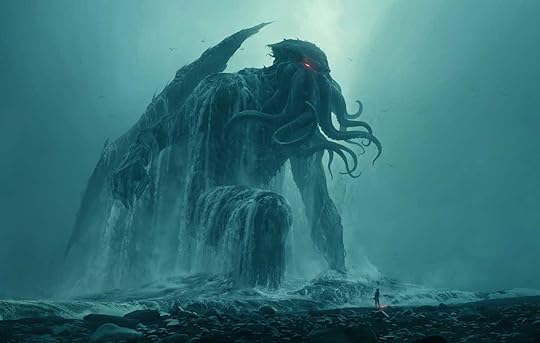
A definitive collection of stories from the unrivaled master of twentieth-century horror in a Penguin Classics Deluxe edition with cover art by Travis Louie.
Frequently imitated and widely influential, Howard Philips Lovecraft reinvented the horror genre in the 1920s, discarding ghosts and witches and instead envisioning mankind as a tiny outpost of dwindling sanity in a chaotic and malevolent universe. S. T. Joshi, Lovecraft's preeminent interpreter, presents a selection of the master's fiction, from the early tales of nightmares and madness such as "The Outsider" to the overpowering cosmic terror of "The Call of Cthulhu." More than just a collection of terrifying tales, this volume reveals the development of Lovecraft's mesmerizing narrative style and establishes him as a canonical- and visionary-American writer.
Howard Phillips Lovecraft, of Providence, Rhode Island, was an American author of horror, fantasy and science fiction.
Lovecraft's major inspiration and invention was cosmic horror: life is incomprehensible to human minds and the universe is fundamentally alien. Those who genuinely reason, like his protagonists, gamble with sanity. Lovecraft has developed a cult following for his Cthulhu Mythos, a series of loosely interconnected fictions featuring a pantheon of human-nullifying entities, as well as the Necronomicon, a fictional grimoire of magical rites and forbidden lore. His works were deeply pessimistic and cynical, challenging the values of the Enlightenment, Romanticism and Christianity. Lovecraft's protagonists usually achieve the mirror-opposite of traditional gnosis and mysticism by momentarily glimpsing the horror of ultimate reality.
Although Lovecraft's readership was limited during his life, his reputation has grown over the decades. He is now commonly regarded as one of the most influential horror writers of the 20th Century, exerting widespread and indirect influence, and frequently compared to Edgar Allan Poe. See also Howard Phillips Lovecraft.
I think I've read every story in this compilation numerous times before, so there's really nothing new to add, other than each re-reading of a Lovecraft story uncovers something new and unusual about Lovecraft's fascinating worldview.
Things I gleaned this time:
*Lovecraft was a pretty sad, lonely dude. Every story in this collection, by default or design, is essentially about loneliness, in a cosmic sense. I've always felt Lovecraft was a virulent racist---he was, of course---but in a larger sense, he was mostly just a miserable misanthrope. I think he hated all of humanity in general, mainly because he felt like he didn't "fit in" with his fellow humans.
*When he was bad, he was atrocious, and it's clear how influential Poe was in his writing, and Poe's style of writing was already passe when Lovecraft was young. However, when Lovecraft was good---and "The Color Out of Space" and "The Shadow Over Innsmouth" are very good stories---he was fabulous, in every meaning of that word.
*Women didn't exist in Lovecraft's world, except maybe as rumors.
*Lovecraft didn't like fish.
It must be said that this Penguin Deluxe Edition is a beautiful must-have edition, and the notes in the back of the book, written by S.T. Joshi (as far as I know, the only self-proclaimed Lovecraft scholar/expert in existence), are worth a read as much as the stories.
American author H.P Lovecraft is such a prominent and prolific horror writer that a subgenre of horror was even named after him. Lovecraftian horror involves "the cosmic horror of the unknown and the unknowable more than gore or other elements of shock". With this mind, I was quite excited to read this anthology which collected his finest eighteen short stories throughout the years. This paperback edition I own even includes a great introductory essay to the life and times of Lovecraft, as well as explanatory notes that serve as expansions of ideas taken from his stories; a glossary that also offers more insights to his writing process, influence and conceptualization.
Frankly, I think The Call of Cthulu and Other Weird Stories is a fascinating though difficult read.
I have my reservations both in reviewing and recommending this anthology. I don't believe this is exactly something anyone can just enjoy and appreciate. In fact, upon closer inspection, I found that most tales included in this volume are interrelated, if not indirectly referential of each other. This is probably because Lovecraft, like all great literary masters, has created his own fictional universes where these stories breathe. For example, mentions of the place Arkham happens frequently, as well as the elusive grimoire known as the Necronomicon.
This could mean that for a novice, the collection may get alienating here and there. If this is the very first Lovecraft material you will ever read, then I think this particular anthology might baffle you at times because the degree of difficulty to his prose that might not be accessible to a reader more used to a contemporary and more straightforward style of storytelling, particularly when it comes to horror.
Speaking of which, I rather found Lovecraft's style challenging myself. There are so many adjectives and lengthy phrases; his general tonality can be bizarrely bone-dry in delivery which sometimes dilutes whatever horrific or terrifying plot thread you're supposed to be following. To be perfectly honest, a few of the stories in the volume have rendered me sluggish, mostly because I could predict the ending. In addition to that, there are three of four stories that are mostly repetitive, thematic-wise. I think these are my major criticisms of the anthology in general. However, his style isn't necessarily a bad thing though. When a certain story being told is unbelievably haunting and evocative, Lovecraft's prose can put you under a terrifying trance. What such stories excel in isn't about the gore or the shocking twist, really. It's the slow-burning build-up that leads to the tragedy. The Call of Cthulu and Other Weird Stories is ruthlessly engaging when you least expect it to and that's what made the obstacles along the way worth conquering as a reader.
I think this anthology would be more enjoyable when one's focus is singular. You can consume this in a slower pace if it means developing a richer and deeper understanding of what makes Lovecraft's stories so magnetic. Personally, I would re-read the stories again just so I can spot more connections among them. After all, I think this volume doesn't even cover the wide expanse of the Lovecraft universe, particularly that of the Cthulu mythos which is a rather influential piece of fiction and a tirelessly imaginative lore that has enchanted other writers across generations to contribute their own works to this perplexing creature of the most visceral and unknowable of horrors ever realized in fiction. The story Festival is credited as probably the first time Lovecraft has tried to weave Cthulu mythos for the very first time. I highly suggest that you and I check out more about said mythos in other collections.
I only have five stories that I would consider absolute favorites because they spoke to me in the most unpleasant yet invigorating ways. Understandably, I must include the namesake The Call of Cthulhu which was simply the stuff that makes nightmares real. Elaborate and layered with puzzles within puzzles, this story leaves so much to the reader's interpretation as it slowly crawls its way into your consciousness; right until the moment when you realize that it's irreversibly stuck in the damaged corners of your own mind. Two other stories like Facts Concerning the Late Arthur Jermyn and His Family and The Picture in the House are astounding because Lovecraft has woven them in a way that makes the discovery at the end so dreadful to comprehend. The suspense in these stories are unforgivably subtle, as if it only managed to graze my skin, but further reflection of these tales would reveal just how much they made me slightly sick to my stomach.
The stories Herbert West -- Reanimator and The Rats in the Walls really got under my skin. The former was definitely the best horror story I ever read about resurrecting dead people that I think rivals even Mary Shelley's classical novel Frankenstein. I could imagine watching the story unfold on screen which was why I want to watch the said film version of this story soon enough. Meanwhile, the latter story almost, sort of, destroyed me. It was an exploration of madness that is so hard to put in words even as I type this review unless one has dabbled in something akin to it (which, unfortunately, I once had back when I was less in control of my mental state as a young girl).
The Rats in the Walls symbolize a rude awakening where there really is no way you can ever go back; where a physical manifestation of your fears become a consuming preoccupation that can deteriorate the rest of your soul. I think there are many levels to this story that will make for a fruitful discussion. It's almost painful for me to read this tale without cringing in revulsion and distress.
Some other noteworthy tales to read are The Whisperer in Darkness, The Colour Out of Space, The Shadow Over Innsmouth, and The Haunter of the Dark. They are deft and daring in concept and execution and would make you question certain comfortable things in life after finishing them.
In a nutshell, H.P Lovecraft's The Call of Cthulu and Other Weird Stories is a worthwhile and challenging reading experience that I can only recommend to people who are prepared for something drastically eye-opening. The very best of the stories included in this anthology are like itches you can only keep scratching if the relief you garner from it also means that you have to bleed.
"The most merciful thing in the world, I think, is the inability of the human mind to correlate all its contents. We live on a placid island of ignorance in the midst of black seas of the infinity, and it was not meant that we should voyage far."
For a long time, Lovecraft himself seemed to be a bit of a myth to me. Until recently, I have never read anything written by him and yet a disconcerting amount of pop culture I've consumed in my life (may that be a TV show such as Stranger Things or even a video game like Bloodborne) would be described as "Lovecraftian" by somebody who knew more about it than me. How could an author, who died as young as he did and who didn't even write a full-length novel influence an entire genre even a hundred years after his lifetime to this extent? It all lead me to believe that it was my fate to meet the so-called father of horror.
This book presents a selection of stories, from early tales to the most famous nightmare of "The Call of Cthulhu". This edition proved to be the perfect introduction to Lovecraft's writing, as each story is introduced and carefully annotated, providing interesting and valuable background-knowledge.
I've spent a fair amount of time thinking about what it is that draws people to horror as a form of entertainment. Why seek out the horrible? Why look for things that may scare us? Why is it gives us the ability to even find pleasure in feelings that are evoked by the dark? I might not have found the answers yet, but what I am sure of is that it is the unknown that is particularly exciting. The potential of something terrible is much scarier than being faced with a monster upfront - things we can't perceive we can't fight and that's when things get unpredictable.
Lovecraft plays with the idea of unsolved mysteries a lot, which is his biggest strength. I love how he created an entire universe and embedded it seamlessly into ours - in his stories, he introduces us to Arkham, a fictional city and location of many of his stories; the Old Ones, a powerful supernatural entity and he is also the inventor of the Necronomicon as well as the Cthulhu myth. His imagination is rich, integral and unlike anyone else's. I can totally see why his writing was a real game-changer for the genre.
Admittedly, I'm still left undecided about what to think of Lovecraft's writing. I had a problem with how the narrators basically all sounded the same and were sometimes even transparent or irrelevant to what was being told. Reading the stories back to back I had to keep reminding myself that what I was reading was not a sequel to the previous story, despite the similarity in tone and narrative voice. It was impossible to relate to the protagonists, as they all expressed their thoughts in a very sober and impersonal, almost scientifically dry manner.
There's a good chance I'll come back to Lovecraft's writing at some point to revisit the dead and waiting Cthulhu and friends.
This story, a keystone of cosmic horror, a category Lovecraft himself helped forge, unfolds through a sequence of interconnected narratives, presented as a retrospective investigation by Francis Wayland Thurston. It begins with the discovery of a strange bas-relief and notes left by his deceased great-uncle, Professor George Gammell Angell. These artifacts lead Thurston into a maze of interpretations that hint at the existence of the ancient, god-like entity, Cthulhu. As the layers of the story are peeled back, the reader encounters a global cult, strange dreams, and the horrifying realization of humanity's vulnerability in the face of incomprehensible cosmic forces. What works behind the undying charm of a story written 98 years earlier, in the summer of 1926? Several factors, actually. To begin with, Lovecraft masterfully builds an oppressive atmosphere. His descriptions of the sea, the cultic rituals, and the titular creature evoke a sense of dread and awe, immersing readers in an alien and threatening world. Secondly, the story introduces the mythos surrounding Cthulhu and the Great Old Ones, forming a massive and integrated and amalgamated universe that has enchanted readers and writers for decades. Lastly, the philosophical undertones of this story is extremely poignant. Lovecraft's search for humanity's place in the cosmos and the fear of the ‘mysterious, unknown’ reverberates deeply. The narrative challenges anthropocentric views, leaving readers with unsettling questions about reality. There are blemishes as well. Several readers have an issue with Lovecraft's prose, which is often dense and overly verbose. At the same time, his antiquated style often alienates modern readers. Above all, the author’s blatantly xenophobic and racist opinions intermittently seep into the text, predominantly in his representations of non-Western cultures, which can be jarring and out-of-favour with contemporary audiences. To conclude, we can safely hold that in the face of all its lacunae and host of flaws, ‘The Call of Cthulhu’ is a revolutionary work that has had a profound sway on horror and all of speculative fiction, penned to this very era. Lovecraft’s vision of an ‘indifferent universe populated by incomprehensible entities’ has inspired countless writers, filmmakers, and game developers, and continues to do so even to this day. The Cthulhu Mythos has grown into a cultural phenomenon, shaping the modern appreciation of cosmic horror.
"I'm afraid the creatures are learning to steer better with their space wings" is either your favorite sentence ever or you're not gonna love Lovecraft.
Lovecraft can be silly, racist, and extremely purple, but he has this terrifically unique imagination: his stories feel like nothing else. And they're very enticing. There's a certain feel to his stories - a pallid green glow - a whole collection of words like "eldritch", phrases like "foetid green ichor" - that feel forcefully Lovecraftian. "The foulest nightmares of secret myth" is what he's about. He's a true individual. I dig him.
Some brief notes on some of his more famous stories:
PARODIES? Herbert West - Reanimator (Ha, this was a ton of fun) The Hound (also great)
RACISM! Horror at Red Hook (Whee!) He (Racism alert!)
CTHULHU Dunwich Horror At the Mountains of Madness (Fun stuff) Shadow out of Time (Kinda too long) Call of Cthulhu Whisperer in Darkness (fantastic! This is where we get the space wings.)
THE REST OF IT The Case of Charles Dexter Ward The Dreams In The Witch House Colour out of Space (Great...sortof like a parable about radioactivity?) Shadow over Innsmouth
While this Penguin edition is lovely, I'm supplementing it with a cheapo Collected Works on my Kindle, for the stories I want to read that aren't in this collection.
While I really enjoyed these scary tales Lovecraft built on the foundation of his own nightmares and neuroses, I couldn’t not notice and not get seriously annoyed with obvious racism, xenophobia and misogyny of his views. Because of this it puts his works on a much lower level among other classics of horror. And 'tis a great pity, because these are some fascinating visions and ideas, fathering too many works of literature and cinema to this day and I am sure future ones as well.
Despite being one of Lovecraft's early stories, it's on par with his later masterpieces such as The Shadow Over Innsmouth and Call of Cthulhu. A very short yet classic tale that touches on one of my greatest fears; the unknown horrors of the sea and the infinite secrets that it holds within itself. Discovering dark secrets and higher beings never meant to be witnessed by human eyes, being driven to madness and suicidal tendencies, hallucinatory encounters with unfathomable horrors, all of the Lovecraftian staples are present here. The writing is phenomenal, rivaling the effectiveness of his greatest works that he would go on to write at the end of his career.
***
The Outsider - 4/5
This was a hidden gem that I wasn’t expecting to be as good as it was. A very short story that somehow captures the same level of dread and gothic atmosphere of works like The Curse of Yig and the Diary of Alonzo Typer in just a few pages. The gothic aesthetic is very reminiscent to E.F. Benson’s The Room in the Tower and Poe’s House of Usher (only in terms of setting not story.)
***
The Hound - 4/5
Wow, Lovecraft created a pretty harrowing and dreadful piece without a single mention of the infamous elder gods or Lovecraftian monstrosities. This was pure gothic horror, much more akin to Joseph Sheridan Le Fanu with all of the romantic horrors of the unexplored and marvelous depictions of graveyards and all that jolly stuff. Very underrated Lovecraft story if you ask me, I’m surprised that Lovecraft himself hated it so much.
***
The Rats in the Walls - 4/5
Feels like a more fleshed out and intense version of The Lurking Fear. Much of the same elements are borrowed such as the family house with a terrible history, deformed, human-like monstrosities and a very subtle reference to a creature from the Cthulhu Mythos.
The dread and tension as the protagonist explores the dark corridors of the wretched house’s forbidden depths smothers you with its intensity. The decrepit tragedies lurking within its violent and disturbing history were passed down through the ages, giving the dreadful impression that the very foundation of the world is built upon such horrors.
***
The Haunter of the Dark - 4/5
In Providence, Rhode Island, Robert Blake, a young writer with an interest in the occult, becomes fascinated by a large disused church on Federal Hill which he can see from his lodgings on the city's Upper East side. His researches reveal that the church has a sinister history involving a cult called the Church of Starry Wisdom and is dreaded by the local migrant inhabitants as being haunted by a primeval evil.
Another of Lovecraft's final tales that emphasizes how much he grew as a writer. It's much more personal and his characters have a lot more depth to them. I wish he could've gone on to write for another 30-50 years. I can only imagine how amazing his stories could've became if he had another lifetime's worth of improvement.
***
The Shadow over Innsmouth - 4/5
A student on an antiquarian tour of New England takes notice of an exotic piece of jewelry in a museum and learns that its source is the nearby decrepit seaport of Innsmouth. He travels to Innsmouth and observes disturbing events and people. It doesn't take long to notice that something is horrifically wrong about the seaport. A local resident informs the student of a horrifying story of aquatic monsters who can interbreed with humans to produce amphibian hybrids and they've made a residence within the waters of Innsmouth. The student is tricked into staying overnight in the seaport town and he is attacked in his hotel by unfathomable beings.
This is definitely one of Lovecraft's scariest tales. The attack and escape sequence within the hotel is incredibly tense and eerie, it rivals The Shining with its use of a wicked hotel and the supernatural entities within it that drive the protagonist to madness. If there's anything you can learn from reading Lovecraft, it's to stay the hell away from large bodies of water.
***
The Whisperer in Darkness - 4/5
Folklore professor Albert Wilmarth investigates legends of strange creatures in the most remote hills of Vermont. His enquiry reveals a terrifying glimpse of the truth that lurks behind the legends. The answer to what lies beyond the vast cosmos is a question that may better be left unanswered.
One of Lovecraft's best as it takes full advantage of his direction into science fiction rather than pure abstract horror. The elder gods, outer ones and other extraterrestrial beings feel more like real, living beings with their own unique identities, cultures and histories here than any other story in the mythos. The Colour out of Space and Mountains of Madness are other fantastic examples of Lovecraft's turn to science fiction and the humanization of unknown lifeforms. It really adds to the realism. It's a shame he wasn't able to write more of the genre, I can only imagine what he could've accomplished if he lived for another 30-50 years.
The Colour out of Space - 4/5
Foreboding and mysterious. The plot is extremly simple yet one of the most effective Lovecraft has ever written. A strange meteorite from another realm crashes into Europe and buries itself into the soil, contaminating everything in its circumference. The process of contamination is simple. It poisons the soil, it poisons the water, it kills the animals and it drives people mad. Eventually, the place becomes so corrupt that it transforms into an eldritch nightmarescape. To make things even more unsettling, the strange meteorite appears to have sentience and can move freely as it pleases. Perhaps it was never a meteorite in the first place, but something far more sinister?
***
The Call of Cthulhu - 4/5
Although not my favorite of the Cthulhu Mythos tales, it certainly does the best job of encompassing all of the primary and lovable elements of weird tales and cosmic horror.
Ancient texts, insane cults, forbidden knowledge, social recluses going mad and blasphemous abominations galore.
This is the story that brought it all together, paving way for incredible tales such as The Dunwich Horror, The Shadow Over Innsmouth, At The Mountains of Madness as well as thousands of other tales by writers that followed in Lovecraft’s macabre and charmingly eldritch footsteps.
***
Cool Air - 4/5
Afraid of death? No worries, just freeze yourself and gain immortality through artificial preservation. One of Lovecraft’s more down-to-earth tales that relies on traditional horror themes instead of his more dream-like and alien works.
***
He - 3/5
The prose in this story was phenomenal and dripping with eldritch fascination, but the racial undertones dragged it down quite a bit. He could have pulled off a nice dream cycle story here, but chose to go with this instead. Luckily, this was around the point he began to grow out of his discriminatory attitude and moved on to bigger and better things.
***
The Festival - 3/5
Nothing like a good old jolly Christmas festival, eh? Wrong! This is Lovecraft we're talking about, so of course strange alien monsters and dark forbidden lore is gonna show up to crash the party. This story makes the horrors of the Necronomicon feel more real as it actually provides a quote from the fictional text of terror. The ending is similar to that of Dagon, which is one of my favorites.
***
Herbert West Reanimator - 3/5
Has all the essential elements of a good Hammer Film Productions piece. It’s gritty and gross, cheesy yet fun and verbose. Feels like a skeletal frame of Frankenstein, just not nearly as long and emotionally complex. Frankenstein is the better book in my opinion, but I gotta give Lovecraft credit for whipping up something that’s pretty damn morbid.
***
The Statement of Randolph Carter 3/5
The twist at the end was cool in itself, but the way it was delivered made it feel like something you would see in a cheesy, low budget horror film involving a phone call.
***
Facts Concerning the Late Arthur Jermyn and His Family - 3/5
The story overall has an intensely mysterious vibe with an exciting buildup, but what could have been an incredible twist ended up being something that had no merit and was rather degrading.
***
Celephais - 4/5
The concept of this story is one I can relate to on a very personal level. The more the protagonist grows to loathe the contemporary world, the more he begins to value the world of dreams and imagination, much like a modern person would prefer to lose themselves in the comfort of books and music rather than dealing with a painful and depressing reality.
***
Nyarlathotep - 3/5
A truly nightmarish vision of a horrifying, gothic landscape induced by the frenzied visions from the one called The Crawling Chaos.
***
The Picture in the House - 3/5
Has the makings of a great horror setting, but the ending falls incredibly flat. The decrepit house where the protagonist is forced to seek shelter during a horrible storm, the ravings of a crazed old man, the blood dripping from the ceiling. It was all building up to something fantastically scary.
And then the narrator closes his eyes and pretends he didn’t see it to save his own sanity. And... that’s kind of it. The climax was not worth the tension building up to it. But still enjoyed it for the early tension and imagery alone.
You may not know it, but the writings of H.P. Lovecraft influenced much of the modern horror and science fiction you enjoy today. In fact, the other day I read a New Yorker review of Netflix’s series Stranger Things (if you have Netflix, or have a friend with Netflix, watch this show. It’s so freaking good) and what author was mentioned as having influenced Stranger Things? Why, H.P. Lovecraft, of course; specifically his story “The Colour Out of Space.” I read The Call of Cthulhu and Other Weird Stories cover to cover. I’ve decided that I’d prefer reading a critical analysis of his stories rather than reading any more of his stories. I find Lovecraft’s theories fascinating, but was rather so-so on how he applied those theories to his fiction.
I bought the Penguin Classics Deluxe edition and I’m pleased I did. Along with the very cool artwork and attractive look and feel of the book, the editor (S.T. Joshi) is extremely knowledgeable about Lovecraft and thorough in his introduction and story notes. When I read books that have notes, I usually very faithfully flip to the back of the book to read these notes, assuming they will assist me in my understanding and enjoyment of what I’m reading. Joshi’s notes are many and frankly, they are mostly for the most fanatic of Lovecraft fans. After flipping back and forth several times for one ten-paged story just learn things like: “this address is where his aunt used to live” and “Lovecraft loved cats,” I began ignoring the notes unless I came across something extremely puzzling. Also to be avoided are the explanatory introductions to each story before the notes. Sometimes, along with telling the reader when Lovecraft wrote this particular story and how the idea came to him and where it eventually was published, Joshi gave away the endings of the stories. No spoiler warnings at all! So, read those introductions after you read the story. Not that it’s often a surprise at how many (most) of these stories end, but still. I’d rather not have it spoiled by the editor.
In the introduction, Joshi quotes Lovecraft at length regarding his theories about fiction. The supernatural, Lovecraft believes, should be super natural, outside the laws of human knowledge and Earthly life: “To achieve the essence of real externality, whether of time or space or dimension, one must forget that such things as organic life, good and evil, love and hate, and all such local attributes of a negligible and temporary race called mankind, have any existence at all” (xviii). Aliens should be alien, and not hold the same values as humans nor care about humans. I’ve had my own thoughts on this, mostly from viewing sci-fi shows in which the “aliens” are very human and have similar values as humans (love, kindness, the importance of life, etc.). Why are they so human? I would often wonder and I usually decided, well, the writers are human and it’s difficult to create creatures who are entirely different from our selves. Of all the sci-fi I’ve ever read and viewed, only the Daleks and Cybermen of Doctor Who seem to have the true “alien” quality that Lovecraft prefers. Also, in Ann Leckie’s Ancillary trilogy, the alien race, the Presger, are nothing like humans and aren’t even sure if humans are a Significant species. So, I really like this idea and Lovecraft’s other thoughts on fiction (as discussed by Joshi) but I found his stories lacking.
Sometimes Lovecraft can go a bit overboard in his descriptions, but I love his writing style. I love his formality. He knows the meanings of the words he uses (gasp!) and I appreciate that. I think too many modern writers (particularly genre writers; sorry, but it’s true) are really very loosey-goosey about word choice and often don’t know what the hell the words actually mean, but they use them anyway (see: Mary Kubica’s utter crapfest The Good Girl). Lovecraft’s description are creepy and a little crazy, and I like them. Here’s the narrator of “Nyarlathotep” describing…well, something: “A sickened, sensitive shadow writhing in hands that are not hands, and whirled blindly past ghastly midnights of rotting creation, corpses of dead worlds with sores that were cities, charnel winds that brush the pallid stars and make them flicker low. Beyond the worlds vague ghosts of monstrous things; half-seen columns of unsanctified temples that rest on nameless rocks beneath space and reach up to dizzy vacua above the spheres of light and darkness” (33). I like that. I like that his aliens are kind of alien, at least in their complete disregard for humanity, but too often they’re described as some kind of fish or, as in the case of “The Whisperer in Darkness,” as funky giant crabs that can fly through space (but are unfortunately lumbering and slow on land). Why was Lovecraft so hostile towards sea life? If the alien creatures were not some kind of bastardized fish or crab, they were so awful as to be indescribable. Having the narrator of your stories babble too frequently that what they are seeing or hearing is so awful as to defy description is a total cop-out by the author. I prefer the space crabs, or not seeing the alien at all and just having the narrator describe the effects of the alien life on the surrounding landscape and people (“The Colour Out of Space”). While the setting may be creepy, I never felt the stories were scary. I don’t know if this is because I’m a modern reader and it takes a lot to freak me out, much more than Lovecraft’s weird fish people, or if the stories just aren’t all that scary anyway. But they aren’t scary. Mostly I felt the stories were predictable and sometimes silly.
As a man writing in the late 19th to early 20th century, Lovecraft was a reflection of his culture. That is, apparently, a very bigoted culture that considered anyone not of white European descent to be ape-ish, a half-breed, a simpleton and crude. Lovecraft also has issues with country folk as they are often described as “rustic” in a sneering manner which equivocates “rustic” with superstitious, stupid and uncivilized. “The Call of Cthulhu,” a story I looked forward to reading, is incredibly racist. All the “bad” people (who worship Cthulhu) are of a “very low, mixed-blooded, and mentally aberrant type” (153). I didn’t care for this story; it’s boring, silly, and not very interesting. Of the stories in this collection, I primarily enjoyed the longer ones: “The Whisperer in Darkness,” and “The Shadow Over Innsmouth.” The first story of the book, “Dagon,” is also one I enjoyed. It has a certain fuzzy, nightmare-ish aura to it that I liked. The narrator’s surroundings seem to be genuinely alien, even though he is (to his knowledge) still on Earth.
This collection was my first foray into Lovecraft and possibly it will be my last. I was distinctly underwhelmed by the stories as a whole. They are too racist and too formulaic for my enjoyment. However, I’m glad I read them as they satisfied my intellectual curiosity about H.P. Lovecraft.
Finally finished this collection, taken me longer than I care to admit.
I loved every story individually, Lovecraft's flare for weird imagination and horror is second to none. So sensory, I've never felt so immersed in a short story collection.
However, I had to space out my reading for this eventually, as the 1st person narration for every book was exactly the same style, but didn't explicitly state that this was the same voice narrating each story (I think it was supposed to be different people; surely no one would have this much bad luck with monsters and spooky islands!) This did mean it got a little repetitive and dull after a while, so I took a much needed break, allowing me to love the second half just as much as the first.
Every Lovecraft story only gets so far before dissolving in a bout of hysterical shrieking. Typically it's a fear of madness rather than actual physical danger. To be so terrified of losing one's mind is perhaps to have already lost it. Would it be possible for the existence of a race of indescribable monsters not to be an occasion for extreme horror, but rather something to be lived with and perhaps even celebrated under certain circumstances? This question almost seems like the starting point for China Mieville. If the old weird was one of strict hierarchies, the new weird holds out the possibility of radically egalitarian spaces.
On the one hand, sure, Lovecraft obviously wasn't that great of a writer; then again he's admirably obsessive in the way he returns to the same themes over and over again.
I really wanted to love you Lovecraft, I really did. But I couldn't, so you get three stars.
The first negative part was the blatant racism, which bothered me more and more, but was only pronounced in the first third or so of the stories. When it got to the part where the narrator had named his pet cat N* Man, I was just like nope, done. I know that people have said that "he's a product of the times" and yea, I get that, but I don't have to agree with it or like it. He was blatantly, offensively racist, and that's a serious negative for me.
Next up, the stories were all very similar. Some of them are obviously related with the same places, creatures and names. The similarity of stories, as well as the fact that every first person narrator seemed to be the exact same person with the exact same thoughts and narration, meant that all the stories blended into each other and I frequently lost track of what was happening and who was who in each story. The connections between the stories made this confusion more pronounced and I can barely recollect separate stories as opposed to one long story with all the weird things included. Of course there were stand outs among the stories, and only one that seemed to have a completely different ending to all the other ones (which I ended up liking a lot for that reason). Many of the stories centered on the same stories, legends, and creatures, which probably confused me more than it should have. If each story was a distinct piece of writing with a distinct narrator and differing modes of story telling with new and different horrors, I would have liked this collection a lot more.
Another annoying bit was the constant repetition of the horrors talked about in the stories as being "too awful for words" or other similar sentences. I know that that was probably the way horror was written back in the day, but sometimes it just struck me that Lovecraft had a limited imagination, and if he only wrote that things were too horrifying for words then maybe the readers would fill it in for themselves with their own imaginations and he wouldn't have to think up actual things to write down. But for me, a reader nearly a hundred years later, it was just a little annoying. Maybe we're desensitised these days, but when I read a horror novel, I want to be scared, or at least a little shocked. The lack of concrete descriptions of these implied horrors didn't really do much for my imagination. It might be unfair to say, but it just seemed like he wasn't trying hard enough to scare people, at least not people now.
I will probably read more Lovecraft in the future if I get my hands on it. I did like most of the stories even if I did get a little annoyed more than once.
A friend pointed out to me that Cthulu was wearing A FUCKING MONOCLE ON THE COVER OF THIS BOOK so I just couldn't take it seriously anymore. Its enough of a problem that no one takes this guy's incredibly conjugal and mystical style of writing as anything besides some gross nerd's D&D fodder or something (no offense to D&D). What Lovecraft does that Poe does not is root psychological horror in the indifference of the world to us, in the billions of harrowing years that loom in the shadows of life, in the deep pits of unseen subterranea, in a mysticism from which we are excluded.
"The most merciful thing in the world, I think, is the inability of the human mind to correlate all its contents.", the beginning sentence of Call of Cthulu. What is interesting today is that Cthulu is no longer scary, that this monster of the deep unknown has, almost as if overnight, lost its knack. This can be traced back to that first sentence. So much of Lovecraft is based on cosmic indifference, and the profound insignificance our biggest most impressive inventions within the realm of the universe. I think it was Maurice Merleau-Ponty that first asked what the implications would be for the mind when most of the world's population will never see a landscape that was not human-made. Today scientists are saying that three-fourths of the planet has been cultivated by humans for various means of human consumption. We've lost 60% of the average animal population. Much like Francis Wayland Thurston himself, it is pushing our own self-importance to its very limits that is sealing our fates and leading us to our doom. The unseen world that provides an abode to The Deep Ones is not only our unconscious, but also the non-conscious. Preceding life is an unfathomable a priori process that sets matter in motion. We are tomorrow's archaeology, and next weeks dirt.
Yeah I'll finish the rest of the stories at some point.
I first met Lovecraft at the age of twelve, courtesy of The Rats in the Walls. Since then, he has had no peer in the art of absolutely freaking me out, of which this collection delightfully reminds me.
He's at his best, I think, when he's not quite specific, and he is a master of that. The giant crabs with bat-wings of The Whisperer in the Dark? Please. But this from The Colour Out of Space?
There were the usual winter prints of red squirrels, white rabbits and foxes, but the brooding farmer professed to see something not quite right about their nature and arrangement. [. . .] There had been a moon, and a rabbit had run across the road, and the leaps of the rabbit were longer than either Ammi or his horse liked. [. . .{ the MacGregor boys. . . were out shooting woodchucks, and not far from the Gardner place bagged a very peculiar specimen. The proportions of its body seemed slightly altered in a queer way impossible to describe, while its face had taken on an expression which no one ever saw in a woodchuck before.
Stand outs: The Color Out of Space Herber West Reanimator (Had read this one before and I love the very loosely adapted movies)
Also enjoyed: The Whisperer in The Darkness (even though the main character is the naivest idiot alive apparently) The Call of Cthulhu The Picture in the House (Didn't think much of it at the time but looking back this is the only story that successfully creeped me out so it deserves a mention) The Shadow Over Innsmout (This probably would have been a standout for me too if it weren't for the middle bulk where an old man tells the backstory of the place....I can't read accents lovecraft pls)
Generally the shorter stories were forgettable while the stories bordering on novellas were much more enjoyable.
All in all not bad for a dead racist/5
And specifically about this edition: While a lot of the notes at the end were interesting most of them were tangentially related and looking them up while reading took me out of the story. Like there would be a note to tell me a date in the story is close to the death date of Lovecrafts father.
Interessant om te lezen hoeveel invloed deze verhalen nog steeds hebben op het horrorgenre. The Rats in the Walls sprong er voor mij echt uit: beklemmend en goed opgebouwd. Wel is de kwaliteit wisselend, en sommige verhalen voelen gedateerd aan. Toch de moeite waard om de oorsprong van zoveel hedendaagse horror te zien.
I borrowed this collection to read Herbert West, Reanimator. Not only did I read Reanimator, I read every other story I hadn't already read in other collections.
Of what I read, I really only liked Reanimator and Facts Concerning the Late Arthur Jermyn and His Family. I take it as a sign that I have just about reached my limit of Lovecraft.
NB: The cover and jacket art is friggin' cool.
UPDATE: The 1985 film Reanimator, based on Lovecraft's Reanimator and starring Jeffrey Combs, is a heckuva lot of fun!
waste of time, if we're being perfectly honest. He probably charted a path for much more talented horror fiction authors with this stuff, but the actual writing is bad, the mysteries are underdeveloped, and he is so cartoonishly racist and xenophobic that it drains anything interesting from the story. Skipped some of the stories here cause they all just started to sound the same, and if that means I missed some real gems, then, well so be it.
i reallyyyyy wanted to get this worn out edition! it's such a pity that it wasn't available in my own language as i know that classic english can be somewhat tricky. especially when talking about terror, lovecraf's prose is so dense yet subtle that it was a little difficult to read, getting lost at times. nevertheless, the short stories format really helped me to catch up and was very refreshing. it was pretty cool reading this for spooky season!
Sorely, sorely disappointed. I simply don't see what all the fuss is about. I have heard it said though that no book is completely devoid of value, and at least my reading of Lovecraft did throw up a few interesting questions.
The main question is this: how fair is it to criticize an author for being a blatant horrible racist, given that the author lived a century ago and such attitudes were widespread during his time? I'm sure some allowances have to be made for the 'product of his time' factor. If the racism gets in the way of my enjoyment of his stories, some may say well, that's my problem - not Lovecraft's. Get over it.
However, the problem is that the racism is not confined to a few remarks here and there. It is constant, and indeed it is apparent that Lovecraft intended race to be a main contributing factor to the 'horror' of the stories. A couple of examples: in the story 'Facts Concerning the Late Arthur Jermyn and his Family', the horrible dénouement is the protagonist's realisation that he is descended from a tribe of ape-men. The explanatory notes expand on Lovecraft's difficulty coming to grips with the fact that the white race is derived from a 'primal' African race - that "we are all products of miscegenation". Likewise, at the end of 'The Rats in the Walls', the protagonist displays a supposed regression down the evolutionary scale through babbling in various languages, each one 'baser' than the last - English, Old English, Latin, Gaelic, grunting. This is not to mention the numerous times the mere fact that a person is of colour or otherwise 'low breeding' is shamelessly used as a device to convey the unnaturalness of the events at hand - e.g. the Negro sailor and exotic cultists in 'The Call of Cthulhu' - or even when the description of someone being 'of mixed blood' etc. is entirely superfluous.
The main problem here is therefore that the 'horror' of many of these storeis derives from Lovecraft's assumption that his reader shares his revulsion and obsession with humans' evolutionary predecessors and the idea of 'low breeding', reverting to type, the savage lurking beneath the surface, the 'corrupt' origins of the white race. This simply isn't a problem for the modern reader - and consequently, the stories are not scary - they do not work.
The repeated racism is symptomatic of another, stylistic defect in Lovecraft's writing - namely, that his formulaic style (first person, ex-post-facto recounting of events) shows negligible variance throughout all his stories. It may as well be the exact same protagonist in every single story - the same wordy description, the same racial obsessions, the same "this may be terrible but I am a man of science" attitude. Lovecraft, you are a one-trick pony.
Indeed, this wouldn't matter so much if the one trick was at least a good one. In fact, these stories were overblown, predictable and anticlimactic. The trope of 'the horror was indescribable and it has driven many men to madness' is a boring cliché. Additionally, many of the stories bear striking similarities to other stories by better authors - who couldn't note the uncanny resemblance between 'Herbert West - Reanimator' and 'Frankenstein', or 'The Hound' and 'The Hound of the Baskervilles'?
Finally, a note on this particular edition (Penguin Classics Deluxe Edition) - the notes were distracting and pointless to the point of absurdity. I think the series editor is paying people to shoehorn the author's biography into the notes section to give the impression of value for money, no matter how irrelevant the details may be. For example: in one story, a mentioned date of "Oct 19, 1852" was noted with the detail "Lovecraft's mother was born on October 17, 1857". So what? In 'Cool Air, the passage describing the protagonist's landlady as Spanish explains that Lovecraft's own landlady was an Irishwoman. I flipped all the way to the back of the book for this? Who gives a shit? How is this relevant?
When I was a teenager I read through all the stories I could get my hands on written by the famed master of horror: H.P. Lovecraft. That was, after all, what a boy of my age and interests was supposed to do. Or so I thought. But as much as I read his works I just couldn't find myself liking him. I tried to give him a chance. Page after page. Story after story. But nope.
He was a bad writer. Stylistically he was terrible and his stories of 'cosmic terror' were just plain boring. Nothing ever happened. The stories were slow and the horror he described was always too vague and obscure and 'too horrific for even words to describe'. Those even were the actual words (or something like that) he sometimes used when describing something horrific: 'too horrific for even words to describe'. And I was like: "What the f**k? If you are so bad writer that you can't describe it with your own words why do you even bother writing about it?" So, for my part, Lovecraft and his reputation as a master of horror was a bit overstated. Although I did appreciate the fact that on almost every one of his stories the protagonist ended up mad.
This summer, after some years have passed from my teenage years, totally unaware and with the kind assistance of Alan Moore, I delved back into the world of H.P. Lovecraft once more. I borrowed from the library, just by a chance, a copy of "Yuggoth Cultures and Other Growths" written by, well, Alan Moore. Immediately as I started to read it I felt something familiar in the mood and the pictures on the pages. Something 'Lovecraftian'. Although I hadn't read Lovecraft for ages, and even disliked him, I felt the presence of Lovecraft all through those pages. One thing I didn't realise then, interestingly enough, was that the whole book was inspired by Lovecraft.
This time, however, I enjoyed and felt captivated. I even got some visual flashbacks from the stories I had read so long time ago. Which is pretty strange if I didn't even like the stories in the first place. Tells something about the writer I guess. The more I kept reading the more I felt enthralled with his world of 'cosmic terror'. The cosmic terror being the one thing I totally felt ridiculous about his stories before. But people change, grow up, evolve. For better or worse, I have no idea. But they do. And this must be the case with me as well.
So right away after I had finished the Yuggoth Cultures I went to the nearest book store and picked up the most alluring copy of Lovecraft's stories I could find. That was of course "The Call of Cthulhu and Other Weird Stories". So I bought it. Call of Cthulhu... Well, that was, after all, what a boy of my age and interests was supposed to do.
I started reading it right away. And from the very first story I was there. I was there in his bleak desolate world where humanity is only a tiny little speck in some insignificant lost corner of the universe while inhumanity is occupying a considerably larger area of the cosmos. And I was right there in his dark woods, strange old islands risen from the bottom of the sea and in his undergroung caverns beneath the eerie graveyards in the outskirts of the city of Arkham. I was there. And I could say that this time, despite his faults as a writer, which I too eagerly recognised in my teens, I felt what I could not feel before. That there are things words cannot describe. Or even should not. That there are things left for imagination. And things even beyond that. Things which, if faced with even in the slightest, may drive you mad.
Matagal ko nang nasimulan ito, years ago na, 2013 daw sabi ni GoodReads. Nahinto ako kasi naghanap ako sa net ng iba pang sikat na kuwento ni Lovecraft. Ilan sa mga wala dito na maganda rin ay yung The Dunwich Horror, The Case of Charles Dexter Ward (well pero medyo mahaba ito), Pickman's Model at The Thing on the Doorstep. Public Domain na yata yung mga kuwento niya kaya nagkalat na ngayon sa net pero hindi ko pa actually nababasa lahat (na-bore ako sa At the Mountains of Madness). Isa si Lovecraft sa pinaka-favorite kong author, mix siya ng (unintentional?) black humor+purple prose+camp. Pag binabasa ko siya parang nanonood ako ng horror na B-Movie na sobrang entertaining. Kakaiba rin ang pinanggagalingan ng horror niya, either from outer space or from the lost pages of our history or from racism (ayun, warning lang, racist ang lolo niyo). Para siyang lighter version ni Edgar Allan Poe (another favorite!). Madalas ko siyang naririnig na influence ng ibang horror creators kaya sinimulan ko siyang basahin. Actually kahit ngayon, buhay na buhay pa rin siya kahit sa platform ng online streaming (Lovecraft Country ng HBO). Out of all the stories in this book, itong lima ang pinaka-da best:
1) Herbert West--Reanimator - May pagka-Frankenstein ito 2) The Colour Out of Space 3) The Whisperer in the Darkness - dahil sa baha sa Cagayan at Isabela, naalala ko tuloy ang kuwento na ito! 4) The Shadow Over Innsmouth 5) The Haunter of the Dark
Ang ganda ng cover art ng libro (Lovecraft version ni Cthulu? XD) tsaka yung edges niya may style na hindi pantay-pantay at medyo lukot kaya parang lumang libro ang effect niya. Very informative ang intro na nagbibigay ng short bio and literary background ni HPL. Ok din yung explanatory notes sa bawat kuwento kaso medyo nakaka-distract siya sa pagbabasa. Magandang sabayan ito ng pakikinig sa H.P. Lovecraft Literary Podcast, free yung episodes nila for the stories na si Lovecraft mismo ang nagsulat. Hinihimay-himay nila yung bawat kuwento at nakakatuwa/nakakatawa yung insights nila. Sana this year or next year magkaroon ng online na Necronomicon Providence which is a celebration of all things Lovecraft para naman maka-attend ako kahit isang beses. Or better yet sana makapunta ako personally in the future (haha asa pa!).
Writing a review of a collection of stories is always difficult as some of the stories are always better than others.
I rated this collection as a 3 for a few reasons.
First, the text is a collection of HP Lovecraft Stories. Its easy to recommend this to a Lovecraft fan as these are some (not all) of his most popular works. However, if you are not a Lovecraft fan this may only rate 2-3 as the type of stories Lovecraft wrote may not be for you.
Second, the collection is incomplete. While the text does have some of Lovecraft's most well known works (Dagon, Call of Cthulhu, Herbert West - Reanimator, etc...) it doesn't have all of his stories. Notably missing from the collections are At the Mountains of Madness, The Dunwich Horror, and The Case of Charles Dexter Ward. While collections rarely have every single story written by the author these works are must reads for a fan of Lovecraft.
Finally, in comparison to another collection I am currently working my way through ("The New Annotated HP Lovecraft") this book lacks the notes and history that puts the individual tales in context of when Lovecraft was writing them.
I would recommend this book for Lovecraft fans who haven't been able to find some of the stories contained in the text in other places and for new readers who are considering diving into Lovecraft as the stories are generally easy to read and don't have all the historical context that a new reader might get overwhelmed by. However, for more serious readers seeking the history behind these stories another text may be better suited for their research.
This was disappointing to say the least, I expected much better writing and stories from the author who is supposed to be a master of horror. It seemed more a poor reimagining of some of Poe’s stories and others of that era, and Lovecraft’s racism and classicism etc woven throughout doesn’t make it better in the slightest. Added star because it mentions Ohio cities that I know in one of the surprises (which was mildly surprising) Furthermore, the explanatory notes don’t add to the story (and should definitely come with a “spoilers” warning) and it’s even more frustrating that another Lovecraft story (At the Mountains of Madness) is often referenced in the aforementioned notes but not included in this collection (so don’t mention the story if one cannot read what is referenced, would be better to have also included that story if the explainer wanted to include comments on it so bad).
GoodReads description doesn’t say what stories are in the collection, thus below is copied the Table of Contents:
CONTENTS Introduction by S. T. Joshi Suggestions for Further Reading A Note on the Text
Dagon The Statement of Randolph Carter Facts Concerning the Late Arthur Jermyn and His Family Celephais Nyarlathotep The Picture in the House The Outsider Herbert West-Reanimator The Hound The Rats in the Walls The Festival He Cool Air The Call of Cthulhu The Colour Out of Space The Whisperer in Darkness The Shadow Over Innsmouth The Haunter of the Dark
I am loving Lovecraft! I want to savor these delectable stories, so I don't plan to finish this collection any time soon :-) And now I've finished! I didn't love every story, but enough of them to say I am definitely a fan. It's probably best to take your time and space the stories out. They can get repetitive if you read them quickly, one after the other. Lovecraft was a terrific mind in early horror fiction, and while his ideas were amazing, he could have used an editor. He tends to run on a bit in places and there are quite a few rough patches, but the underlying stuff is quite fantastic! Personal favorites of this collection are: Dagon (short, but glorious) The Picture in the House (these sorts of stories always creep me out!) The Outsider (delicious!) Herbert West - Reanimator (so much fun) The Rats in the Walls (Didn't see that coming) The Festival (He really should have known better) The Call of Cthulhu (of course, it's the centerpiece for a reason) The Shadow over Innsmouth (Just when you think it's all over....) This won't be everyone's cup of tea, but Lovecraft is worth a go if you're a fan of weird stuff. His is some of the weirdest and has inspired even weirder.
Lovecraft's short stories are highly influential and widely discussed. They are worth reading for that reason alone. Anyone familiar with recent examples of horror and sci-fi thriller in writing and film will find that many familiar themes and tropes started with Lovecraft, and in some ways I'm not even sure that writers are aware of Lovecraft's influence on their own work. In reading these stories, I found several parallels to recent films, whose directors do not anywhere acknowledge Lovecraft as an influence. Maybe they are coy about it, or maybe they simply learned these tropes due to them being "in the air" and they are unaware that Lovecraft invented them, but his ideas are everywhere.
The stories in this book are representative, and range from average (3 stars) to excellent (5 stars). Overall, I enjoyed the reading experience greatly. It can be said that Lovecraft repeated his style too closely, too often, and that even some of his horror tactics became gimmicky by overuse. Some of his first person narrators were also too similar at times. These stories are flawed. But, they are an awful lot of fun to read, and I think that's all I wanted.