

What do you think?

Dominic Sandbrook’s History of Britain #3
State of Emergency: The Way We Were: Britain 1970-1974
The book behind the major new BBC2 series "The Seventies In the early 1970s", Britain seemed to be tottering on the brink of the abyss. Under Edward Heath, the optimism of the Sixties had become a distant memory. Now the headlines were dominated by strikes and blackouts, unemployment and inflation. As the world looked on in horrified fascination, Britain seemed to be tearing itself apart. And yet, amid the gloom, glittered a creativity and cultural dynamism that would influence our lives long after the nightmarish Seventies had been forgotten. In this brilliant new history, Dominic Sandbrook recreates the gaudy, schizophrenic atmosphere of the early the world of Enoch Powell and Tony Benn, David Bowie and Brian Clough, Germaine Greer and Mary Whitehouse. It was an age when the unions were on the march and the socialist revolution seemed at hand, but also when feminism, permissiveness, pornography and environmentalism were transforming the lives of millions. It was an age of miners' strikes, tower blocks and IRA atrocities, but it also gave us celebrity footballers and high-street curry houses, organic foods and package holidays, gay rights and glam rock. For those who remember the days when you could buy a new colour television but power cuts stopped you from watching it, this book could hardly be more vivid. It is the perfect guide to a luridly colourful Seventies landscape that shaped our present from the financial boardroom to the suburban bedroom.
768 pages, Paperback
First published September 30, 2010
About the author
Dominic Sandbrook
50 books711 followersAn English historian, commentator and broadcaster and author of two highly acclaimed books on modern Britain: Never Had It So Good and White Heat. Their follow-up is State of Emergency.
Ratings & Reviews
Friends & Following
Create a free account to discover what your friends think of this book!
Community Reviews
Displaying 1 - 30 of 104 reviews

December 1, 2025
This is the third of a series of books written by the author on the history of post-war Britain. I’ve not read the first two, but decided to try this one because I can, to an extent, remember the period in question. I was born in 1961 so was aged roughly between 8 and 12 during the period covered. I remember the power cuts, and many of the other events featured, even if that was mainly through hearing the news (when there was electricity) and with only a child’s understanding.
The book focuses on the period when Edward “Ted” Heath was the British Prime Minister (June 1970 – March 1974), a period so chaotic that the government was forced to declare a State of Emergency no less than 5 times during the course of 3 years. There were major strikes by railway workers, dockers, local authority workers, automobile factory workers, power station workers, and most of all the miners, who launched two major strikes during the period and who are generally seen as having brought down the government. It led to, inter alia, power cuts, rubbish piling up in the streets, raw sewage pouring into rivers, and surgeons operating on patients by the light of hand torches held by nursing staff. Economically it was a period of “stagflation” - recession combined with surging inflation - “a new and baffling combination of evils,” as the then Chancellor of the Exchequer described it. Meanwhile there was slaughter on the streets of Belfast. In the UK today, those who are old enough, remember the 1970s as a uniquely depressing time, like a massive hangover after the glamour of the “swinging sixties.”
Actually the author argues there was far more continuity between the two decades than is usually acknowledged, suggesting that “…many of the things popularly associated with the 1960s, from feminism and pornography to gay rights and flared trousers, did not become familiar elements of British life until the following decade.” The book discusses the social changes of the era, as well as the fact that, for all the economic chaos at national level, a large proportion of ordinary people led lives of prosperity and comfort that their grandparents could never have dreamed of. It was an era when many working people, for the first time; owned their own car, took a foreign holiday, had a telephone, a colour TV, or even the first time their house had an inside toilet.
Britain's entry into the EU, or the Common Market as it was known then, occurred on New Year’s Day 1973, and was without doubt the achievement of which Heath was most proud. Heath was the most genuinely pro-EU of all the British Prime Ministers. His commitment came partly from his experiences in WW2, when he was appalled at the devastation and misery he saw in Europe in 1944-45. Philosophically he had a genuine belief that Britain should align with Europe rather than the USA. It was interesting for me to see the extent to which British membership of the Common Market was sold as a panacea for all the country’s problems, which it wasn’t. In 2015, Brexiteers sold the message that leaving the EU would be a panacea for all the country’s problems, which it wasn’t.
The author concludes that, by any conventional measurement, the Heath government must be judged as a total failure, "but not an ignoble one”. Heath’s proposed solution for Northern Ireland – the Sunningdale Agreement – was basically identical to the Good Friday Agreement of 1998, but Sunningdale was rejected by the hardliners of both sides. He also argues that Heath was right to see that the country’s industrial relations were “an anarchic shambles” and that British industry needed modernisation to compete in a global economy, but as with NI, the public were not yet ready for solutions. Heath himself was never the best communicator.
A bit of a trip down memory lane for me. The series continues with the next book covering 1974-79, and if we thought things were bad in the first half of the decade…
The book focuses on the period when Edward “Ted” Heath was the British Prime Minister (June 1970 – March 1974), a period so chaotic that the government was forced to declare a State of Emergency no less than 5 times during the course of 3 years. There were major strikes by railway workers, dockers, local authority workers, automobile factory workers, power station workers, and most of all the miners, who launched two major strikes during the period and who are generally seen as having brought down the government. It led to, inter alia, power cuts, rubbish piling up in the streets, raw sewage pouring into rivers, and surgeons operating on patients by the light of hand torches held by nursing staff. Economically it was a period of “stagflation” - recession combined with surging inflation - “a new and baffling combination of evils,” as the then Chancellor of the Exchequer described it. Meanwhile there was slaughter on the streets of Belfast. In the UK today, those who are old enough, remember the 1970s as a uniquely depressing time, like a massive hangover after the glamour of the “swinging sixties.”
Actually the author argues there was far more continuity between the two decades than is usually acknowledged, suggesting that “…many of the things popularly associated with the 1960s, from feminism and pornography to gay rights and flared trousers, did not become familiar elements of British life until the following decade.” The book discusses the social changes of the era, as well as the fact that, for all the economic chaos at national level, a large proportion of ordinary people led lives of prosperity and comfort that their grandparents could never have dreamed of. It was an era when many working people, for the first time; owned their own car, took a foreign holiday, had a telephone, a colour TV, or even the first time their house had an inside toilet.
Britain's entry into the EU, or the Common Market as it was known then, occurred on New Year’s Day 1973, and was without doubt the achievement of which Heath was most proud. Heath was the most genuinely pro-EU of all the British Prime Ministers. His commitment came partly from his experiences in WW2, when he was appalled at the devastation and misery he saw in Europe in 1944-45. Philosophically he had a genuine belief that Britain should align with Europe rather than the USA. It was interesting for me to see the extent to which British membership of the Common Market was sold as a panacea for all the country’s problems, which it wasn’t. In 2015, Brexiteers sold the message that leaving the EU would be a panacea for all the country’s problems, which it wasn’t.
The author concludes that, by any conventional measurement, the Heath government must be judged as a total failure, "but not an ignoble one”. Heath’s proposed solution for Northern Ireland – the Sunningdale Agreement – was basically identical to the Good Friday Agreement of 1998, but Sunningdale was rejected by the hardliners of both sides. He also argues that Heath was right to see that the country’s industrial relations were “an anarchic shambles” and that British industry needed modernisation to compete in a global economy, but as with NI, the public were not yet ready for solutions. Heath himself was never the best communicator.
A bit of a trip down memory lane for me. The series continues with the next book covering 1974-79, and if we thought things were bad in the first half of the decade…

December 24, 2010
One of the curious things about Dominic Sandbrook’s whistle-stop tour through recent British history is that very little original research seems to be on offer. Unlike Andy Beckett (whose ‘When The Lights Went Out’ covers much the same period) there are no fresh meetings with the participants in crucial events and no descriptions of the author heading out to once important, but now obscure parts, of the UK to see these sites from himself. As such these books are really a distillation of history. But what saves them from being like hearing the same bad joke twice is Sandbrook’s mastery of his material and a fine, witty style.
So we have Edward Heath “lecturing the television cameras like some latter-day General De Gaulle”; radio DJs John Peel and Bob Harris “who liked to torment night owls with interminable progressive rock”; the special effect of a giant rat in Doctor Who being “one of the worst-realized monsters not merely in the show’s history, but in the history of human entertainment”; while on the lack of success of would-be far right leader Andrew Fountaine, the author writes – “Somehow it said it all that Fountaine could not even win the support of his own mother, who heckled him during his public meetings.” The book also includes the remarkable tale of Labour big-hitter Barbara Castle arriving at a Cabinet meeting in a trouser suit and exciting her male colleagues so much that then Chancellor of the Exchequer, Denis Healy, felt compelled to tuck her under his armpit. “It is hard to imagine,” Sandbrook observes, “many of Edward Heath’s ministers treating Margaret Thatcher in quite the same way.”
This is essentially a swift trip through the chaotic events of Edward Heath’s premiership, with other chapters investigating important topics such as racism, feminism, environmentalism, football and music. Despite the reputation he earned as a fervent slasher of public services with a wild desire to take on the Unions, Heath’s government was actually the biggest spending of any post-war government at that point (remarkably, given what would happen later, Margaret Thatcher’s Education was the biggest spending department) and he tried his absolute best to be conciliatory to the Unions. Unfortunately though a combination of circumstance, bad luck and his own faulty political antennae, it all exploded spectacularly in his strange granite face.
Reading this in 2010 (or 2011 as it now is, Happy New Year All!) one is struck by the parallels with recent events. A leader who lacks the common touch besieged by a huge Global economic downtown, a general election which didn’t take place, a Liberal Party which is suddenly resurgent in the eventual election campaign, followed by an inconclusive result at the polls. I don’t need to read the next volume to know what chaos lay ahead for Britain in 1974. Let’s hope we’re a bit luckier now.
So we have Edward Heath “lecturing the television cameras like some latter-day General De Gaulle”; radio DJs John Peel and Bob Harris “who liked to torment night owls with interminable progressive rock”; the special effect of a giant rat in Doctor Who being “one of the worst-realized monsters not merely in the show’s history, but in the history of human entertainment”; while on the lack of success of would-be far right leader Andrew Fountaine, the author writes – “Somehow it said it all that Fountaine could not even win the support of his own mother, who heckled him during his public meetings.” The book also includes the remarkable tale of Labour big-hitter Barbara Castle arriving at a Cabinet meeting in a trouser suit and exciting her male colleagues so much that then Chancellor of the Exchequer, Denis Healy, felt compelled to tuck her under his armpit. “It is hard to imagine,” Sandbrook observes, “many of Edward Heath’s ministers treating Margaret Thatcher in quite the same way.”
This is essentially a swift trip through the chaotic events of Edward Heath’s premiership, with other chapters investigating important topics such as racism, feminism, environmentalism, football and music. Despite the reputation he earned as a fervent slasher of public services with a wild desire to take on the Unions, Heath’s government was actually the biggest spending of any post-war government at that point (remarkably, given what would happen later, Margaret Thatcher’s Education was the biggest spending department) and he tried his absolute best to be conciliatory to the Unions. Unfortunately though a combination of circumstance, bad luck and his own faulty political antennae, it all exploded spectacularly in his strange granite face.
Reading this in 2010 (or 2011 as it now is, Happy New Year All!) one is struck by the parallels with recent events. A leader who lacks the common touch besieged by a huge Global economic downtown, a general election which didn’t take place, a Liberal Party which is suddenly resurgent in the eventual election campaign, followed by an inconclusive result at the polls. I don’t need to read the next volume to know what chaos lay ahead for Britain in 1974. Let’s hope we’re a bit luckier now.

July 15, 2012
The following review was published on my blog in October 2010. For some reason I did not think to add it here, an omission I’m now making good. I do so for one reason: I’m in the process of writing a review of Seasons in the Sun: The Battle for Britain, 1974-1979, the sequel by the same author.
I’ve entered into a room in the middle of a conversation. I missed the opening, so it has taken a little time for things to assemble in proper order. This is a conversation that’s far from finished, one that’s destined to go on, one that I intend not to miss. What’s being talked about, what’s the subject? Why, we are the subject, the British are the subject, a large part of our post-war political, social and cultural history is the subject. You see I’ve been reading State of Emergency-the Way We Were: Britain, 1970-1974 by Dominic Sandbrook!
This is the first of his books I’ve ever tackled though it is the third part in what is clearly shaping up to be a classic of narrative history, a story told in a simple, discursive style, scholarly without being weighed down by scholarship, accessible in the best sense of the term. I missed the early parts of the ‘conversation’, his account of the Macmillan years – Never Had it so Good, and the first ministry of Harold Wilson- White Heat. I intend to catch up with these just as soon as I am able, just as I intend to follow the author’s future meanderings through the mid and late seventies.
The four years he describes in State of Emergency, so called because Edward Heath, then prime minister, called no less than five states of emergency, are full of incident, high politics and low drama. Drama, yes, that’s the word, in politics certainly, though tragedy might serve better. It’s the tragedy of Edward Heath, conceivably the unluckiest prime minster in all of British history, a man overwhelmed by events.
As I said previously, I acquired a greater understanding of the Heath years in a few pages of Sandbrook than I did from several hundred of Edward Heath, the official biography by Philip Ziegler. Heath had the reputation of being a new kind of Conservative, so his friends thought, so his enemies assumed, one who was believed to have embraced a free-market oriented policy, adopted at a conference held at Selsdon, allowing Harold Wilson to dub him Selsdon Man, after Piltdown Man, the famous anthropological fraud.
It was a myth: Heath was not a monetarist, not a prototype for Margaret Thatcher. No, he was the last of the ‘one nation’ Tories, the last of a pre-war generation who believed that unemployment was the greatest evil. Rather than cutting back on public expenditure, his government presided over a major expansion in the welfare state. The simple fact is that this philosophy was untenable, that the economic progress that had upheld the political consensus pursued since 1945 was over never to return. Inflation and stagflation, its new cousin, were set to replace unemployment as the great evil.
The storms that beset Heath, this elusive, cold, slightly ridiculous man with his overblown ‘upper class’ accent, would have destroyed even the strongest, and he was far from that. I alluded previously to George Dangerfield’s classic The Strange Death of Liberal England, a study of the four years leading up to the First World War when England was in danger of being torn apart by union militancy, by the Irish problem, by feminist radicals. Between 1970 and 1974 the spectres returned: England was once again being torn apart by union militancy, the Irish problem and all sorts of radicals! It seems to me that these are the key years, a bridge between the past of Macmillan and the future of Thatcher. Heath was not the wave of the future; he was the last surge of the past.
There is so much more in this book than politics. Sandbrook has an incredible mastery of his brief, with wonderful attention to detail. It’s almost as if he had lived through the period himself, although he was only born in 1974. There are dark passages, the account of the Troubles in Northern Ireland and the IRA atrocities are particularly grim. But there is much on the details of ordinary life, of a time which actually saw an increase in living standards and expectations.
Some snippets caused me to laugh out loud, including a comment by one Dave Hill of a band called Slade, dressed outrageously in silks and satins favoured by performers at the time, a dreadful gay caricature, saying that he could not be camp if he tried “coz I’m working-class.” This was a time, up until 1971, that Wimpey burger restaurants did not allow unaccompanied women in after midnight because they were assumed to be prostitutes; a time when the wholly naff avocado with prawns emerged as the sophisticated and favoured starter at pretentious middle-class dinner parties!
The details go on and on in a hugely entertaining way. Sandbrook quotes an article by a certain firebrand Labour Member of Parliament, something that might very well have been penned by Karl Marx, on improving the condition of the working class – “…few people could have imagined that Robert Kilroy-Silk would end up smothering himself with cockroaches to amuse the viewers of ITV.”
Some enthusiasms were rendered absurd by future developments, including The Ecologist magazine’s welcome to the Khmer Rouge in Cambodia, a movement which “deserves our best wishes, our sympathy and our attention. We might learn something”. The Daily Telegraph fared no better, predicting that a certain new African leader would be a contrast to all the others and a “staunch friend to Britain.” What was his name, you ask? He was Major General Idi Amin.
This is a splendid book, a conversation that really is worth listening to, a drama worth watching, by far the best account I have come across of our passage from one state of social and political evolution to another.
I’ve entered into a room in the middle of a conversation. I missed the opening, so it has taken a little time for things to assemble in proper order. This is a conversation that’s far from finished, one that’s destined to go on, one that I intend not to miss. What’s being talked about, what’s the subject? Why, we are the subject, the British are the subject, a large part of our post-war political, social and cultural history is the subject. You see I’ve been reading State of Emergency-the Way We Were: Britain, 1970-1974 by Dominic Sandbrook!
This is the first of his books I’ve ever tackled though it is the third part in what is clearly shaping up to be a classic of narrative history, a story told in a simple, discursive style, scholarly without being weighed down by scholarship, accessible in the best sense of the term. I missed the early parts of the ‘conversation’, his account of the Macmillan years – Never Had it so Good, and the first ministry of Harold Wilson- White Heat. I intend to catch up with these just as soon as I am able, just as I intend to follow the author’s future meanderings through the mid and late seventies.
The four years he describes in State of Emergency, so called because Edward Heath, then prime minister, called no less than five states of emergency, are full of incident, high politics and low drama. Drama, yes, that’s the word, in politics certainly, though tragedy might serve better. It’s the tragedy of Edward Heath, conceivably the unluckiest prime minster in all of British history, a man overwhelmed by events.
As I said previously, I acquired a greater understanding of the Heath years in a few pages of Sandbrook than I did from several hundred of Edward Heath, the official biography by Philip Ziegler. Heath had the reputation of being a new kind of Conservative, so his friends thought, so his enemies assumed, one who was believed to have embraced a free-market oriented policy, adopted at a conference held at Selsdon, allowing Harold Wilson to dub him Selsdon Man, after Piltdown Man, the famous anthropological fraud.
It was a myth: Heath was not a monetarist, not a prototype for Margaret Thatcher. No, he was the last of the ‘one nation’ Tories, the last of a pre-war generation who believed that unemployment was the greatest evil. Rather than cutting back on public expenditure, his government presided over a major expansion in the welfare state. The simple fact is that this philosophy was untenable, that the economic progress that had upheld the political consensus pursued since 1945 was over never to return. Inflation and stagflation, its new cousin, were set to replace unemployment as the great evil.
The storms that beset Heath, this elusive, cold, slightly ridiculous man with his overblown ‘upper class’ accent, would have destroyed even the strongest, and he was far from that. I alluded previously to George Dangerfield’s classic The Strange Death of Liberal England, a study of the four years leading up to the First World War when England was in danger of being torn apart by union militancy, by the Irish problem, by feminist radicals. Between 1970 and 1974 the spectres returned: England was once again being torn apart by union militancy, the Irish problem and all sorts of radicals! It seems to me that these are the key years, a bridge between the past of Macmillan and the future of Thatcher. Heath was not the wave of the future; he was the last surge of the past.
There is so much more in this book than politics. Sandbrook has an incredible mastery of his brief, with wonderful attention to detail. It’s almost as if he had lived through the period himself, although he was only born in 1974. There are dark passages, the account of the Troubles in Northern Ireland and the IRA atrocities are particularly grim. But there is much on the details of ordinary life, of a time which actually saw an increase in living standards and expectations.
Some snippets caused me to laugh out loud, including a comment by one Dave Hill of a band called Slade, dressed outrageously in silks and satins favoured by performers at the time, a dreadful gay caricature, saying that he could not be camp if he tried “coz I’m working-class.” This was a time, up until 1971, that Wimpey burger restaurants did not allow unaccompanied women in after midnight because they were assumed to be prostitutes; a time when the wholly naff avocado with prawns emerged as the sophisticated and favoured starter at pretentious middle-class dinner parties!
The details go on and on in a hugely entertaining way. Sandbrook quotes an article by a certain firebrand Labour Member of Parliament, something that might very well have been penned by Karl Marx, on improving the condition of the working class – “…few people could have imagined that Robert Kilroy-Silk would end up smothering himself with cockroaches to amuse the viewers of ITV.”
Some enthusiasms were rendered absurd by future developments, including The Ecologist magazine’s welcome to the Khmer Rouge in Cambodia, a movement which “deserves our best wishes, our sympathy and our attention. We might learn something”. The Daily Telegraph fared no better, predicting that a certain new African leader would be a contrast to all the others and a “staunch friend to Britain.” What was his name, you ask? He was Major General Idi Amin.
This is a splendid book, a conversation that really is worth listening to, a drama worth watching, by far the best account I have come across of our passage from one state of social and political evolution to another.
March 30, 2017
Ah, popular history.
Free from the constraints of academia, Dominic Sandbrook, in his four-volume history of post-war Britain, is able to select the facts he needs to support the argument he had clearly decided on before he even sat down.
Then he is allowed to interpret those facts however he wishes as long as it looks good, and if the facts don’t quite back up his argument, well, he can choose some others. That’s what makes him a journalist rather than a historian.
Sandbrook claims to have at least tried to be even-handed. Really? Just read the chapter on the Polytechnic of North London.
I’ve read the last two books in the series, State of Emergency and Seasons in the Sun, and both, especially the latter, form what is not far short of a Thatcherism cookbook.
You put in the following ingredients – inflation, out-of-control unions, IRA bombing campaigns, growing extremism on the left, add a pinch of punk rock. Allow to simmer through the Winter of Discontent by limiting the money supply, and by May 1979 you’ll have a fully formed Iron Lady.
Sandbrook may even be right. He argues his case well, and plenty of people will agree with him.
He may also be wrong, which is where you have to look at his sources and see whether his conclusions are justifiable.
This is where it gets a bit muddy. Apparently it took him just 18 months to write Seasons in the Sun, which is quite some feat for a book of this length, especially bearing in mind he makes TV series and writes hysterical (not in the funny sense of the word) articles for the Daily Mail.
It took me nearly a month to read it, and I was going quite quickly.
That leads you to question whether he was quite as rigorous a historian as he may have been.
The same sources pop up again and again: Bernard Donoughue, the adviser to both Harold Wilson and James Callaghan; Tony Benn, Peter Hall.
Every historian would use contemporary diaries as principal sources, but Sandbrook goes back to the same ones again and again, and the book seems to go beyond mere use and into rehash.
I started to think he was giving the impression of being authoritative, without necessarily being so. Again, the art of journalism. I’m not the only one to think so. There is even a website dedicated to pointing out the errors in his work. Here’s one I spotted this morning: he writes of education being a common topic on Question Time in the 1970s – but the BBC TV programme did not start until September 14, 1979.
That all said, it is well-written and easy to read. But good writing, certainly in non-fiction, can be a danger. Just because he has a good turn of phrase and can write in a way that makes you want to read on doesn’t necessarily mean he’s not lying through his teeth. (Although, it has to be said, it’s not a bad test. Not that I’ve ever looked at it, but Mein Kampf is supposed to be almost unreadable.)
One of the things that tires me greatly is that people on the right will read this book because they agree with it, but people on the left will not, as they don’t. This strikes me as ignorant. You shouldn’t just read books that back up what you already think. Everyone should read books that challenge their preconceptions. Once you have a few facts at your disposal, you may have to change your mind (that is called growing up), and even if you don’t, you’ve informed your own argument and made it much broader by examining the alternatives.
That’s the political side of the book. Definitely worth looking at. It’s far better than the cultural chapters, which is where his lack of firsthand experience of the 1970s is exposed. Sandbrook was born in 1974, so he’s brave to tell us who were around at the time what we were listening to, watching, and most of all thinking.
He seems to think that a quick look at what was the most popular song, film, book or TV programme will tell us all we need to know.
For example, many reviewers have taken umbrage of his dismissal of punk rock: he points out that for all the fuss, the Bay City Rollers and Abba sold far more records than the Sex Pistols.
A fact, maybe. But let me put it this way. Can you name the biggest selling singles of 1972? They were Mouldy Old Dough by Lieutenant Pigeon, and in top place, The Royal Scots Dragoon Guards with Amazing Grace. If you don’t remember them, their true awfulness is available on Youtube. And their influence? Nil. Punk rock was a reaction to the rubbish in the charts. That was the whole point. And when those of us who lived through it as teenagers grew up and the world became ours, we remembered.
So, in conclusion, probably not worth reading if you yearn for the days of Thatcher, because a piece of journalism like this, as opposed to history, will just confirm your prejudices. For everyone else, worth a look for the politics, if only to find out what you are up against. But if it’s a culture and social history you are after, look elsewhere.
Read my other reviews at booksandbikes.co.uk
Free from the constraints of academia, Dominic Sandbrook, in his four-volume history of post-war Britain, is able to select the facts he needs to support the argument he had clearly decided on before he even sat down.
Then he is allowed to interpret those facts however he wishes as long as it looks good, and if the facts don’t quite back up his argument, well, he can choose some others. That’s what makes him a journalist rather than a historian.
Sandbrook claims to have at least tried to be even-handed. Really? Just read the chapter on the Polytechnic of North London.
I’ve read the last two books in the series, State of Emergency and Seasons in the Sun, and both, especially the latter, form what is not far short of a Thatcherism cookbook.
You put in the following ingredients – inflation, out-of-control unions, IRA bombing campaigns, growing extremism on the left, add a pinch of punk rock. Allow to simmer through the Winter of Discontent by limiting the money supply, and by May 1979 you’ll have a fully formed Iron Lady.
Sandbrook may even be right. He argues his case well, and plenty of people will agree with him.
He may also be wrong, which is where you have to look at his sources and see whether his conclusions are justifiable.
This is where it gets a bit muddy. Apparently it took him just 18 months to write Seasons in the Sun, which is quite some feat for a book of this length, especially bearing in mind he makes TV series and writes hysterical (not in the funny sense of the word) articles for the Daily Mail.
It took me nearly a month to read it, and I was going quite quickly.
That leads you to question whether he was quite as rigorous a historian as he may have been.
The same sources pop up again and again: Bernard Donoughue, the adviser to both Harold Wilson and James Callaghan; Tony Benn, Peter Hall.
Every historian would use contemporary diaries as principal sources, but Sandbrook goes back to the same ones again and again, and the book seems to go beyond mere use and into rehash.
I started to think he was giving the impression of being authoritative, without necessarily being so. Again, the art of journalism. I’m not the only one to think so. There is even a website dedicated to pointing out the errors in his work. Here’s one I spotted this morning: he writes of education being a common topic on Question Time in the 1970s – but the BBC TV programme did not start until September 14, 1979.
That all said, it is well-written and easy to read. But good writing, certainly in non-fiction, can be a danger. Just because he has a good turn of phrase and can write in a way that makes you want to read on doesn’t necessarily mean he’s not lying through his teeth. (Although, it has to be said, it’s not a bad test. Not that I’ve ever looked at it, but Mein Kampf is supposed to be almost unreadable.)
One of the things that tires me greatly is that people on the right will read this book because they agree with it, but people on the left will not, as they don’t. This strikes me as ignorant. You shouldn’t just read books that back up what you already think. Everyone should read books that challenge their preconceptions. Once you have a few facts at your disposal, you may have to change your mind (that is called growing up), and even if you don’t, you’ve informed your own argument and made it much broader by examining the alternatives.
That’s the political side of the book. Definitely worth looking at. It’s far better than the cultural chapters, which is where his lack of firsthand experience of the 1970s is exposed. Sandbrook was born in 1974, so he’s brave to tell us who were around at the time what we were listening to, watching, and most of all thinking.
He seems to think that a quick look at what was the most popular song, film, book or TV programme will tell us all we need to know.
For example, many reviewers have taken umbrage of his dismissal of punk rock: he points out that for all the fuss, the Bay City Rollers and Abba sold far more records than the Sex Pistols.
A fact, maybe. But let me put it this way. Can you name the biggest selling singles of 1972? They were Mouldy Old Dough by Lieutenant Pigeon, and in top place, The Royal Scots Dragoon Guards with Amazing Grace. If you don’t remember them, their true awfulness is available on Youtube. And their influence? Nil. Punk rock was a reaction to the rubbish in the charts. That was the whole point. And when those of us who lived through it as teenagers grew up and the world became ours, we remembered.
So, in conclusion, probably not worth reading if you yearn for the days of Thatcher, because a piece of journalism like this, as opposed to history, will just confirm your prejudices. For everyone else, worth a look for the politics, if only to find out what you are up against. But if it’s a culture and social history you are after, look elsewhere.
Read my other reviews at booksandbikes.co.uk

February 2, 2021
Well, we think we have it bad with the politicians/social climate of today.
Sounds like society was on the verge of collapse in the years between 1970-74.
This is the 3rd book in the series of modern British History from the 60s and you should start with book 1 at the beginning. Same style here - the political and cultural readily mixed in an easy reading style with a sense of humour and the ability to pick out some gems. You can sense the author entertaining himself (example: praising people from Shropshire) as he writes.
We have the strikes, the three day week, "stagflation" (shockingly bad set of circumstances where the economy was in reverse and inflation was running at an eye watering 25%), the genuine horrors of Northern Ireland, Enoch Powell, Edward Heath and an emerging Maggie Thatcher.
In the cultural world, we have glam rock, the fall and rise of Reginald Perrin (recommended - a joy that I have discovered as a result of this book), the terrible state of the British Film Industry (confessions, anyone?) and again, some top quality sports writing as we cover England failing to win entry into the 74 world cup and the antics of Don Revie.
Superbly entertaining and as a 52 year old - born just before the period of this book - I can see how my working class parents outlook on life was shaped by what was taking place. They married young, had a family young, yet were able to get a mortgage and property ownership very easily. This led to financial security for life but still with the fear of the poverty they were brought up with. I can remember us having no telephone. I can remember us sending the Colour TV Back to the rental place, as we couldn't afford the license. I can remember the food.
Here we are in lockdown, with a government out of its depth like in the 70s. Yet they seemed to have it much worse. Things have got better.
Sounds like society was on the verge of collapse in the years between 1970-74.
This is the 3rd book in the series of modern British History from the 60s and you should start with book 1 at the beginning. Same style here - the political and cultural readily mixed in an easy reading style with a sense of humour and the ability to pick out some gems. You can sense the author entertaining himself (example: praising people from Shropshire) as he writes.
We have the strikes, the three day week, "stagflation" (shockingly bad set of circumstances where the economy was in reverse and inflation was running at an eye watering 25%), the genuine horrors of Northern Ireland, Enoch Powell, Edward Heath and an emerging Maggie Thatcher.
In the cultural world, we have glam rock, the fall and rise of Reginald Perrin (recommended - a joy that I have discovered as a result of this book), the terrible state of the British Film Industry (confessions, anyone?) and again, some top quality sports writing as we cover England failing to win entry into the 74 world cup and the antics of Don Revie.
Superbly entertaining and as a 52 year old - born just before the period of this book - I can see how my working class parents outlook on life was shaped by what was taking place. They married young, had a family young, yet were able to get a mortgage and property ownership very easily. This led to financial security for life but still with the fear of the poverty they were brought up with. I can remember us having no telephone. I can remember us sending the Colour TV Back to the rental place, as we couldn't afford the license. I can remember the food.
Here we are in lockdown, with a government out of its depth like in the 70s. Yet they seemed to have it much worse. Things have got better.
August 16, 2011
I was born in 1963, so the period covered in this book, 1970-1974, coincides with my first proper memories of a world outside my family. I don't remember the election of 1970, but, being brought up in an SNP-supporting household I do remember Margo McDonald winning Govan in 1973, and the SNP's subsequent successes in the 1974 elections. Decimalisation impacted the sixpence in my pocket directly, and what schoolboy could forget the excitement of having to huddle round candles during the power cuts of the miners' strike and the three-day week.
My perspective was Scottish. The Ibrox disaster (dismissed in this book in a sentence, in one of the few misjudgements of perspective) was traumatic as my father was at the game - waiting with my mother for him to return home from the game as news of fatalities mounted will always stay with me. Jimmy Reid only became a hero once I was old enough to understand the nature of the UCS work-in, and how it differed from ordinary industrial disputes. However, the horrors unfolding in Northern Ireland were distant, despite Glasgow perching precariously on the edge of the same sectarian precipice.
My memories of the period are patchwork, and necessarily underinformed. I remember Slade and The Goodies, but not Lord Lambton, and I was too young to understand the fuss about Poulson. Yet it made the experience of reading this book different from that of reading its splendid predecessors, Never Had It So Good and White Heat. With respect to these, the past is definitely a foreign country as one has little context with which to refer except for what one has read in books. However, reading State of Emergency allowed me to affirm my experiences and to better understand the context of the events which had unfolded around me.
When discussing the book with a friend, he said that it was too soon for a proper perspective on the events of the seventies, but I don't agree. What Sandbrook has achieved is a masterly summery of the major movements of the period - political events, social, cultural - and brought it together in a synthesis which is highly engaging. There is something Tragicomic about the Heath administration, and Sandbrook manages to capture Heath's gaucheness and rudeness (of the Leader of an Orchestra who said "if you don't stop being so rude to us, Sir Edward, we might start following your instructions") but is also willing to give him credit for much which is today forgotten.
It is a top down book and despite its length it is of necessity superficial in a lot of ways - his earlier books contrast sharply with David Kynaston's bottom-up surveys of the forties and fifties in Austerity Britain and Family Britain which are largely compiled from dairy observations and Mass Observation. Sandbrook does use such sources (the frequent references to diaries of upper-class reactionary James Lees-Milne are particularly entertaining and illuminating, calling Captain Mark Phillips, for instance, "barely a gentleman") but more of his sources are from a dizzying variety of books, newspapers, government papers, film and television. It is the skill with which he manages this mass of information which impresses. Above all, he achieves a nuance of tone which allows him to switch seamlessly from high political drama to carnage in Ulster to the permissive society and Woman's Lib, whilst maintaining a uniformity of clarity, humour and insight. It is quite brilliantly done, and I look forward to further volumes.
Taken from my blog http://roderick-random.blogspot.co.uk...
My perspective was Scottish. The Ibrox disaster (dismissed in this book in a sentence, in one of the few misjudgements of perspective) was traumatic as my father was at the game - waiting with my mother for him to return home from the game as news of fatalities mounted will always stay with me. Jimmy Reid only became a hero once I was old enough to understand the nature of the UCS work-in, and how it differed from ordinary industrial disputes. However, the horrors unfolding in Northern Ireland were distant, despite Glasgow perching precariously on the edge of the same sectarian precipice.
My memories of the period are patchwork, and necessarily underinformed. I remember Slade and The Goodies, but not Lord Lambton, and I was too young to understand the fuss about Poulson. Yet it made the experience of reading this book different from that of reading its splendid predecessors, Never Had It So Good and White Heat. With respect to these, the past is definitely a foreign country as one has little context with which to refer except for what one has read in books. However, reading State of Emergency allowed me to affirm my experiences and to better understand the context of the events which had unfolded around me.
When discussing the book with a friend, he said that it was too soon for a proper perspective on the events of the seventies, but I don't agree. What Sandbrook has achieved is a masterly summery of the major movements of the period - political events, social, cultural - and brought it together in a synthesis which is highly engaging. There is something Tragicomic about the Heath administration, and Sandbrook manages to capture Heath's gaucheness and rudeness (of the Leader of an Orchestra who said "if you don't stop being so rude to us, Sir Edward, we might start following your instructions") but is also willing to give him credit for much which is today forgotten.
It is a top down book and despite its length it is of necessity superficial in a lot of ways - his earlier books contrast sharply with David Kynaston's bottom-up surveys of the forties and fifties in Austerity Britain and Family Britain which are largely compiled from dairy observations and Mass Observation. Sandbrook does use such sources (the frequent references to diaries of upper-class reactionary James Lees-Milne are particularly entertaining and illuminating, calling Captain Mark Phillips, for instance, "barely a gentleman") but more of his sources are from a dizzying variety of books, newspapers, government papers, film and television. It is the skill with which he manages this mass of information which impresses. Above all, he achieves a nuance of tone which allows him to switch seamlessly from high political drama to carnage in Ulster to the permissive society and Woman's Lib, whilst maintaining a uniformity of clarity, humour and insight. It is quite brilliantly done, and I look forward to further volumes.
Taken from my blog http://roderick-random.blogspot.co.uk...

December 4, 2012
STATE OF EMERGENCY is the third in an ongoing series on modern British history by Dominic Sandbrook, this one focusing on the tumultuous years under Ted Heath. As usual, Sandbrook is excellent at making the cut-and-thrust of British politics compelling reading, meaning that the decision to end each volume with a change of government ensures that the last chapter is filled with verve. And while Sandbrook is obviously writing for a British audience, I found it all very accessible. (It's possible too that I'm just getting used to how the whole system works.)
(As an aside, Wikipedia is saying that I should call the government that ruled Britain from 1970 to 1974 'the Heath ministry,' like I would say the Nixon administration or the Ford administration. That sounds a little staid to me, but I don't honestly know any better so there you are.)
In WHITE HEAT, Sandbrook described the Wilson ministry as an endless (and amusing) series of feuds and plots and squabbles, which was all very entertaining. The Heath ministry lacks that kind of personal appeal, so it helps for dramatic purposes that Britain was apparently coming apart at the seams. The chapters on Northern Ireland were horrifying, as you might expect (and not great for encouraging pride in the Irish-American community either). But even the chapter on sports, a snooze for me in WHITE HEAT because I don't even care about _real_ football, includes a long section on hooliganism, that turns out is not as funny as it is on THE SIMPSONS.
It was also interesting to see the old clubby spirit of British politics in the Macmillan era surviving in some ways well into the 70s. The bipartisan dismay that greeted the resignation of Reginald Maulding (who, like many bipartisan heroes in the US, was corrupt as hell), or the decision by Labour not to demagogue the issue of the Uganda Asians. And while I can sympathize with the decision to sideline Enoch Powell, the fact that the most popular politician in the UK at the time was left to cool his heels in the back benches suggests a political universe where elite opinion mattered most. At the same time, you can see this world crumbling, both from the rise of investigative journalism and eventually in the tacit alliance between Powell and Harold Wilson in the 1974 election. (The latter led to my favorite part of the book, where Powell rebuts a pro-Heath heckler with, "Judas was paid! JUDAS WAS PAID!")
Of course, one reason why the clubbiness survived could be because Britain was more stable than it might have been. As disturbing as the rise in crime might have been, Britain during the 'mugging epidemic' had a murder rate an order of magnitude lower than the US at the time (and a fifth the size of the US murder rate in 2014). And while there was a great to-do about a million people being unemployed in 1972, 4% unemployment doesn't sound so bad. (Maybe this shows a vague Thatcherite sympathy on my part, but the idea of an expansionary fiscal policy under 4% unemployment and high inflation strikes me as totally insane. Which I suppose just goes to show how different British political culture was at the time, or alternatively, that I'm a brain-dead neoliberal stooge.)
I think what I appreciate about STATE OF EMERGENCY, and what I'm coming to appreciate about Sandbrooks' series as a whole, is its reliability. Sandbrook writes an accessible account that is totally lucid without (so far as I can tell) skimping on complexity, and with a story-teller's eye for the revealing anecdote or detail. I very much look forward to SEASONS IN THE SUN and Sandbrook's forthcoming WHO DARES WINS.
(As an aside, Wikipedia is saying that I should call the government that ruled Britain from 1970 to 1974 'the Heath ministry,' like I would say the Nixon administration or the Ford administration. That sounds a little staid to me, but I don't honestly know any better so there you are.)
In WHITE HEAT, Sandbrook described the Wilson ministry as an endless (and amusing) series of feuds and plots and squabbles, which was all very entertaining. The Heath ministry lacks that kind of personal appeal, so it helps for dramatic purposes that Britain was apparently coming apart at the seams. The chapters on Northern Ireland were horrifying, as you might expect (and not great for encouraging pride in the Irish-American community either). But even the chapter on sports, a snooze for me in WHITE HEAT because I don't even care about _real_ football, includes a long section on hooliganism, that turns out is not as funny as it is on THE SIMPSONS.
It was also interesting to see the old clubby spirit of British politics in the Macmillan era surviving in some ways well into the 70s. The bipartisan dismay that greeted the resignation of Reginald Maulding (who, like many bipartisan heroes in the US, was corrupt as hell), or the decision by Labour not to demagogue the issue of the Uganda Asians. And while I can sympathize with the decision to sideline Enoch Powell, the fact that the most popular politician in the UK at the time was left to cool his heels in the back benches suggests a political universe where elite opinion mattered most. At the same time, you can see this world crumbling, both from the rise of investigative journalism and eventually in the tacit alliance between Powell and Harold Wilson in the 1974 election. (The latter led to my favorite part of the book, where Powell rebuts a pro-Heath heckler with, "Judas was paid! JUDAS WAS PAID!")
Of course, one reason why the clubbiness survived could be because Britain was more stable than it might have been. As disturbing as the rise in crime might have been, Britain during the 'mugging epidemic' had a murder rate an order of magnitude lower than the US at the time (and a fifth the size of the US murder rate in 2014). And while there was a great to-do about a million people being unemployed in 1972, 4% unemployment doesn't sound so bad. (Maybe this shows a vague Thatcherite sympathy on my part, but the idea of an expansionary fiscal policy under 4% unemployment and high inflation strikes me as totally insane. Which I suppose just goes to show how different British political culture was at the time, or alternatively, that I'm a brain-dead neoliberal stooge.)
I think what I appreciate about STATE OF EMERGENCY, and what I'm coming to appreciate about Sandbrooks' series as a whole, is its reliability. Sandbrook writes an accessible account that is totally lucid without (so far as I can tell) skimping on complexity, and with a story-teller's eye for the revealing anecdote or detail. I very much look forward to SEASONS IN THE SUN and Sandbrook's forthcoming WHO DARES WINS.

October 25, 2024
A dull, dense trawl through the 1970s with a heavy emphasis on UK politics. I much prefer Alwyn Turner’s retrospective books where the focus is on cultural and social history. Here, music barely gets a mention and even then it’s derogatory in tone. The greats of the early 70s are either dismissed as not being as good as The Beatles or else not named at all. I am happy to have social and artistic developments looked at in a political context, but here the ups and many downs of the Heath government are picked over in excruciating detail and I confess to skipping swathes of this overlong and depressing book.

February 12, 2020
Okay. I’m annoyed.
The author mentions U2’s “Sunday Bloody Sunday” and dismisses it as “not good”. Okay, buddy. Them’s fightin words, but ok.
Little things like that in this book got under my skin. He relies too much on certain phrases, like a crutch, when he can’t be arsed to find new ways to express ideas. Despite being my age, he comes across as a snobby old guy.
Still, very informative and well-told. I guess. Grrr.
The author mentions U2’s “Sunday Bloody Sunday” and dismisses it as “not good”. Okay, buddy. Them’s fightin words, but ok.
Little things like that in this book got under my skin. He relies too much on certain phrases, like a crutch, when he can’t be arsed to find new ways to express ideas. Despite being my age, he comes across as a snobby old guy.
Still, very informative and well-told. I guess. Grrr.

July 1, 2026
A sweeping history of the time, focusing not just on the wider political and economic trends, but also on the daily lives of the people of Britain in this time period.
While Sandbrook does have a slightly sneering tone towards the left and a slight right wing bias, his account of the tumultuous era comes across as evenhanded and pragmatic.
The book brings to life what had seemed to me an unglamorous and even boring stretch of recent history, one which lurks in the minds of our parent's generation, and hangs spectral in the memory of our institutions and in our towns, with many of the stark concrete edifices of this era looming across the nation.
Things I especially enjoyed:
-The Three-Day-Week being experienced in a similar vein to some people's experience during the COVID lockdown, a pleasant, if anxious, interlude from normal life
-Unpicking the nightmare of the Troubles
-Weaving disparate threads and topics across the time period the work deals with, and skillfully flitting from subject to subject
-The authors willingness to confront the stranger-than-fiction absurdity, sprinkling in bizarre anecdotes as they appear, such as the chancellors nervous breakdown and stripping naked and rolling around on the floor during a particular meeting
Overall, definitely worth a read if you don't know much about the era. The audiobook is excellent.
While Sandbrook does have a slightly sneering tone towards the left and a slight right wing bias, his account of the tumultuous era comes across as evenhanded and pragmatic.
The book brings to life what had seemed to me an unglamorous and even boring stretch of recent history, one which lurks in the minds of our parent's generation, and hangs spectral in the memory of our institutions and in our towns, with many of the stark concrete edifices of this era looming across the nation.
Things I especially enjoyed:
-The Three-Day-Week being experienced in a similar vein to some people's experience during the COVID lockdown, a pleasant, if anxious, interlude from normal life
-Unpicking the nightmare of the Troubles
-Weaving disparate threads and topics across the time period the work deals with, and skillfully flitting from subject to subject
-The authors willingness to confront the stranger-than-fiction absurdity, sprinkling in bizarre anecdotes as they appear, such as the chancellors nervous breakdown and stripping naked and rolling around on the floor during a particular meeting
Overall, definitely worth a read if you don't know much about the era. The audiobook is excellent.

August 2, 2020
Sandbrook's epic history of Postwar Britain reaches the early seventies by which time the country seemed to be tottering on the brink of an abyss. Embracing the period of the Heath Government from 1970-74, we see the optimism of the Sixties becoming a hazy memory. Strikes, blackouts, unemployment and inflation dominated the headlines. But amid the gloom, glittered a creativity and cultural dynamism that would influence our lives for decades to come. Sandbrook recreates the gaudy atmosphere of the early Seventies. A time of:
Enoch Powell and Tony Benn,
David Bowie and Brian Clough,
Germaine Greer and Mary Whitehouse.
An age when the unions dominated. Where socialist revolution seemed at hand. But one in which feminism, permissiveness and environmentalism were transforming lives. Sandbrook also covers topics as diverse as:
miners' strikes,
tower blocks,
IRA atrocities,
celebrity footballers,
curry houses,
package holidays,
gay rights, and
glam rock.
State of Emergency is a splendid guide to the luridly colourful Seventies landscape of popular culture, social change, economics and politics. A 650-page book on an unfashionable epoch of a declining country that shaped our present.
Enoch Powell and Tony Benn,
David Bowie and Brian Clough,
Germaine Greer and Mary Whitehouse.
An age when the unions dominated. Where socialist revolution seemed at hand. But one in which feminism, permissiveness and environmentalism were transforming lives. Sandbrook also covers topics as diverse as:
miners' strikes,
tower blocks,
IRA atrocities,
celebrity footballers,
curry houses,
package holidays,
gay rights, and
glam rock.
State of Emergency is a splendid guide to the luridly colourful Seventies landscape of popular culture, social change, economics and politics. A 650-page book on an unfashionable epoch of a declining country that shaped our present.

February 13, 2023
This is the third of Mr Sandbrook's series of histories of modern Britain, while the cover-line suggests its focus is the period from 1970-1974, as said in the preface there are plenty of times where the narrative reaches into the late seventies and further and goes backward. I consider that makes the book more comprehensive and certainly more interesting.
The challenges faced by the people including politicians of this period seem, even by current (early 2020s) standards to be very difficult indeed. Increasing violence in Northern Ireland, rises in inflation, labour unrest and the so-called Oil Shock were just some of the difficulties faced and faced head on by Mr Heath's government. It's not all emergency measures and the three-day week, there's still time for one of the better pieces on football, broadly English football in the period that i've read and the author's antipathy if not loathing of the now often-sainted John Lennon remains strong. For what it's worth i tend to agree with Mr Sandbrook on this.
There are wonderful chapters on the continuing struggle for gender equality and the rise of the permissive society. I was quite surprised to learn that it seems right to say that while some were disturbed by the ease of access to pornography, most were either strongly in favour or saw no problem with sensible easing of previous controls. And, as i share his love of the programme it's always good to read what Mr Sandbrook has to say about the TV programme Dr Who.
Given the amount of time spent outside the time period on the cover, i imagine that the next volume Seasons In The Sun which is in my to-be-read pile will fill in some of the gaps. I intend to read that book later this year.
Finally, i was born in the period covered by this book, though my birth was not, as with Mr Sandbrook, anything to do with the Three Day Week. It's perhaps odd then that the events and personalities of the previous books in this series, Never Had It So Good and White Heat seem to be clearer to me, perhaps those were the periods that those around me, remembered and told stories about. As this covers the period when my parents would have had two children under three years old, i can imagine how they had little time to even notice the outside world. On that basis, i consider i learned more from this book than the previous volumes.
The challenges faced by the people including politicians of this period seem, even by current (early 2020s) standards to be very difficult indeed. Increasing violence in Northern Ireland, rises in inflation, labour unrest and the so-called Oil Shock were just some of the difficulties faced and faced head on by Mr Heath's government. It's not all emergency measures and the three-day week, there's still time for one of the better pieces on football, broadly English football in the period that i've read and the author's antipathy if not loathing of the now often-sainted John Lennon remains strong. For what it's worth i tend to agree with Mr Sandbrook on this.
There are wonderful chapters on the continuing struggle for gender equality and the rise of the permissive society. I was quite surprised to learn that it seems right to say that while some were disturbed by the ease of access to pornography, most were either strongly in favour or saw no problem with sensible easing of previous controls. And, as i share his love of the programme it's always good to read what Mr Sandbrook has to say about the TV programme Dr Who.
Given the amount of time spent outside the time period on the cover, i imagine that the next volume Seasons In The Sun which is in my to-be-read pile will fill in some of the gaps. I intend to read that book later this year.
Finally, i was born in the period covered by this book, though my birth was not, as with Mr Sandbrook, anything to do with the Three Day Week. It's perhaps odd then that the events and personalities of the previous books in this series, Never Had It So Good and White Heat seem to be clearer to me, perhaps those were the periods that those around me, remembered and told stories about. As this covers the period when my parents would have had two children under three years old, i can imagine how they had little time to even notice the outside world. On that basis, i consider i learned more from this book than the previous volumes.

August 22, 2024
Great, like the rest of these, and in the same way as the rest of these. The political class in 70s Britain is so feckless and so useless that you almost wish there were even more ways for them to be humiliated than ended up happening later on.
May 25, 2026
Detailed, but not overwhelming political and labor history, a tremendously adroit social survey, and an amusingly … bitchy(?)) tone make this way more fun than I thought going in.

May 29, 2020
As listeners to his successful podcast, The Rest of history, will attest, Dominic Sandbrook has that happy knack of combining his considerable scholarship with accessibility. This large book is actually merely the first instalment of what would have been an immense book, detailing British history during the 1970s. Such is the wealth of material available to him, that he had to opt instead for two volumes.
While the basic frame of the book follows the political history during that turbulent period, he consolidates that with detailed consideration of the cultural and sociological context. There is scarcely n aspect of British life in the early 1970s that doesn’t some under his pellucid gaze.
What rapidly becomes clear is that, although the book only covers four years, there was so much going on. The period was bookended by two general elections that would yield surprise results. I was just seven years old in 1970, so have no valuable recollection of that year’s general election.
In 1970, no one, least of all Tory leader Edward Heath himself, really expected that the Conservatives might win the election. True, Harold Wilson’s government had, like so many Labour administrations of recent years, subsided into internal wrangling, with personality clashes among the front benchers spilling over into bitter policy disputes. His Conservative rivals, however, were also divided, and lacked any clear economic vision, and Wilson had chosen to cut and run a year earlier than required under the constitution, hoping to secure a third term. Sandbrook covers the election campaign with great verve, conveying Harold Wilson’s surprise and disappointment at the outcome.
Heath’s four years as Prime Minister would see major upheavals, all of which reverberated through subsequent history to a greater degree than could reasonably have been foreseen at the time. He is probably now best remembered for having clashed with the miners, and taking Britain into the Stygian gloom of the three-day week and lengthy power cuts. On a more positive point, he also succeeded, where previous Labour and Conservative governments had failed, at gaining admission into the European Economic Community, negotiating membership from 1 January 1973.
Although the prism of memory renders an image of him in constant strife against the trade unions, counterintuitively, he actually enjoyed a better relationship with most of the union leadership than his Labour predecessor. Indeed, many people on the right of the party came almost to suspect him of crypto-Socialism. Even Joe Gormley, the relatively moderate national leader of the miners’ union, got on well with Heath, and attempted to maintain constructive relations with him, although these overtures were undermined by the scheming of his more extreme colleagues Mick McGahey, leader of the Scottish miners, and Arthur Scargill, leader of the Yorkshire chapter.
Sandbrook’s analysis shows that Heath’s greatest weakness was his inability to deal with people. Far too prickly, he simply couldn’t communicate, and could never be comfortable in company. He was, also, incredibly unlucky. All the way through his administration he was overtaken by external events over which he had no control (such as the sudden outbreak of war in the Middle East and the consequential surge in oil and petrol prices around the world).
Sandbrook’s analysis of the industrial strife, and in particular the miners’ strikes, is very clear. He encapsulates complex concepts and sequences of events in a lucid and easily absorbed manner. Obviously, writing with the pellucid focus lent by hindsight helps, but he manages his material with great dexterity.
He also knows how to strike the right balance between the factual accounts of the political machinations with insights into the changing cultural and social horizons, offering diverting chapters on the rise of feminism, the lengthening shadow of unemployment and the grimmer aspects of professional football.
This is accessible history of the highest calibre.
While the basic frame of the book follows the political history during that turbulent period, he consolidates that with detailed consideration of the cultural and sociological context. There is scarcely n aspect of British life in the early 1970s that doesn’t some under his pellucid gaze.
What rapidly becomes clear is that, although the book only covers four years, there was so much going on. The period was bookended by two general elections that would yield surprise results. I was just seven years old in 1970, so have no valuable recollection of that year’s general election.
In 1970, no one, least of all Tory leader Edward Heath himself, really expected that the Conservatives might win the election. True, Harold Wilson’s government had, like so many Labour administrations of recent years, subsided into internal wrangling, with personality clashes among the front benchers spilling over into bitter policy disputes. His Conservative rivals, however, were also divided, and lacked any clear economic vision, and Wilson had chosen to cut and run a year earlier than required under the constitution, hoping to secure a third term. Sandbrook covers the election campaign with great verve, conveying Harold Wilson’s surprise and disappointment at the outcome.
Heath’s four years as Prime Minister would see major upheavals, all of which reverberated through subsequent history to a greater degree than could reasonably have been foreseen at the time. He is probably now best remembered for having clashed with the miners, and taking Britain into the Stygian gloom of the three-day week and lengthy power cuts. On a more positive point, he also succeeded, where previous Labour and Conservative governments had failed, at gaining admission into the European Economic Community, negotiating membership from 1 January 1973.
Although the prism of memory renders an image of him in constant strife against the trade unions, counterintuitively, he actually enjoyed a better relationship with most of the union leadership than his Labour predecessor. Indeed, many people on the right of the party came almost to suspect him of crypto-Socialism. Even Joe Gormley, the relatively moderate national leader of the miners’ union, got on well with Heath, and attempted to maintain constructive relations with him, although these overtures were undermined by the scheming of his more extreme colleagues Mick McGahey, leader of the Scottish miners, and Arthur Scargill, leader of the Yorkshire chapter.
Sandbrook’s analysis shows that Heath’s greatest weakness was his inability to deal with people. Far too prickly, he simply couldn’t communicate, and could never be comfortable in company. He was, also, incredibly unlucky. All the way through his administration he was overtaken by external events over which he had no control (such as the sudden outbreak of war in the Middle East and the consequential surge in oil and petrol prices around the world).
Sandbrook’s analysis of the industrial strife, and in particular the miners’ strikes, is very clear. He encapsulates complex concepts and sequences of events in a lucid and easily absorbed manner. Obviously, writing with the pellucid focus lent by hindsight helps, but he manages his material with great dexterity.
He also knows how to strike the right balance between the factual accounts of the political machinations with insights into the changing cultural and social horizons, offering diverting chapters on the rise of feminism, the lengthening shadow of unemployment and the grimmer aspects of professional football.
This is accessible history of the highest calibre.

November 22, 2012
Sandbrook's epic history of Postwar Britain reaches the early seventies with this, by Sandbrook's standards, relatively slim volume covering the period of the Heath Government from 1970-74. The book is much more densely political than previous installments, which may partially be because the period itself was intensely so, but may also reflect an increasing deftness in weaving themes together on Sandbrook's part. It is also, for myself as for Sandbrook, the first to cover my lifetime, albeit a period only vaguely etched in personal memory.
The early 1970s were a time of profound upheaval and societal conflict, from the waves of strikes in mines and shipyards to the conflagration that swept Northern Ireland and has, somewhat dismissively, gone down in history as "The Troubles." It was a period when the Marxist left tried to radicalise everything from sex to the environment, whilst the conservative right railed against the perceived tide of permissiveness and religious decline. Unlike in the 1960s, which Sandbrook told us mostly happened to other people, the impacts of the seventies affected everyone, with strikes, power outages, high inflation and the beginnings of the IRA campaign in the mainland UK.
Sandbrook, as ever, tells the story through both politics and cultural reference, whether relating the package holiday boom to Carry on Abroad or attitudes to Northern Ireland to Paul McCartney's banned Give Ireland Back to the Irish (something Sandbrook believes should have been banned on artistic rather than political grounds). He even identifies the socialist messages in Doctor Who (of which he is clearly a fan). As ever, he gives a measure of the intensity of feeling at the time, helping us to understand a period which, although relatively recent, still seems almost like a foreign country, with uncomfortable attitudes to race, to women and to violence. These views would be tempered by time, but the binding theme of the book seems to be that those who espoused revolutionary views of society were as doomed to fail as those whose views were merely reactionary. Britain, as ever, muddled through on its middle way, avoiding the difficult decisions for as long as was possible - something which would create much greater problems only a few years later. That, however, is a tale for another volume and a volume I will definitely be purchasing very soon.
The early 1970s were a time of profound upheaval and societal conflict, from the waves of strikes in mines and shipyards to the conflagration that swept Northern Ireland and has, somewhat dismissively, gone down in history as "The Troubles." It was a period when the Marxist left tried to radicalise everything from sex to the environment, whilst the conservative right railed against the perceived tide of permissiveness and religious decline. Unlike in the 1960s, which Sandbrook told us mostly happened to other people, the impacts of the seventies affected everyone, with strikes, power outages, high inflation and the beginnings of the IRA campaign in the mainland UK.
Sandbrook, as ever, tells the story through both politics and cultural reference, whether relating the package holiday boom to Carry on Abroad or attitudes to Northern Ireland to Paul McCartney's banned Give Ireland Back to the Irish (something Sandbrook believes should have been banned on artistic rather than political grounds). He even identifies the socialist messages in Doctor Who (of which he is clearly a fan). As ever, he gives a measure of the intensity of feeling at the time, helping us to understand a period which, although relatively recent, still seems almost like a foreign country, with uncomfortable attitudes to race, to women and to violence. These views would be tempered by time, but the binding theme of the book seems to be that those who espoused revolutionary views of society were as doomed to fail as those whose views were merely reactionary. Britain, as ever, muddled through on its middle way, avoiding the difficult decisions for as long as was possible - something which would create much greater problems only a few years later. That, however, is a tale for another volume and a volume I will definitely be purchasing very soon.
September 30, 2012
I have read the first 3 volumes of Sandbrooks contemporary British historyand am halfway through the fourth. They are all entertaining and very readable. However though Sandbrook strains for objectivity his right wing bias can't help but shine through. Still plenty of food for thought for all lefties here. However not as well written as David Kynaston's work dealing with the same period which in my view is a far superior Histoty
If you have the time and money read both Sandbrook and Kynaston but if you have to choose read Kynaston
Ken Hall

October 26, 2021
A Daily Mail-ish perspective.
Repetitive. Ignores real power. Sneering towards powerless plebs. Fawning toward The Establishment.
Narration by David Thorpe is excellent. Wouldn't have persevered had it been otherwise.
Repetitive. Ignores real power. Sneering towards powerless plebs. Fawning toward The Establishment.
Narration by David Thorpe is excellent. Wouldn't have persevered had it been otherwise.

December 31, 2011
Perhaps not quite as gripping as earlier volumes but this is to quibble; still a darn good read, with Heath rendered a much more interesting and conflicted man than popularly believed by history.

September 2, 2024
Dominic Sandbrook has taken upon himself to do a complete history of mid-century Britain, dealing with everything from grand politics to football to TV series. The scope and the fact that each book deals with a set chronological period, or, as Sandbrook admits, a few topics that center but are by no means contained exactly in that period, means that the reader of this book is not going to come away from this book with any new theories or theses about Britain in the era. Instead, the book comes across as the retellings of a talented if somewhat garrulous raconteur, one who wants to bring both long forgotten events and long forgotten feelings back to mind.
Unlike some "social histories," the book is not shy centering the story around politics, so it begins with the surprise June 1970 election of the Conservatives and Prime Minister Edward Heath and their defeat of Labour and Harold Wilson, and it ends, in a perfect mirrored bookend, with the surprise defeat of the Conservatives and Edward Heath by Labour and Harold Wilson in February 1974. As Sandbrook points out, one can hardly deny that Heath's premiership had been a disaster. Heath had been elected into office to unite the nation and restore its economic dynamism, especially its deteriorating terms of trade. He left after the balance of payments deficit had ballooned 10 times, after inflation hit double digits, after Northern Ireland had exploded and a year after the Provo IRA bombing campaign hit the mainland, after numerous battles with the NUM coal miners union and the electrical power union and others had led to blackouts and even a three-day week. Crime was up, violence was up, disorder was up, and people were much less happy in 1974 than they were four years earlier.
Although when elected many had either hailed or derided the "Selsdon" manifesto which had seemed to offer Tories a proto-Thatcherite vision for renewal, in reality Heath was always a cautious One Nation conservative who looked for the middle and was unlikely to cause trouble (as was, at the time, his Education Minister, Margaret Thatcher). Yet the fact that he soon imposed national "income" and price controls, with his Pay Board and Price Commission, used Anthony Barber's 1972 budget to explode spending and ignite an inflationary spiral, created a national industries act and bailed out and semi-nationalized Ross Royce and the Clydes Shipyards, and generally caved to union efforts outraged many of his supporters even as these swerves didn't change this "reactionary" image among the left. Heath himself was a mystery, a "grammar school boy" who showed the Tories were moving away from their upper-class background, and who, in one of the strangest events in modern politics, captained the winning sailing team in the Admiral's Cup when he was still prime minister, all while he was a more than passable classical pianist who also occasionally conducted. Rather than a kind of superman, however, he came across as dull, self-interested, and supremely rude. This made it impossible for him to assemble the teams he needed to run the nation and make the negotiations, above with the Northern Irish and especially the unions, that were so essential to his premiership.
Of course the book goes into far more than politics, talking about how Reuters journalist Vladimir Raitz who flew 32 students and teachers to Corsica in 1950 and set up what became by 1970 the "holidays" package industry," the rise of "Til Death do us Part" (the British "All in the Family"), the first mention of "mugging" in a British newspaper (in 1972) as a "foreign" import, the early 1970s rise of and panic about pornography, and so forth. Although lacking a strong center, it's a look at a distinct and seemingly forgotten world. I'm looking forward to reading the next one.
Unlike some "social histories," the book is not shy centering the story around politics, so it begins with the surprise June 1970 election of the Conservatives and Prime Minister Edward Heath and their defeat of Labour and Harold Wilson, and it ends, in a perfect mirrored bookend, with the surprise defeat of the Conservatives and Edward Heath by Labour and Harold Wilson in February 1974. As Sandbrook points out, one can hardly deny that Heath's premiership had been a disaster. Heath had been elected into office to unite the nation and restore its economic dynamism, especially its deteriorating terms of trade. He left after the balance of payments deficit had ballooned 10 times, after inflation hit double digits, after Northern Ireland had exploded and a year after the Provo IRA bombing campaign hit the mainland, after numerous battles with the NUM coal miners union and the electrical power union and others had led to blackouts and even a three-day week. Crime was up, violence was up, disorder was up, and people were much less happy in 1974 than they were four years earlier.
Although when elected many had either hailed or derided the "Selsdon" manifesto which had seemed to offer Tories a proto-Thatcherite vision for renewal, in reality Heath was always a cautious One Nation conservative who looked for the middle and was unlikely to cause trouble (as was, at the time, his Education Minister, Margaret Thatcher). Yet the fact that he soon imposed national "income" and price controls, with his Pay Board and Price Commission, used Anthony Barber's 1972 budget to explode spending and ignite an inflationary spiral, created a national industries act and bailed out and semi-nationalized Ross Royce and the Clydes Shipyards, and generally caved to union efforts outraged many of his supporters even as these swerves didn't change this "reactionary" image among the left. Heath himself was a mystery, a "grammar school boy" who showed the Tories were moving away from their upper-class background, and who, in one of the strangest events in modern politics, captained the winning sailing team in the Admiral's Cup when he was still prime minister, all while he was a more than passable classical pianist who also occasionally conducted. Rather than a kind of superman, however, he came across as dull, self-interested, and supremely rude. This made it impossible for him to assemble the teams he needed to run the nation and make the negotiations, above with the Northern Irish and especially the unions, that were so essential to his premiership.
Of course the book goes into far more than politics, talking about how Reuters journalist Vladimir Raitz who flew 32 students and teachers to Corsica in 1950 and set up what became by 1970 the "holidays" package industry," the rise of "Til Death do us Part" (the British "All in the Family"), the first mention of "mugging" in a British newspaper (in 1972) as a "foreign" import, the early 1970s rise of and panic about pornography, and so forth. Although lacking a strong center, it's a look at a distinct and seemingly forgotten world. I'm looking forward to reading the next one.

August 9, 2026
I really wanted to like State of Emergency: The Way We Were: Britain, 1970–1974 more than I did. I’m a big fan of Dominic Sandbrook through The Rest Is History, which was actually one of the things that inspired me to start making history content myself, so I went into this expecting to enjoy it. Instead, I found it incredibly difficult to get through.
The book runs to around 700 pages and essentially follows Edward Heath’s premiership from 1970 to 1974. That gives Sandbrook an enormous amount of space to explore the period in almost obsessive detail. Politics, strikes, Europe, Northern Ireland, inflation and the oil crisis are all here, but so are television, music, football, fashion, changing social attitudes and everyday life. The research is clearly phenomenal and there are moments where the book gives you an incredibly vivid sense of what Britain actually felt like in the early 1970s.
For me, the strongest sections are political. Sandbrook is consistently critical of Heath’s personality and obvious flaws, but he is also surprisingly sympathetic towards him. Heath could be awkward, rude, aloof and stubborn, yet Sandbrook makes a strong case that he was also desperately unlucky. The miners’ disputes, the escalating crisis in Northern Ireland and the 1973 oil shock would have presented huge problems for any government, and the book does a good job of separating Heath’s own mistakes from crises that were partly beyond his control.
There is also a fascinating sense throughout that Thatcherism is looming somewhere in the distance. Thatcher herself is not yet the dominant figure she would become, but the arguments over inflation, trade union power, the role of the state and the apparent breakdown of the post-war settlement make it almost impossible not to read the period with the 1980s in mind. Labour figures such as Tony Benn, Denis Healey and Shirley Williams also feature heavily, while Harold Wilson increasingly feels like a politician entering the twilight of his career.
The sections on Northern Ireland are probably the most powerful in the book. The violence, political failures and sheer sadness of the Troubles repeatedly cut through the wider story and remind you how horrific this period actually was.
My main problem is that Sandbrook wants to cover absolutely everything. There is a huge amount on popular culture, including Doctor Who, Alf Garnett, television comedy and music, and after a while I found the political narrative disappearing beneath endless cultural digressions. For someone more interested in social history, that may be a strength. For me, it became exhausting.
I also had a serious issue with Sandbrook placing Hillsborough within a wider discussion of football hooliganism. As a Liverpool season-ticket holder who knows people who were there, I found that framing deeply uncomfortable given the established findings that supporter behaviour did not cause or contribute to the disaster. It also made me question some of Sandbrook’s other confident judgements in areas where I have less knowledge.
Ultimately, this is a book I respect much more than I enjoyed. The research is extraordinary and parts of it are genuinely excellent, but it took me far too long to finish and often felt like an endurance test.
The book runs to around 700 pages and essentially follows Edward Heath’s premiership from 1970 to 1974. That gives Sandbrook an enormous amount of space to explore the period in almost obsessive detail. Politics, strikes, Europe, Northern Ireland, inflation and the oil crisis are all here, but so are television, music, football, fashion, changing social attitudes and everyday life. The research is clearly phenomenal and there are moments where the book gives you an incredibly vivid sense of what Britain actually felt like in the early 1970s.
For me, the strongest sections are political. Sandbrook is consistently critical of Heath’s personality and obvious flaws, but he is also surprisingly sympathetic towards him. Heath could be awkward, rude, aloof and stubborn, yet Sandbrook makes a strong case that he was also desperately unlucky. The miners’ disputes, the escalating crisis in Northern Ireland and the 1973 oil shock would have presented huge problems for any government, and the book does a good job of separating Heath’s own mistakes from crises that were partly beyond his control.
There is also a fascinating sense throughout that Thatcherism is looming somewhere in the distance. Thatcher herself is not yet the dominant figure she would become, but the arguments over inflation, trade union power, the role of the state and the apparent breakdown of the post-war settlement make it almost impossible not to read the period with the 1980s in mind. Labour figures such as Tony Benn, Denis Healey and Shirley Williams also feature heavily, while Harold Wilson increasingly feels like a politician entering the twilight of his career.
The sections on Northern Ireland are probably the most powerful in the book. The violence, political failures and sheer sadness of the Troubles repeatedly cut through the wider story and remind you how horrific this period actually was.
My main problem is that Sandbrook wants to cover absolutely everything. There is a huge amount on popular culture, including Doctor Who, Alf Garnett, television comedy and music, and after a while I found the political narrative disappearing beneath endless cultural digressions. For someone more interested in social history, that may be a strength. For me, it became exhausting.
I also had a serious issue with Sandbrook placing Hillsborough within a wider discussion of football hooliganism. As a Liverpool season-ticket holder who knows people who were there, I found that framing deeply uncomfortable given the established findings that supporter behaviour did not cause or contribute to the disaster. It also made me question some of Sandbrook’s other confident judgements in areas where I have less knowledge.
Ultimately, this is a book I respect much more than I enjoyed. The research is extraordinary and parts of it are genuinely excellent, but it took me far too long to finish and often felt like an endurance test.

August 28, 2024
I loved this book. I was initially drawn to it because it covers a very formative time from my childhood, from just before I turned 9 to just after I turned 13. It was a chaotic time of big news: power cuts, miners’ strikes, IRA bombings, the Three-Day Week, Enoch Powell, entry in to the EEC….
I thought, quite correctly as it turned out, that the book would be a mixture of nostalgia and filling in the more technical details of what passed me by as a schoolchild. By way of example on the latter point, I was a vary news-aware child who remembers Rolls Royce falling into insolvency, but what I didn’t realise until I read this book was that it happened because RR had signed an onerous contract to supply engines to Lockheed.
As a pure history book for big events, it is fabulous. The combination of the level of detail and the accessibility with which the book is written completely hooked me: 600+ pages to cover 4 years in a single country. It’s also beautifully written and surprisingly funny.
As for the nostalgia, that aspect of the book was pure joy: T Rex, Brian Clough, Eric & Ernie, Fawlty Towers, The Good Life. The list is endless, and even covers an event which I attended: PM Ted Heath conducting the London Philharmonic. And that is perhaps where the book is at its strongest: not only including popular culture and everyday experience as being as big a part of history as are major events, but even using them to illustrate some of those bigger themes. By way of example, there is an entire chapter dedicated to the emergence and growth of a burgeoning green movement, into which the author weaves detailed stories of The Good Life and Doctor Who to illustrate the growing awareness of environmental issues and attitudes towards them. Indeed, as well as the big political issues of the time and the chapter on the environment, there are also specific chapters on race relations, suburbia, the growth of feminism and football.
They say that the past is another country, but until I read this book I hadn’t fully appreciated that that applied to my own lifetime. Take this passage about Labour’s 1974 manifesto: "Potentially the most radical commitment, though, was the promise to set up compulsory planning agreements with industry and a National Enterprise Board (NEB) to take over firms ‘where a public holding is essential to enable the Government to control prices, stimulate investment, encourage exports, create employment, protect workers and consumers from the activities of irresponsible multi-national companies, and to plan the national economy in the national interest’.” I’d forgotten quite how centralised and planned an economy the UK had in the late 1970s, because this sounds like it comes from another planet.
This book is one of five from the same author covering the period from 1956 to 1982. I have already started the one beginning in 1956 and wouldn’t be surprised if I read all 5 before I pick up anything else. Brilliant.
I thought, quite correctly as it turned out, that the book would be a mixture of nostalgia and filling in the more technical details of what passed me by as a schoolchild. By way of example on the latter point, I was a vary news-aware child who remembers Rolls Royce falling into insolvency, but what I didn’t realise until I read this book was that it happened because RR had signed an onerous contract to supply engines to Lockheed.
As a pure history book for big events, it is fabulous. The combination of the level of detail and the accessibility with which the book is written completely hooked me: 600+ pages to cover 4 years in a single country. It’s also beautifully written and surprisingly funny.
As for the nostalgia, that aspect of the book was pure joy: T Rex, Brian Clough, Eric & Ernie, Fawlty Towers, The Good Life. The list is endless, and even covers an event which I attended: PM Ted Heath conducting the London Philharmonic. And that is perhaps where the book is at its strongest: not only including popular culture and everyday experience as being as big a part of history as are major events, but even using them to illustrate some of those bigger themes. By way of example, there is an entire chapter dedicated to the emergence and growth of a burgeoning green movement, into which the author weaves detailed stories of The Good Life and Doctor Who to illustrate the growing awareness of environmental issues and attitudes towards them. Indeed, as well as the big political issues of the time and the chapter on the environment, there are also specific chapters on race relations, suburbia, the growth of feminism and football.
They say that the past is another country, but until I read this book I hadn’t fully appreciated that that applied to my own lifetime. Take this passage about Labour’s 1974 manifesto: "Potentially the most radical commitment, though, was the promise to set up compulsory planning agreements with industry and a National Enterprise Board (NEB) to take over firms ‘where a public holding is essential to enable the Government to control prices, stimulate investment, encourage exports, create employment, protect workers and consumers from the activities of irresponsible multi-national companies, and to plan the national economy in the national interest’.” I’d forgotten quite how centralised and planned an economy the UK had in the late 1970s, because this sounds like it comes from another planet.
This book is one of five from the same author covering the period from 1956 to 1982. I have already started the one beginning in 1956 and wouldn’t be surprised if I read all 5 before I pick up anything else. Brilliant.

August 21, 2022
This book continues in the same vein as his previous titles, covering politics and culture between the general elections of 1970 and 1974 and Edward Heath's premiership. Despite being comprehensive it is nicely paced and not difficult to read it in large chunks, but I felt the politics were more dominant in this volume.
This made sense as there was a lot of upheaval, with rampant inflation, blackouts, strikes and the three day week. It was interesting seeing the similarities with the present day, as Tories talked about an aim to grow the economy without saying why, and tough words about tackling the unions. But there were marked differences too, Heath not willing to engage in what would now be called wedge politics and being indifferent to his members and backbenchers who were less liberal socially, and more liberal economically. There was also a naivete in businesses not investing as he wanted them to, nor prioritising British energy needs.
Northern Ireland was harrowingly covered too, in the other significant political issue, whereas joining the EEC was unremarkable, although it is one of the few times Sandbrook gives credit to Heath. Perhaps it was the shorter timeframe or the less dominant trends compared with the sixties, but there is less cultural detail. It's there, but without the colour that accompanied the Rolling Stones or Beatles, with Bowie, T-Rex and Slade getting brief mentions in comparison. There are no publishing sensations either, and a lot of culture is used to demonstrate social attitudes, rather than being the focus of discussion. Perhaps this was in his previous books too but the author also gives his own opinion on the merits of a film or book, although it might sway my future reading plans.
I can't recall any business sensation nor inventions and the impression to this reader is of a society that was gradually improving, but without any major developments. Even with stagflation, consumer goods are owned by a higher proportion of people and there is little to no talk of real economic struggle. The chapter on football also seemed slightly odd, touching on the success of Leeds but without a bigger profile of Revie, and except in passing comments, there was nothing about other sport. The football was the only weak chapter for me though, and I have always felt that Sandbrook gets the level of political detail spot on, ensuring the big events are detailed and the bridging periods are only summarised.
There were fewer anti-elitist snide remarks in this volume, and this probably compensated for not liking it quite as much as the sixties ones. One gets the impression reading this that 1974 was much the same as 1970 and low wealth growth countered by rising crime, but with almost full employment despite the landmark 1m unemployed figure at one point. That, or Sandbrook was downplaying the upheaval of the strikes and 3 day working week.
This made sense as there was a lot of upheaval, with rampant inflation, blackouts, strikes and the three day week. It was interesting seeing the similarities with the present day, as Tories talked about an aim to grow the economy without saying why, and tough words about tackling the unions. But there were marked differences too, Heath not willing to engage in what would now be called wedge politics and being indifferent to his members and backbenchers who were less liberal socially, and more liberal economically. There was also a naivete in businesses not investing as he wanted them to, nor prioritising British energy needs.
Northern Ireland was harrowingly covered too, in the other significant political issue, whereas joining the EEC was unremarkable, although it is one of the few times Sandbrook gives credit to Heath. Perhaps it was the shorter timeframe or the less dominant trends compared with the sixties, but there is less cultural detail. It's there, but without the colour that accompanied the Rolling Stones or Beatles, with Bowie, T-Rex and Slade getting brief mentions in comparison. There are no publishing sensations either, and a lot of culture is used to demonstrate social attitudes, rather than being the focus of discussion. Perhaps this was in his previous books too but the author also gives his own opinion on the merits of a film or book, although it might sway my future reading plans.
I can't recall any business sensation nor inventions and the impression to this reader is of a society that was gradually improving, but without any major developments. Even with stagflation, consumer goods are owned by a higher proportion of people and there is little to no talk of real economic struggle. The chapter on football also seemed slightly odd, touching on the success of Leeds but without a bigger profile of Revie, and except in passing comments, there was nothing about other sport. The football was the only weak chapter for me though, and I have always felt that Sandbrook gets the level of political detail spot on, ensuring the big events are detailed and the bridging periods are only summarised.
There were fewer anti-elitist snide remarks in this volume, and this probably compensated for not liking it quite as much as the sixties ones. One gets the impression reading this that 1974 was much the same as 1970 and low wealth growth countered by rising crime, but with almost full employment despite the landmark 1m unemployed figure at one point. That, or Sandbrook was downplaying the upheaval of the strikes and 3 day working week.

March 27, 2024
State of Emergency: Britain, 1970-1974 is a really satisfying account of five of the most tumultuous years in British postwar history. An era characterised by strikes and industrial unrest, rampant inflation, IRA bombs, the three day week, football hooliganism, paranoia, permissiveness, nationalism, and much more.
Given the plethora of events this lengthy account justifies every one of its 700 pages and it's hard to imagine there's anything of significance left out. It's totally engrossing and I loved it all. From politics to popular culture this is a vivid account. I was a child during this era and it chimes with my memories. Some of it was familiar but I also learned a lot too.
I eagerly await the next instalment Seasons in the Sun: The Battle for Britain, 1974 - 1979.
5/5
More about State of Emergency: Britain, 1970-1974....
State of Emergency: Britain, 1970-1974 is a brilliant history of the gaudy, schizophrenic atmosphere of the early Seventies.
The early 1970s were the age of gloom and glam. Under Edward Heath, the optimism of the Sixties had become a distant memory. Now the headlines were dominated by social unrest, fuel shortages, unemployment and inflation.
The seventies brought us miners' strikes, blackouts, IRA atrocities, tower blocks and the three-day week, yet they were also years of stunning change and cultural dynamism, heralding a social revolution that gave us celebrity footballers, high-street curry houses, package holidays, gay rights, green activists and progressive rock; the world of Enoch Powell and Tony Benn, David Bowie and Brian Clough, Germaine Greer and Mary Whitehouse.
Dominic Sandbrook's State of Emergency is the perfect guide to a luridly colourful Seventies landscape that shaped our present, from the financial boardroom to the suburban bedroom.
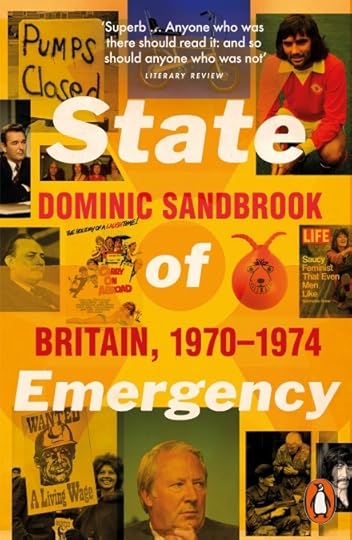
Given the plethora of events this lengthy account justifies every one of its 700 pages and it's hard to imagine there's anything of significance left out. It's totally engrossing and I loved it all. From politics to popular culture this is a vivid account. I was a child during this era and it chimes with my memories. Some of it was familiar but I also learned a lot too.
I eagerly await the next instalment Seasons in the Sun: The Battle for Britain, 1974 - 1979.
5/5
More about State of Emergency: Britain, 1970-1974....
State of Emergency: Britain, 1970-1974 is a brilliant history of the gaudy, schizophrenic atmosphere of the early Seventies.
The early 1970s were the age of gloom and glam. Under Edward Heath, the optimism of the Sixties had become a distant memory. Now the headlines were dominated by social unrest, fuel shortages, unemployment and inflation.
The seventies brought us miners' strikes, blackouts, IRA atrocities, tower blocks and the three-day week, yet they were also years of stunning change and cultural dynamism, heralding a social revolution that gave us celebrity footballers, high-street curry houses, package holidays, gay rights, green activists and progressive rock; the world of Enoch Powell and Tony Benn, David Bowie and Brian Clough, Germaine Greer and Mary Whitehouse.
Dominic Sandbrook's State of Emergency is the perfect guide to a luridly colourful Seventies landscape that shaped our present, from the financial boardroom to the suburban bedroom.
September 21, 2021
Sandbrook approaches the years of the Heath Government in, what might be called, a thematic way, as opposed to a strictly chronological manner. This allows him to take each theme (Industrial unrest, the rise of Suburbia, the increasing Troubles in Northern Ireland) and delve into more detail. In maintaining the context of these themes he often discusses their roots pre 1970 and extends their trajectory beyond 1974, well and truely crossing the boundaries of the books title (but then history doesn't come in neat packages, as Sandbrook points out). The book is, by turns, hilarious, fascinating, shocking and harrowing (the latter especially applies to the two chapters dealing with the Troubles in Northern Ireland).
The rise in militancy in the unions (frequently against the advise and wishes of their moderate leaders) points the way to further problems down the line (see the follow up book "Seasons in the Sun: The Battle for Britain, 1974-1979" and the eventual backlash of the Thatcher era). Given the double humiliation of Heath by the miners, at a time when Thatcher was in cabinet, it is hardly suprising that Thatcher fixed her sight on them when she came into power making sure that she didn't fall foul in the same way Heath did.
The pitfalls of Globalisation loom large in the shape of the global recession and the imposition of huge increases in the price of oil and embargoes of some countries (esp. the US) by the Arab States, in response to aid provided by the US when Egypt and Syria attacked Israel. This resulted in a massive increase in oil prices which really didn't help an already struggling UK that was trying to deal with a trade deficit and problems due to general industrial decline.
Was Heath one of the unluckiest Prime ministers in Britian - almost certainly, sadly his own personality (rude, aloof and stuborn) combined with his belief in "One Nation Toryism and the general postwar consensus meant he frequently squandered any chances he had for re-election. Scroll on a few years down the line, with the post war consensus in tatters and "one nation" ideals well and truely ditched and we all know what happens next.....
The rise in militancy in the unions (frequently against the advise and wishes of their moderate leaders) points the way to further problems down the line (see the follow up book "Seasons in the Sun: The Battle for Britain, 1974-1979" and the eventual backlash of the Thatcher era). Given the double humiliation of Heath by the miners, at a time when Thatcher was in cabinet, it is hardly suprising that Thatcher fixed her sight on them when she came into power making sure that she didn't fall foul in the same way Heath did.
The pitfalls of Globalisation loom large in the shape of the global recession and the imposition of huge increases in the price of oil and embargoes of some countries (esp. the US) by the Arab States, in response to aid provided by the US when Egypt and Syria attacked Israel. This resulted in a massive increase in oil prices which really didn't help an already struggling UK that was trying to deal with a trade deficit and problems due to general industrial decline.
Was Heath one of the unluckiest Prime ministers in Britian - almost certainly, sadly his own personality (rude, aloof and stuborn) combined with his belief in "One Nation Toryism and the general postwar consensus meant he frequently squandered any chances he had for re-election. Scroll on a few years down the line, with the post war consensus in tatters and "one nation" ideals well and truely ditched and we all know what happens next.....

April 25, 2019
One suspects that this is as close as you can get to living through the early 70s in book form (with the added benefit of hindsight, memoirs and diaries to add behind the scenes insight to the contemporary accounts). Sandbrook marshalls a simply staggering amount of material into what feels like a panoramic view of each area he addresses. A discussion of housing, for example, will bounce from insightful political commentary on Heath's approach to the property market, to contemporaneous accounts from twenty-somethings about getting onto the housing ladder, to newspaper articles, to extracts from J.G. Ballard's High Rise and--as happens with glorious frequency throughout--probably a quote from Doctor Who. The result is an apparently effortless portrayal of life from all angles.
If there is a central thesis to the work, it is one that I assume permeates all the books in this series, that History is a continuum of events, reacting to what has come before. Explicitly, Sandbrook continually refers back to the seeds of the early 70s being sown in the 60s, and implicitly, you see the foundations of Thatcherism being laid throughout in the response to almost every major decision that Heath takes.
If I can fault the work, it's that such a panoramic, studiously even-handed perspective, tends to lead the author towards a fairly status quo/centrist perspective. Marginal voices (whether or the political left or right, unionists, gay activists, or feminists) are painted in broad terms; colourful, entertaining eccentrics, whose narrow perspective is generally skewered by the author. There's also a drive by the author to push back against prevailing narratives, which perhaps borders on contrarianism. Often this is very enlightening (e.g. when he leavens notions of 70s sexual liberation with relatively conservative statistics on sex before marriage), but it also leads to, say, Enoch Powell getting a far more dramatic, principled and sympathetic portrayal than the gay rights movement. Which is a tad odd.
If there is a central thesis to the work, it is one that I assume permeates all the books in this series, that History is a continuum of events, reacting to what has come before. Explicitly, Sandbrook continually refers back to the seeds of the early 70s being sown in the 60s, and implicitly, you see the foundations of Thatcherism being laid throughout in the response to almost every major decision that Heath takes.
If I can fault the work, it's that such a panoramic, studiously even-handed perspective, tends to lead the author towards a fairly status quo/centrist perspective. Marginal voices (whether or the political left or right, unionists, gay activists, or feminists) are painted in broad terms; colourful, entertaining eccentrics, whose narrow perspective is generally skewered by the author. There's also a drive by the author to push back against prevailing narratives, which perhaps borders on contrarianism. Often this is very enlightening (e.g. when he leavens notions of 70s sexual liberation with relatively conservative statistics on sex before marriage), but it also leads to, say, Enoch Powell getting a far more dramatic, principled and sympathetic portrayal than the gay rights movement. Which is a tad odd.

February 8, 2023
After the stunning upset of defeating Wilson's Labour, Edward Heath and the conservatives set out to shape Britain in its ideal image. However, Heath ended up presiding over one of the most calamitous times in British's modern history. Due to political tactlessness, Heath's personal weaknesses, and even sheer misfortune, Britain was put into near-endless labour union strikes, high unemployment, high inflation, sectarian strife in Northern Ireland, complete with bombing terror campaign into British Mainland, and energy crisis to top those. A One Nation Tory at heart, Heath found itself unable to take radical steps to solve Britain's problems like what Thactcher would do later, contrasting his instinct with what how he had been advertised as Selsdon Man, who will rule Britain with greater efficiency, a Heathco, if you like.
Other underlying and consistent theme in this book (and other books within the series) is, despite the constant steps into decline, doom and gloom, The British People became more affluent than ever before. Many cultural aspects of Britain during this turbulent times are also discussed, from the rise of High-Rise housing projects, Mary Whitehouse Anti TV-filth campaign, Hooliganism in football, to environmentalism and radical feminism in media.
The Book ended with the ending of Heath's political suffering. After a series of political mismanagement, Harold Wilson, against all odds (even he himself doubted), managed to recapture the premiership. While things seems to be bad at that time, it only served as a backdrop for even worse crises which culminated in Winter of Discontent, in which Thatcher rode into premiership. Overall, as with other books I have read in this series this far, I enjoy reading it immensely, and would rather jump to the next book, If only I don't have other books I have to read first.
Other underlying and consistent theme in this book (and other books within the series) is, despite the constant steps into decline, doom and gloom, The British People became more affluent than ever before. Many cultural aspects of Britain during this turbulent times are also discussed, from the rise of High-Rise housing projects, Mary Whitehouse Anti TV-filth campaign, Hooliganism in football, to environmentalism and radical feminism in media.
The Book ended with the ending of Heath's political suffering. After a series of political mismanagement, Harold Wilson, against all odds (even he himself doubted), managed to recapture the premiership. While things seems to be bad at that time, it only served as a backdrop for even worse crises which culminated in Winter of Discontent, in which Thatcher rode into premiership. Overall, as with other books I have read in this series this far, I enjoy reading it immensely, and would rather jump to the next book, If only I don't have other books I have to read first.

April 30, 2024
I was very young during the years covered in this book, but I was surprised by how many memories it brought back. From Doctor Who and Slade to power cuts and candles. It was a time of considerable turmoil at the very start of our membership in the European Union.
The size of this book and the volumes that follow are a little daunting, but I love 'The Rest is History' and hoped Dominic Sandbrook's entertaining podcast style would carry over into his books. The style is certainly more journalistic than academic, and it is more of a detailed gathering of facts than an original take on events. It's very good at conjuring up the feel of the times and the key personalities that drove events, both politically and culturally. It was laugh-out-loud funny at times, and then horrifying as the start of the Troubles in Ireland are documented.
I did have some issues with the book. Despite the detail and the copious footnotes and further reading, sources were a little repetitive - the same diaries and biographies were quoted again and again. There was a distinct right wing bias at times. Heath was a grumpy but good egg, despite taking the country to the brink of ruin. Wilson, on the other hand, was a devious spent force running a cabinet of evil communists. He really dislikes Tony Benn! I'm sure I'm not alone in finding it easier to name the members of Wilson's cabinet than Rishi Sunak's, but Sandbrook has very little good to say about the Labour Party. There's also more than a hint of preparing the ground for Mrs T. The right wing tone didn't stop me enjoying this book, but it did make me question some of the conclusions.
The size of this book and the volumes that follow are a little daunting, but I love 'The Rest is History' and hoped Dominic Sandbrook's entertaining podcast style would carry over into his books. The style is certainly more journalistic than academic, and it is more of a detailed gathering of facts than an original take on events. It's very good at conjuring up the feel of the times and the key personalities that drove events, both politically and culturally. It was laugh-out-loud funny at times, and then horrifying as the start of the Troubles in Ireland are documented.
I did have some issues with the book. Despite the detail and the copious footnotes and further reading, sources were a little repetitive - the same diaries and biographies were quoted again and again. There was a distinct right wing bias at times. Heath was a grumpy but good egg, despite taking the country to the brink of ruin. Wilson, on the other hand, was a devious spent force running a cabinet of evil communists. He really dislikes Tony Benn! I'm sure I'm not alone in finding it easier to name the members of Wilson's cabinet than Rishi Sunak's, but Sandbrook has very little good to say about the Labour Party. There's also more than a hint of preparing the ground for Mrs T. The right wing tone didn't stop me enjoying this book, but it did make me question some of the conclusions.

May 3, 2019
The third volume in Sandbrook’s ongoing history of postwar Britain, and we’re now covering off Edward Heath’s premiership.
State of Emergency feels a little less focused on the political infighting and chicanery than the previous books in the series, but this may be a factor both of Heath’s dogged pursuit of his goals, brooking little competition, as well as the fact that during the period in question, the whole idea of the UK was falling apart. We see the first major escalation of the troubles in Northern Ireland, as well as increasing union militancy. In the background we have the entry of the UK into the EEC (which has a certain resonance given that Brexit is still up in the air at the time of writing).
As always with Sandbrook there’s as much concentration on the social and cultural as the political, but this somehow feels a trifle flatter than its predecessors.
State of Emergency feels a little less focused on the political infighting and chicanery than the previous books in the series, but this may be a factor both of Heath’s dogged pursuit of his goals, brooking little competition, as well as the fact that during the period in question, the whole idea of the UK was falling apart. We see the first major escalation of the troubles in Northern Ireland, as well as increasing union militancy. In the background we have the entry of the UK into the EEC (which has a certain resonance given that Brexit is still up in the air at the time of writing).
As always with Sandbrook there’s as much concentration on the social and cultural as the political, but this somehow feels a trifle flatter than its predecessors.

December 7, 2025
It's taken me four months to finish this (and I've read 26 other books during that period); like Sandbrook's previous books in this series, it's fascinating, entertaining and sometimes saddening, but it's not meant as criticism to say that it's also hard work - there's a lot to take in. This instalment is the first one that covers events within my living memory (just), which is what I was most interested in when I started these books. Again, what stands out is the sensation of history repeating itself: for example, change the word "permissiveness" to "political correctness" or "woke" and chapter 11 here could be describing the same moral panic from the 90s or today. And so unfortunately, one is left with a depressing feeling that no-one learns anything - there are as many people interested igniting fires for personal gain, now, as there were fifty years ago.
Displaying 1 - 30 of 104 reviews