

What do you think?
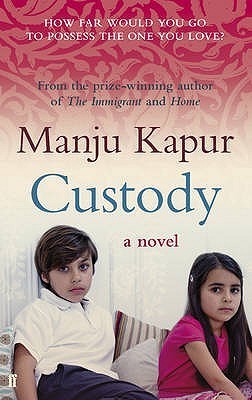
Custody
When Shagun leaves Raman for another man, a bitter legal battle ensues. The custody of their two young children is thrown into question and Shagun must decide what price she will pay for freedom...
432 pages, Paperback
First published January 1, 2010
About the author
Manju Kapur
13 books224 followersManju Kapur is the author of four novels. Her first, Difficult Daughters, won the Commonwealth Prize for First Novels (Eurasia Section) and was a number one bestseller in India. Her second novel A Married Woman was called 'fluent and witty' in the Independent, while her third, Home, was described as 'glistening with detail and emotional acuity' in the Sunday Times. Her most recent novel, The Immigrant, has been longlisted for the DSC Prize for South Asian Literature. She lives in New Delhi.
Ratings & Reviews
Friends & Following
Create a free account to discover what your friends think of this book!
Community Reviews
Displaying 1 - 30 of 93 reviews
September 26, 2013
Protagonists: Shagun, the initially bored & later rather over-active wife; Raman, the hard-working corporate slave; Ashok, the ambitious boss and Ishita, the divorcee.
Set in the 90’s in Delhi, the story revolves around Raman & Shagun and their pursuit for seeking love and companionship. Married for over a decade; Shagun comes to terms with her suffocation and unexciting married life in the arms of her husband’s boss Ashok. Raman, the hard-working and rather unobservant husband realizes his wife’s infidelity when irreparable damage was done.
And then the quest of seeking divorce begins. However, the twist in the tale occurs when the divorce is granted and custody of minor children needs to be settled. The mother; filled with new-found love and the want to marry the love of her life quickly agrees for part-custody of the children. Shifted from one house to another like pieces of furniture; their two children began their early life in turbulence. The defiant son is soon sent to boarding soon while the much younger daughter tries settles in with her father.
In parallel, unravels the life of young Ishita born to typical middle-class East Delhi residing parents whose sole aim in life is to get their only child settled in matrimony. Love soon finds its way in Ishita’s life in the form of an arranged marriage making her postpone her higher studies plans. As expected, the demands for a grandchild mount upon the young couple. Endless doctor visits, medical tests and taunt from relatives shatters Ishita’s confidence and shakes the foundation of her marriage. An ‘amicable’ divorce brings Ishita back to her maternal home with a suitcase full of her marriage transactions.
Two parallel lives of divorcees are brought together with Raman’s younger daughter seeking a mother in Ishita. Fight for maternal love and jealousy surges in Ishita who cannot bear to part with her daughter and soon finds them fighting for full custody of the children.
Manju Kapur’s ‘Custody’ is a sure-shot page turner that will make you yearn to read more. Each character is weaved so brilliantly that you will have empathy towards each of them. Dealing with sensitive issues of infidelity and infertility, Manju Kapur artfully tackles the matter with her skillful writing.
Custody
Set in the 90’s in Delhi, the story revolves around Raman & Shagun and their pursuit for seeking love and companionship. Married for over a decade; Shagun comes to terms with her suffocation and unexciting married life in the arms of her husband’s boss Ashok. Raman, the hard-working and rather unobservant husband realizes his wife’s infidelity when irreparable damage was done.
And then the quest of seeking divorce begins. However, the twist in the tale occurs when the divorce is granted and custody of minor children needs to be settled. The mother; filled with new-found love and the want to marry the love of her life quickly agrees for part-custody of the children. Shifted from one house to another like pieces of furniture; their two children began their early life in turbulence. The defiant son is soon sent to boarding soon while the much younger daughter tries settles in with her father.
In parallel, unravels the life of young Ishita born to typical middle-class East Delhi residing parents whose sole aim in life is to get their only child settled in matrimony. Love soon finds its way in Ishita’s life in the form of an arranged marriage making her postpone her higher studies plans. As expected, the demands for a grandchild mount upon the young couple. Endless doctor visits, medical tests and taunt from relatives shatters Ishita’s confidence and shakes the foundation of her marriage. An ‘amicable’ divorce brings Ishita back to her maternal home with a suitcase full of her marriage transactions.
Two parallel lives of divorcees are brought together with Raman’s younger daughter seeking a mother in Ishita. Fight for maternal love and jealousy surges in Ishita who cannot bear to part with her daughter and soon finds them fighting for full custody of the children.
Manju Kapur’s ‘Custody’ is a sure-shot page turner that will make you yearn to read more. Each character is weaved so brilliantly that you will have empathy towards each of them. Dealing with sensitive issues of infidelity and infertility, Manju Kapur artfully tackles the matter with her skillful writing.
Custody

April 10, 2013
In ‘Custody’ Manju Kapur has tried to explore the finer nuances of a divorce – both pre and post. Not only are we taken through the journey of what leads up to one, but also the repercussions of this as well. The story takes us through the life of Raman, who works for ‘The Brand’, a leading soft drinks manufacturing company. He has this respectable job, gets paid handsomely, and leads a decently content life with his gorgeous wife Shagun, his smart teenager son Arjun and his adorable three year old daughter, Roohi.
Parellely, we are introduced to Ishita, who although not strikingly beautiful, is wise, kind and generous. Ishita gets married and leads a happy life, adapting to her new family, being everybody’s favourite.
Raman, like a dedicated employee, gets completely absorbed in his work and starts spending even less time with his family. Shagun, after leading a happily married life so far, decides that she is bored of being just a house-wife and now wants to start working. The twist begins with the entry of Raman’s bold and dashing boss – Ashok...
For the full review, visit IndiaBookStore.
Parellely, we are introduced to Ishita, who although not strikingly beautiful, is wise, kind and generous. Ishita gets married and leads a happy life, adapting to her new family, being everybody’s favourite.
Raman, like a dedicated employee, gets completely absorbed in his work and starts spending even less time with his family. Shagun, after leading a happily married life so far, decides that she is bored of being just a house-wife and now wants to start working. The twist begins with the entry of Raman’s bold and dashing boss – Ashok...
For the full review, visit IndiaBookStore.

September 21, 2012
The blurb leads you to think of Shagun as the victim, but like most women these days, sadly, she wants to have the whole chocolate cake to herself and remain a size 0. This is a woman who clearly wants the finer things in life, and then resents the life she allows to unfold, believing it is everybody else's fault but her own.
Her vindictive behaviour towards her husband, who has worked himself into the ground to give her what her family, his family, their culture and customs expects from a 'good' man is not enough for her; proving my point that you can have all the material things in life you want, but if you do not love and care for each other with the small things, you are never going to be happy.
I really felt for Raman, and his new wife Ishita, as the actions of Shagun came more from acts of selfishness and manipulation, rather than love. The question on the front of the book 'How far would you go to possess the one you love?' captures the real issues here in families that are broken, possession. Children are not possessions, they are human beings, fragile when it comes to their world's being ripped apart by anger, jealousy, pain and ultimately revenge. As adults in these situations, parents have to put their children first, but so many fail to do this. They dwell on their own feelings, instead of looking at the situation through the eyes of the child. Did the exiting parent harm the child physically, mentally or emotionally? If not, then they should be allowed to see the exiting parent. When signs of harm or damage begin occur, then it is time to step in and have a mediation between both parents and a counsellor, possibly removing them from the situation. But of course if the parents were not wise enough to have counselling before the break up then, the likelihood of it happening afterwards is nigh impossible.
This story shows all that is wrong with so many Eastern cultures when it comes to cultural pressures from the wider community, from the expectations forced upon both the man and the woman. It was an interesting book, up to a point. Disappointing in others, especially given the hype around it. But is that simply because I come from the West, a broken family and now live in the East? Who knows.
If you want something easy to read, a summary of some Eastern principles when it comes to marriage, then it's worth a look, but I wouldn't get too excited about it.
Her vindictive behaviour towards her husband, who has worked himself into the ground to give her what her family, his family, their culture and customs expects from a 'good' man is not enough for her; proving my point that you can have all the material things in life you want, but if you do not love and care for each other with the small things, you are never going to be happy.
I really felt for Raman, and his new wife Ishita, as the actions of Shagun came more from acts of selfishness and manipulation, rather than love. The question on the front of the book 'How far would you go to possess the one you love?' captures the real issues here in families that are broken, possession. Children are not possessions, they are human beings, fragile when it comes to their world's being ripped apart by anger, jealousy, pain and ultimately revenge. As adults in these situations, parents have to put their children first, but so many fail to do this. They dwell on their own feelings, instead of looking at the situation through the eyes of the child. Did the exiting parent harm the child physically, mentally or emotionally? If not, then they should be allowed to see the exiting parent. When signs of harm or damage begin occur, then it is time to step in and have a mediation between both parents and a counsellor, possibly removing them from the situation. But of course if the parents were not wise enough to have counselling before the break up then, the likelihood of it happening afterwards is nigh impossible.
This story shows all that is wrong with so many Eastern cultures when it comes to cultural pressures from the wider community, from the expectations forced upon both the man and the woman. It was an interesting book, up to a point. Disappointing in others, especially given the hype around it. But is that simply because I come from the West, a broken family and now live in the East? Who knows.
If you want something easy to read, a summary of some Eastern principles when it comes to marriage, then it's worth a look, but I wouldn't get too excited about it.

June 17, 2011
I think this is the best of Kapur's novels so far. She explores very emotional topics with such fervour.
What does it mean to be a mother? Is a mother a bad mother if she chooses to seek her own happiness? Can a mother be replaced by a mother figure? Is a mother entitled to her children's love is she is physically separate from them?
Divorce is not uncommon in Asian society today, but in an Indian setting, seems more complicated by the roles of the extended family members- the in-laws with bitter recriminations, the doting grandparents who are denied their weekly feeding sessions, the cousins who seem to be perfectly happy, the lawyer-relative who is caught between legalities and emotional outbursts.....everyone has an opinion. All the adults seem to have forgotten about the child's turmoil; and I think that was exactly what Kapur was trying to convey.
Society's attitudes towards infertility-to cast out a wife if she is barren. The obsession with ensuring a lady is married and settled, as a yardstick to measure her happiness which filters down to parental coercion and feeling of low self-esteem. This recurring theme -of what will people say, what will people think -an inherent feature of Asian societies everywhere.
It would be interesting if Kapur does a follow-up novel, focussing on the Roohi and Arjun, as they grow up and away from their divided family.
What does it mean to be a mother? Is a mother a bad mother if she chooses to seek her own happiness? Can a mother be replaced by a mother figure? Is a mother entitled to her children's love is she is physically separate from them?
Divorce is not uncommon in Asian society today, but in an Indian setting, seems more complicated by the roles of the extended family members- the in-laws with bitter recriminations, the doting grandparents who are denied their weekly feeding sessions, the cousins who seem to be perfectly happy, the lawyer-relative who is caught between legalities and emotional outbursts.....everyone has an opinion. All the adults seem to have forgotten about the child's turmoil; and I think that was exactly what Kapur was trying to convey.
Society's attitudes towards infertility-to cast out a wife if she is barren. The obsession with ensuring a lady is married and settled, as a yardstick to measure her happiness which filters down to parental coercion and feeling of low self-esteem. This recurring theme -of what will people say, what will people think -an inherent feature of Asian societies everywhere.
It would be interesting if Kapur does a follow-up novel, focussing on the Roohi and Arjun, as they grow up and away from their divided family.
February 1, 2014
Want to read ..

November 21, 2021
This novel centered around a divorce and custody battle in modern India is a character-driven story that will make you question your morals and loyalties. I did not find myself dying to read this book, but when I did it really made me question and think. I still don't know who was right or if it matters. I have enjoyed this author in the past and would gladly pick up something else by her. If you are in the middle of a nasty custody battle, pick another book. If not, pick this one up, but prepare to be challenged. Every character in this book was both sympathetic and despicable at different points, and it is the mark of good writing that kept me wanting to continue this book after long periods away.

dnfed
July 26, 2022Not for me

April 13, 2011
Manju Kapur writes with honesty and emotion in her novel "Custody", a heart-wrenching tale of infidelity,divorce and broken hearts. Kapur explores the minds and hearts of the divorced couple Raman and Shagun, their future spouses and the traumatic effects of the complicated custody arrangement on the children, Arjun and Roohi.
Ashok Khanna is in love with Shagun from the moment he sees her. It would have been a fairytale romance except that Shagun is a married woman, married to Ashok's best employee and sales genius, Raman. Ashok is charming, handsome and wealthy; though Shagun leads a privileged life, she desires the excitement that Ashok promises. Once Raman discovers the affair, Shagun must decide whether or not to leave everything behind, including her two young children.
Through familial intervention, Raman meets Ishita, who attempts to soothe Raman's pain from his divorce as well as her own longing for a child. A ready made family may seem ideal, but where there are children there are complications, and Raman's son, Arjun proves to be difficult to love.
Kapur writes a realistic portrayal of the effects of divorce on children, and examines the damage that parents can do to children when they are used to emotionally blackmail the former spouse. She reveals the complex dance people do to settle custody disputes and what a person will do in order to fulfill their selfish desires. A very realistic and honest portayal of people trying to secure what the heart wants.
I received this book from the Goodreads First Reads program

Ashok Khanna is in love with Shagun from the moment he sees her. It would have been a fairytale romance except that Shagun is a married woman, married to Ashok's best employee and sales genius, Raman. Ashok is charming, handsome and wealthy; though Shagun leads a privileged life, she desires the excitement that Ashok promises. Once Raman discovers the affair, Shagun must decide whether or not to leave everything behind, including her two young children.
Through familial intervention, Raman meets Ishita, who attempts to soothe Raman's pain from his divorce as well as her own longing for a child. A ready made family may seem ideal, but where there are children there are complications, and Raman's son, Arjun proves to be difficult to love.
Kapur writes a realistic portrayal of the effects of divorce on children, and examines the damage that parents can do to children when they are used to emotionally blackmail the former spouse. She reveals the complex dance people do to settle custody disputes and what a person will do in order to fulfill their selfish desires. A very realistic and honest portayal of people trying to secure what the heart wants.
I received this book from the Goodreads First Reads program

September 20, 2011
Manju Kapur never fails to amaze. With her pincer grasp of Indian values and emotions, she can spin realistic tales of the Indian family life. This story dealt with the trauma of divorce: two individuals who are divorced by their spouses without any pertinent reason, the male counterpart having two children who are the pawns of vicious custody battle, and the female counterpart divorced because of her infertility. They end up married to each other, but have to face the aftermath of the bitter custody struggle for the man's children, especially the innocent, withdrawn female child, Ruhi. I was drawn into the story and finished it almost in 2-3 prolonged sittings, otherwise I would be obsessed by the characters and find it difficult to concentrate in my day to day life. It was a worthwhile read, but not a happy one. It left me with a dull ache in my head as well as my heart. I hate families splitting due to no apparent reason at all.

January 13, 2013
As I really enjoyed Home by Manju Kapur I was really looking forward to reading this novel and I certainly wasn’t disappointed.
Raman feels blessed with a very beautiful wife, Shagan, but that doesn’t stop him spending most of his time working and travelling. Then Ashok, Raman’s dynamic new boss, meets Shagan and decides he must have her as his wife, whatever the consequences. As Shagan and Raman both forge relationships with new partners, they find it impossible to reach agreement about the custody of their two children leading to years of conflict between the two couples.
Set in Delhi during the 1900s, this novel provides a fascinating insight into modern India, uneasily emerging from the traditions and culture of the past.
Raman feels blessed with a very beautiful wife, Shagan, but that doesn’t stop him spending most of his time working and travelling. Then Ashok, Raman’s dynamic new boss, meets Shagan and decides he must have her as his wife, whatever the consequences. As Shagan and Raman both forge relationships with new partners, they find it impossible to reach agreement about the custody of their two children leading to years of conflict between the two couples.
Set in Delhi during the 1900s, this novel provides a fascinating insight into modern India, uneasily emerging from the traditions and culture of the past.

July 31, 2016
This is fiction that is impressive in its skill and heartrending in its honesty.
Manju Kapur's 'Custody' demands a sensitive reading and it offers readers with many important aspects of understanding how marital life in India is fast disintegrating and being shaped by extra marital affairs, materialistic pursuits, and so on. It also offers valuable insights into the vulnerability of children of broken marriages and new 'happily divorced and remarried' statuses of Indian couples.
This is not merely a story. It is a battlefield of sorts that tears your heart and soul apart because of it's masterful narrative and honesty. Read it but be ready to cry.
Manju Kapur's 'Custody' demands a sensitive reading and it offers readers with many important aspects of understanding how marital life in India is fast disintegrating and being shaped by extra marital affairs, materialistic pursuits, and so on. It also offers valuable insights into the vulnerability of children of broken marriages and new 'happily divorced and remarried' statuses of Indian couples.
This is not merely a story. It is a battlefield of sorts that tears your heart and soul apart because of it's masterful narrative and honesty. Read it but be ready to cry.

February 27, 2019
In India approximately 11 marriages in every 1000 end in divorce. At a shade over 1%, this is one of the lowest rates in the world. I decided not to look up the statistics on how many wives die suddenly from unexplained accidents in the home as a result of dowry disputes as that’s another issue entirely. Let’s just say that when things go bad, a trip to the lawyers isn’t always the outcome.
In Manju Kapur’s novel 'Custody' she addresses the complex issues of Indian divorce. It’s not her first time dealing with controversial issues – in fact every one of her four previous books has contained plenty to upset her more conservative readers – and like each of those books there’s a discontented woman at the heart of the story. But unlike the others, this time our sympathies are pretty firmly directed against the woman and in favour of the husband.
The tale of Raman (the husband) and Shagun (his wife) and the destruction of the marriage is – for India – a rather modern story even though it’s set in the 1990s. It’s also a rather upper-middle class story of people who don’t have to live as their parents and grandparents did before them. They have the economic independence to not have to live with their parents within the protective cocoon of the extended family. They can afford an affluent lifestyle, a nice place to live, staff to do the drudge work and top schools for their children because they benefit from the salary that goes with working for a big international company.
When we first meet them Raman and Shagun have a great relationship despite having a marriage which was ‘arranged’ by their families. Raman is a successful marketing exec at a company referred to as ‘The Brand’ (a very thinly disguised cover for Coca Cola) and Shagun is a strikingly beautiful stay at home mum who perhaps married a bit too young. All seems fine in their family until Raman’s new boss Ashok rolls into Delhi from the USA. He’s a bachelor with a lot to prove, a fabulous reputation for his visionary management and an eye for the ladies. Ashok’s a man who is used to getting what he wants and taking no prisoners. He and Shagun are soon involved in a passionate affair, one for which both will give up everything to be together. When Shagun asks her husband for a divorce he refuses and she abducts their children. Thus begins the battle for Custody at the heart of Manju Kapur’s fifth novel.
An Indian marriage is a marriage of families and not just the husband and wife. In no time at all both families are drawn into the battle, forced to take sides against someone who had long been a part of their family. Lawyers and court submissions become the rhythm of their lives – lies are told, allegations are made, hurt is magnified as games are played and threats are made but there can be no outright winners in these circumstances. Shagun wants her children but she wants her new man more and despite her protestations that Ashok considers her children to be his own, it’s pretty clear that he only wants them because she wants them. Raman is devastated – as the wronged party it’s bad enough he’s lost the woman he loved without losing the children too. And when Ashok looks set to be given a big promotion in the USA, the stakes are raised to a point where compromise is impossible.
Manju Kapur lives in Delhi where she is a teacher at an elite girl’s school. She’s never been afraid to shock her society with past story lines including one about a relationship with a much older man, another featuring a lesbian affair, one with a sub-plot of juvenile incest and wives generally cheating about all over the place. Her decision to tackle divorce is almost too conventional for her and may disappoint some of her more established readership who buy in an expectation of being shocked.
Whilst the story is an unusual one in an Indian context and introduces a different slant on the role of the extended families in a divorce, for most international readers based in countries where divorce is sadly all too common, there’s not too much to surprise anyone. I couldn’t help but think of this as an Indian ‘Kramer versus Kramer’, a story that’s nothing new if you take away the geographic setting. Many of us will know couples who’ve been through a marriage breakdown and whose stories are all too similar to that of Raman and Shagun and for that reason I found ‘Custody’ a little bit disappointing.
In Manju Kapur’s novel 'Custody' she addresses the complex issues of Indian divorce. It’s not her first time dealing with controversial issues – in fact every one of her four previous books has contained plenty to upset her more conservative readers – and like each of those books there’s a discontented woman at the heart of the story. But unlike the others, this time our sympathies are pretty firmly directed against the woman and in favour of the husband.
The tale of Raman (the husband) and Shagun (his wife) and the destruction of the marriage is – for India – a rather modern story even though it’s set in the 1990s. It’s also a rather upper-middle class story of people who don’t have to live as their parents and grandparents did before them. They have the economic independence to not have to live with their parents within the protective cocoon of the extended family. They can afford an affluent lifestyle, a nice place to live, staff to do the drudge work and top schools for their children because they benefit from the salary that goes with working for a big international company.
When we first meet them Raman and Shagun have a great relationship despite having a marriage which was ‘arranged’ by their families. Raman is a successful marketing exec at a company referred to as ‘The Brand’ (a very thinly disguised cover for Coca Cola) and Shagun is a strikingly beautiful stay at home mum who perhaps married a bit too young. All seems fine in their family until Raman’s new boss Ashok rolls into Delhi from the USA. He’s a bachelor with a lot to prove, a fabulous reputation for his visionary management and an eye for the ladies. Ashok’s a man who is used to getting what he wants and taking no prisoners. He and Shagun are soon involved in a passionate affair, one for which both will give up everything to be together. When Shagun asks her husband for a divorce he refuses and she abducts their children. Thus begins the battle for Custody at the heart of Manju Kapur’s fifth novel.
An Indian marriage is a marriage of families and not just the husband and wife. In no time at all both families are drawn into the battle, forced to take sides against someone who had long been a part of their family. Lawyers and court submissions become the rhythm of their lives – lies are told, allegations are made, hurt is magnified as games are played and threats are made but there can be no outright winners in these circumstances. Shagun wants her children but she wants her new man more and despite her protestations that Ashok considers her children to be his own, it’s pretty clear that he only wants them because she wants them. Raman is devastated – as the wronged party it’s bad enough he’s lost the woman he loved without losing the children too. And when Ashok looks set to be given a big promotion in the USA, the stakes are raised to a point where compromise is impossible.
Manju Kapur lives in Delhi where she is a teacher at an elite girl’s school. She’s never been afraid to shock her society with past story lines including one about a relationship with a much older man, another featuring a lesbian affair, one with a sub-plot of juvenile incest and wives generally cheating about all over the place. Her decision to tackle divorce is almost too conventional for her and may disappoint some of her more established readership who buy in an expectation of being shocked.
Whilst the story is an unusual one in an Indian context and introduces a different slant on the role of the extended families in a divorce, for most international readers based in countries where divorce is sadly all too common, there’s not too much to surprise anyone. I couldn’t help but think of this as an Indian ‘Kramer versus Kramer’, a story that’s nothing new if you take away the geographic setting. Many of us will know couples who’ve been through a marriage breakdown and whose stories are all too similar to that of Raman and Shagun and for that reason I found ‘Custody’ a little bit disappointing.

December 23, 2017
Manju Kapur has touched upon a very delicate and emotional subject of custody of children in a broken relationship. As the number of divorces has increased even in the eastern world, with multitude of relationships crumbling under the ways of the modern world, lonely kids split between parents are the inevitable by-product. Ruhi is one such child who has to bear the brunt of her parents' separation . Ishita, a childless divorcee steps into the role of Ruhi's step-mom and the author has captured the nuances of the complex relationship that both Ishita and Ruhi develop.
The author has touched upon sensitive issues like infedility in the picture perfect marriage of Raman and Shagun, where the reader can't help but sympathise with Raman who has been an ideal and devoted husband. The characterisation is intricate and one can connect with the emotions of the protagnists. Be it the distraught Raman who is caught by surprise at his wife's extra-marital affair, Shagun- the dissatisfied wife who is ready to give up her children for her flamboyant lover Ashok , the childless Ishita who is struggling with the taboo of infertility, the rebellioius Arjun who struggles to come to terms with his parents' separation and the little Ruhi longing for a mother's love. The story reiterates the fact that giving birth doesn't make a mother, nurturing a child with love does. The development of the special bond between Ishita and Ruhi is interesting to read . The child responds to love and accepts a stranger in place of her biological mother and Ishita happily embraces Ruhi with her motherly instincts that she never had a chance to share with a biological child.
Although the plot is very interesting and characters well etched, there are some lose ends that could have been tidied up for a believable impression with the readers. Having said that, a worthwhile read.
The author has touched upon sensitive issues like infedility in the picture perfect marriage of Raman and Shagun, where the reader can't help but sympathise with Raman who has been an ideal and devoted husband. The characterisation is intricate and one can connect with the emotions of the protagnists. Be it the distraught Raman who is caught by surprise at his wife's extra-marital affair, Shagun- the dissatisfied wife who is ready to give up her children for her flamboyant lover Ashok , the childless Ishita who is struggling with the taboo of infertility, the rebellioius Arjun who struggles to come to terms with his parents' separation and the little Ruhi longing for a mother's love. The story reiterates the fact that giving birth doesn't make a mother, nurturing a child with love does. The development of the special bond between Ishita and Ruhi is interesting to read . The child responds to love and accepts a stranger in place of her biological mother and Ishita happily embraces Ruhi with her motherly instincts that she never had a chance to share with a biological child.
Although the plot is very interesting and characters well etched, there are some lose ends that could have been tidied up for a believable impression with the readers. Having said that, a worthwhile read.

April 26, 2020
Was so absorbed into the book. Never has a story on divorce and children’s custody been told in such a detailed manner.
A must read if you’re fans of the whole 90s landscape.
A must read if you’re fans of the whole 90s landscape.

August 22, 2019
Once upon a time, Raman Kaushik was a very happy man with his wife Shagun and kids – Arjun and Roohi. Good job in MNC with handsome salary, very happy married life, two adorable kids – everything was there. At that time, even Raman didn’t know what else is needed to become more happy. But you never know when everything will go so wrong. Now he is a divorcee who is struggling to get the custody of his children. When his wife Shagun Sabbarwal left him for his boss Ashok Khanna, his life became devastated. He got a cardiac arrest after that. Later, he tried to accept the reality. And now, all he wants is the CUSTODY of his kids.
On the other hand, there is another woman, Ishita Rajora, who is the neighbor of Raman’s parents. She too had a very happy married life just like Raman’s. But here, Suryakanta didn’t left Ishita for another woman. It was all Ishu’s fault. Yes, she can’t conceive and that became a problem in their marriage. Of course, children are blessings, but some people like Suryakanta will take it to another level. You can’t leave your parents, your siblings, your relatives but there is always an easy option to leave your wife. Why? Because she’s an outsider, she’s not a part of your family. So, that’s easy. You can always leave your wife by following instructions of your parents. Okay, I can understand this. You are so obedient toward your parents since childhood. So yeah, men can do anything that their parents demand when it comes to their wives. Why? Because they enjoy being a mumma’s boy otherwise how will they deal with the society? After all, being a mumma’s boy is so better than being a ‘Joru ka Ghulam’. (Not all of them. Have to write this otherwise some people will start WW3 unnecessarily.) So, that is the story of poor Ishu. Her parents are now trying to get her married again. But Ishu doesn’t like the idea, instead she wants to adopt a baby. Her mother, Mrs Rajora, becomes so worried since the chance of Ishita’s remarriage (if there is any) will be vanished, if she goes for adoption. So, yes! Life is hard. You think life is beautiful? Oh dear! You are just being too dreamy or you are trying to be. You don’t know life at all. (Don’t worry! You are not the only one in this case. Maybe you are thinking just like me.)
The plot is so similar to an Indian TV show named ‘Yeh Hai Mohabbatein’. Actually, the mega-serial’s story is based on this novel. While the TV show focuses on the romantic story of Raman and Ishita, the novel deals with social issues such as – infidelity, infertility, divorce, remarriage, custody battle etc. I wish the writer only focused on these things. I didn’t like the part of Raman-Ishita’s story in the novel. Society doesn't permit this type of relationship in South-Asian culture (specially in late 90's). Otherwise how their relationship will be so different from Shagun and Ashok's? Don't know what the writer was thinking when she was writing this novel! Whatever! In terms of character, I liked most the character of Ishita Rajora in the part of her first marriage and after becoming Roohi's mother. Poor Ishu! I can so relate to her. I don’t know how, I don’t know why. She is the soul of this novel. In contrast, Raman was the favorite character of mine in YHM.
Well, I don’t watch TV shows that much, so I was not interested in this show initially. After successfully running one year, one day I watched an episode (accidentally or by mistake) and began to like it. I watched three Hindi TV shows (Kuchh Is Tara, Tere Liye and Bade Acche Lagte Hain) by Ekta Kapoor before and liked them. That’s why I thought to give it a chance. I watched first 300 episodes online within a month and watched further 150 episodes too. After that I stopped watching it since the show has been dragged unnecessarily and it has lost it’s charm. But yes, I liked the first 450 episodes and for that reason, I wanted to read the novel. But I was disappointed. The novel perfectly deals with the social and family issues but Raman-Ishita’s story failed to charm me. Though this part is not that long. I purchased this book long ago but started reading it last year. Due to my busy schedule couldn’t continue it. Finally, I have finished it a few days ago and it was just okay. After reading 270 pages I thought I will definitely try to read Manju Kapur’s other novels. But after finishing it, I think one book of this author is enough for me.
On the other hand, there is another woman, Ishita Rajora, who is the neighbor of Raman’s parents. She too had a very happy married life just like Raman’s. But here, Suryakanta didn’t left Ishita for another woman. It was all Ishu’s fault. Yes, she can’t conceive and that became a problem in their marriage. Of course, children are blessings, but some people like Suryakanta will take it to another level. You can’t leave your parents, your siblings, your relatives but there is always an easy option to leave your wife. Why? Because she’s an outsider, she’s not a part of your family. So, that’s easy. You can always leave your wife by following instructions of your parents. Okay, I can understand this. You are so obedient toward your parents since childhood. So yeah, men can do anything that their parents demand when it comes to their wives. Why? Because they enjoy being a mumma’s boy otherwise how will they deal with the society? After all, being a mumma’s boy is so better than being a ‘Joru ka Ghulam’. (Not all of them. Have to write this otherwise some people will start WW3 unnecessarily.) So, that is the story of poor Ishu. Her parents are now trying to get her married again. But Ishu doesn’t like the idea, instead she wants to adopt a baby. Her mother, Mrs Rajora, becomes so worried since the chance of Ishita’s remarriage (if there is any) will be vanished, if she goes for adoption. So, yes! Life is hard. You think life is beautiful? Oh dear! You are just being too dreamy or you are trying to be. You don’t know life at all. (Don’t worry! You are not the only one in this case. Maybe you are thinking just like me.)
The plot is so similar to an Indian TV show named ‘Yeh Hai Mohabbatein’. Actually, the mega-serial’s story is based on this novel. While the TV show focuses on the romantic story of Raman and Ishita, the novel deals with social issues such as – infidelity, infertility, divorce, remarriage, custody battle etc. I wish the writer only focused on these things. I didn’t like the part of Raman-Ishita’s story in the novel. Society doesn't permit this type of relationship in South-Asian culture (specially in late 90's). Otherwise how their relationship will be so different from Shagun and Ashok's? Don't know what the writer was thinking when she was writing this novel! Whatever! In terms of character, I liked most the character of Ishita Rajora in the part of her first marriage and after becoming Roohi's mother. Poor Ishu! I can so relate to her. I don’t know how, I don’t know why. She is the soul of this novel. In contrast, Raman was the favorite character of mine in YHM.
Well, I don’t watch TV shows that much, so I was not interested in this show initially. After successfully running one year, one day I watched an episode (accidentally or by mistake) and began to like it. I watched three Hindi TV shows (Kuchh Is Tara, Tere Liye and Bade Acche Lagte Hain) by Ekta Kapoor before and liked them. That’s why I thought to give it a chance. I watched first 300 episodes online within a month and watched further 150 episodes too. After that I stopped watching it since the show has been dragged unnecessarily and it has lost it’s charm. But yes, I liked the first 450 episodes and for that reason, I wanted to read the novel. But I was disappointed. The novel perfectly deals with the social and family issues but Raman-Ishita’s story failed to charm me. Though this part is not that long. I purchased this book long ago but started reading it last year. Due to my busy schedule couldn’t continue it. Finally, I have finished it a few days ago and it was just okay. After reading 270 pages I thought I will definitely try to read Manju Kapur’s other novels. But after finishing it, I think one book of this author is enough for me.

Read
January 3, 2026Kapur treats divorce not as a structural outcome, but as a moral lapse. Women’s desire is pathologised, their choices framed as excess, while the institution of marriage remains curiously untouched, intact, and absolved. The argument is blunt: if women want more, families will collapse. The proposed antidote is simplicity, coded as tradition, discipline, and quiet endurance. In other words, patriarchy, rebranded as wisdom. If this were irony, it might have worked. Unfortunately, it’s offered as prescription. Perhaps written for the Baghban generation, the piece hasn’t aged well. More troublingly, it shouldn’t have been positioned as insight in the first place. It doesn’t interrogate marriage; it protects it, by asking women to shrink. This book pissed me off.

November 23, 2014
Curiosity got the best of me when I decided to pick up this one. Sometimes books become the reason you watch a particular show/movie the other way around also holds true; precisely what made me wanna give this one a shot. Being a fan of the show inspired by this book I was excited and looking forward to this one and hence had decided to pick it up at leisure only for my expectations to go kaput. This one was clearly not for me as I couldn't connect to any of the characters otherwise familiar to me. For me this was just blah.

June 26, 2012
What I love about Manju Kapur is that the characters she weaves are so real. You can see them walking past you in the lanes of Karol Bagh, Delhi. Being a Delhi-ite, she makes me fondly remember good ol' delhi and the people.
Having said that I was left asking, is it so easy for a woman to fall for an extra marital affair, just because she is bored and the husband is busy? Is it so easy for her to leave behind her kids and go for a new life altogether?? Where does friends, hobbies, an alternate career come into picture?
I couldn't agree with the author here.
Having said that I was left asking, is it so easy for a woman to fall for an extra marital affair, just because she is bored and the husband is busy? Is it so easy for her to leave behind her kids and go for a new life altogether?? Where does friends, hobbies, an alternate career come into picture?
I couldn't agree with the author here.

October 18, 2014
The beauty of Kapur's writing lies in her spot-on expression of the emotions usually felt by middle class Indian families. The book keeps you riveted to the end with good characterisation and heavy drama.
Another strong point of Kapur's narrative is that she neither idolises nor vilifies any of the characters- leaving the reader free to choose sides or more realistically come to the conclusion that human nature is necessarily coloured in shades of grey.
An enjoyable and interesting read.
Another strong point of Kapur's narrative is that she neither idolises nor vilifies any of the characters- leaving the reader free to choose sides or more realistically come to the conclusion that human nature is necessarily coloured in shades of grey.
An enjoyable and interesting read.

November 29, 2015
This is the story of a couple in India getting a divorce and the custody battle that ensues for their children. The only part that kept me interested was understanding the culture-where west meets east, what is acceptable, what is not, and throwing in the mix of the arranged marriages.
Want to Read
February 8, 2014I want to read this book "Custody" full story. pls give a chance.

February 28, 2016
Loved this beautifully observed story of a fractured family.

September 1, 2020
To be honest, I didn't anticipate this book to be as riveting as it turned out to be. The subject matter itself is such that one can't help thinking that but I was completely shook by how very affected I was after reading this one. The name is very suggestive of what the book is about, custody, and the implications and impact of divorce on children, parents and a new normal within a family, the dynamics of which are impossible to predict. The characters are real and flawed, sometimes to the point of exasperation yet much like reality, the characters operate in shades of grey, as it is so in real life. A book that will leave a melancholic after effect on your mind, making you think about things we often don't want to think about. That humans are selfish, that family is a fraught unit, which can disperse any time, and that every individual will react in unique ways to cope with impossibly messy situations. As a reader, the book drove me to points of desperation and anger, but that is telling of how great a storyteller Kapoor is. While it left me sombre, I am rather glad I read this book.
September 15, 2022
Raman is distraught when his beautiful wife Shagun leaves him for Ashok. However Raman is able to find comfort in his two children Arjun and Roohi who remain in his care. Slowly a relationship develops between Raman and Ishita, who was shunned by her previous husband and his family due to her infertility. As time passes Shagun is determined to gain custody of the children and a lengthy, aggrieved battle ensues resulting in pain and heartache for all parties.
This was a bit of a roller coaster in terms of enjoyment and holding my interest. Starting very slowly, if it hadn't been for my 5 star rating of Immigrant, I would probably have given up. The pace picked up but then got bogged down in minutiae detail, with little progression in the story. The bones of the story, character development and writing are good, just feel it needs a good edit. At the end of the day no one is a winner in bitter custody disputes, least of all the children.
This was a bit of a roller coaster in terms of enjoyment and holding my interest. Starting very slowly, if it hadn't been for my 5 star rating of Immigrant, I would probably have given up. The pace picked up but then got bogged down in minutiae detail, with little progression in the story. The bones of the story, character development and writing are good, just feel it needs a good edit. At the end of the day no one is a winner in bitter custody disputes, least of all the children.

December 22, 2019
Custody is Manju Kapur's take on contemporary urban Indian life and the shaking of the great institution of the traditional Indian family.
The book's strength lies in the strong story line and an unsentimental approach to the telling of it. But the main characters, Shagun, Raman and Ashok seem to be one-dimensional creatures with no nuances to mark their individuality. Shagun is a beauty, Ashok is the brilliant boss and Raman is a hard-working regular guy trying to rise through the ranks through his sincerity and hard work. All the women fall into typical stereotypes; it is as if any other aspect of a woman's personality is of no consequence once defined by marriage and motherhood, in spite of previous trauma in that department.
Perhaps Manju Kapur has honestly chronicled the lives to today's Indian woman. But it does not give much hope for the masses.
The book's strength lies in the strong story line and an unsentimental approach to the telling of it. But the main characters, Shagun, Raman and Ashok seem to be one-dimensional creatures with no nuances to mark their individuality. Shagun is a beauty, Ashok is the brilliant boss and Raman is a hard-working regular guy trying to rise through the ranks through his sincerity and hard work. All the women fall into typical stereotypes; it is as if any other aspect of a woman's personality is of no consequence once defined by marriage and motherhood, in spite of previous trauma in that department.
Perhaps Manju Kapur has honestly chronicled the lives to today's Indian woman. But it does not give much hope for the masses.

July 9, 2019
This book, as the name suggests is all about Custody of children caused due to irrational decisions made by parents and more. But what can they do? They are humans too. Custody is a journey that delves into the lives of those involved. Story of a Harvard winning over IIM. The change which is inevitable, the change which is constant; of feelings, emotions, relationships and persons. The writer has efficiently narrated the turmoil that goes on not only in our surroundings but also within us, how children get caught in the tug-of-war between the parents for custody which clearly has an impact on them not just physically but mentally as well.
Readers must definitely give it a read to understand how humans react to change.
Readers must definitely give it a read to understand how humans react to change.
March 27, 2023
Raman was a rising star in the corporate world. He feels having lucked out marrying the beautiful Shagun. Their children are his happiness. He does all things a good husband and father has to do. But Shagun discontent grows as she starts fearing the loss of her youth and beauty. Till she meets the US returned Raman's boss Ashok. To find her happiness with Ashok, she has to sacrifice her children. In this battle of custody, who loses?

July 19, 2017
I Loved it! :) This story is indeed a mirror of what many families and especially children face not only in India but in the round world itself. The characters are wonderfully narrated. I liked reading about such a hard time in a family’s life so I could relate with it. It a must read, I suggest you to read it once. If you’ve lived through a similar situation you might like this book.

July 30, 2019
Since the book was about things I have personally experienced I had high expectations and more involved with any other novel I have read and Manju Kapur didn't disappoint. Her characterizations are so well that they almost become archetypes of people with marital problems. Absolutely loved this and looking forward to reading more of her!
Displaying 1 - 30 of 93 reviews