Jump to ratings and reviews
Rate this book

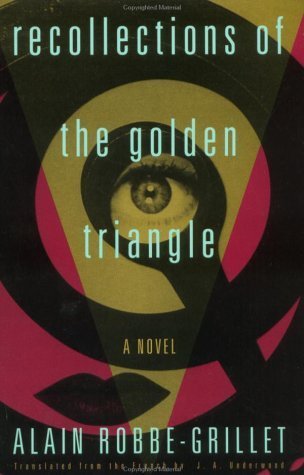
Recollections of the Golden Triangle

Rate this book
A provocative novel by the most influential living French writer, Recollections of the Golden Triangle is a tour de force: a literary thriller constructed of wildly diverse elements—fantasy and dream, erotic invention, and the stuff of popular fiction and movies taken to its farthest limits.

A secret door that is opened slightly by an electronic device, a beautiful hanged factory girl, a pale young aristocrat whose blood apparently nourishes his vampiric lover, the evil Dr. Morgan who conducts his experiments in “tertiary dream behavior,” the beautiful and sinister women from the world of horror films, and the investigating police, who are not all what they seem to be, are just some of the ingredients of this intriguing new novel by the French master of the intellectual thriller, whose novels and films have effectively changed the way we can look at the “real” world today.

Recollections of the Golden Triangle challenges the reader to find his own meaning in its descriptions, clues, and contradictions, and to play detective by assembling the pieces of the fictional puzzle.

160 pages, Paperback

First published January 1, 1978

21 people are currently reading
593 people want to read

About the author

Alain Robbe-Grillet

102 books431 followers
Screenplays and novels, such as The Erasers (1953), of French writer Alain Robbe-Grillet, affiliated with the New Wave movement in cinema, subordinate plot to the treatment of space and time; directors, such as Jean Luc Godard and François Truffaut, led this movement, which in the 1960s abandoned traditional narrative techniques in favor of greater use of symbolism and abstraction and dealt with themes of social alienation, psychopathology, and sexual love.

Alain Robbe-Grillet was a French writer and filmmaker. He was along with Nathalie Sarraute, Michel Butor and Claude Simon one of the figures most associated with the trend of the Nouveau Roman. Robbe-Grillet was elected a member of the Académie française on March 25, 2004, succeeding Maurice Rheims at seat #32.

He was married to Catherine Robbe-Grillet (née Rstakian) .

Alain Robbe-Grillet was born in Brest (Finistère, France) into a family of engineers and scientists. He was trained as an agricultural engineer. In the years 1943-44 Robbe-Grillet participated in service du travail obligatoire in Nuremberg where he worked as a machinist. The initial few months were seen by Robbe-Grillet as something of a holiday, since in between the very rudimentary training he was given to operate the machinery he had free time to go to the theatre and the opera. In 1945, Robbe-Grillet completed his diploma at the National Institute of Agronomy. Later, his work as an agronomist took him to Martinique, French Guinea,Guadeloupe and Morocco.

His first novel The Erasers (Les Gommes) was published in 1953, after which he dedicated himself full-time to his new occupation. His early work was praised by eminent critics such as Roland Barthes and Maurice Blanchot. Around the time of his second novel he became a literary advisor for Les Editions de Minuit and occupied this position from 1955 until 1985. After publishing four novels, in 1961 he worked with Alain Renais, writing the script for Last Year at Marienbad (L'Année Dernière à Marienbad), and subsequently wrote and directed his own films. In 1963, Robbe-Grillet published For a New Novel (Pour un Nouveau Roman), a collection of previous published theoretical writings concerning the novel. From 1966 to 1968 he was a member of the High Committee for the Defense and Expansion of French (Haut comité pour la défense et l´expansion de la langue française). In addition Robbe-Grillet also led the Centre for Sociology of Literature (Centre de sociologie de la littérature) at the university of Bruxelles from 1980 to 1988. From 1971 to 1995 Robbe-Grillet was a professor at New York University, lecturing on his own novels.

In 2004 Robbe-Grillet was elected to the Académie française, but was never actually formally received by the Académie because of disputes regarding the Académie's reception procedures. Robbe-Grillet both refused to prepare and submit a welcome speech in advance, preferring to improvise his speech, as well as refusing to purchase and wear the Académie's famous green tails (habit vert) and sabre, which he considered as out-dated.

He died in Caen after succumbing to heart problems

Style

His writing style has been described as "realist" or "phenomenological" (in the Heideggerian sense) or "a theory of pure surface." Methodical, geometric, and often repetitive descriptions of objects replace the psychology and interiority of the character. Instead, one slowly pieces together the story and the emotional experience of jealousy in the repetition of descriptions, the attention to odd details, and the breaks in repetitions. Ironically, this method resembles the experience of psychoanalysis in which the deeper unconscious meanings are contained in the flow and disruptions of free associations. Timelines and plots are fractured and the resulting novel resembles the literary

Ratings & Reviews

What do you think?
Rate this book

Friends & Following

Create a free account to discover what your friends think of this book!

Community Reviews

5 stars
52 (26%)
4 stars
69 (34%)
3 stars
47 (23%)
2 stars
24 (12%)
1 star
6 (3%)
Displaying 1 - 21 of 21 reviews
Profile Image for Vit Babenco.
1,787 reviews5,806 followers
January 25, 2021
Everything is liquid. Everything vacillates and fluctuates… Townscapes turn into derelict mazes, tangled labyrinths lead to grotesque spectacles, nightmarish scenes change into fatal erotic visions… Everything is not what it seems to be… Everything looks as if painted by René Magritte.
I make my planned detour none the less via the fashion boutique with the double-exit trying-on cubicles to check that everything is in place. The young brides and communicants in their immaculate tulle dresses are still smiling with the same air of innocence – tender ewes awaiting the sacrificial knife – figures or costumes whose freshness comes as a surprise in the landscape of demolitions and ruins dominated by this small and apparently intact building in dubious Directoire style.

And somewhere in the town, on some lost street, there is a secret door... Like in the Steppenwolf by Hermann Hesse: “Magic theatre – for madmen only – price of admission – your mind.”
Is it really a magic theatre? Or is it a magic prison? Or probably a magic bordello...
This is a rectangle of glass identical to the first, giving on a completely dark space. The spectacle taking place there supplies (provisionally) an explanation for those repeated sounds that seemed to come from a metronome or a piano, or from drops of some liquid echoing in the silence. It is in fact pearls dropping and one after another hitting the exact centre of an oval mirror laid flat on the floor along the axis of the glazed embrasure. There is nothing else visible in the room but the mirror and the succession of silver pearls falling from an invisible ceiling to strike their own image at the same time as the immaterial surface of reflection with a clear, musical sound that is scarcely deadened by the transparent partition, then bouncing up again very high but following trajectories that incline at a greater or lesser angle from the vertical, depending on infinitesimal variations in impact between the two little glistening spheres, which soon disappear together from the view of the spectators immediately on leaving the zone of light emanating from the consulting room, audition room, observation room, showroom, or interrogation room, etc.

The best shows are those that take place in our own heads...
Profile Image for John Mauro.
Author 7 books984 followers
February 1, 2024
Alain Robbe-Grillet was the leader of the Nouveau Roman ("new novel") movement among the French literati in the 1950s. The Nouveau Roman movement explored new styles of writing, with particular emphasis on detailed descriptions and depersonalization of the novel. "Recollections of the Golden Triangle" was one of Robbe-Grillet's later works, published in 1978.

"Recollections of the Golden Triangle" involves a murder mystery, a bizarre cult, an evil doctor, hidden passageways, and detectives who may or may not be trustworthy.

Sounds interesting, right?

Unfortunately, it's not. This novel is so depersonalized to the point where the characters have no life. The writing is precise but dry, centering on minute details that are building up the related crimes/mysteries depicted in the book but not on the characters themselves.

This approach appeals to the mind but not to the heart. In focusing so much attention on minutiae, Robbe-Grillet has completely ignored the emotional aspects of the novel.

With all the violent crime and intrigue, there should be some passion here, or at least some emotional response. But that aspect is completely missing.
Profile Image for Jack Tripper.
532 reviews352 followers
November 22, 2017
Though I understood even less of this than I did my previous (and only other) Robbe-Grillet read, The Voyeur, I actually enjoyed this one a bit more. Again, it was virtually impossible for me to follow exactly what was happening much of the time, but the novel was filled with loads of mesmerizing and surreal-yet-disturbing images, many of which will still unsettle me at random times even though it's been over two weeks since I'd finished reading it. I also appreciated the fact that in the two decade interval between having written The Voyeur and Recollections, Robbe-Grillet appears to have really toned down his somewhat overbearing use of repetitious descriptions.

My rating may seem a bit low considering the impact it had -- and still has -- on me. The problem is I felt no real connection with the main characters (or were they the same character, who knows?). All I can tell you is that, somewhere, there's a secret, sinister sex cult, some vaguely supernatural goings-on, missing girls, and a detective trying to figure it all out, whose first-person narration will suddenly morph -- sometimes mid-paragraph -- into that of . Are they the same person? Is it some weird Mulholland Drive/Lost Highway-esque personality swap? Or is Robbe-Grillet just playing around with perspective? I don't know, and the fact that I eventually stopped caring is the main reason I can't give this a higher recommendation. I did like the overall dreamlike (or oneiric, if you want to get all fancy) atmosphere, however.

So far, in my limited experience reading this author, I feel like his work would translate very well to the screen, and the sudden shifts in time, location, and perspective would work more effectively in a visual medium. I look forward to finally checking out the classic French film, Last Year at Marienbad, for which he wrote the screenplay.

3.0 Stars.
Profile Image for Nate D.
1,654 reviews1,256 followers
November 17, 2010
Recollections of the Golden Triangle is amazing and puzzling and frustrating. As a hyper-stylized pulp-avant-garde, it is utterly unique and highly effective, rendering sinister secret societies, post-apocalyptic architecture, corrupt police forces, shady medical experiments, and various sex, violence, and sleaze in immaculate sentences and paragraphs that smoothly cross all traditional boundaries in narrative structure. Particularly fascinating, the novel is full of Alain Robbe-Grillet's slippery contortions between narrator, reader, frame, and story. The frame's exterior and interior surfaces are confused and continuous; they are the surfaces of a single mobius-frame, or nested mobius-frames, with holes punched through at intervals to allow many other points of communication across the whole. This baffling structure supports an entirely gymnastic storytelling which rarely rests or lags and is full of memorable moments.

However.

This book confuses me. Not due to this structure, which is its most fascinating asset. Not due to its perhaps intractably amorphous plotting, which is par for the course in 1970s Robbe-Grillet. Nor to its broken chronology, or the ambiguous narrators, or slippery character identities, or passed-over crucial events. All of these elements are part of what makes Robbe-Grillet's detourned pulp-forms so tantalizing, so seductive. This book confuses me because, in pushing much further into the sort of viciously hyper-sexualized wet-nightmares that lurk in the peripheries of his other books, Robbe-Grillet has made it clear to me that I have little idea what he is attempting to do here anymore. Or I know, but rather wouldn't. Part of it is that in other concurrent 1970s work with which this novel forms a kind of interconnected whole, he undercuts his most lurid moments with hilariously self-aware gestures (in my very favorite, at the climax of a long build-up, we are told that the narrator's head has blocked our view of the action -- as if, overcome with excitement, he has leaned into the shot; in another, illustrations serve not to portray the action, but the reader's shocked reaction to it). But in Recollections, though still filled with absurd gestures and narrative games, Robbe-Grillet plays the more titillating sequences a little straighter, and leans more heavily upon them, which forces me to consider that they could really be intended largely to titillate. To be fair, if this is actually erotica it is of an extremely weird sort, pandering not to any mass desire but to some kind of debased avant-garde sensibility, fodder for the secret lives of art lit critics. Or perhaps it is simply direct access to the inner motions of Robbe-Grillet himself, his writing exactly what he himself wants to read, or an extremely honest presentation of his own darkened driving urges. (I did some research, and okay, yeah, this last seems to be be the case. I guess I'm not confused anymore. From a telling late interview in the Guardian):

"In [his 1955 novel] The Voyeurs, the only difference between fact and fiction is that I did not kill the woman. A psychoanalyst once told me that it was useful that I had written the novel so I did not need to perform the murder. Similarly, lots of my books feature 13-year-old girls getting fucked. That doesn't mean I have done so." Are your films autobiographical? "They grow from my fantasies, yes. But if you are asking me if I have chained a slave to a bed in a room in Marrakech, I would say your question is ridiculous."


And so, how do I feel about Robbe-Grillet's aestheticization of problematic personal drives? Is this (see the psychoanalyst above) exactly the sort of sublimation of unacceptable desires that art has long been facilitating in healthy ways? Or disagreeable (horrifying?) windows into sexual violence? Is it perhaps wrong to force (not so uncommon) sadomasichistic urges into either of these compartments? Or, finally, is this simply another case of the vital provocations of transgressive art, significant because they cause divided or conflicted reactions? I can't even write about this without feeling simultaneously like a puritan with zero awareness of lit since de Sade, and like some kind of apologist for sex crimes. Jesus.

Well, this review has taken a sharp late turn, hasn't it? I'm getting lost in my own tangled thoughts here.

To re-center (and return to something I wrote prior to dredging up the account of Robbe-Grillet's motives), my own relationship with the text is essentially one of aesthetic fascination. I'm not terribly susceptible to "erotic" writing of any kind (note this isn't any kind of high-road thing; I find my unresponsiveness in general sort of disappointing but that is another whole psychological analysis for another day) and this is no exception. But this is nonetheless completely aesthetic, and completely fascinating. And beyond that, whatever misgivings I have about what this is and why it was written, I can't say that I wasn't entirely entertained by it. It might even be one of Robbe-Grillet's strongest showings of whatever-the-hell-exactly-it-is-that-he-is-doing. And it was certainly useful in the larger context of his oeuvre. Much of the first 60 pages is reproduced exactly from the text of La Belle Captive but shorn of illustration, placed in new context, and encountered after my reading of Topology of a Phantom City, whose images and plotting Recollections echos and resonates with -- in this new context, my understanding of the story is somewhat fresh and different. Which makes me want to re-read the other two texts in light of this one, etc. In short, the city-labyrinth which this trio (and perhaps other 70s Robbe-Grillet work) occupies is broad and complicatedly interconnected (or perhaps the streets reconfigure themselves unseen, like those of Schulz's Cinnamon Shops, and it would be easy to wander and re-wander its streets for some time, noting how different a certain boulevard appears when traversed from either end in turn, or in the daytime vs. nighttime, and so forth).
Profile Image for Liviu.
2,520 reviews706 followers
December 4, 2011
This book is so crazy that it definitely belongs to the speculative field. While I read the book twice and started to understand it better, I need at least one more reread to make real sense of it though it may still be that there is no such "real sense' with the time shifts, the narrative shifts and the moving around of characters, but it is a truly haunting and visual book that just throws at you unforgettable imagery

If you want a mind bender which is short but offers more than novels three times its size, this one is highly recommended.
Profile Image for Jeff Jackson.
Author 4 books528 followers
November 24, 2013
Some folks like to claim the Nouvelle Roman was a dead-end for literature. But this remarkable narrative of shifting tunnels and cycling stories not only shows Robbe-Grillet's advancement as a writer from his more celebrated early works, but it contains a myriad of unexplored pathways for the novel as a whole. Don't get caught napping.
4.5 stars.
82 reviews14 followers
Read
December 28, 2024
This is a difficult book to characterize. If all the bubbles in the speculative fiction diagram had a section where none overlapped, this is where I'd put this. It's almost like magical realism, but rather than wonder and magic being part of reality, it's unease and disgust. It's horrific, but it almost feels like those events were meant to titillate instead. It's an incredibly weird read, but somehow Weird Fiction doesn't seem quite right either.

This may be a long review- Recollections is an intriguing but ***extremely*** disturbing puzzle box of a book, and **very** difficult to describe. It's incredibly hard to follow at times, with incredibly interesting narration choices, and many questions as to where and who and when the character(s?) are. Mid section or even mid paragraph, the perspective seems to change, but the narrator stays the same. It's not clear if the narrator *is* changing into these people, simply seeing from there perspective, or if there are different people at all.

The narration jumps around in time, and when one narrator, who appears to be imprisoned and interviewed, is asked similar questions, his answers change, and it's unclear whether his story is simply changing, or the act of asking the question changes the past. Sometimes the narrator describes events differently, and sometimes the narration becomes from the perspective of someone else in his original story, and this new "I" changes their behavior.

All of this, though certainly confusing, is exactly the sort of weird, literary puzzle box of a book I usually love. But the digust comes from the premise and some of the content. I'm going to be extremely vague and avoid describing any events, but I can't even describe the *premise* of this book without mentioning sexual violence, so I'll put a big thoughts title to skip to.

#CW: Sexual Violence- skip to Thoughts to avoid

***

The premise, if I can even manage to grasp it well enough to describe, is that a cult, or perhaps just one man, is abducting and sexually assaulting young women, sometimes underage, and either killing them or drugging and imprisoning them in a sort of cult of sexually sadistic voyeurs. The intial narrator appears to be a man either doing the same for himself, or supplying this cult. He makes mistakes on his latest abduction, and becomes hunted by a police detective and the police special forces.

It becomes interesting again as the book progresses though, as while what appears to be this man having been caught is being interviewed in a cell, he begins to narrate from the perspective of the detective hunting him. It begins to appear as if he might be both this sexual serial killer and the man trying to catch him, and the lines between the two's roles and places begins to blur and switch as things go on.

It then begins to appear as if the latest women he abducted were agents of the special police force, trying to lure him into an abduction attempt to catch him. As we progress though, with frequent circles back to previously described scenes, like a record skipping and becoming distorted each time, it seems like perhaps these special forces are in fact a part of the cult supplying women, and the man was the detective trying to catch *them*.

Throughout this slow transformation, we see (usually absolutely horrifying) vignettes from a variety of women. I don't want to describe them, but they intersect with this frame narrative as these women are alterations or other facets of the victims and police. These are where the most overtly speculative elements crop in- dream visting, vampires, apparently magical fires.

The narrative and all the vignettes contain a number of common thematic objects: an apple which is a number which is a key; a broken high heel from the victim which begins the investigation; pearls which are jewelry which are manacle decorations which are light sources; winding narrowing featureless corridors which are in the prison which are in the cult building which are in a theatre.

These intrude on whoever the narrator is in the "main" frame, presented to him as evidence or to trigger more confessions. Things begin to become in flux in the frame, too: the outside of the cell which lead to the interrogation room suddenly leads to the corridors then leads to a cave; the cell becomes a medical asylum and the narrator becomes some of the women subjected to experiments on dreams; the metronomic ticking becomes a pearl of light becomes a bullet bouncing around the narrators cell as the recurrent objects become numbers on a marksmanship target.

***
#Thoughts

This is probably the hardest book to review I've ever read. I wrote this review partially to see if it would let me work out how I feel, and partially because I need to see if anyone else has read it. I can find perhaps two in depth reviews on the whole of the internet.

This book is sort in a superposition of a 1 star and 5 star in my head. The narration style and changes, the circular and intersecting and flowing narratives, the recurrent and thematic elements that reappear out of the blue, all are incredibly interesting to try and follow and pick apart, absolutely would be a 5 star experience.

But I'm *thoroughly* disgusted by the amount of sexual assault and violence. Even if it mostly avoids being explicit, it's just a non stop barrage. Elements of every thread of the narrative either involves planning, attempting, or investigating it. And the worst part is it doesn't appear to be portrayed as horror- it's almost as if it's meant to be erotic. And apparently interviews with author don't make it sound any better. Some small reviews I read said it's like a modern Marquis de Sade, and the book exudes evil, and I don't entirely disagree. Fully a 0 star enjoyment component if that were possible.

I would only "recommend" this book to people who enjoy extremely experimental and literary fiction, and who have an *extremely* high tolerance for reading about horrific events/ability to divorce fiction from reality. I think such readers may have a similar experience to me, able to really enjoy and appreciate the narrative craft, but being rather disturbed. Though I think of myself as rather unflappable, it's a stronger stomach than mine to *like* this book.

Later thoughts Edit: Having gotten a better handle on it by writing it out, I think I have a better handle on my feelings. I think I would say that I enjoy the main/frame story, and the narrative structure, but it's the sexual violence in the vignettes, which feels completely unnecessary and doesn't feed into the main core of the book, that's bringing me down and leaving me discomfited.
Profile Image for Thom.
14 reviews
September 14, 2025
this would have been a chore to read if the prose wasn’t so good. Kind of a horrid little story about the banality of evil told by a shifting parade of narrators who are varying degrees of aroused by the bizarre events unfolding around them. My takeaway is that I would never leave a drink unattended around the author.
Profile Image for Jim.
3,109 reviews155 followers
December 11, 2021
Another bricolage of various Robbe Grillet writings enlarged (engorged?) in with enough reasonably connected novelty bits and sold to us as a new novel, pun oh so fully intended. We get the usual suspects - a murder or a killing or an accidental death or a ritual sacrifice or a mere performance of one of those, changing viewpoints, recursive timelines, geometric/architectural details - but with the added, or enhanced, fetishistic sex, quasi-BDSM, voyeurism, ogling/objectification of females, all of which now seem less subtextual/phantasmal and/or more unrestrained/graphic, autobiographical even. Considering the films Robbe Grillet had been involved in leading up to this time, one should be in no way surprised at the variety and (generally speaking) transgressive nature of the sex between these pages. Not that this makes it redeeming or interesting, mind you. It all rather feels like Robbe Grillet had one of his students go through his novels and essays and sieve out some lines, paragraphs, and details, to which Robbe Grillet would augment with some literary cast-offs he had on a shelf somewhere. One can still use all the Nouveau roman critical analyses here, if one desired to, a la Robbe Grillet, dabble in some of their own repetition and observatory masturbation. I found little to impress me, and am fully of the belief Robbe Grillet was using all his talents in his filmworks, regardless of one's appreciation of said cinema. I still have 'The Repetition' to (re?)read (rather ironic, self-congratulatory title for R-G...) and then the oft-panned and almost wholly rejected 'A Sentimental Novel' too. I am a completist, no denying that.
Profile Image for Chumbert Squurls.
45 reviews6 followers
June 13, 2012
When I picked up House of Leaves a couple months ago, I expected it to be complex and mystifying fully realizing the labyrinth described. This book lives up to be everything that House of Leaves failed at. The format of this book is unconventional: scenes and narrators switch back and forth from one another within paragraphs and the whole story is spat out in a stream of consciousness style. Each story within the story is a piece of a vast and intricate puzzle concerning the police's mysterious ties with an underground organization that ritually murders young girls. Also thrown into the mix is a sinister doctor with a dream emulator and some rather hush-hush goings on at an opera house. Unfortunately, the avante garde format can be maddening at times and might throw some readers off, but those who stay will be richly rewarded. I would imagine this novel deserves many re-readings.


Profile Image for Charlie.
732 reviews51 followers
February 10, 2023
A little bit at a loss with Monsieur Robbe-Grillet. His work is undeniably appealing in its distinctive approach to narrative. And yet... this does feel like a book with a deep-seated evil emanating from it. Not that I think that is necessarily a disqualifier, and maybe it speaks to Robbe-Grillet's skill as a writer that his depictions of rape and dismemberment feel... unencumbered is perhaps the right word... in comparison to some other works that are undoubtedly more grotesque but shackled to a narrative structure that trades in a more obvious construction. I think, as of now, I can say that I appreciated Recollections more than I enjoyed it.
3 reviews
October 12, 2025
I didn’t like this so much. There is some interesting sensation of the viewpoint being from a disembodied camera that pans, zooms and rolls on some track, in a more mathematical than human way. This kind of detached violence and repeated non-linear motifs feel useless to me, even if it was a new aesthetic direction at the time. Some scenes were beautiful and captivating though, especially one featuring a group of people running through a corridor stands out to me. Maybe this is not the best Robbe-Grillet, but it didn’t make me so intrigued about his other books
Profile Image for Kayla Rogers.
28 reviews2 followers
July 27, 2023
bounced between admiring the translation and abhorring it. bodies pile up identical and distorted in the house of mirrors until you can’t tell one sadistic pig from another (nor can you the young girls they torture). float in the still waters of the underground tunnels until you’ve had your fill. some images that really stick with ya
Profile Image for Daniel Polansky.
Author 35 books1,249 followers
Read
June 12, 2019
A post-modern Marquise de Sade. Which, I mean, if that appeals to you, have at it! There's actually a fair bit of artistry here, but beyond illicit erotic/horrific thrills I'm really not sure what the point was.
101 reviews1 follower
February 23, 2021
What is the organisation of the Golden Triangle? This is the question that runs through Robbe-Grillet's 1978 novel. Like most of his other books, it is a mystery within a mystery within a mystery. Definitely a puzzle box where there is a 'scheme' if you care to ponder over it for long enough to work it out, it is however tempting to say that this is sort of Robbe-Grillet by numbers. All of his favourite themes and images are here, in yet another aesthetic tour de force full of crisp, precise, evocative sentences. Having read all of Robbe-Grillet's novels from 1953 onwards, it seems that they get less interesting as they go along, as this seems like merely another exercise in Robbe-Grillet's particular aesthetic scheme. No matter, devotees like myself will read it all, as there's hardly anything else quite as radical. But as an artist, Robbe-Grillet seems a bit stuck in a loop (or a repetition?) since 1965's Les Maison des Rendez-vous. Still a dimming master however
Profile Image for in8.
Author 20 books113 followers
September 26, 2012
blogged about it here:
http://www.5cense.com/12/bangkok.htm

Classic Robbe-Grillet. Very detailed, surgical descriptions. Like reading a geometry or logic book written by an obsessive-compulsive lunatic with a fine arts degree in architecture. Not a lot happens, but something about the meticulous methodology makes you think every detail must mean something.
16 reviews
Read
June 12, 2016
Disgusting fantasies, not sure what he was thinking when he wrote this.

Enjoyed minimally on the side of intrigue and keeping me interested, enjoyed the collapsing narrative style whatever
298 reviews3 followers
June 27, 2021
Very dark and disturbing. I wonder why he took this route.
Displaying 1 - 21 of 21 reviews

Can't find what you're looking for?

Get help and learn more about the design.