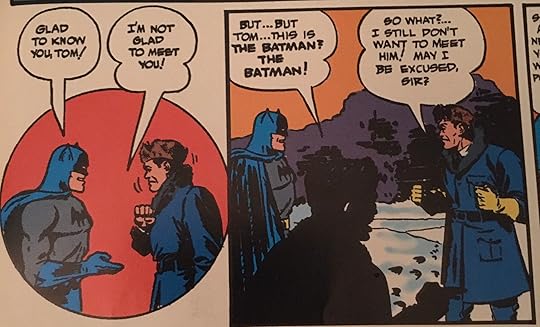
William "Bill" Finger was an American comic strip and comic book writer best known as the uncredited co-creator, with Bob Kane, of the DC Comics character Batman, as well as the co-architect of the series' development. In later years, Kane acknowledged Finger as "a contributing force" in the character's creation. Comics historian Ron Goulart, in Comic Book Encyclopedia, refers to Batman as the "creation of artist Bob Kane and writer Bill Finger", and a DC Comics press release in 2007 about colleague Jerry Robinson states that in 1939, "Kane, along with writer Bill Finger, had just created Batman for [DC predecessor] National Comics".
Film and television credits include scripting The Green Slime (1969), Track of the Moon Beast (1976), and three episodes of 77 Sunset Strip.
The most fascinating thing about reading these early reprints from Detective Comics is seeing the mythos that surround Batman take form. That is largely due to Bill Finger, the unsung (well, until recently) co-creator of Batman. Finger's stories not only introduce legendary characters like Two-Face and the Penguin, but were also instrumental in making Gotham City the standout setting it is in popular culture.
One particular tale from Detective Comics 53 tells the story of struggling actress Viola Vane and how Gotham - under direction from Batman - works to make a dream come true. It is a positive side of Gotham City, but establishes the deep connection Batman and Bruce Wayne have to all corners of it. I felt this was perhaps the best story in this volume.
Other highlights include the introduction of the Penguin (also written by Finger). The ruthlessness and mob-connected aspects of the character were there from the very beginning. No one laughs -for long - at the Penguin. Other highlights include a Two-Face two-parter (by Finger) and "The Man Who Could Read Minds" (by Don Cameron).
This book contains nearly 300 pages of Golden Age reprints of Batman stories from Detective Comics #51-#70 with each story being 12 pages long.
The book features a great introduction by crime writer Max Allan Collins who breaks down the history on each comic and what it's going for. Collins is also able to offer some cogent comparisons with Dick Tracy.
Then we're for a total of 20 different stories which are solid quality. Of the twenty stories in the book, we have the first two stories with Two Face, three stories with Penguin (including the first two), and three with the Joker.
And the rest of the book is no slouch either. There's a great amusement park story which is plenty of fun: pirates, a story featuring black marketeers with a fight on board a Nazi Zeppelin. There are some strange crime tales like a man who has 24 hours to live and starts killing off his heirs, a criminal gang hijacking police radio to send criminal messages, and a phony mentalist that actually gets the ability to read minds. I also loved, "The Three Racketeers."
The war rhetoric stars to heat up. Batman wants everyone to do their part, urging criminals shooting at him to conserve on bullets and the Joker flies away in a stolen bomber but assures Batman, "I'll send the Bomber back so it can drop a few eggs on the Japs." The Joker may be a homicidal maniac, but he's a patriotic one!
Robin continues to be outstanding, less of the traditional sidekick and more of a true partner. The villains put Batman to the test and Batman comes through every time.
These are simply superb stories. There are minor points to critique. The second Two Face Story is a little too over the top. The story featuring a Raffle Rip off named Baffles is merely okay. And the gesture of having the entire city conspire to deceive the parents of an understudy actress is sweet, but comes off as more of a Superman thing to do with an ending that's a little forced. It's interesting to see someone argue that Gotham City isn't so bad though as we live in the "Gotham is hell" age.
Overall, these stories are absolute fun. The rough edges of the early comics have been cleaned up and what remains is one of the best Golden Age characters of them all. Whether in the Archives or the Batman Chronicles, these are must-read stories.
This was a tough one for me. I really enjoy the more modern comic story telling style with a complex plot stretching out through multiple issues, so these short one-off stories of Batman and Robin punching a collection of random bad guys (Penguin, Joker and Two-Face are the only main Bat-Rogues at this point in time) was pretty hard for me to get through. The writing is fine and I KNOW the art is a product of its time but that doesn't make it any easier to look at. Four out of the 20 stories included (issues 52, 56, 60 and 67) have painfully racist depictions so fair warning there. There are good moments, though. Two-Face's introduction is very well done and it shocks me that it took until the great Denny O'Neil (may he rest in peace) for his place to be cemented in the Rogues Gallery! I also enjoyed #53 which showed Bruce's kindness and compassion for other people and #62 for being a version of Joker that was ... actually kind of compelling? And a shout out to #65 for the best panels in the whole collection:
Overall, I'm glad I tried out this collection - I'm interested in older comics and there's definitely some worthwhile stories in here but it was too much of a slog and didn't engage me as much as I would like.
Great fun to read: especially the earliest stories of Penguin and Two-Face. There are other writers here, but Bill Finger is most fun. This is an opportunity to take stock of the early inks and designs of Jerry Robinson, as he grows in craft, too. Recommended.
Drifting away from the casual violence of the early comics, and maybe getting a little less interesting as a result, but still a lot of good, silly, colorful fun.
It is hard for many people who grew up reading comics in the fifties and sixties to read comics from the thirties and forties. While hardly sophisticated, the later comics are much more sophisticated in their art and story telling than older comics. Most of the stories in this collection are just bad, but of interest to comic book historians, Batman die-hards, and those silly people who work on Shakespeare in popular culture. I was trolling for Shakespeare references, of course, and found a couple of unacknowledged quotations. No reason to read this book for pleasure.
Sure it's a blast from the past, but this volume of early 40s Batman comics is a five-star romp all the way. I had a blast reading through these, and I felt like, at times, I was watching unaired episodes of the 60s tv show. Batman and Robin are timeless heroes, but these are some of their earliest stories, which don't shy away from the time period in which they were published. There is a certain flair and character to these shorts that is missing from the dark, pensive Batman of today. I can't wait to find and read the next volume.
Some of the earliest Batman stories. Tightly-plotted and as full of detail as the later stories but with the dark, angular art of Bob Kane and Jerry Robinson.