From treehouses to pre-fabs, this book presents sustainable, micro-green living at its best. Micro Green delves into the concept of compact living and demonstrates the possibilities of living with less while maintaining a rich life. As sustainable architecture becomes mainstream, many architects and designers are using technology and wit to experiment with what it means to be green, and the results are both effective and enthralling. The rustic treehouses, airy domes, and recycled-scrap structures of Micro Green are presented through vivid photography and detailed building plans, and display a range of environmental influences. Here living spaces are carved out of hillsides, trees rise through decks and floors, and walls melt seamlessly back into the surrounding woods. Though many of the homes chronicled in Micro Green are unique in design, their economical size and ingenious interior spaces are the epitome of practicality and illustrate an acute understanding of compact living and its potential for rural, suburban, and even urban ecosystems. Small in both carbon and architectural footprint, the dwellings in Micro Green have large implications for the global movements of eco-consciousness and sustainability.
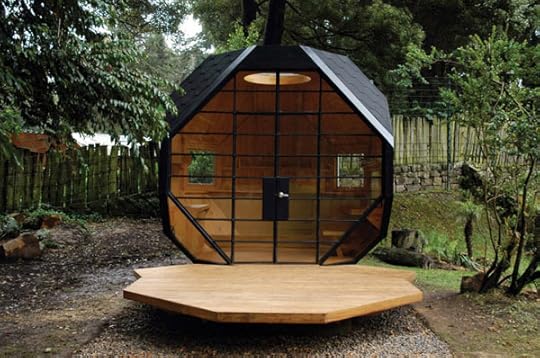
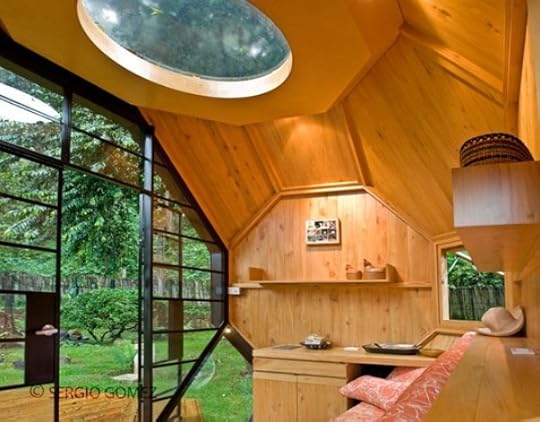
My favorite eco-home was by far the Polyhedron Habitable, situated in Bogota D.C., Colombia, and shaped exactly like it sounds. Beautiful amber-finished woodwork within and attached as a deck outside; cabinets, shelves, desks, and benches molded to the walls; a gorgeous clear bubble cap for the additional taking in of nature.
Other favorites were: the Froschkonig (Frog King) in Germany, the Surfshack in Washington, Banyan Treehouse in California, Sunset Cabin in Canada, and the extremely beautiful Dragspelheset at Ovre Gla in Sweden.
This quick, photo-rich read was the perfect start to 2020! In Micro Green, Mimi Zeiger presents more than 30 small homes, studios, crash pads, and other structures by way of short descriptions, square footage stats and (often) floor plan diagrams. She orders the spaces by square footage, starting with a tiny 43-square-foot sleeper and ending with a spacious 1722-square-foot group getaway. As Zieger puts it in the book's forward, these are designs that "celebrate material choices, energy conservation, awareness of site, conditions, and overall lessening of the impact of a building on the earth." I appreciated the optimistic, informative prose and the gorgeous photographs. However, I'd love a bigger, more readable font! I also found it a bit frustrating that often the homes I was most eager to see came with the least photographs, and in one case (looking at you, Tiny Free House) only photographs of the building process.
There is certainly some interesting architecture and great photography in this book, but tiny "houses" is not the whole truth.
The smaller "houses" are really little more than solid sleeping cells. Permanent tents, you might say. Room to sleep for 2 or more people, but no storage, no kitchen of any kind, no bathroom of any kind, no room to turn around while standing even. While some of these are interesting--the sleeping/playing/resting huts at a Thai orphanage, for example--they are hardly "houses".
Many are vacation homes. I am actually curious how many are lived in by a person/family most/all of the time.
I was disappointed in this book. With a subtitle like "tiny houses in nature" I was expecting tiny houses in nature. It does not deliver. There are tiny structures (not houses) in backyards and glorified treehouses. Many of the actual houses featured in this book are not tiny. 1200+ and 1700+ square feet is not what I would call a tiny house. My interest in architecture and design extends insofar as efficiency. Unlike this author's other tiny house book, these are unsatisfyingly inefficient.
I must admit that I thought about Ted Kaczynski's little shack in the woods at first, but this book is a collection of delightful small houses in nature, ones that a contemporary Henry David Thoreau might enjoy using for his comtemplation and writing! The ones with lots of bookshelves were among my favorites, of course. :-)
Includes 36 tiny "houses" in natural settings like suburban backyards, rural acreage and the desert. Each house is presented along with multiple color photographs, a brief profile of the project's origins and history, and their square footage. Highly creative for sure (!); overall, the designs just feel too modern, extravagant and impractical for my tastes.
I prefer this book to Zeiger's Tiny Houses because Micro Green's interior shots provide more information than images in Tiny. This book shows many inspiring home designs.
Great pictures of a variety of micro homes, all over the world. I appreciated the brief write-ups of each home, but I wish the general blueprint drawings were larger.