

What do you think?

On What Matters #1
On What Matters: Volume One
On What Matters is a major work in moral philosophy. It is the long-awaited follow-up to Derek Parfit's 1984 book Reasons and Persons , one of the landmarks of twentieth-century philosophy. In this first volume Parfit presents a powerful new treatment of reasons and rationality, and a critical examination of three systematic moral theories -- Kant's ethics, contractualism, and consequentialism -- leading to his own ground-breaking synthetic conclusion. Along the way he discusses a wide range of moral issues, such as the significance of consent, treating people as a means rather than an end, and free will and responsibility. On What Matters is already the most-discussed work in moral its publication is likely to establish it as a modern classic which everyone working on moral philosophy will have to read, and which many others will turn to for stimulation and illumination.
592 pages, Hardcover
First published May 26, 2011
About the author
Derek Parfit
22 books333 followersDerek Parfit was a British Professor of Philosophy at Oxford University specializing in personal identity, rationality, ethics, and the relations between them.
Ratings & Reviews
Friends & Following
Create a free account to discover what your friends think of this book!
Community Reviews
Displaying 1 - 24 of 24 reviews
September 21, 2011
Parfit argues for an objective theory of ethics; one in which objects, acts, and so forth, generate sufficient reasons for action, not merely our desires. He starts by arguing against the insufficiency of subjectivist accounts saying that they lead to manifest absurdities such as a person desiring to waste his life in trivialities is not wrong, nor is someone who desires pain for no particular reason (and not because they get pleasure from it). He then goes on to argue for his triple theory combining Kantian, Contractualist and Consequentialist theories of ethics together. Before these have seemed to be at odds but Parfit does a very convincing job of uniting them into a single theory.
It goes, an act is not wrong so long as the principle by which it is acted upon can be rationally, universally willed, that it cannot be reasonably rejected and that it is optimific. All three major theories show up here. Parfit argues that this principle is the best that Kant's major principles has to offer, and is an improvement on Rawls' and Scanlon's contractualism. A principle which can be universally rationally willed so happens to be one that is optimific and vice versa. His principle, he argues, can be used as a further principle in guiding our intuitive sense of wrongness or can also be used to undermine certain moral intuitions which are contested.
In an interesting aside about the consequences of compatibilism, Parfit also includes an interesting argument against desert of suffering. He argues that if acts are events in time then we do not have sufficient control of our actions to deserve to suffer. This is Kant's argument turned on its head when Kant argued that people can deserve suffering, as well as happiness for virtue, because they are able to, by participating in the noumena, be genuinely free of the physical causal web.
Parfit is a clear and concise writer and thinker. This book is accessible to most educated people and clearly illustrates applications of principles through moral thought experiments. Insofar as I was already a moral realist and intuitionist looking for a way to solve moral problems through higher-level principles I found his case helpful and illuminating.
It goes, an act is not wrong so long as the principle by which it is acted upon can be rationally, universally willed, that it cannot be reasonably rejected and that it is optimific. All three major theories show up here. Parfit argues that this principle is the best that Kant's major principles has to offer, and is an improvement on Rawls' and Scanlon's contractualism. A principle which can be universally rationally willed so happens to be one that is optimific and vice versa. His principle, he argues, can be used as a further principle in guiding our intuitive sense of wrongness or can also be used to undermine certain moral intuitions which are contested.
In an interesting aside about the consequences of compatibilism, Parfit also includes an interesting argument against desert of suffering. He argues that if acts are events in time then we do not have sufficient control of our actions to deserve to suffer. This is Kant's argument turned on its head when Kant argued that people can deserve suffering, as well as happiness for virtue, because they are able to, by participating in the noumena, be genuinely free of the physical causal web.
Parfit is a clear and concise writer and thinker. This book is accessible to most educated people and clearly illustrates applications of principles through moral thought experiments. Insofar as I was already a moral realist and intuitionist looking for a way to solve moral problems through higher-level principles I found his case helpful and illuminating.

September 19, 2012
As an amateur philosopher I loved the first half of this book. It convinced me that ethics could be approached with the same rigor as analytic philosophy. Parfit's style of building a case slowly and methodically, then suddenly ending the chapter with simple statement of thesis, took me awhile to get used to, but I learned to expect these abrupt chapter conclusions. This tendency toward abrupt conclusions was amplified in the overall structure of the volume, which for me rushed to thesis statement at the end after such a long, methodical, and enjoyable buildup. I'm excited to see if the second volume offers more space to explore the ideas that ended volume one.

March 13, 2018
This is a highly acclaimed book by a distinguished philosopher but what is Parfit up to here?
Essentially, the bookinvolves two primary claims. First, Parfit defends a realist view of reasons or value. This view contrasts with expressivist and subjectivist theories of reasons. Parfit's arguments are often convincing but they basically rest on the intuitive idea that things are good or bad - he often uses unnecessary suffering as an example - independently of the agent's desires or aims. Parfit argues that if subjective theories of reasons are correct then nothing matters. But things do matter, Parfit argues. Therefore subjective theories are false. Again, these arguments are often convincing but Parfit's account often seems somewhat arbitrary. What is lacking is a more fundamental account of how reasons are able to gain traction within agents' practical reasoning.
In the second part of the book Parfit aims to show that the most plausible variants of Kantian, Contractualist, and Rule Utilitarian moral theories are equivalent. He does this by first arguing that the most plausible Kantian view is something called Kantian contractualism, where an act is wrong insofar as it conflicts with principles that could be rationally accepted by everyone. Parfit then argues that Scanlon's contractualism is equivalent to the Kantian contractualist view. Following this, he argues that the principles that could be rationally chosen by everyone (and which could not be rationally rejected by anyone, according to Scanlon's version) are optimific principles, principles whereby things would go best if they were followed by everyone. These arguments are also convincing but they raise countless questions. Specifically, much more needs to be said about how we might decide what principles could be accepted by everyone. Parfit gives some examples but they are inadequate to show that intractable conflict between reasonable partices can be avoided.
Parfit does violence to his interlocutors views, especially Kant, in a way that is indicative of a deep familiarity with the relevant texts, but this is a very fruitful process. There are a number of shortcomings of this approach. First, as noted above, Parfit's realist theory of reasons at times comes off as a arbitrary, seemingly involving an appeal to the intuitions of Western elites. Much more needs to be said about how reasons get a grip on agents' practical reasoning and about how we might distinguish between real and apparent reasons. An appeal to an Aristotelian meta-ethics, especially work by Kieren Setiya, Alasdair MacIntyre, Michael Thompson, and Talbot Brewer would go some way toward addressing this problem, showing how reasons are related to the human form of life. Second, Parfit argues that Kant's claims should be understood as appealing to a substantive notion of reasons such as he defends in the first part of the book so at times his discussion of Kantian views suffers from a similar arbitrariness. Finally, Parfit ignores virtue ethics, despite noting the similarity between versions of virtue theory and versions of rule utilitarianism. A more detailed engagement with Aristotelianism would allow Parfit to present a more satisfying ethical synthesis.
Essentially, the bookinvolves two primary claims. First, Parfit defends a realist view of reasons or value. This view contrasts with expressivist and subjectivist theories of reasons. Parfit's arguments are often convincing but they basically rest on the intuitive idea that things are good or bad - he often uses unnecessary suffering as an example - independently of the agent's desires or aims. Parfit argues that if subjective theories of reasons are correct then nothing matters. But things do matter, Parfit argues. Therefore subjective theories are false. Again, these arguments are often convincing but Parfit's account often seems somewhat arbitrary. What is lacking is a more fundamental account of how reasons are able to gain traction within agents' practical reasoning.
In the second part of the book Parfit aims to show that the most plausible variants of Kantian, Contractualist, and Rule Utilitarian moral theories are equivalent. He does this by first arguing that the most plausible Kantian view is something called Kantian contractualism, where an act is wrong insofar as it conflicts with principles that could be rationally accepted by everyone. Parfit then argues that Scanlon's contractualism is equivalent to the Kantian contractualist view. Following this, he argues that the principles that could be rationally chosen by everyone (and which could not be rationally rejected by anyone, according to Scanlon's version) are optimific principles, principles whereby things would go best if they were followed by everyone. These arguments are also convincing but they raise countless questions. Specifically, much more needs to be said about how we might decide what principles could be accepted by everyone. Parfit gives some examples but they are inadequate to show that intractable conflict between reasonable partices can be avoided.
Parfit does violence to his interlocutors views, especially Kant, in a way that is indicative of a deep familiarity with the relevant texts, but this is a very fruitful process. There are a number of shortcomings of this approach. First, as noted above, Parfit's realist theory of reasons at times comes off as a arbitrary, seemingly involving an appeal to the intuitions of Western elites. Much more needs to be said about how reasons get a grip on agents' practical reasoning and about how we might distinguish between real and apparent reasons. An appeal to an Aristotelian meta-ethics, especially work by Kieren Setiya, Alasdair MacIntyre, Michael Thompson, and Talbot Brewer would go some way toward addressing this problem, showing how reasons are related to the human form of life. Second, Parfit argues that Kant's claims should be understood as appealing to a substantive notion of reasons such as he defends in the first part of the book so at times his discussion of Kantian views suffers from a similar arbitrariness. Finally, Parfit ignores virtue ethics, despite noting the similarity between versions of virtue theory and versions of rule utilitarianism. A more detailed engagement with Aristotelianism would allow Parfit to present a more satisfying ethical synthesis.

June 21, 2017
Another very clearly written, rigorously argued book from Parfit, as you would expect. I was initially ambivalent about the contention between objective and subjective reasons, but have been strongly convinced by Parfit that there are objective reasons. Although his Kantian argument was well-argued, I am not so convinced that it is necessary (or perhaps relevant) for two reasons: (1) I am unconvinced that there are any reasons in addition to agent-neutral or impartial reasons, and (2) I am unconvinced that people's acceptance of principles (or maxims, or policies, or acts) bears on whether these principles (maxims, policies, acts) ought to be acted upon. That said, Parfit's Triple Theory does seem quite plausible, especially considering that most people do not share my beliefs in (1) and (2). So Parfit offers here what seems to be quite an intuitively pleasing theory, which draws upon many supposedly disagreeing moral theories.

August 1, 2014
Two great passages:
-"... the Golden Rule is theoretically inferior [to 2 other principles]. But this rule may be, for practical purposes, the best of these three principles. By requiring us to imagine ourselves in other people's position, the Golden Rule may provide what is psychologically the most effective way of making us more impartial, and morally motivating us. That may be why this rule has been the world's most widely accepted fundamental moral idea" (330).
- quoting Williams: "deep attachments to other persons... cannot embody the impartial view, and... also run the risk of offending against it... yet unless such things exists, there will not be enough substance or convictions in a man's life to compel his allegiance to life itself" (387). In other words, we have to be partial to ourselves and our people, otherwise life sucks bad.
-"... the Golden Rule is theoretically inferior [to 2 other principles]. But this rule may be, for practical purposes, the best of these three principles. By requiring us to imagine ourselves in other people's position, the Golden Rule may provide what is psychologically the most effective way of making us more impartial, and morally motivating us. That may be why this rule has been the world's most widely accepted fundamental moral idea" (330).
- quoting Williams: "deep attachments to other persons... cannot embody the impartial view, and... also run the risk of offending against it... yet unless such things exists, there will not be enough substance or convictions in a man's life to compel his allegiance to life itself" (387). In other words, we have to be partial to ourselves and our people, otherwise life sucks bad.
April 29, 2012
I don't agree with all the arguments Parfit presents (he's a cognitive realist about both reasons and morals, a believer in normative, objective truths, which I find difficult to swallow) but his prose is clear and concise and he's really freaking smart. Also, this tumblr exists, which just makes me happy: http://onwhatmatters.tumblr.com/

May 11, 2022
We can deserve many things, such as gratitude, praise, and the kind of blame that is merely moral dispraise. But no one could ever deserve to suffer.
Best work on moral philosophy from this century that I have read. Can't recommend highly enough.
Best work on moral philosophy from this century that I have read. Can't recommend highly enough.

December 17, 2013
1. Summary
Parfit wants to show that three major ethical theories—Kantianism, contractualism, and consequentialism—actually converge toward a single unified theory. To do this, he looks at some prominent versions of those theories, points out weaknesses in them, and argues that those weaknesses are best addressed by revising the theories in particular ways. Parfit thinks these revisions make it so that the theories often or even always agree with each other, and can therefore be combined into what he calls the “Triple Theory”:
I think there are really two core premises which drive Parfit’s revisions to the original theories and which, if accepted, make the convergence plausible:
- Morality must reflect a certain kind of impartiality.
- Objective reasons exist and morality must be informed by them.
2. Impartiality
Parfit’s view leaves plenty of room for moral principles that allow people to prioritize their selfish interests, or the interests of their loved ones, over the interests of strangers. The principles themselves, however, should not be chosen in a way that stacks the deck in favor of particular people.
Thus Parfit rejects, for example, versions of contractualism that ask merely what kind of contract real people would actually make if they all sat down and tried to agree on a set of moral rules. In such a process, more privileged people would have more bargaining power. Parfit summarizes a better version of contractualism, devised by Scanlon, as follows: “Everyone ought to follow the principles that no one could reasonably reject.”[2] The word reasonable is meant in a “partly moral sense”[3] which seems to bake a degree of impartiality into the theory: “We are unreasonable in this sense if we give too little weight to other people’s well-being or moral claims.”[4] (I wrote a detailed walkthrough of Scanlon’s book What We Owe to Each Other here.)
Similarly, Parfit rejects forms of Kantianism that ask merely what you could will to be a universal law. Many people can will things to be law which place unfair burdens on others, simply because they themselves are unlikely to suffer the consequences. Parfit develops what he calls Kantian Contractualism: “Everyone ought to follow the principles that everyone could rationally will to be universal laws.”[5] (If you didn’t catch the difference, consider: I could wish that everyone followed the rule give Jacob all your money every time you see him. But not everyone could wish that everyone followed that rule.)
3. Reasons
On a subjectivist view, “our reasons for acting are all provided by, or depend upon, certain facts about what would fulfil or achieve our present desires or aims.”[6] In contrast, Parfit accepts an objectivist view (not to be confused with Ayn Rand’s so-called “Objectivism”), in which “there are certain facts that give us reasons both to have certain desires and aims, and to do whatever might achieve these aims.”[7]
The notion of objective reasons does a lot of work in this book. It allows Parfit to call things “universally willable” or “not reasonably rejectable” even when the individuals involved don’t will them and would reject them. For some conflicts, there is no solution that everyone involved would actually accept, nor even a solution that is compatible with everyone’s most fundamental desires/goals/interests. But if we instead look for a solution everyone “could rationally” accept—where rationally is defined with respect to objective reasons—we may be able to find one by appealing to claims about what people should be willing to accept. Consider Parfit’s defense of a “Consent Principle”, where he discusses the following example:
Parfit thinks that “[i]f these are the only morally relevant facts, it is clear that I ought to save White’s life.”[9] And he thinks this conclusion can be justified in terms of “sufficient reasons to consent”[10].
Imagine a Venn diagram showing which option(s) each person could rationally endorse; to find a morally acceptable option, you look in the region of overlap.
(Of course, Parfit also recognizes that “[i]t is often morally important whether people actually consent to being treated in some way, or whether, if they had the opportunity, these people would in fact consent.”[12])
4. Motivation
By showing a convergence among different moral theories, Parfit ultimately hoped to neutralize one of the arguments against morality in general:
He was, at least according to Edmonds’s biography of him (review), fanatically obsessed with this issue. At stake for Parfit was not just a particular conception of morality, but whether anything matters at all:
I share this worry. There are, perhaps, two levels to it. The prospect that all morality might be arbitrary—that there is no meaningful sense in which, for example, someone who likes to torture children is worse than someone who likes to nurture them—would be horrifying enough. But what really motivates that sort of relativism seems, generally, to be subjectivism about reasons, which can undermine our values in an even more radical way. Subjectivism would (in my opinion) imply not only that our goals and desires are fundamentally arbitrary, but also that the whole project of trying to accomplish goals and fulfill desires is arbitrary. Seeking one’s own success and happiness would be no more worthwhile than seeking failure and misery, because there would be no facts about what’s worthwhile at all—just facts about what we happen to be programmed to do.
But Parfit’s anxiety over the issue doesn’t really seem rational to me. For one thing, the strongest argument against the conclusion that “nothing matter[s]” is just that some things obviously do matter. It’s self-evident to anyone who’s experienced intense suffering that it matters how much more of it they have to suffer. We can, I think, perceive this fact much more vividly and directly than we can perceive the validity of any purported argument against it.
But also, most people who accept subjectivism and relativism are not nihilists. So Parfit (and I) disagree with them on two issues: which theory is true, and what the implications of each theory are. In disagreements like this, it’s worth keeping in mind that if we were persuaded to change our minds on one issue, we would likely acquire a new perspective on the other issue too. (To give a related example: evangelical Christians are often convinced that God is necessary to justify morality. But when they deconvert, they don’t become amoral; instead, they become convinced that morality has a different foundation, and often become convinced that postulating a God wouldn’t even help with grounding morality anyway.)
5. Evaluation
Summarizing the reception of this book, Edmonds wrote:
That was pretty much my impression when I first read the book a decade ago: too long and mostly pointless.
On rereading, I noticed that Parfit uses whitespace as generously as an undergraduate trying to meet a page-count requirement, so volume 1 isn’t really as long as it looks.
More importantly, I have more appreciation for the problem of disagreement that gave Parfit so much anxiety. When I was younger and more arrogant, I was perhaps more prone to dismiss people who disagreed with me, on the assumption that they’d given the issue less careful thought or simply weren’t as intelligent.
Does Parfit successfully defang the problem of moral disagreement? Doubtful. But I think he shows that quite a lot of convergence is plausible if you accept the existence of objective reasons. This suggests the deepest point of disagreement in ethics may really be the subjectivist vs objectivist debate.
(I think the whole point of Korsgaard’s version of Kantianism, for example, was to avoid relying on any notion of objective reasons.)
If we accept objectivism, the next big question is just what range of objective reasons actually exist. It’s easiest to make the case that we have reasons to avoid suffering and pursue happiness; but if you stop there, I think you just get utilitarianism. Parfit’s arguments seem to depend on humans having a more open-ended capacity for recognizing objective reasons.
6. Aside: Four senses of “wrong”
Parfit is great at drawing subtle distinctions that allow us to analyze a situation more clearly. For example, I really like how chapter 7 (“Moral Concepts”) distinguishes several senses in which an action might be called (morally) “wrong”:
[1] Derek Parfit, On What Matters, The Berkeley Tanner Lectures (Oxford ; New York: Oxford University Press, 2011), 413.
[2] Ibid., 360.
[3] Ibid.
[4] Ibid.
[5] Ibid., 407, emphasis added.
[6] Ibid., 45.
[7] Ibid.
[8] Ibid., 185.
[9] Ibid.
[10] Ibid., 184.
[11] Ibid., 186.
[12] Ibid., 191.
[13] Ibid., 418–19, emphasis added.
[14] David Edmonds, Parfit: A Philosopher and His Mission to Save Morality (Princeton: Princeton University Press, 2023), 280, emphasis added.
[15] Ibid., 293, emphasis added.
[16] Parfit, On What Matters, 150–51.
[17] Ibid., 158.
(crosspost)
Parfit wants to show that three major ethical theories—Kantianism, contractualism, and consequentialism—actually converge toward a single unified theory. To do this, he looks at some prominent versions of those theories, points out weaknesses in them, and argues that those weaknesses are best addressed by revising the theories in particular ways. Parfit thinks these revisions make it so that the theories often or even always agree with each other, and can therefore be combined into what he calls the “Triple Theory”:
An act is wrong just when such acts are disallowed by some principle that is optimific, uniquely universally willable, and not reasonably rejectable.[1]
I think there are really two core premises which drive Parfit’s revisions to the original theories and which, if accepted, make the convergence plausible:
- Morality must reflect a certain kind of impartiality.
- Objective reasons exist and morality must be informed by them.
2. Impartiality
Parfit’s view leaves plenty of room for moral principles that allow people to prioritize their selfish interests, or the interests of their loved ones, over the interests of strangers. The principles themselves, however, should not be chosen in a way that stacks the deck in favor of particular people.
Thus Parfit rejects, for example, versions of contractualism that ask merely what kind of contract real people would actually make if they all sat down and tried to agree on a set of moral rules. In such a process, more privileged people would have more bargaining power. Parfit summarizes a better version of contractualism, devised by Scanlon, as follows: “Everyone ought to follow the principles that no one could reasonably reject.”[2] The word reasonable is meant in a “partly moral sense”[3] which seems to bake a degree of impartiality into the theory: “We are unreasonable in this sense if we give too little weight to other people’s well-being or moral claims.”[4] (I wrote a detailed walkthrough of Scanlon’s book What We Owe to Each Other here.)
Similarly, Parfit rejects forms of Kantianism that ask merely what you could will to be a universal law. Many people can will things to be law which place unfair burdens on others, simply because they themselves are unlikely to suffer the consequences. Parfit develops what he calls Kantian Contractualism: “Everyone ought to follow the principles that everyone could rationally will to be universal laws.”[5] (If you didn’t catch the difference, consider: I could wish that everyone followed the rule give Jacob all your money every time you see him. But not everyone could wish that everyone followed that rule.)
3. Reasons
On a subjectivist view, “our reasons for acting are all provided by, or depend upon, certain facts about what would fulfil or achieve our present desires or aims.”[6] In contrast, Parfit accepts an objectivist view (not to be confused with Ayn Rand’s so-called “Objectivism”), in which “there are certain facts that give us reasons both to have certain desires and aims, and to do whatever might achieve these aims.”[7]
The notion of objective reasons does a lot of work in this book. It allows Parfit to call things “universally willable” or “not reasonably rejectable” even when the individuals involved don’t will them and would reject them. For some conflicts, there is no solution that everyone involved would actually accept, nor even a solution that is compatible with everyone’s most fundamental desires/goals/interests. But if we instead look for a solution everyone “could rationally” accept—where rationally is defined with respect to objective reasons—we may be able to find one by appealing to claims about what people should be willing to accept. Consider Parfit’s defense of a “Consent Principle”, where he discusses the following example:
…two people, White and Grey, are trapped in slowly collapsing wreckage. I am a rescuer, who could prevent this wreckage from either killing White or destroying Grey’s leg.[8]
Parfit thinks that “[i]f these are the only morally relevant facts, it is clear that I ought to save White’s life.”[9] And he thinks this conclusion can be justified in terms of “sufficient reasons to consent”[10].
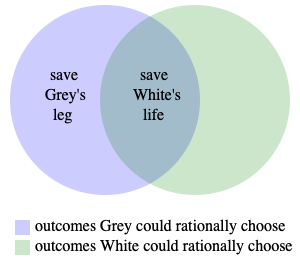
Grey could rationally choose that I save her leg, since this choice would be much better for her. But she would not be rationally required to make this choice. Grey could rationally choose instead that I save White’s life. Grey could rationally regard White’s well-being as mattering about as much as hers, and White’s loss in dying would be much greater than Grey’s loss in losing her leg.
White, in contrast, could not rationally choose that I save Grey’s leg. We could often rationally choose to benefit some stranger, I believe, even if our choice would make us lose a somewhat greater benefit. But there is too great a difference between the possible benefits to White and Grey. White would not have sufficient reasons to give up her life so that I could save Grey’s leg.[11]
Imagine a Venn diagram showing which option(s) each person could rationally endorse; to find a morally acceptable option, you look in the region of overlap.
(Of course, Parfit also recognizes that “[i]t is often morally important whether people actually consent to being treated in some way, or whether, if they had the opportunity, these people would in fact consent.”[12])
4. Motivation
By showing a convergence among different moral theories, Parfit ultimately hoped to neutralize one of the arguments against morality in general:
Of our reasons for doubting that there are moral truths, one of the strongest is provided by some kinds of moral disagreement. Most moral disagreements do not count strongly against the belief that there are moral truths, since these disagreements depend on different people’s having conflicting empirical or religious beliefs, or on their having conflicting interests, or on their using different concepts, or these disagreements are about borderline cases, or they depend on the false assumption that all questions must have answers, or precise answers. But some disagreements are not of these kinds. These disagreements are deepest when we are considering, not the wrongness of particular acts, but the nature of morality and moral reasoning, and what is implied by different views about these questions. If we and others hold conflicting views, and we have no reason to believe that we are the people who are more likely to be right, that should at least make us doubt our view. It may also give us reasons to doubt that any of us could be right.[13]
He was, at least according to Edmonds’s biography of him (review), fanatically obsessed with this issue. At stake for Parfit was not just a particular conception of morality, but whether anything matters at all:
…Parfit came to believe that dissent about ethics—especially dissent between leading philosophers—was evidence for its relativism. And he thought that relativism essentially collapsed into nihilism. If your moral truth conflicted with, but was no less valid than, my moral truth, this would show that, ultimately, nothing mattered.[14]
I share this worry. There are, perhaps, two levels to it. The prospect that all morality might be arbitrary—that there is no meaningful sense in which, for example, someone who likes to torture children is worse than someone who likes to nurture them—would be horrifying enough. But what really motivates that sort of relativism seems, generally, to be subjectivism about reasons, which can undermine our values in an even more radical way. Subjectivism would (in my opinion) imply not only that our goals and desires are fundamentally arbitrary, but also that the whole project of trying to accomplish goals and fulfill desires is arbitrary. Seeking one’s own success and happiness would be no more worthwhile than seeking failure and misery, because there would be no facts about what’s worthwhile at all—just facts about what we happen to be programmed to do.
But Parfit’s anxiety over the issue doesn’t really seem rational to me. For one thing, the strongest argument against the conclusion that “nothing matter[s]” is just that some things obviously do matter. It’s self-evident to anyone who’s experienced intense suffering that it matters how much more of it they have to suffer. We can, I think, perceive this fact much more vividly and directly than we can perceive the validity of any purported argument against it.
But also, most people who accept subjectivism and relativism are not nihilists. So Parfit (and I) disagree with them on two issues: which theory is true, and what the implications of each theory are. In disagreements like this, it’s worth keeping in mind that if we were persuaded to change our minds on one issue, we would likely acquire a new perspective on the other issue too. (To give a related example: evangelical Christians are often convinced that God is necessary to justify morality. But when they deconvert, they don’t become amoral; instead, they become convinced that morality has a different foundation, and often become convinced that postulating a God wouldn’t even help with grounding morality anyway.)
5. Evaluation
Summarizing the reception of this book, Edmonds wrote:
…the general tenor of the reviews was that Parfit’s project resembled a vast baroque cathedral that evoked a sense of awe less for its beauty than for its sheer construction. ‘It stands as a grand and dedicated attempt to elaborate a fundamentally misguided perspective,’ declared The New Republic. Several of the reviews mentioned the daunting length of the volumes; one reviewer went to the trouble of putting Volumes 1 and 2 on the scales: they weighed in at ‘4.8 pounds’ (2.18 kilos).[15]
That was pretty much my impression when I first read the book a decade ago: too long and mostly pointless.
On rereading, I noticed that Parfit uses whitespace as generously as an undergraduate trying to meet a page-count requirement, so volume 1 isn’t really as long as it looks.
More importantly, I have more appreciation for the problem of disagreement that gave Parfit so much anxiety. When I was younger and more arrogant, I was perhaps more prone to dismiss people who disagreed with me, on the assumption that they’d given the issue less careful thought or simply weren’t as intelligent.
Does Parfit successfully defang the problem of moral disagreement? Doubtful. But I think he shows that quite a lot of convergence is plausible if you accept the existence of objective reasons. This suggests the deepest point of disagreement in ethics may really be the subjectivist vs objectivist debate.
(I think the whole point of Korsgaard’s version of Kantianism, for example, was to avoid relying on any notion of objective reasons.)
If we accept objectivism, the next big question is just what range of objective reasons actually exist. It’s easiest to make the case that we have reasons to avoid suffering and pursue happiness; but if you stop there, I think you just get utilitarianism. Parfit’s arguments seem to depend on humans having a more open-ended capacity for recognizing objective reasons.
6. Aside: Four senses of “wrong”
Parfit is great at drawing subtle distinctions that allow us to analyze a situation more clearly. For example, I really like how chapter 7 (“Moral Concepts”) distinguishes several senses in which an action might be called (morally) “wrong”:
It is often assumed that the word ‘wrong’ has only one moral sense. This assumption is most plausible when we are considering the acts of people who know all of the morally relevant facts. We can start by supposing that, when we think about such acts, we all use ‘wrong’ in the same sense, which we can call the ordinary sense. In many cases, however, we don’t know all of the relevant facts, and we must act in ignorance, or with false beliefs. When we think about such cases, we can use ‘wrong’ in several partly different senses. Some of these senses we can define by using the ordinary sense. Some act of ours would be
wrong in the fact-relative sense just when this act would be wrong in the ordinary sense if we knew all of the morally relevant facts,
wrong in the belief-relative sense just when this act would be wrong in the ordinary sense if our beliefs about these facts were true,
and
wrong in the evidence-relative sense just when this act would be wrong in the ordinary sense if we believed what the available evidence gives us decisive reasons to believe, and these beliefs were true.[16]
… [a few pages later]
wrong in the moral-belief-relative sense just when the agent believes this act to be wrong in the ordinary sense.[17]
[1] Derek Parfit, On What Matters, The Berkeley Tanner Lectures (Oxford ; New York: Oxford University Press, 2011), 413.
[2] Ibid., 360.
[3] Ibid.
[4] Ibid.
[5] Ibid., 407, emphasis added.
[6] Ibid., 45.
[7] Ibid.
[8] Ibid., 185.
[9] Ibid.
[10] Ibid., 184.
[11] Ibid., 186.
[12] Ibid., 191.
[13] Ibid., 418–19, emphasis added.
[14] David Edmonds, Parfit: A Philosopher and His Mission to Save Morality (Princeton: Princeton University Press, 2023), 280, emphasis added.
[15] Ibid., 293, emphasis added.
[16] Parfit, On What Matters, 150–51.
[17] Ibid., 158.
(crosspost)

January 21, 2021
This book can serve as a good textbook for moral philosophy, following the 1874 book The Methods of Ethics by Henry Sidgwick.
Three views of moral philosophy: Kantian deontology (acting because some action is good), Consequentialism (acting towards a good result), and Contractualism (acting because the action constitutes a good "social contract" in the context of enlightenment movement philosophies).
The author posits that these three views can be combined and get to similar conclusions in action. For me, this is not a perfect answer, maybe none of the three can completely model the truth, so that people take the ensemble to overfit situation-specific solutions. For a specific decision made by a political decision-maker, or a normal person about his/her own life decision, the solution is based on specific scenarios, information, and expert ideas from those who are experienced. This is mainly because for complicated decision-making which needs to take into consideration hundreds and thousands of factors, it is better to use experiences or situation-specific hints, instead of top-down theories.
Three views of moral philosophy: Kantian deontology (acting because some action is good), Consequentialism (acting towards a good result), and Contractualism (acting because the action constitutes a good "social contract" in the context of enlightenment movement philosophies).
The author posits that these three views can be combined and get to similar conclusions in action. For me, this is not a perfect answer, maybe none of the three can completely model the truth, so that people take the ensemble to overfit situation-specific solutions. For a specific decision made by a political decision-maker, or a normal person about his/her own life decision, the solution is based on specific scenarios, information, and expert ideas from those who are experienced. This is mainly because for complicated decision-making which needs to take into consideration hundreds and thousands of factors, it is better to use experiences or situation-specific hints, instead of top-down theories.

September 14, 2018
More focused on the step-by-step explanation about why Kantian and Contrarianism philosopies are essentially just different lenses on Altruism than on the underlying titular topic.

March 30, 2020
I'm very interested in the study of ethics and have been looking forward to reading this for a long time...I've read that it's a huge step forward in ethical philosophy. Honestly, I don't know why I'm even giving this two stars, but all I can say is that I'm glad I didn't go to graduate school for philosophy, which was something I was seriously considering.
Let me tell you how that's relevant here: I feel that Parfit (1) is overly enamored with Kant and existing ethical philosophy, and (2) thinks analyzing concepts with hypotheticals moves an argument along, which logically doesn't make sense.
Regarding the first part, he talks about Kant's achievements (and I consider myself a Kantian and appreciate Kant's contribution to ethics) and how great he is and then goes into detail about Kant's ethical positions: thoughts on "duty" and "rationality" and "dignity"...these are all words that are vague and undefined by Kant, and come on now...we live in a world of Kahneman and tversky and behavioral science now. People just don't act rationally. Haven't we moved on from that? People don't act from duty. You can't divorce Kant's writings from the world he lived in...one where duty and dignity were important. Where he could only imagine behaving a certain way. Like talking about honor...it's not something that people act by in our world like they did in other long dead cultures.
Anyway, why on earth is a new groundbreaking ethical treatise not talking about psychology and how people actually act ethically? Why is it talking about "duty" and "rationality"? Look at politics and tell me people agree on what rationality is. Anyway, sorry, I'm just annoyed that the work doesn't get beyond those antiquated notions and come into the modern millennium. And believe me, it's not just semantics where you can replace duty with how people think they ought to act...Parfit revisits definitions of dignity and rationalism like they're all that matter.
Secondly, and I don't know if Allan Wood talks about this (it alludes to that) but creating hypotheticals that make no sense don't do much to convince me of the points being discussed...probably because they don't seem feasible, so they leave out the psychological component. For instance, should you let one person die or let another lose his leg? What? In what world would that happen? And how logically does it make sense to create conclusions by coming up with one odd hypothetical to prove your point?
(And please, if I've missed anything here, I'd be happy to know what I should go back and reread...I'd rather get something out of this than write a bad review.)
Anyway, I know I'm fixated on what people do vs how the book is more about what they ought to do. So regarding what people ought to do, I don't like revisiting the ideas of consequentialism (you must decide what everyone would agree to...how would anyone know that?) or utilitarianism (you must retroactively judge ethics by what happens ultimately...really?) or Kantianism (people act by by duty and dignity). Kantianism is great for acknowledging intent based on uncertain knowledge and should be a launching point for a discussion on how people act based on what they think is the right thing to do...and then there's a range of how much they think they should be acting rightly. But this is not that book.
Sorry if I missed things that are relevant here...as I grew frustrated I gave up on sections and moved forward. But if I didn't miss anything, this is more a book about bringing Kant and contractualism to the present than it is creating anything new. And combatting subjectivism because Parfit has a personal belief that things matter. So much for objectivism.
Let me tell you how that's relevant here: I feel that Parfit (1) is overly enamored with Kant and existing ethical philosophy, and (2) thinks analyzing concepts with hypotheticals moves an argument along, which logically doesn't make sense.
Regarding the first part, he talks about Kant's achievements (and I consider myself a Kantian and appreciate Kant's contribution to ethics) and how great he is and then goes into detail about Kant's ethical positions: thoughts on "duty" and "rationality" and "dignity"...these are all words that are vague and undefined by Kant, and come on now...we live in a world of Kahneman and tversky and behavioral science now. People just don't act rationally. Haven't we moved on from that? People don't act from duty. You can't divorce Kant's writings from the world he lived in...one where duty and dignity were important. Where he could only imagine behaving a certain way. Like talking about honor...it's not something that people act by in our world like they did in other long dead cultures.
Anyway, why on earth is a new groundbreaking ethical treatise not talking about psychology and how people actually act ethically? Why is it talking about "duty" and "rationality"? Look at politics and tell me people agree on what rationality is. Anyway, sorry, I'm just annoyed that the work doesn't get beyond those antiquated notions and come into the modern millennium. And believe me, it's not just semantics where you can replace duty with how people think they ought to act...Parfit revisits definitions of dignity and rationalism like they're all that matter.
Secondly, and I don't know if Allan Wood talks about this (it alludes to that) but creating hypotheticals that make no sense don't do much to convince me of the points being discussed...probably because they don't seem feasible, so they leave out the psychological component. For instance, should you let one person die or let another lose his leg? What? In what world would that happen? And how logically does it make sense to create conclusions by coming up with one odd hypothetical to prove your point?
(And please, if I've missed anything here, I'd be happy to know what I should go back and reread...I'd rather get something out of this than write a bad review.)
Anyway, I know I'm fixated on what people do vs how the book is more about what they ought to do. So regarding what people ought to do, I don't like revisiting the ideas of consequentialism (you must decide what everyone would agree to...how would anyone know that?) or utilitarianism (you must retroactively judge ethics by what happens ultimately...really?) or Kantianism (people act by by duty and dignity). Kantianism is great for acknowledging intent based on uncertain knowledge and should be a launching point for a discussion on how people act based on what they think is the right thing to do...and then there's a range of how much they think they should be acting rightly. But this is not that book.
Sorry if I missed things that are relevant here...as I grew frustrated I gave up on sections and moved forward. But if I didn't miss anything, this is more a book about bringing Kant and contractualism to the present than it is creating anything new. And combatting subjectivism because Parfit has a personal belief that things matter. So much for objectivism.

June 9, 2020
As one could tell from my notes on this book, I have some disagreements with Parfit, often substantially so. I think he dismisses purely impartial consequentialism too readily, relying on our intuitions that it really seems like we should care relatively more about ourselves and our loved ones - these are intuitions that I think simply irrationally prejudice one's values in favor of oneself/such loved ones. When there are genuine tradeoffs to be made for other people, who are as real and as sentient as oneself/loved ones, and who are themselves loved by other people, why should these people matter less in determining the *reasons* for one's own actions?
Act consequentialism is also given short shrift; I think Parfit gives some interesting game theoretic arguments to be made that acting with the intent of following AC ends up making things worse, but shouldn't this just cause us to revise our analysis to one's acts in the context of others', and future norms influenced by those acts?
Gripes aside, I don't think these or other flaws indicate any sloppiness on Parfit's part. This book is incredibly clear, carefully argued, even creative without sacrificing rigor for the sake of provocation. I never would have imagined that a case could be made that Kant's moral formulas lead one to (rule) consequentialism - it sounds like "Randian Communism," and yet it works. There's also a solid defense of a form of moral realism here.
Most importantly, this book is grounded in the reality of "what matters." Please do check it out if you want to take a deep dive in ethics and wrestle with your own intuitions, even (especially?) if you've never read anything else on the subject.
Act consequentialism is also given short shrift; I think Parfit gives some interesting game theoretic arguments to be made that acting with the intent of following AC ends up making things worse, but shouldn't this just cause us to revise our analysis to one's acts in the context of others', and future norms influenced by those acts?
Gripes aside, I don't think these or other flaws indicate any sloppiness on Parfit's part. This book is incredibly clear, carefully argued, even creative without sacrificing rigor for the sake of provocation. I never would have imagined that a case could be made that Kant's moral formulas lead one to (rule) consequentialism - it sounds like "Randian Communism," and yet it works. There's also a solid defense of a form of moral realism here.
Most importantly, this book is grounded in the reality of "what matters." Please do check it out if you want to take a deep dive in ethics and wrestle with your own intuitions, even (especially?) if you've never read anything else on the subject.

October 12, 2025
In einem Satz wie einem moralischen Donnerschlag verdichtet Derek Parfit (1942 - 2017) den Kern seines ethischen Projekts: „Some of us ask how much of our wealth we rich people ought to give to these poorest people. But that question wrongly assumes that our wealth is ours to give. This wealth is legally ours. But these poorest people have much stronger moral claims to some of this wealth.“ Parfit verschiebt hier die Perspektive von freiwilliger Wohltätigkeit zu moralischer Verpflichtung. Eigentum, so legt er nahe, ist kein naturgegebenes Recht, sondern eine institutionelle Vereinbarung, die die tiefere moralische Realität nur unvollkommen widerspiegelt.
In „On What Matters“ entfaltet Parfit daraus eine Ethik, die Rationalität, Moral und Mitgefühl zu versöhnen sucht. Sein Denken sprengt den Rahmen bloßer Pflichtenlehre: Er will zeigen, dass moralische Wahrheit nicht im subjektiven Gefühl, sondern in der geteilten Vernunft wurzelt. Das Zitat macht diese Radikalität spürbar — es zwingt dazu, Wohlstand nicht als Belohnung, sondern als ungleich verteilte Verantwortung zu begreifen.
So wird Parfit zum Philosoph der unbequemen Einsicht: Moralisches Handeln beginnt dort, wo wir unsere vermeintlichen Rechte als Fragmente eines größeren, gemeinsamen Anspruchs erkennen.
In „On What Matters“ entfaltet Parfit daraus eine Ethik, die Rationalität, Moral und Mitgefühl zu versöhnen sucht. Sein Denken sprengt den Rahmen bloßer Pflichtenlehre: Er will zeigen, dass moralische Wahrheit nicht im subjektiven Gefühl, sondern in der geteilten Vernunft wurzelt. Das Zitat macht diese Radikalität spürbar — es zwingt dazu, Wohlstand nicht als Belohnung, sondern als ungleich verteilte Verantwortung zu begreifen.
So wird Parfit zum Philosoph der unbequemen Einsicht: Moralisches Handeln beginnt dort, wo wir unsere vermeintlichen Rechte als Fragmente eines größeren, gemeinsamen Anspruchs erkennen.
March 29, 2020
I'm looking forward to reading part two as he mentions that he'll further tackle the argument that nothing matters since our reasons are given by reasonless desires which leads to meaninglessness.
Just like Reasons and Persons this has a lot to chew on. That said, even though I'm giving this five stars it didn't quite live up to R&P for me, which I thought was truly excellent. I guess perhaps more accurately, my memory of R&P was that there were some exceptional sections and some mediocre sections (could well be I just didn't grok those). Here everything seemed "just" very good. I had a couple glimpses of the awe I felt while reading R&P but never quite fully captured it.
I have a goal to finish OWM this year so finishing this before the end of March keeps me on track for that.
Just like Reasons and Persons this has a lot to chew on. That said, even though I'm giving this five stars it didn't quite live up to R&P for me, which I thought was truly excellent. I guess perhaps more accurately, my memory of R&P was that there were some exceptional sections and some mediocre sections (could well be I just didn't grok those). Here everything seemed "just" very good. I had a couple glimpses of the awe I felt while reading R&P but never quite fully captured it.
I have a goal to finish OWM this year so finishing this before the end of March keeps me on track for that.

December 2, 2017
If you're into Kant, this is definitely worth the read. He writes clearly enough to be followed. I'm not sure if what I didn't like about it was Parfit's fault or rather the direction that philosophy has headed in recently. It seems bizarre to me to try to generalize moral principles on very strange thought experiments.


October 14, 2018
Challenging to read but once you get into his line of arguments it is very interesting.

August 24, 2019
On What Doesn't Matter would be a more appropriate title.
This is an argument without a plan, and with no real conclusion. Broadly, it reduces to a rose-tinted defense of Kant.
This is an argument without a plan, and with no real conclusion. Broadly, it reduces to a rose-tinted defense of Kant.

March 15, 2021
Dense but thought changing and hard to disagree with.
August 28, 2022
the best book of ethics since Kant and Sidgwick

January 23, 2024
Tough. Must be awake and charged to digest.
September 13, 2025
Explained Kants ethics better than Kant
February 27, 2014
Tough going for me, but worth it.

March 7, 2017
the loneliest point in my life was when i asked for this for christmas and had to work over the holiday break and spent new years eve in a cubicle alone reading this book
Displaying 1 - 24 of 24 reviews