

What do you think?

Greenhill's Alternate Decisions
Rising Sun Victorious: An Alternate History of the Pacific War
In war, victory can be held hostage to seemingly insignificant incidents–chance events, opportunities seized or cast aside–that can derail the most brilliant military strategies and change the course of history. What if the Japanese had conquered India and driven out the British? What if the strategic link between the United States and Australia had been severed? What if Vice Admiral Nagumo had launched a third attack on Pearl Harbor? What if the U.S. Navy’s gamble at Midway had backfired?
Ten leading military historians ask these and other questions in this fascinating book. The war with Japan was rife with difficult choices and battles that could have gone either way. These fact-based alternate scenarios offer intriguing insights into what might have happened in the Pacific during World War II, and what the consequences would have been for America.
Ten leading military historians ask these and other questions in this fascinating book. The war with Japan was rife with difficult choices and battles that could have gone either way. These fact-based alternate scenarios offer intriguing insights into what might have happened in the Pacific during World War II, and what the consequences would have been for America.
320 pages, Mass Market Paperback
First published March 13, 2001
Ratings & Reviews
Friends & Following
Create a free account to discover what your friends think of this book!
Community Reviews
Displaying 1 - 26 of 26 reviews

September 19, 2023
Another thoughtful, realistic AH anthology from Tsouras; this time focused on Japanese victories in the Pacific. Highly recommended for fans of the genre.

February 14, 2013
U.S. military analysts and historians craft 10 scenarios, of varying believability, of "where could Japan have won," ranging from never having attacked U.S. to a super storm right before invasion of Kyushu.
Quality of scenarios vary (10 different authors), many with heavy technical information incl. lists of units and obscure commanders; this work not for generalist readers.
Scenarios are generally believable. There is some tendency to transpose Cold War events with a Japanese victory context (actually, things would go differently if the Axis had won WW2).
the most aggressively "Japan victorious" scenario posits Japan gaining Indochina, making major advances in China, and getting the US to sign a peace treaty. cf. PKD The Man in the High Castle where a combined Axis victory leaves the Japanese installed on the West Coast. ironically, this is one of the most read and highly well-regarded alternative fiction novels.
generally historians, fiction writers, and military analysts agree that Japan was playing for a measured victory in WW2 and ended up losing it all. this leads the modern viewer to wonder why Japan attacked the US at all. perhaps the past can never be understood by the present ?
I. Russo-Japanese War?
>Sorge network
http://en.wikipedia.org/wiki/Nomonhan...
or "Khalkyun Gol Battle" in Russian
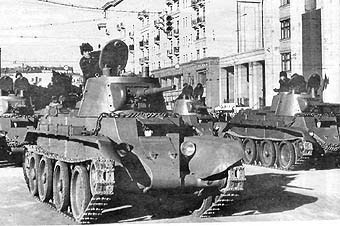
>Soviet BT-7, predecessor to the famed T-34 that shocked Hitler. designed 1935, weighing some 14.0 tons, 45mm L/45 cannon, 6 - 22mm of armor (presumably 6mm on rear, 22 up front), crew of 3, 450hp engine= 50 kph offroad, 70kph on roads, some flaws noted with flammability (a cold weather tank). was engaged by infantry with Molotov cocktails and specialized anti-tank guns. Soviets had some ~500 at Nomonhan.

Japanese type 89 tank, after adoption of 'Strike South' school, was used until end of war (unlike Soviets, who invented bigger and bigger tanks). Japanese had some ~135 of this or smaller tankettes, designed 1927, weighting some 12.8 tons, 57mm cannon + two machine guns 6.5mm calibre, crew of 4, 120hp engine, armor 6-17 mm, top speed: 26 kph. = severely underpowered by ww2 standards.
amateurs talk tactics; professionals talk logistics. 'Nomonhan, the graveyard of reputations' meant the end of the career for IJA generals, but put Zhukov in place as the head of Red forces against Germany. Zhukov's decision to mobilize 2000+ supply trucks is regarded by military historians as the critical decision for victory, whilst the Japanese emphasis on 'spirit' or 'morale' is generally downplayed in the modern world.
a proposed "Japanese assault on the Soviet Union" seems one of those justifiably 'large' decisions that could have resulted in a dramatically difficult outcome for the war. would the Soviet Union have been able to survive a double- assault from East and West? if not, and the USSR collapsed, would the Western democracies UK-US-Netherlands be able to stand up to the Axis Berlin-Tokyo without any dramatic power between them? the resulting "Cold War" would then be between the Axis and the West, but presumably, the West would have still had nuclear weapons by 1948.
this seems one of the sort of 'alternate history scenarios' that at first sight seems to make perfect retroactive sense, but in reality considering force-dispositions at the time is pretty idle speculation. the Japanese had little tank-industry, they did have huge battleships. accordingly, the strike south faction had all the weight of material logic on their side. putting this issue aside, even if the Japanese with their slow tank designs (above) did attack the Soviet Union, the USSR probably could have held on in the Urals for some time, as Siberia is relatively economically unimportant and consists of vast amounts of territory.
II. India liberation ?
the India liberation scenario is the other 'grand strategy' level matter that may promote systematic evaluation. if S. Chandra Bose had sent in 'pan-Asian' liberation forces to India and captured broad support, the presumed outcome is a severe degradation of British Empire war-making capacity. Indonesia was never recovered after it was liberated by the Japanese, and possibly India too would have been boldly committed to an anti-UK cause if it actually had military divisions and such under its control.
this outcome presupposes the possibility of an Axis victory in the Caucasus. but once again we deal with the reality that the US atomic bomb program was considerably far more advanced that any Axis counterpart. we can imagine scenarios with the war prolonged to the early 1950s, but ultimately it is difficult to see how either Berlin or Tokyo would have been able to counter repeated atomic strikes.
ahistorical / allohistorical writing invites questions of 'are we living in a predetermined world?'
Quality of scenarios vary (10 different authors), many with heavy technical information incl. lists of units and obscure commanders; this work not for generalist readers.
Scenarios are generally believable. There is some tendency to transpose Cold War events with a Japanese victory context (actually, things would go differently if the Axis had won WW2).
the most aggressively "Japan victorious" scenario posits Japan gaining Indochina, making major advances in China, and getting the US to sign a peace treaty. cf. PKD The Man in the High Castle where a combined Axis victory leaves the Japanese installed on the West Coast. ironically, this is one of the most read and highly well-regarded alternative fiction novels.
generally historians, fiction writers, and military analysts agree that Japan was playing for a measured victory in WW2 and ended up losing it all. this leads the modern viewer to wonder why Japan attacked the US at all. perhaps the past can never be understood by the present ?
I. Russo-Japanese War?
>Sorge network
http://en.wikipedia.org/wiki/Nomonhan...
or "Khalkyun Gol Battle" in Russian
>Soviet BT-7, predecessor to the famed T-34 that shocked Hitler. designed 1935, weighing some 14.0 tons, 45mm L/45 cannon, 6 - 22mm of armor (presumably 6mm on rear, 22 up front), crew of 3, 450hp engine= 50 kph offroad, 70kph on roads, some flaws noted with flammability (a cold weather tank). was engaged by infantry with Molotov cocktails and specialized anti-tank guns. Soviets had some ~500 at Nomonhan.
Japanese type 89 tank, after adoption of 'Strike South' school, was used until end of war (unlike Soviets, who invented bigger and bigger tanks). Japanese had some ~135 of this or smaller tankettes, designed 1927, weighting some 12.8 tons, 57mm cannon + two machine guns 6.5mm calibre, crew of 4, 120hp engine, armor 6-17 mm, top speed: 26 kph. = severely underpowered by ww2 standards.
amateurs talk tactics; professionals talk logistics. 'Nomonhan, the graveyard of reputations' meant the end of the career for IJA generals, but put Zhukov in place as the head of Red forces against Germany. Zhukov's decision to mobilize 2000+ supply trucks is regarded by military historians as the critical decision for victory, whilst the Japanese emphasis on 'spirit' or 'morale' is generally downplayed in the modern world.
a proposed "Japanese assault on the Soviet Union" seems one of those justifiably 'large' decisions that could have resulted in a dramatically difficult outcome for the war. would the Soviet Union have been able to survive a double- assault from East and West? if not, and the USSR collapsed, would the Western democracies UK-US-Netherlands be able to stand up to the Axis Berlin-Tokyo without any dramatic power between them? the resulting "Cold War" would then be between the Axis and the West, but presumably, the West would have still had nuclear weapons by 1948.
this seems one of the sort of 'alternate history scenarios' that at first sight seems to make perfect retroactive sense, but in reality considering force-dispositions at the time is pretty idle speculation. the Japanese had little tank-industry, they did have huge battleships. accordingly, the strike south faction had all the weight of material logic on their side. putting this issue aside, even if the Japanese with their slow tank designs (above) did attack the Soviet Union, the USSR probably could have held on in the Urals for some time, as Siberia is relatively economically unimportant and consists of vast amounts of territory.
II. India liberation ?
the India liberation scenario is the other 'grand strategy' level matter that may promote systematic evaluation. if S. Chandra Bose had sent in 'pan-Asian' liberation forces to India and captured broad support, the presumed outcome is a severe degradation of British Empire war-making capacity. Indonesia was never recovered after it was liberated by the Japanese, and possibly India too would have been boldly committed to an anti-UK cause if it actually had military divisions and such under its control.
this outcome presupposes the possibility of an Axis victory in the Caucasus. but once again we deal with the reality that the US atomic bomb program was considerably far more advanced that any Axis counterpart. we can imagine scenarios with the war prolonged to the early 1950s, but ultimately it is difficult to see how either Berlin or Tokyo would have been able to counter repeated atomic strikes.
ahistorical / allohistorical writing invites questions of 'are we living in a predetermined world?'

May 28, 2020
Battles, like history itself, often turn on the most innocuous pieces of luck. Japan's eventual defeat in World War II is just such an example of that, as this volume edited by Peter G. Tsouras shows. From a decision to attack the Soviet Union's Siberian holdings in 1941 to realizations of broken codes early enough in the war or even something as simple as a group of planes flying in a different direction at Midway, Tsouras and his fellow essayists demonstrate how changes big and small might have given the Imperial Japanese a taste of victory. Would it have been lasting, though? As essays examining Japanese invasions of Australia and India show, perhaps not. Perhaps the biggest surprise was discovering how, as late as Leyte Gulf and perhaps even the never realized invasion of the Japanese home islands across late 1945/early 1946, the war might have turned in their favor, even if not as unquestionable victories as earlier in the war.
History does indeed turn on innocuous events and, by the time you've finished reading it, you'll be glad it didn't in these cases.
History does indeed turn on innocuous events and, by the time you've finished reading it, you'll be glad it didn't in these cases.

August 23, 2018
Rising Sun Victorious: An Alternate History of the Pacific War edited by Peter G. Tsouras is a series of essays by military historians on ways that the Pacific theater of WWII could have gone differently.
I liked the style of this book. The essays are not stories per se, but rather written in the style of historical essays that recount a historical event, in this case military campaigns.
The writers having a background in history lent the stories some weight. The essays don’t simply tell of the US immediately surrendering after a battle is won by the Japanese in these alternate timelines. Rather they try and show how the US would have reacted to the changing circumstances. The end result isn’t a case of just winning and losing, but rather the extent by which the Japanese could have won.
A nicely done collection that if you are a fan of history, allows one to muse about possibilities. Histories we never experienced, but could have with one simple change…
I liked the style of this book. The essays are not stories per se, but rather written in the style of historical essays that recount a historical event, in this case military campaigns.
The writers having a background in history lent the stories some weight. The essays don’t simply tell of the US immediately surrendering after a battle is won by the Japanese in these alternate timelines. Rather they try and show how the US would have reacted to the changing circumstances. The end result isn’t a case of just winning and losing, but rather the extent by which the Japanese could have won.
A nicely done collection that if you are a fan of history, allows one to muse about possibilities. Histories we never experienced, but could have with one simple change…

May 11, 2018
Brilliant
A fascinating collection of potential turning points in the Pacific War. The essay on a hypothetical second Russo-Japanese war makes for particularly thought-provoking reading.
A fascinating collection of potential turning points in the Pacific War. The essay on a hypothetical second Russo-Japanese war makes for particularly thought-provoking reading.
October 21, 2022
Rising Sun Victorious: Alterations Histories of the Pacific War
Interesting story about the war in the Pacific was able to be rewritten in several different ways. I found it interesting and very possible
Interesting story about the war in the Pacific was able to be rewritten in several different ways. I found it interesting and very possible

June 21, 2020
Good set up and lots of good alternate history. In True Tsouras fashion, the craziest story is at the end.
May 8, 2024
The only disappointment of the three "Victorious" collections by Peter G. Tsouras, consisting of Rising Sun Victorious, Third Reich Victorious, and Dixie Victorious (Battle of the Bulge technically counts as part of the series, I guess, but A) it doesn't have Victorious in the title and B) I haven't read it yet, something I'll be correcting soon)
The book consists of ten different scenarios on how the Japanese Empire could have won WWII. Or so you'd think based on the title and description.
Three of the stories conclude with Japan outright losing, arguably worse than in our world. These are also annoyingly "America Fuck Yeah!", where they have the Japanese be complete inept at all levels while the US troops and commanders are hyper-competent and always destroy much larger enemy forces. After a while I wouldn't have been surprised if there was a passage that said "the American troops only had ten biplanes from WWI, and managed to sink one Japanese carrier".
Another has the US completely destroy the Japanese armed forces yet somehow choosing to withdraw, as if the author remembered at the last minute that he's writing a story where Japan is supposed to win.
These four stories have a very narrow view of "Japan couldn't win. Period." Which I get, but the key tenet of alternate history is "alternate history is about what 's possible, not about what's likely". It would've made a bigger impact if the author had to go through hoops to make them win and then explain just how much they had to stack on their favor.
My conspiracy theory is that Tsouras was in the middle of writing the Britannia's Fist trilogy - the most "America Fuck Yeah" novels I've read - while compiling this collection and that influenced the stories he decided to use.
The remaining six stories do show Japan winning WWII, four in the early stages of the war, two nearly at the end (thought by this point "victory" is simply not unconditional surrender and that's perfectly fine).
All stories are very well written, though, even the four I disliked.
The book consists of ten different scenarios on how the Japanese Empire could have won WWII. Or so you'd think based on the title and description.
Three of the stories conclude with Japan outright losing, arguably worse than in our world. These are also annoyingly "America Fuck Yeah!", where they have the Japanese be complete inept at all levels while the US troops and commanders are hyper-competent and always destroy much larger enemy forces. After a while I wouldn't have been surprised if there was a passage that said "the American troops only had ten biplanes from WWI, and managed to sink one Japanese carrier".
Another has the US completely destroy the Japanese armed forces yet somehow choosing to withdraw, as if the author remembered at the last minute that he's writing a story where Japan is supposed to win.
These four stories have a very narrow view of "Japan couldn't win. Period." Which I get, but the key tenet of alternate history is "alternate history is about what 's possible, not about what's likely". It would've made a bigger impact if the author had to go through hoops to make them win and then explain just how much they had to stack on their favor.
My conspiracy theory is that Tsouras was in the middle of writing the Britannia's Fist trilogy - the most "America Fuck Yeah" novels I've read - while compiling this collection and that influenced the stories he decided to use.
The remaining six stories do show Japan winning WWII, four in the early stages of the war, two nearly at the end (thought by this point "victory" is simply not unconditional surrender and that's perfectly fine).
All stories are very well written, though, even the four I disliked.
April 24, 2024
USED A GLOBE TO KEEP TRACK OF LOCATIONS
US history is a requirement for HS graduation in this state, yet I've never studied WWII. Didn't even make it to the Treaty of Versailles. Every book begins with Columbus.
They should really begin with the Trail of Tears. Heaven knows I've heard Columbus, the French & Indian War, the Revolutionary War, and the War of 1812 every year since I was 8.
So reading an alternate history about Japan in WWII was challenging. The authors could've passed off each story as true and I would've been fooled.
So I checked facts as I read and traced imaginary battles on a globe, forgetting that names of places often changed. It was tedious, but still I learned.
US history is a requirement for HS graduation in this state, yet I've never studied WWII. Didn't even make it to the Treaty of Versailles. Every book begins with Columbus.
They should really begin with the Trail of Tears. Heaven knows I've heard Columbus, the French & Indian War, the Revolutionary War, and the War of 1812 every year since I was 8.
So reading an alternate history about Japan in WWII was challenging. The authors could've passed off each story as true and I would've been fooled.
So I checked facts as I read and traced imaginary battles on a globe, forgetting that names of places often changed. It was tedious, but still I learned.
October 28, 2023
A very interesting (unconnected) series of alternate history vignettes of ten battles in the Pacific theater of World War II, written by different historians. They all have footnotes for real-world and alternate-history (i.e., fictional) source documents. The chapters are written as historical accounts, not as novels or short stories.
August 16, 2021
Interesting food for thought though I would argue that the title was somewhat misleading since in virtually none of the scenarios was Japan victorious.

April 25, 2022
Fun read of .various alternate histories for Japan prior & during WW II

June 20, 2024
interesting Pacific War counterfactuals

January 7, 2017
Með betri efsögum eða hjásögum (e. counterfactual history, what-if history) sem ég hef lesið. Virtir sagnfræðingar leggja mat á aðstæður í átökum bandamanna og Japans í síðari heimsstyrjöldinni. Þeir fylgja sögunni upp að vissum atburði og leggja síðan mat á hvað hefði gerst ef ákvarðanir hefðu verið teknar hjá herforingjum og pólitískum leiðtogum sem hefðu haft afdrifarík áhrif á gang baráttunnar Japan í vil. Þeir sýna fram á að við vissar aðstæður eða ákvarðanir hefði Japan getað náð umtalsvert betri hernaðarárangri en sömuleiðis hefðu þær getað valdið enn verri aðstæðum til langs tíma. Góðar röksemdarfærslur studdar rannsóknum ásamt lýsingum á því sem gerðist í raun og veru.

March 9, 2017
Quite an entertaining reading, with several interesting hypothesis about what could have happened. Definitely much better than "Cold War Hot", from the same authors.

August 22, 2011
Alternate military history. And its pretty dang technical on the military side of things. Too technical to be fun for a layman like me. Also, many of the chapters concerned specific battles like Guadalcanal or midway which I don't know much about (and therefore, different permutations of those events dont resonate with me since I can barely tell them from the actual event). I skimmed those chapters. The best chapters were the ones dealing with theatre wide changes, or changes in grand strategy. So, the Japanese invasion of Russia, India, California, and Australia were the best. I'd rate those chapters as 4 star.

May 22, 2013
I found this book interesting and full of information I didn't know about the Pacific War. However, I think that a person with more extensive historical knowledge would enjoy the book more then I did. The first chapters were very technical and somewhat dry to read. I started to enjoy the book more when I hit sections I was more familiar with such as the attack on Pearl Harbor.
I think this book could seriously confuse my understanding of history. I had to constantly remind myself this is an "Alternate History."
I think this book could seriously confuse my understanding of history. I had to constantly remind myself this is an "Alternate History."
May 16, 2014
Part fiction and part nonfiction, this was a fascinating look into ten different possible outcomes of the Pacific Theater. The most chilling scenario was the final one where the Japanese military was successful in deposing the Emperor and continuing the war, which in turn forces the United States to launch a bloody land invasion of the island and use four atomic bombs against the Japanese. It was very disturbing to imagine all the carnage that could have happened if history was different. Very powerful and thought-provoking read.

Read
May 5, 2016For the World War II buff, an interesting book. If you expect the story telling of an alternate history novel, forget this one, it reads like a detailed history replete with all its dryness. So what were the possible changes that could have caused either a Japanese victory, or a cessation of hostilities? This book presents a number of scenarios for an American defeat.

August 4, 2013
Interesting, but I think only to those with an already indepth grasp of the Asian Theater in WWII. Even I found myself a little lost at times, and I'm a big nerd. Well researched and well executed. It did a great job for what it is.

March 9, 2016
An interesting approach to military history: a look at how different decisions at the levels of grand strategy to tactics could have changed the course of the war in the Pacific. A well researched presentation by a variety of military historians.

May 8, 2008
Love me some alternate history.
July 22, 2011
A well researched and thought provoking book. Each section dealt with different campaigns of the pacific war. However it got a little tedious towards the end.
January 2, 2012
Japan gewinnt fast nie, mdennoch nett zu lesen
http://www.weberseite.at/buecher/risi...
http://www.weberseite.at/buecher/risi...

May 13, 2012
Excellant historical fiction, looks at a number of alternative possibilities of how Japan might have won...
December 27, 2013
I like all of Tsouras's works, read them all.
Displaying 1 - 26 of 26 reviews