L'amour de la vie chez Goya irriguait constamment son inspiration et le rendait plus sensible que d'autres artistes, alors ligotés par le néo-classicisme, aux différents aspects de la il l'aimait profondément et en a dépeint les multiples nuances avec un sens de l'observation aussi aigu que celui du Zadig de Voltaire et une facture magique digne de Velázquez, atteignant ainsi un degré de science incomparable qui ferait croire qu'en regardant ses tableaux on peut toucher la réalité quel qu'en soit l'objet.
Humaniste comme Cervantès, il n'a cessé de s'interroger, la plume, la pointe à graver ou le pinceau à la main, sur les mécanismes secrets qui font mouvoir cette étrange et passionnante l'homme. Il ne supporte pas que cet homme, qui possède le privilège du choix entre le bien et le mal, se conduise comme une bête sauvage ou cède aux terreurs maléfiques ancestrales. Il est aussi le témoin le plus sincère des événements funestes ou heureux de son époque, en quelque sorte le premier reporter des Temps modernes. C'est pourquoi il importe de le replacer dans le contexte politique où il a vécu et de bien connaître la situation des princes, des grands seigneurs, des protecteurs dont il dépendait; il ne se contente pas de les il les juge avec une perspicacité diabolique. Or c'est en vérifiant l'exactitude de ces verdicts dans les archives publiques et privées, les Mémoires, les correspondances et les témoignages contemporains qu'on parvient à reconstituer sa flamboyante personnalité.
Jeannine Baticle, conservateur général honoraire au musée du Louvre, a consacré sa carrière au département des Peintures où elle est entrée en 1945 après avoir fait l'Ecole du Louvre. Passionnée de culture espagnole, elle a acquis au cours des années une connaissance approfondie des moeurs et de l'art de ce pays. Devenue l'une des meilleures spécialistes actuelles de la peinture espagnole, elle a publié de nombreux travaux. Parmi les expositions qu'elle a organisées, il faut citer la grande rétrospective Zurbarán (New York, 1987, Paris, 1988).
I am one of those folks who require some assistance when looking at artwork. When walking in art galleries around the world, the chance to sit down on a bench in front of a masterpiece is more than just an opportunity to rest my sore tootsies. It’s also the chance to view art in a quieter and less rushed fashion. Usually a subject matter expert will then engage me about what I’m looking at and what I feel and I will most likely respond with, “I like the colours”. So, art connoisseur I am not which is why I rely on little books like this one, to explain what I initially did not comprehend.
Francisco Goya is considered one of the greatest artists of all time, born in Spain in the middle 18th-century and later appointed as court painter for the declining Spanish Crown. He is characterized as “the last of the Old Masters and the first of the moderns” which is one reason I love to view his work. He stood upon the annals of time as a connecting point between two vastly different periods of art. While he started out with the intent to emulate the style of the old greats, his work evolved into something altogether darker. This is why I love to look at Goya’s paintings, because one sees an actual transition based on his progression in years.
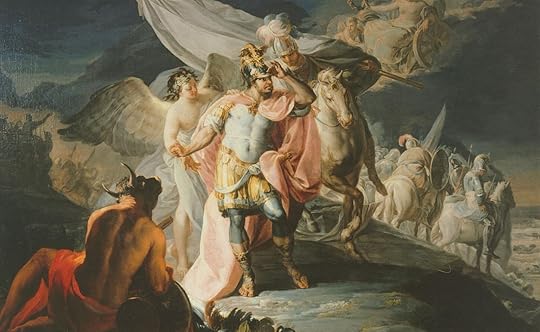
Here, one can see his youthful outlook in this painting of Hannibal.
HANNIBAL CROSSING THE ALPS painted 1771
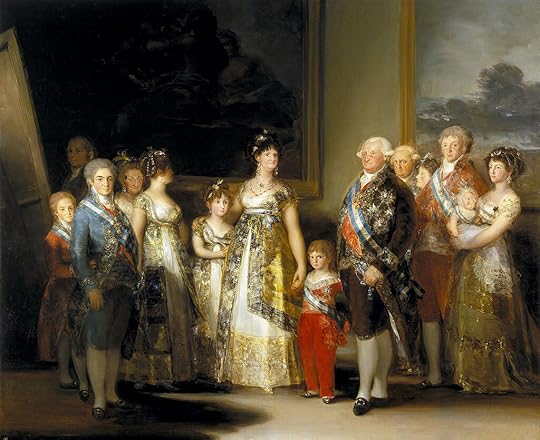
Goya then attains success and becomes the court painter for the royal Family of Spain.
THE FAMILY OF CHARLES IV painted 1801
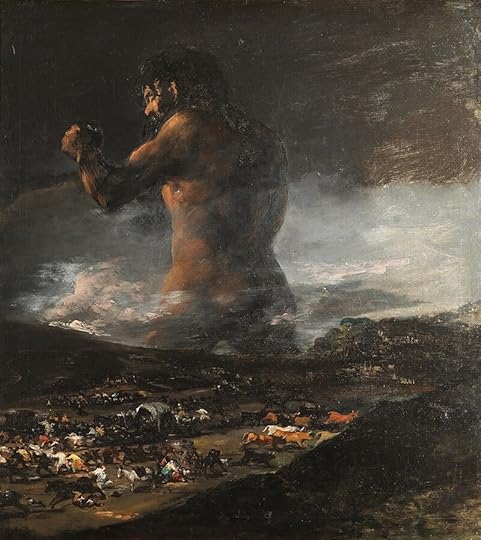
When war comes to Spain and tears apart the fabric of society, Goya paints in darker and angrier tones. THE COLOSSUS painted 1808
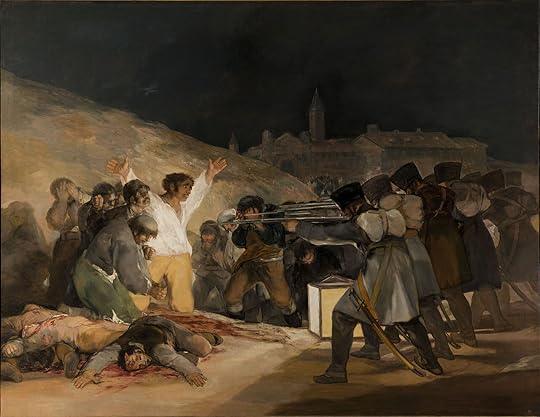
Politics enters Goya’s work with his most famous painting, depicting invading French soldiers killing civilians.
THE THIRD OF MAY 1808 painted 1814
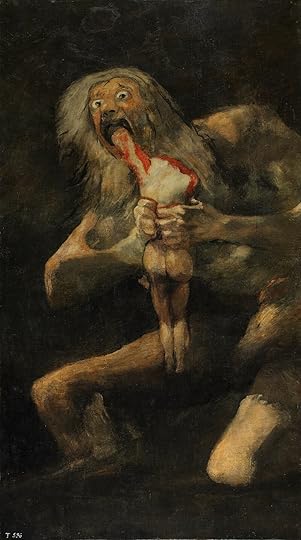
Finally, frustrated by deafness and other health issues, he enters his final and blackest period.
SATAN DEVOURING HIS SON painted 1819-1823
This book is not a huge volume because it’s meant to be a quick primer for Goya’s biography and some of his most famous paintings. But there is quite a bit here with multiple colour plates and chapters on each section of the artist’s life. I can definitely read this again, although it’s starting to fall apart with use. This is the type of art book I love, one I can carry with me as I walk a museum in the hope of learning more while the feet get their due rest.
Oby więcej takich dzieł. Bardzo sumiennie napisana książka z wieloma nazwiskami, datami i miejscami ważnymi do biografii Goi. Niestety w Polsce ciężka do zdobycia w całości
I saw a lot of Goya in Madrid, and so I followed it up with this book. It was not too long, not too short. Placed Goya in his time. Lots of color pictures. Perfect.
Nice, but superficial biography of Francisco de Goya and the times he was living in, nicely illustrated with his paintings, portraits of people, and pictures of places where events happened. It lists lots of names and names and names, -Elrond council style- but it never goes deeper into the people that surrounded and affected his life and opinions. I suppose it's because the book is tiny. The chronology is a bit confusing, and treats a lot of topics like "you ought to know this already so let's move on" but it's ok if you want to be acquainted with Goya for the first time. The author knows the stuff, but it seems that she wanted to push too much information into a small book, and struggled with choosing what was important to write about. Good thing: all the illustrations are in colour and it's a good companion if you are going to visit an exhibition on the topic, though keep in mind it's not very thorough. Not so good thing: Sometimes it talks about paintings and there is no image attached, so having a device with internet and google near comes in handy. Weird thing: reading about Goya in English as a Spanish speaker is a very strange thing indeed. My Spanish-English brain fighting constantly with names of people and places. Charles the fourth? who the heck is Charles the fourth? Spanish brain translates to Carlos IV. Ok good. Moving on. Who the heck is Prince Ferdinand??... etc
One of my favourite art books read this year. I was surprised to learn that Goya was a successful and rich court painter (the book makes much of his obsession with money) where the majority of his career focussed on commissions and paintings of rich nobility.
Some of the more iconic paintings, such as the revolutionary ones or the Black Paintings, form a small part of his oeuvre, and I really liked many of the earlier court paintings- a very good realist painter. The asylum pictures are also great.
Enjoyed learning about his dependence on Rembrandt and Velasquez, and lots of great paintings in the book. Some interesting critical commentary at the end too including sections from Baudelaire and others.
These little books are great! Except for this one- for me. Today we are amazed at Goya for certain areas of his artwork, but the writing concentrates on other areas - Royal relations & all their names. Personally I hate 99% of portraiture (it mostly is record keeping as prephotography in many ways). Very poorly written in areas, felt rushed. The darker work, war, witchcraft, mythology are barely mentioned & with obvious little knowledge or interest by the writer. The crux is, I don't think it's a good representation of his artwork. Nor will make new comers to his work care much for it.
Goya is not an artist whose works I "get" by looking at them. I need some background to understand why he chooses his subjects and paints them as he does. This book supplies that very effectively. Goya is still a three star painter in my heart, but this book is a four star introduction to his art.