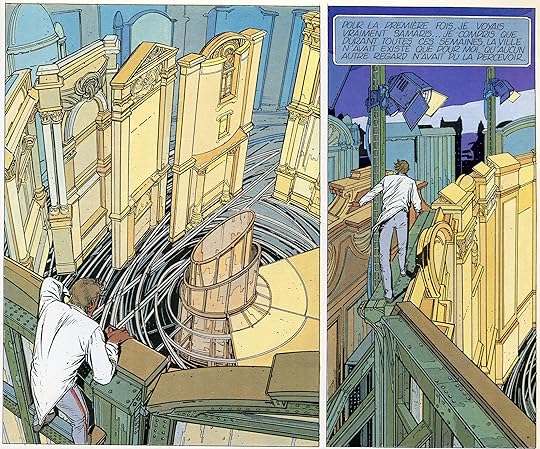
Que se passe-t-il au juste à Samaris ? C’est pour le savoir que Franz, un envoyé de la ville de Xhystos, prend à son tour la très longue route qui mène à la cité. Mais sur place, le secret ne fait que s’épaissir. Toutes les tentatives de Franz pour appréhender et comprendre ce qui se noue exactement à Samaris restent vaines. Pourquoi ne voit-on jamais d’enfants dans les rues de la cité ? Pourquoi les passages et les lieux que Franz semblait connaître semblent-ils se volatiliser ? La ville (dont l’emblème est la drosera, une plante carnivore), plus insaisissable, plus sinueuse, plus complexe qu’elle ne paraît l’être de prime abord, s’ingénie à lui échapper, encore et toujours…
Avec Les Mysterères de Pȃhry:
I Le grand secret II Passage du Louvre III Le Fugitif (altered version) IV L'éstrange cas du dr Abraham
François Schuiten was born in Brussels in 1956, as the son of two architects. He studied at the Saint-Luc Institute where he met Claude Renard. Together, they created the comics 'Aux Médianes de Cymbiola' and 'Le Rail', as well as three volumes of '9ème Rêve'. François also collaborated with his brother Luc on the series 'Terres Creuses' which was published in the legendary Pilote magazine. His final breakthrough into the mainstream of comics came with his transfer to the more adult Métal Hurlant magazine. In 1980, together with Benoît Peeters, he created the series 'Cités Obscures', in which his love of architecture is magnificently visible.
سلام سلام سلام 😍 آدینه به کام☺️❤️ این کتاب یه گرافیک ناول هستش، اولین جلد از مجموعه ۱۲ تایی شهرهای عجیب یا شگفت انگیز ، با عنوان دیوارهای ساماریس کتاب خیلی جذابه، آرت و داستان برای من نوستالژیک بود و یاد داستان های ژولورن میفتادم. از طرف دیگه چون تم داستان براساس شهرهای عجیب غریب و معماری های شگفت انگیز غیرواقعیه، خیلی شبیه ایده شهرهای نامرئی کالوینو بود برام که کتابشو با خفن ترین های زندگیم همخوانی کردم و یه ریویوو هم براش دارم گودریدز 🙃🙃 ایده سینماییش هم شبیه ترومن شو هستش. داریم مجموعه رو با حسین و چنتا از بقیه دوستاش میخونیم . خیلی بلدن و امیدوارم منم بتونم ازشون کلی یادبگیرم🥸🥹❤️
This is the first instalment of one of the central masterpieces of the Franco-Belgian comic tradition – a series by François Schuiten and Benoît Peeters known as the Cités obscures, irritatingly rendered as ‘Cities of the Fantastic’ in the English translations that exist for some of them.
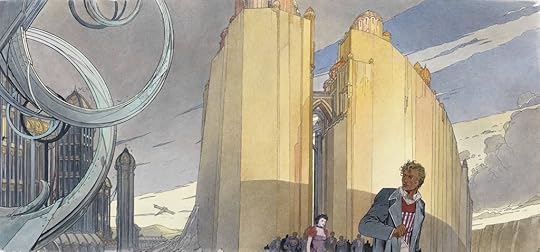
It is really like nothing else out there. Set on a strange Counter-Earth (anti-Terre), where humans live in independent city-states, and which is linked to our own world through various ‘passages obscures’, the books offer stories of profoundly thoughtful weirdness, where philosophical mysteries are situated in dreamscapes of geometric precision. Schuiten's artwork is monumental, architectural – his father was in fact a noted Belgian architect, and he lavishes pseudorealistic detail on the buildings beside which his characters often seem insect-like and insignificant in the frame:
Rereading this, though, I realised how much better the story itself is than I had remembered. It opens in the art-deco-inflected city of Xhystos, where a minor civil servant called Franz accepts a mission to the remote and mysterious city of Samaris, where he is to carry out some simple reconoissance for a few weeks before returning home. But when (after a challenging journey) Franz finally reaches his destination, something is very wrong: Samaris is hushed, the people laconic; there are no children in the streets; and everywhere Franz can hear a whirring, buzzing noise on the edge of his hearing which no one else appears to notice.
One night, convinced that the noise is coming from the hotel room next to his own, he bangs angrily on the door, and then, finally, tries to break it down. Instead, he finds himself bursting through – not the door, but what turns out to be a plasterboard set, to look out on a sea of scaffolding: his own room next door is an isolated box on stilts, and every other room in the hotel is a fake. Investigating further, he realises that the entire city is just an array of various interchangeable sets – un labyrinthe mouvant – which runs on a series of rails, and that every street, every interior he had been in during his stay was assembled for that purpose moments before.
Like a Camus rewrite of The Truman Show, the book spirals off from there into a metaphysical climax of impressive power. The ending is fantastic, but the whole journey is worth the trip, with Schuiten channelling a productive mélange of Jules Verne, René Magritte and MC Escher. This special ‘remastered’ edition also includes four chapters of an unfinished Cités obscures story called Les mystères de Pâhry which shows off Schuiten in a different style, working in black-and-white with exquisite ex-libris-style line-shading. It's a beautiful piece of work and a great introduction to a great series; I hear that a Kickstarter campaign is underway to finance a complete translation of the series into English, so perhaps it will soon get the wider recognition it deserves.
Update: به آقای بنوآ پیترز ای-میل ارسال کردم و درمورد سماریس پرسیدم. ایشون فرمودن که نظریه من در خصوص ارتباط سماریس و سمسرای بودایی اصلا درست نیست. و وجه تسمیه سماریس، سمرقند هست. -------+++
کتاب به طور خودآگاه و هدفمند گیجکننده (disorienting) هست. در حدی که در چاپ دوم، پایان بندی جوری تغییر پیدا کرده تا کمی از سردرگمی خواننده کاسته بشه و این باعث می شه با اطمینان و بی رودربایستی بگم "نمیدونم کتابو فهمیدم یا نه ولی از تجربه کردنش لذت بردم." و درنتیجه باز هم از ریویو نوشتن خودداری میکنم و سعی میکنم فقط یه یادداشت بنویسم از چیزهایی برام که جالب/دوستداشتنی بودن.
⛔اسپیولر در کمین است!⛔ به علاوه تاثیر روش پژوهشی بیضایی رُ هم انکار نمی کنم.
همونجور که در The Invisible Frontier هم تجربه کردم، اینجا هم از مارپیچ و دایره، و اضافهتر، هزارتو برای القای حس "تکرار بی انتها" و "سردرگمی" استفاده شده بود. به علاوه اشارهای که عنوان اثر به سَمسرا (البته ترکیبی از سمسرا و سولاریس) داشت هم یاد آور The Wheel of Samsara هست. کسانی که با هندوییزم و بودیزم آشنا هستن بهتر از من می دونن این به چه معناست؛ سَمسرا در سانسکریت به معنی "سرگردان wandering" و "جریان مدام continuous flow" هست(دقت کنید به حالت فیزیکی و روحی فرانز در طی داستان) و در بودایی سمسرا اینطور توصیف شده: چرخه ای مدام از تولد، مرگ و بازتولد که حالتی دردناک و رنجآور است به واسطه ناآگاهی (Avidya/ignorance)، اشتیاق (Tanha/longing) و نارضایتی از حیات (Dukkha/unsatisfactoriness' of life). هدف اصلی در تعالیم بودایی، رهایی از سمسارا و «دستیابی به نیروانا (Nirvana) ست، که حالتی از رهایی نهایی و خاموشی رنجها محسوب میشود. برای این رهایی، فرد باید از چرخهی تولد و مرگ خارج شده و به بصیرت و آگاهی کامل دست یابد.»
نکته دیگه پایانبندی داستان قرار داره; بازگشت فرانز به سماریس و شروع یه تکرارِ تمام نشدنی، پذیرش سماریس به عنوان وطن، نامُتجانس بودن زمان پیرنگ و پلات و همینطور ابهامی که این پایانبندی در اتکاپذیر بودن راوی ایجاد کرد، باعث شد باز هم تم های همسنخ با "چرخه تکرار" در بودایی/هندویی به ذهنم بیاد. به نظر من شخصیت فرانز در ابتدای داستان آلوده به هر سه گناه اشتقیاق، نارضایتی و ناآگاهی بود (دقت کنید به صفحات ابتدایی کتاب و مخصوصاً رویارویی فرانز با معشوقهش، اَن) و با اینکه تاحدی به ناآگاهیش غلبه کرد، اما چون نتونست به اشتیاق و نارضایتی فائق بیاد، محکوم شد به حبس در سماریس/سمسرا.
🌜پی نوشت: اگه حوصله داشتید تصویرگریهای The Wheel of Samsara رُ چک کنید خالی از لطف نیست. همینطور، نقاشی رُز سفید (….the white rose) از گوستاو دُرِ(Gustave doré) که در ریویو The Inveisible Frontier فراموش کردم خاطرنشانش کنم.
Ceci est le premier album de la série Les Cités obscures, que ses auteurs, François Schuiten et Benoît Peeters, enrichissent depuis plus d’un quart de siècle. Ce premier tome se présente comme un conte fantastique, dont le sujet principal est l’architecture urbaine. A mesure que le héros (un personnage sommairement esquissé) déambule dans les bâtiments et les rues, il découvre un angoissant secrets : la ville est de la même nature qu’une plante carnivore...
Les dessins de Schuiten sont superbes de froideur et d'inventivité, quelque part entre le style Art déco et le Steampunk. Le scénario de Peeters fait penser aux enquêtes oppressantes d’Edgar Allan Poe et aux labyrinthes de Jorge Luis Borges. Cette édition inclut les quatre chapitres des Mystères de Pâhry où l’on découvre l'histoire fragmentée d'un Paris alternatif (dans une ambiance de IIIe République), qui n’est pas sans évoquer les Aventures Extraordinaires d’Adèle Blanc-Sec.
Some weird, art nouveau inspired, sci-fi. It was slow paced, but odd and enjoyable. The art reminded me of some of Barry Windsor-Smith's creator owned work.
The graphic novels from Belgian François Schuiten are always fascinating trips into a strange alternate reality with imaginative architectures and lots of trains. Les murailles de Samaris is the first of several in his Obscure Cities series which is both tantalizing and disorienting but a pleasure to look at and read.
This is the volume that started it all -- what is the longest, most intricate and enigmatic puzzlebox narrative in European comics. These are books that really take the reader away, to a vastly realized alternate history. When I was a kid, just seeing the covers of these books would set me off on some imaginary tangent, to a world where dreams had their own architects, and the architecture could be engineered in your dreams. That may or may not make sense, but it's exactly the kind of giddy, wondrous moods this series can still inspire. But they're not children's books; they explore dark, complicated themes, and 'the beautiful woman' that takes an inexplicable interest in the usually flawed protagonist makes sure to show off her tits in every album. But considering that it was serialized in 'Metal Hurlant' and 'Heavy Metal', it seems tame in comparison to some of the typical fare.
This, at long last, is an available reprint of the first of Schuiten & Peeters' first Cities of the Obscure story, "The Walls of Samaris". As a starting point, there's some clumsiness: the art, despite a fantastic rigor for fantastical architectures, feels a little constrained in some way, perhaps because it subordinates design in a more traditional approach to its panels and character designs. And despite Peeters' already having published several novels by the time of his composing this, the narration has a utilitarian quality. Despite this, the concept here is brilliant, shades of Borges and Calvino's Invisible Cities (obviously an acknowledged reference point given the series title) distilled down to pure mystery and surprise at the peeling back of facades onto a cryptic glimpse of underlying reality.
The second half moves into a series of fragments or short stories drawn from a different concept/city, again playing with the layers of reality, again with a strong sense of architectural intrigue. As later work seemingly composed and revised over a much longer period, the writing and design here have more focus even as the story becomes more diffuse, and I perhaps prefer the clarity of line found in the black & white art.
This is just the tip of the iceberg. I'm very happy to see that these are coming into print again, greatly look forward to further exploration of the unknown territories composing this series.
2025: I like this short comic even more on this re-read. It reminds me of something like Truman Show or I guess more Dark City with the way the city interacts in the story. There's an element of paranoia involved. François Schuiten's architectural artwork is fantastic and works perfectly with the script.
2016: A wonderful start to what I'm hoping is going to be a great series. I had already read the 8th volume in this series and loved it so much I had to seek this one out.
I read this in Heavy Metal, and I guess the book version had some edits included a revised ending. Does anybody know what changes were made?
The art is wonderful, very Art Nouveau to my eyes. Lots of floral decorations. The story was certainly intriguing and had a pitch perfect execution for an alternative world. The characters all act and behave like they actually live in this strange world, and the reader is just taken along for the ride and forced to make his/her own opinions.
Franz, el narrador, reside en la ciudad de Xysthos. La historia comienza cuando acepta una misión en la que han fracasado ya varios agentes, que están desaparecidos. Dicha misión consiste en llegar hasta la lejana Samaris y averiguar qué está sucediendo. Las explicaciones no abundan, algo típico de estos autores, aunque lo que se desvela es sorprendente. Lo mejor es el viaje junto a Franz y lo que le acontece. El dibujo, en color, es muy bueno, donde resaltan las extrañas arquitecturas.
El álbum se completa con un relato inacabado, ‘Los misterios de Pâhry’, este en blanco y negro, una historia que no está mal, con detalles que se encontrarán más adelante en otras de sus obras.
Schuiten's startling imagery was the initial attraction, and the intricacy of his baroque Art Nouveau-ish urban labyrinths did not disappoint. But almost immediately found myself wrapped up in the equally elaborate narrative provided by Benoît Peeters as well. There's a movement and sweep to the marriage of image + text that is almost cinematic; it's something like those imaginative sci-fi B-films of the 1950's Hollywood writ large with the unlimited budget and resources provided by pen and ink to paper. Graphic novels aren't really thing, but I just sent away for the next installment.
Es el primer tomo de la serie "Las ciudades oscuras" y como su nombre lo indica es una revisión obsesiva, al milímetro, de las posibilidades de la arquitectura como una estructura que conforma la realidad y el mundo del protagonista. Como cajas chinas, los edificios forman la barrera natural del personaje que intenta traspasarlos y llegar al centro, mientras se da cuenta que quizás las estructuras no forman realmente nada. Me recordó mucho a Las ciudades invisibles de Italo Calvino. Los diseños son maravillosos, entre el art déco y el mundo propio de los sueños de Schuiten.
Les Murailles de Samaris (published in English variously as "The Walls of Samaris" and "The Great Walls of Samaris") is my first taste of Benoît Peeters and François Schuiten's acclaimed series Les Cités Obscures (alternatively known in English as "Obscure Cities" or "Cities of the Fantastic"). It was also the first to be published, though my understanding is that the volumes are self-contained enough that they can be read in any order.
The premise of the series, as I understand it, is a fantasy world made up of autonomous city-states separated by vast swathes of wasteland. Each city has a distinctive culture and architectural style and, due to large distances and lack of communication technology, the cities remain "obscure" to one another. However, none of this is explicitly explained in Les Murailles de Samaris. Indeed, despite the decidedly high-fantasy premise, this isn't a Tolkien-esque work focused on explicit world-building or epic narrative. Rather, this is a philosophical story saturated with mystery, where little is explained and the reader is left to reach his or her own conclusions. It's hard to describe the story much more without spoiling it. It's definitely a comic where the reader is better off going in without any clear expectations.
One possible weak point in the writing is an excessive reliance on narration boxes. I believe this was Peeters's first time writing a comic and I suspect he wasn't yet entirely comfortable in the medium. Nonetheless, the pacing of the plot is spot-on and the text has a formal, literary feel that perfectly suits the overall mood.
As concerns the visual aspect, I have to say that the depictions of movement are a bit stiff and unconvincing, which detracts somewhat from the more dynamic moments. However, this work prominently showcases the incredible sense of architecture for which Schuiten is deservedly famous: the cities are the stars of this comic, and they all look like real places, with their own characters.
In short, this was an intriguing introduction to the series and I can't wait to read more.
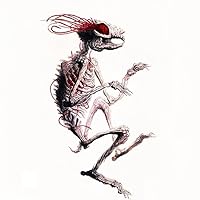
Les Mystères de Pâhry: After the main story, my edition (the 2007 French paperback from Casterman) includes fragments from the unfinished and abandoned work Les Mystères de Pâhry ("The Mysteries of Pâhry"). It's impossible to discern much of a plot here – I assume that if the work had been completed, it would have been a lot clearer. Nonetheless, the fragments included are enjoyable for their nightmarish sense of tension. The final fragment, L'étrange cas du Dr Abraham ("The Strange Case of Dr. Abraham") works particularly well as a standalone short story, and also boasts really lovely use of colour.
Δόξα τον Βραχμαπούτρα που βρήκα και τις υπόλοιπες σκοτεινές πολιτείες σκαναρισμένες εις την Αγγλικήν. Δόξα!
Μετά την ανάγνωση της Σαμάρις δεν θα το άντεχα να μείνω με το μόριο στο χέρι και να μην διαβάσω τα υπόλοιπα 9 (!!!) τεύχη.
Το σχέδιο είναι ανελέητο, πραγματικά δεν σε αφήνει να πάρεις τα μάτια σου από αυτό ούτε μία στιγμή. Το ήθελα μεγαλύτερο, δεν το χόρτασα με 50 κάτι σελιδούλες.
Η αλήθεια είναι πως το σενάριο, όπως και η Ουρμπικάνδη είναι διφορούμενο και τριφορούμενο μη σου πω. Ότι είχα πει, οι ερμηνείες είναι όσοι και οι αναγνώστες. Οκ, Ουρμπικάνδη δεν ήταν γιατί πολύ απλά αυτή δεν πιάνεται, αλλά ήταν εξαιρετικό. Άλλη αίσθηση αυτή η εκτύπωση, στο 9 που το είχα δει (σε κάποιο παζάρι νομίζω; ) ήταν σκουπιδαριό.
Μία παρατήρηση, όχι παράπονο αλλά παρατήρηση. Ίσως να ήταν καλύτερο ασπρόμαυρο ή με άλλο χρωματισμό. Είναι το μόνο χαρακτηριστικό που δεν μου κάθεται τελείως καλά. Ένα μικρό αγκαθάκι, τόσο δα, αλλά τσιμπάει το ρημάδι. :D
Κάαααααααποια στιγμή που οι μέρες θα είναι πιο σκοτεινές,ο κόσμος πιο βρώμικος και εγώ θα έχω παιδέψει την ψυχούλα μου με ολόκληρη την σειρά, θα γίνει μια μελέτη επί προσωπικού για μια φραγκική ερμηνεία του "μιλάς με γρίφους γέροντα". Για κάθε τεύχος ξεχωριστά, δεν είμαστε δα και τίποτα μπακάληδες.
Ich weiß, dass das eines der großen Ikonen moderner Comic-Kunst ist, aber mit fast 40 Jahren merke ich eher die für die 80er typischen postmodernen Tropen und wie schnell die sich in artsy Klischees verwandelt haben. Und weil es einfach an echter Story fehlt (zerquälte Männer, die desorientiert in einer Art Deco-Kulisse rumlaufen und eine generische Geliebte anschmachten sind keine Story), kann ich auch schwer über die seltsame Nostalgie und Retro-Vibes der ganzen Ästhetik hinwegsehen. In gewisser Weise ein bisschen eine Vorschau auf das, was jetzt jeder mit AI-assistierten Bildprogrammen veranstaltet.
Czytany po (podobno) najlepszych odsłonach cyklu, nie robi takiego wrażenie jak tamte. To pierwsza część "Mrocznych miast" i może dlatego momentami czułem, że autorzy dali się ponieść improwizacji. Z drugiej strony jest to nieodłączny element kapitalnej serii, którą kupuję w każdym wydaniu, więc traktuję go jak wstęp do bardziej błyskotliwych tomów. Oczywiście warto
The first in the Obscure Cities series of Franco-Belgian graphic novels; I wrote at greater length about a much more recent entry here. This is a satisfyingly paranoid tale reminiscent of Kafka and Borges and looking ahead to Dark City, but it is somewhat slight, and Schuiten's art is, in this early piece, still very much in the shadow of Moebius, though highly accomplished even so.
Al terminar Las Murallas de Samaris me quedé con una sensación extraña, como desubicada en el tiempo y en la historia. Es una historia que se te mete, llena de simbolismo y misterio, sin respuestas fáciles. Visualmente es una pura maravilla: cada viñeta es una auténtica obra de arte arquitectónica llena de detalles que invita a perderte en sus ciudades. 🏙️
Another beautiful edition in The Obscure Cities series. It contains two shorter pieces that are more fractured and literary than the previous volumes, with echoes of Kafka, Calvino, and even Martin Vaughn-James' "The Cage." An ideal introduction.
I read the 1987 NBM American edition of this title, called "The Great Walls of Samaris," though I also own the 2011 revised French edition. Having just arrived back home from BookExpo where I had the privilege of having breakfast with the author, Benoît Peeters, as as it had been years, possibly as many as 20, since I first read it, I took a couple of hours to revisit the book. The obvious thing that jumps out in this title is François Schuiten's masterful art, but what I had less remembered, was the expert, Rod Serling-like quality of the writing by Mr. Peeters. This story could easily have translated into an episode of THE TWILIGHT ZONE.
The pictured edition is not what I read, though the printing quality in the pictured edition is superior. In addition, the publisher has added 36 pages of supplementary stories, considered rare gems to the followers of the Les Cités Obscure followers.
One thing I want to point out, having been a fan of the artist, François Schuiten, for a quarter century and little to no mastery of the French language, I never paid much attention to the stories until recently. NBM published this title, plus The Fever in Urbicand, Brüsel, The Tower, and The Invisible Frontier, in English. I've recently read the lot of them and have become more impressed than ever with Benoît Peeters' mastering of storytelling.
This is the first book of "The Obscure Cities", one of the most exciting series of all times in the comics/bande dessinée world. Illustrator François Schuiten colaborated with writer Benoît Peeters and produced stories that work on their own but also form a larger body of work. Each story happens in a specific city, and they all are part of another Earth, strangely familiar to ours but definitely not ours.
The style goes into great architectural detail and beauty. And the stories are immersive and captivating. Not often have any other works, in any medium have achieved to create stories showing how the way people live is affected by where they live (as in the houses and cities they live in). Architecture has found in this series a way to reflect upon severall crutial issues, using imagination and art. Just as politics has found in dystopian literature (and in graphic novels, lately) a fertile ground for metaphors and debate.
This volume contains Samaris and The Mysteries of Pahry. Both are visually stunning stories with retro, steampunk feel to them. Samaris very much reminded me of the 1998 film Dark City in terms of the city part. The existential and surreal rule in these stories that are made absurd and unreal with some impressive architecture. As with many of the male created, European and 80s comics, there are few women, and those that are in there are insubstantial and serve the purpose of looking good (sometimes naked). Carla in Samaris perhaps plays an important part, but that's about it. Especially in the Mysteries of Pahry, sometimes it is not clear who's speaking, as the talk balloon tails are too short and don't always point at any specific person.
Obviously the illustrations here are breath-taking- a total triumph of art-nouveau architectural fantasy. But more than that, this is a dreamlike, Kafkaesque nightmare of the edifices of architecture as facades and the ever-just-out-of-reach promise of truth lurking in the dark corners and maintenance passages that are never meant to be seen. This comes to the front most vividly in the chapter in which the Centre Pompidou explodes out of a man's migraine-affected head.
En el punto donde se intersectan La invención de Morel, Las ciudad invisibles, Moebius y el art nouveau, se encuentran estas bellas Murallas de Samaris
Samaris is possibly the most creative and profound metaphor of the allure of cities, capitalism, identity and belonging. A truly magnificent start in the underexplored Obscure Cities series.
On n'a plus de nouvelles de la ville de Samaris. Franz est y est envoyé pour comprendre ce qu'il se passe. Il atterrit dans une cité qui ne tourne vraiment pas rond...
Un scénario incroyable, une histoire dont on ne décroche pas et qui stimule l'imaginaire. Pépite.