Bugs bite, drink blood, and rob food from gardens and fields. They can even kill plants, animals, and, occasionally, people. Is bugging a crime? Alexandra Siy compiles "rap sheets" on several of the major categories of bugs and takes a very close look at some of the types of insects in an engaging text. The fascinating photo micrographs magnify insect parts from 10 to 300,000 times their actual sizes. this kid-friendly approach, coupled with meticulous research and lively writing, turns learning about insects into an intriguing experience.
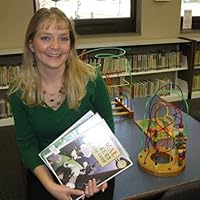
Alexandra Siy is a science writer for kids, merging STEM and art to make STEAM! Many of her titles use primary source scientific imagery to reveal both outer space and the microscopic, inviting young readers to enter worlds that can only be visited using science and technology. Worlds where spiders are superheroes, insects are much more than bugly, a simple sneeze is a micro-second adventure through the body, and the interstellar age is now. Alexandra is also a photographer and the creator of instastem.com, a STEM inspired photography workshop that gets kids reading writing, and creating their own science-as-art photographs. As a visiting author, she travels to schools and libraries nationwide, sharing her passion for science, books, and photography. She's also worked as a teacher in diverse communities, including Alaska and Colorado. Alexandra lives in New York State on her 73-acre sustainable family forest with her teenage son and their cat.
Literary Quality: Bug Shots does a good job of giving information about bugs in a new way. With that being said this book was not something that I just wanted to read over and over.
Originality of Text/Illustrations: Siy presents each bug as one that is wanted. This is original and a bit hokey. The illustrations are magnified pictures of bugs with special coloring applied. These illustrations will engage readers.
Clarity of Style and Language: This book was very easy to read and understand. Middle grade readers will be able to decode the text and learn more about bugs!
Illustrations: The illustrations are well done and are one of the best things about the book!
Design and Format: The book is divided into appropriate chapters. Captions provide adequate information. There are no distractions withing the text.
Accuracy: Appears to be accutate. A detailed list of sources is found at the end of the text.
Interest/Value to Children: Bug lovers will BUT OUT over this book. The information that is presented is interesting and appealing.
Acceptance by Children: Again, bug lovers will love this book. However, I don't know if there will be wide spread appeal with this book.
Of Note: There is an excellent glossary at the end of the book. Additionally, sources are listed including books, articles, multimedia and websites. Lastly a thorough index is included.
This entire review has been hidden because of spoilers.
Too long for a slim little picture-book, better for Middle School. Back matter sufficient, but in very small font. Photos include many extreme close-ups that would appeal to some.
And the premise, I'm not too sure of. In the conclusion, the only bug that got tagged with 'bad' is anopheles (mosquito that carries malaria), but to even imply that humans should have the hubris to judge the worthiness just doesn't sit well with me. After all, everything in ecology is a web and we've known the importance of that perspective for more than fifty years.
There are better bug books out there. And even the photos that make this seem special are surely avl. w/ an online search.
A nonfiction science book with tons of closeup images of bugs. This is closer to a chapter book, though still sized as a picture book, and it’s packed with photos. I especially appreciated the focus on what makes a ‘good’ or ‘bad’ bug, as well as the fact that all the pictures include the scale/magnification rate.
Bug Shots: The Good, the Bad, and the Bugly, is a cute take on the world of insects. the author Alexandria Siy and photographer Dennis Kunkel gives kid an interesting take on insects by showing us there are good and bad kids of bugs along with magnifying the bugs so that kids can see them with the naked eye. She also shows us a neat way to collect bugs without doing any harm! I would say this book is a good read for students who are a little older and can understand the whole idea of “bug shots”, along with ones who actually like bugs. Also students who are not really old mature enough to understand a lot about bugs will love Kunkel’s photographs. This is a cool nifty book. I love books about nature and the outdoors so I know there has to be a kid as weird as me and I have so many ideas of how I could use it in my classroom! I could teach so many lessons on insects and show why they actually are necessary for our ecosystem, or this could just be a cool book to sit on the shelf either way I don’t think it would be on the shelf very long!
The ultra-zoom-precision photos of bugs (primarily insects) and their parts are the undeniable winning feature of this book, making it usable at every level. The text is well-written, engaging, and contains both familiar essentials and very unusual and impressive additional information. Photo captions are equally well-done, as are glossary, sources, and index. This is a must-have for established readers of science but can function well as a visual resource for younger bug-lovers. The photos might even make a fan of those who are not such fans of the creepy crawly things.