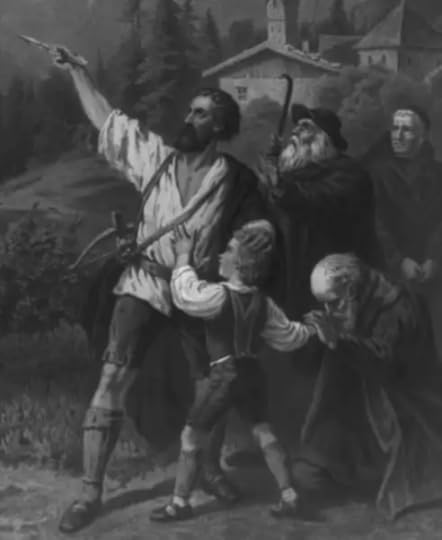
Legend has it that early in the fourteenth century, when the Swiss were oppressed by Austrian Hapsburg rulers, one man stood up to the tyrants. His name was William Tell. William Tell was appalled that his people were forced to kneel to the hat of their govenor, and he refused to do so. His punishment was severe: An apple was placed on his son's head, and Tell was told to shoot it. If his arrow found its mark, the had would be removed from the town square. If it did not, young Jemmy migh die. . . With vigorous text and stunning paintings, Leonard Everett Fisher adapts and illusrates this story of William Tell, which he calls "a metaphor for freedom."
اذا اجبروك على الانحناء لقبعة في غدوك و روحك ..هل ستفعلها؟ حسنا لقد رفض السويسري وليام تل منذ سبعمائة عام فعاقبه الملك برمي تفاحة فوق رأس ابنه بسهم
سأله الملك :و لماذا أتيت بالسهم الاخر؟ فرد وليام تل:أتيت به لاقتلك به اذا اصيب ابني بالسهم الاول.. هكذا👀 أمر الملك بسجنه مدى الحياة في سجن بجزيرة بعيدة لتتوالى مغامرات أشهر رامي في الأساطير ..و تماثيله تملأ الشوارع السويسرية
كانت هذه اول قصة انجليزية اقراها باختياري في سن التاسعة و احببتها
Author/illustrator Leonard Everett Fisher, who has retold many myths and folktales for children in his long career, here presents the legend of William Tell, the Swiss folk hero celebrated for shooting an apple off of his own son's head. Opening in 1307, when Gessler, the brutal Austrian governor of the Swiss town of Altdorf, made the townsfolk bow to his hat, the story follows Tell's refusal to obey, and the punishment meted out to him. After the famous incident in which Tell succeeds in shooting the apple, the book concludes with a brief summary of his adventures thereafter: from escaping imprisonment, by jumping out of a boat carrying him to the prison, to slaying Gessler, thereby freeing the area...
Although I am familiar with his work, William Tell is the first of Fisher's books that I have picked up. I was prompted to do so by my recent reading of Margaret Early's William Tell, which offers another picture-book retelling of the legend, as I wanted to compare that book to other versions. On the whole, I prefer Early's version, which draws in far more of the history - the Rütlischwur, and the foundation of the Old Swiss Confederacy - and feels more authentic to me. I do appreciate Fisher's telling however, and his somewhat dark-toned, but beautiful illustrations. I particularly liked his use of color here, and found his human faces expressive, if a little bit odd at times. Although not my favorite, this is still a solid retelling of the legend, and is one I would recommend to young folklore lovers, and to anyone looking for stories about William Tell for the picture-book set.
William Tell by Leonard Everett Fisher- Children’s Colour Picture Book- The book narrates the story of William Tell. This is a hero’s story of daring & freedom. The story is set in the early 14th century where an oppressive new governor, an agent of the Hapsburg Empire, orders his subjects in a small town in the Swiss Alps to kneel before his hat. William Tell, a skilled and respected marksman. He defies Governor Herr Gessler’s order with his young son Jemmy as his witness. When Tell declares that he will never kneel before a bully, Herr Gessler is enraged. Instead of sending William Tell to prison, Gessler orders Tell to shoot an arrow at an apple placed on top of his own son Jemmy’s head. If Tell is able to strike his target, he and his son will be freed and the townspeople will no longer be compelled to kneel before Gessler. If William Tell misses his mark, however, he will lose his son, face a lifetime in prison, and the townspeople will continue to kneel before Gessler’s hat. William has no alternative but to accept this challenge. An apple is place on the head of Jemmy. 60-steps away, William Tell arches and hits the apple. Jemmy has to be freed. Just then another arrow falls from the coat of William Tell. Her Gessler enquires the reason for the second arrow. William replies that if his aim fails, he would aim his second arrow on Gessler. Before the townspeople react, William is arrested and taken to prison on a boat. William is able to jump from the boat. William hides on a tree from where the army men have to travel. He is able to shoot Gessler. William Tell returned like a hero. This thrilling tale is accompanied by large-scale and mural-like oil paintings that artfully capture the dismay and fear of the townspeople, the frantic pace of the storytelling, and the climax of this gripping tale. I have read the translation of this book in Hindi Language.
Hero Story Fisher, Leonard Everett. William Tell. New York: Farrar, Strauss, Giroux, 1996. Set in the early 14th century, an oppressive new governor, an agent of the Hapsburg Empire, orders his subjects in a small town in the Swiss Alps to kneel before his hat. William Tell, a skilled and well-respected marksman, defies Governor Herr Gessler’s order with his young son Jemmy as his witness. When Tell declares that he will never kneel before a bully, Herr Gessler is enraged. Rather than sending Tell to prison, Gessler orders Tell to shoot an arrow at an apple placed on top of his own son’s head. If Tell is able to strike his target, he and his son will be freed and the townspeople will no longer be compelled to kneel before Gessler. If Tell misses his mark, however, he will lose his son, face a lifetime in prison, and the townspeople will continue to kneel before Gessler’s hat. Will Tell accept this challenge? What will become of William Tell, Jemmy, Her Gessler, and the townspeople? This thrilling tale is accompanied by large-scale and mural-like oil paintings that artfully capture the dismay and fear of the townspeople, the frantic pace of the storytelling, and the climax of this gripping tale. Fisher’s storytelling is masterful and suspenseful, leaving the reader in the lurch at the end of each page. This book is ideal for upper elementary grades and can serve as an introduction to topics such as tyranny, dictatorship, and rebellion. Target Audience: Grades 4-6
Although the story of William Tell itself is grim, this version has little to recommend it. The drawings are not strong, the language is flat and I think children would have a difficult time following it. It might be possible to use this with older children to discuss freedom and what other previous governments were like. However, I think the whole murder aspect would make me more inclined to leave it off of the reading list for at least my first five years.
The character is a mix of Robin Hood and Braveheart in some ways, but, like all great stories where the Hero opposes bullying Authorities, he beats the bully and wins the hearts of his fellow countrymen forever.