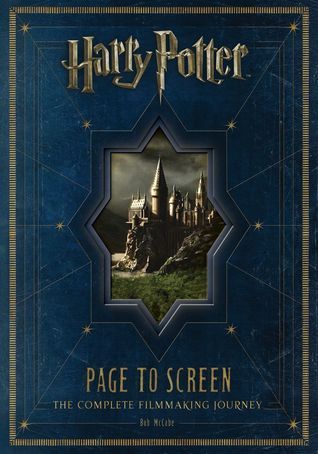
"Harry Potter: Page to Screen" opens the doors to Hogwarts castle and the wizarding world of Harry Potter to reveal the complete behind-the-scenes secrets, techniques, and over-the-top artistry that brought J.K. Rowling's acclaimed novels to cinematic life. Developed in collaboration with the creative team behind the celebrated movie series, this deluxe, 500-plus page compendium features exclusive stories from the cast and crew, hundreds of never-before-seen photographs and concept illustrations sourced from the closed film sets, and rare memorabilia. As the definitive look at the magic that made cinematic history, "Page to Screen" is the ultimate collectible, perfect for Muggles everywhere.
This book exceeded all my expectations, and it certainly befits the Harry Potter film saga.
This is a large format 532-page hardcover. It's so huge and hefty so you can't really hold it for reading without resting it on something, like your lap. The cover is beautifully designed with an embossed title and a window looking at Hogwarts.
There are three parts to the book. The first is "The Making of Harry Potter" and covers the complete film making process of all the seven Harry Potter titles. The second is "The Art of Harry Potter" and that covers the characters, locations, creatures and artifacts. The third is the epilogue. It took me several days to finish reading.
I want to make special mention on the layout of the content which is beautiful and thoughtful. All the stunning photos and art are published at high resolution. On some pages, there are illustrations or patterns printed on a thin gloss that gives the page a slight shine as you flip over. The text is set on light cream coloured paper. There's an illustrated drop cap that starts every chapter, and every section in the chapter ends with a nice symbol. Even the choice of typography used is excellent.
The first part featuring the film production stories are a joy to read. It starts right at the beginning, from getting the copyright to make the films, to casting and filming right to the last day. There are lots of interesting details to read about, such as interactions between the actors and film crew, how the stage and props are made and the challenges and considerations of filming.
You read about how the children were like deers in the headlight on their first day of filming. There were extensive laughing, constant looking into the camera. As you read along towards the last film, you know how much they have grown as actors.
The writing is wonderful. The author Bob McBabely is a master at weaving the stories, controlling the flow and transition from one section to another. There's a part where Emma Watson admits to having a crush on Tom Felton and in the next sentence Tom Felton says,"Poor Emma. Of course I knew; it was obvious. But I never mentioned it.". There amount of research and interviews done must be incredible. Every film crew mentioned are given introductions and a thorough background on what they do.
The stories on set designs are really interesting. You can find out how sets are constructed, like Hogswarts and all the different rooms and secret locations. I thought the underwater scene in Goblet of Fire was totally CGI but it turned out that Daniel Radcliffe actually had to swim, while holding his breath, and act in a water tank. And of course, there are details on how that water tank was built, with heaters, bacteria-killing UV lights, and the little things that don't cross our minds.
The second part of the book is sort of like the encyclopaedic look at the characters, locations and artifacts. There are staff commentary on everything. You can look into the different classrooms of professors, read The Daily Prophet, check out The Weasleys' tent at the Quidditch World Cup, marvel at the different broomstick designs, etc. Amazing and detailed photos of the sets fill the pages.
There are concept art in the book as well, and they are great. There are designs for Dobby, dragons, props, environment art, etc. This is the only book where you can see them because there aren't any Harry Potter art books.
This book is highly recommended to fans of the Harry Potter films. It gives a new sense of appreciation for the film and the people who worked behind the scenes. It's something you'll want to make the magic last a bit longer.
Compared to Harry Potter Film Wizardry
Harry Potter Film Wizardry is like a condensed version of Page to Screen. Much of the content in terms of text and photos are duplicated. There are some information and photos that are not included in Page to Screen though. That book is designed like a scrapbook with little goodies — booklets, stickers, maps, even Harry's letter of acceptance to Hogwarts, etc - attached to the pages. The layout is nice, magazine-like.
If you're just looking to get one book, then there's no doubt about choosing Harry Potter Page to Screen. If you're the true blue Harry Potter fan, then of course you'll want both books.
Just how much information is too much information? This is something each fan of the Harry Potter movies need to ask themselves before buying the book. Harry Potter Page To Screen: The Complete Filmmaking Journey is a book that promises to do exactly like the title says. It gives the complete story of the filmmaking process of the Harry Potter movie franchise. Do some people, who've probably closed the chapter to that part of their life when the last movie came out last July, actually want to know everything about the films that looked so magical on screen? There is, after all, always the danger of being disillusioned after getting to know a certain thing (or a person) to the minutest detail. Familiarity, they say, often breeds contempt.
Furthermore, seeing as there are some people who don't really adore the movie adaptations by Warner Bros. of JK Rowling's beloved novels, those who find the film series lacking should probably steer clear off the book. It's wordy, heavy and, yes, bloody hell, pricey. Not only could you actually break someone's toes if you accidentally drop it on their feet), you might actually break your own wallet buying the book. These people might end up hating the films instead of loving them if they were forced to buy the book.
Having said that, if you are a fan of the movies or at least fans of the people working in the 8 HP movies, this is the one book you simply must have. If Harry Potter: Film Wizardry by Brian Sibley is the fan's ultimate fun book, this is the budding filmmaker's ultimate textbook on how to make an epic franchise that lasts a whole decade. Whatever shortcomings the films have, you can not deny that a lot of thought went into the making of the films. From casting to scriptwriting to designing sets and characters, this book reveals all of them.
There are exclusive photographs of the actors and the crew. There's a list of the actors' heights at the start of the franchise, in Harry Potter and the Philosopher's Stone. There's sketches of Dobby and Kreacher and Quidditch. There are concept arts. There are costumes. There are character references. This book is what happens when someone converts all the behind-the-scenes portion of the DVDs into writings on the printed papers of a hardbound tome. (And the DVD's extra features still can't compete with even half of the book.)
A serious Potter collector will want this book to put on their bookshelf next to the Rowling novels. A casual Potter fan will want to borrow this book from a friend who's a serious Potter collector. Either way, this might be the very last Potter-related book to be published for a while. Now that this book is out, as well as the DVD for the last movie, the Harry Potter saga comes to an end. We hope that there will be more but, just in case there's not, do pull out $75 from your bank accounts and use the cash for the book. Despite the mass, the oversharing and the price, it is a book well worth your time and dime.
I think this book is brilliant! It's another going on my Amazon wishlist!
The book is like a tome and I love it! You get to read about how all of the sets of each movie were put together, who the directors were, how they found each person etc.
I loved seeing the illustrations in the book. Seeing the rooms that you could take your time and eat up each little part! They showed so many beautiful things, like some of the beautiful dresses and clothes the characters wore. I mean they looked so much better in these pictures!
The parts where they were putting together towers and parts for the school was just amazing. I was so enthralled with all of these things. It certainly makes me want to get out the blu rays and have my own Harry Potter day :)
I would recommend this book to anyone who doesn't have it already. It's magnificent!
This is an impressive book is anyones terms - over 500 pages of Harry Potter what more could you ask for (apart from a reinforced book case to house it)
Well okay I will admit I do enjoy the books and films - I do not class myself as a raving fan (took many other books and films out there to compare to for that) but I do think the phenomenon is both a credit to J K Rowling but also a joy to see reading being brought back in to lives of young readers (and possibly future authors).
The book pretty much is exactly as the title says a journey - with the first pages talking about the signing of deals and conversations had by various agents and representatives securing the film rights and what happened from there on. All the way to the last words as the production closes - you see the complete journey in all its glory.
The books is lavishly illustrated from production images both in front and behind the scenes - it shows a very intimate side to the films and the people who created them which is rarely seen especially on such film considering the huge budgets and massive attention they were drawing.
The book itself is broken in to several sections - not only covers the film production but also the costumes, creatures and locations. The book gives a very comprehensive view in to the massive amount of work that goes in to these films which is rarely credited and hardly ever seen. As a result this is an amazing book for both fans and casual readers alike.
At first, I was in love with this book. I am a big fan of the books and then the movies, and I always wondered how they adapted those wonderful books for the big screen. There is just so much information in this book, and it is presented artistically through pictures as well as words. When I finished it, I felt like I knew so much more than I could have ever asked for. However, after a while, I realized that something was missing. The book discussed the changing directors and how they brought their visions to films that became progressively more dark, but the changing composers that brought music to these films are never discussed. Being a musician, I was somewhat disappointed. I would have liked to read about how John Williams was chosen to start the series, why he left, and how he and the others created the music that brought so much feeling to these films.
Some might argue that the book is about adapting the books for the screen, and since the soundtrack is not really part of the books, discussing the soundtrack is not as important to this book. I say that music fills in a lot of emotion and other nuances of the books that can't be covered by the actors or the scenery. This book has plenty of information about making these movies; I just think it would have been more complete if they discussed the soundtrack.
This gargantuan tome details every stage of the process that transformed the J.K. Rowling books into the Warner Bros. movies. When the movies originally came out, I was seriously disappointed with the obvious discrepancies from movie to movie as well as some of the missing plot (as almost every fan of the books was, I suppose). This book gave me a look at the decision making process that the producers, directors, and most importantly the screenplay writer followed, and allowed for a better understanding of the theatrical series as a whole.
One of my favorite aspects of the book, however, was the artwork. From conceptual art detailing the costumes, artifacts, and locations to the several different styles of death-eater masks and wands, it was a beautiful (and at times macabre)supplement to the Harry Potter experience as a whole. This is a must have for any Harry Potter enthusiast!
An amazing Christmas gift... no way is this amazing volume going to be merely a coffee table book. I plan to read it cover-to-cover and soak up every amazing little detail that went into making this series.
It's fun to see which anecdotes I remember from magazine articles over the years, and which details are entirely new...
FUN TIDBITS:
This book has kind of made producer David Heyman one of my heroes. Love how he said he first grew interested in working on Harry Potter because he just generally adored reading so much.
Love the info about Robbie Coltrane and his Hagrid body double. And how his double started practicing his lines just for fun to the point where Coltrane felt "threatened" they'd just use the *real* big guy.
Also had no idea that they initially considered Tom Felton for Harry?!
Never knew they actually tried dentures to give Emma Watson Hermione's buck teeth. But sure enough, watch the end scene in the first movie, and there they are?!
Dan Radcliffe found out on the first film that he has a nickel allergy because the glasses were giving him odd rings around his eyes?!
Richard Harris was producer David Heyman's Godfather?!
Funny to hear actress Clemence Poesy talk about her character Fleur. She says she enjoyed playing the role, but that Fleur was just like all the girls she hated in high school. Lol
In addition to his role as a Weasley twin, James Phelps also served as an assistant director on the "Half-Blood Prince" set.
Alfonso Cuaron said he based the young marauders seen in flashback off of The Beatles.
For the library scenes, crew members wore gloves made out of green screen material in order to grab books from passing characters and re-shelve them. Then, their hands could be removed and it looked like the books were shelving themselves.
Richard Harris actually thought the animatronic Fawkes was a real bird, it looked that lifelike on the set.
The horcrux cave was filmed at the Cliffs of Moher in Ireland, which I have visited twice. Didn't even recognize the place, but I guess that's movie magic for ya!
The first time I saw this, I flipped out. As someone who's obsessed with all things Harry Potter, I just had to get my hands on this massive book. Reading it was even more fun than I thought it would be. It goes through the entire process of making each movie, from selecting the cast to writing the scripts to bringing the incredible magic to life on screen. It's got the big-picture stuff, like the different directors' and producers' visions, as well as the details, like how they made each magical creature. There are tons of interviews and quotes from the cast and crew, plus memorabilia from the sets. Basically, this is the best coffee table book ever if you love Harry Potter.
Here are a few random things I learned while reading this book:
At the beginning, there was discussion of animating the films instead of using real people (how different that would have been!)
Daniel Radcliffe wasn't even going to try out for the role of Harry Potter; fortunately for him, his family ran into one of the producers at an opera and talked his parents into letting him audition
Michael Gambon (Dumbledore) has never read the Harry Potter books (shame on him!)
Emma Watson (Hermione) had a huge crush on Tom Felton (Draco) during the filming of the first several movies
One crew member's only job was gluing individual hairs and feathers into stuff, like the boar's head in Hogsmead and Dumbledore's bird, Fawkes
As soon as I got this book, I knew I would have to read it cover to cover to really feel complete. I couldn't just skim, I had to know everything! And it was lovely and so rewarding. I knew a lot of stuff, granted, but that's what comes with being so immersed in this universe for so long.
This book really made me appreciate the movies more. I could understand more why they chose to do certain things, appreciate the changes they made. I loved the stories offered by the actors and the crew. And god, I got overwhelmed just thinking about the amount of attention, time, and detail they put into some of those props! Individual hairs! Moulds! Casts! 4 different Buckbeaks! It was astounding.
And the photography was crisp and clear, the foldouts were lovely, the details superb. I loved the owls and snakes and castles that you could only see if the page was tilted just right.
Seriously. This book was perfect and amazing and I learned a lot and it recreated the magic for me in a completely new way.
It's the Harry Potter Bible! The movies are amazing, too. This book is very informative and artistic. The visuals are fabulous and the pages overflow with juicy information.
This mammoth tome (I could barely lift it) provides a very detailed behind-the-scenes look at the making of the Harry Potter movies. I especially liked the concept art and unrealized scenes/props from the final films. I also liked learning about how closely the filmmakers worked with Jo as the books were still in progress at the same time. The book is divided into different sections and highlights the characters, locations and objects that make up the magical world. It was a lot of fun to peer closely at the still images and pick up on things that are hard to see on screen.
I recommend this to adult fans of the movies and those who enjoy reading about movie magic. I wouldn't let my young niece and nephew look at it because a)some of the movies do have very scary elements and b)it ruins the magic! Die-hard fans of the books like me may be a bit disappointed that they didn't explain why they made some of the decisions to change the story or remove parts (I'm looking at you Harry Potter and the Goblet of Fire! Where's Winky and SPEW?) except for time constraints. It's still a fun look at how they made some of the most technologically innovative and imaginative movies of the early 21st century.
This book was way better than I thought It would be. It had so many full page photos and so many cool photos of how they made everything. It made me appreciate the movies more now I now how much work was put into the special effects. I recommend EVERYONE to read this if you love harry potter! (This is a really big book and its heavy)
I often begrudge movies the fact that they are not like the book, but it's really like comparing apples and oranges-- though similar, they are inherently different.
It was fascinating to read what each actor thought of their own character-- Fiona Shaw had the most keen insights into her character of Mrs. Dursley that has sparked within me a desire to revisit the early HP novels and pay closer attention to the lesser-focused Dursley dynamic between the matriarch and her nephew (that is often overshadowed by the more comic relationship between Dudley and Harry).
The photos are awesome; it was really astounding to see just how much work went into every single minute detail, whether it was the script, the set, the costume, the miniatures-- oh my goodness, the miniatures! Those diminutive pieces of art that informed their larger and grander counterparts are completely unbelievable to behold in their size and the intricacy of detail. If anything, looking through all the photos made me realize to a greater depth of understanding that there is so much more to a movie than simply the actors and director-- and it really gave me a greater sense of appreciation for the art and science that is movie-making.
This book was beautiful. I loved everything I learned and I enjoyed reading about all the work they put into these movies. So much work that they put into it and to think some of the details were't even noticed in the films. Like the details that they put into the broomsticks and the smaller details of the set. It is very inspiring, especially to me because I'm a filmmaker. Makes me want to work harder and be more dedicated to my work. I know it was a big book, but honestly I felt it could have been much longer. I felt they could have expanded on a lot more things that they worked on in the movies. But I also know that it's hard to put everything in one book. My own production book for my 25min film is 100 pages, so I imagine that they have thousands and thousands of pages of notes, drawings, sketches, and things. And I'm sure it was hard to decide what to share with the readers. And if they made it any longer it probably would have cost like $100 if not more and not many people would have bought it. This was a wonderful book. Every fan should read it.
“Harry Potter: Page to Screen” was really fun to read. It gives a great inside look at how the films were made. I especially enjoyed the beautiful photographs and the funny anecdotes provided by the actors. Here are a few of my favorite tidbits:
- Michael Gambdon (the 2nd, and far worse Dumbledore) never even read the books!!!! No wonder he didn’t have a clue how Dumbledore should act.
- James Phelps (Fred Weasley) worked as a runner on the set of the HP films. Matt Lewis took advantage and always made James bring him coffee.
- They made Matt Lewis (Neville Longbottom) wear a fat suit throughout the films. No wonder it was a shock when he turned out to be such a hottie. :)
I was a bit reluctant to read this at first because I was scared the book would give away too much information and then the movies would lose its magic, if it makes sense. But I’m so glad I started reading it, it’s incredible everything the cast and crew did to bring to life this little and beautiful thing that is Harry Potter.
Este libro es realmente genial. Pensé que me iba a arruinar las películas y que de cierto modo iban a perder su magia, pero fue todo lo contrario. Conocer cómo se hicieron con lujo de detalle hace que Harry Potter sea una experiencia mucho más mágica.
This is one huge book and quite an expensive one. But it is well worth the cost if you are a Harry Potter fan.
There is so much fascinating information on the cast and the characters and the creation of the locations, creatures and all the movie props. I particularly liked finding out the thought processes that went into making each of the movies and why they chose to do certain things the way that they did. It is great reading and there are so many stunning photographs and drawings.
This book has me wanting to re-read the books and re-watch the movies yet again!
Para nada he terminado este libro. Porque sus más de 600 páginas en inglés llevan su tiempo y su disfrute, pues es maravillosa la cantidad de información, anécdotas y curiosidades que desvela de este mundo detrás de las cámaras del fenómeno Harry Potter *-* Una edición "inmensa" no solo en volumen, si no sobre todo en calidad visual y de contenido. Un deleite friki total e imprescindible para todo potterhead.
Mielenkiintoinen ja ihana kirja, mutta ehkä kuiten 3,5. Välistä faktoja oli väärin (esim asiayhteydestä hoksasi ettei kyse olekaan Harrysta vaan Ronista) ja toistoa oli turhan paljon.
Leffoihin käytetty työ on kuitenkin jotain järjettömän suurta, ei voi kuin ihailla. Tuli hinku katsoa leffat uusiksi (aloitin jo), lisäksi lievitti tämänvuotisen kirjanaratonin jättämää haikeutta.
Suosittelen.
Ps 200 sivun jälkeen suurin osa on kuvia, ei tää nii valtava kirja ole vaikka vähä onkin.
This truly is the Harry Potter bible! It took me forever to read picking it up every once in a while but I really enjoyed it! There was information about nearly everything, details you would have never known otherwise. I loved the anecdotes from cast and crew members since we don’t see that much anymore. The pictures were also beautiful. As a Harry Potter and occasionally film nerd, this was fun!
How I Came To Read This Book: I believe I first saw it in Entertainment Weekly and thought it'd be a good fit for my blog, so I requested a review copy.
The Plot: This is basically an encyclopaedia to everything on the Harry Potter films. The first half of the book is the 'story' of the eight films (although Deathly Hallows is combined into one chapter), including getting them made in the first place, before the series was the phenomenon it became. Each film is discussed in terms of how the casting process worked, with commentary from the producers and the actors on what it was like to add each new cast member. The plot is also vaguely discussed in terms of what went into bringing certain scenes (or adding / reducing certain plot points) to life on the big screen - whether it's technical effects, locations, or fun behind-the-scenes anecdotes and photos. There's also a fair bit of discussion and commentary from the three lead actors on what it was like to work with each director / make each film. The second half of the book is more where the encyclopaedia designation comes in. Giant chunks of the book are dedicated to costumes (really, characters), sets, props, and creatures and what went into the design / how they came to life / concept art. It's very photo / caption heavy at this point, with little snippets of information on materials used or hours that went into something.
The Good & The Bad: I read another book on a *very* similar topic earlier this year, Harry Potter Film Wizardry. You might ask what the difference between them is, and the surface answers would be size and the fact this book encapsulates the final film, while the other (rushed out for last year's holiday gift-giving season) did not. But on a more realistic level, this is a book for a student of the films, not a fan. You have to have a real interest in production and art direction (which I'd say I somewhat do...but not quite to this degree) to really appreciate the final detail included here.
Admittedly, it got a little rote. The first half of the book was definitely the most interesting to me, although even then it veered into really dry territory. The second half had much less substance and was almost distracting with all the photo / captions. I mean really, did you ever really care to know what thought went into Percy Weasley or Crabbe & Goyle's "Looks"? No. All too often, the book felt like it was written for the people on the film, as a way to sing the praises of the very talented designers behind-the-scenes that you probably don't give a second thought about, but would if they weren't doing their jobs as well as they were. Sort of a catch-22.
BUT that being said, the book is a wonderful compendium. It made me want to re-watch the films, despite just having done so over the summer before the final movie. It gave me a serious appreciation FOR the amount of work that went into creating them, and it astonished me how often the techniques I assumed were CGI were actually grounded quite heavily in old-fashioned tricks like miniatures and robots. It's a lot to kind of slog through and absorb all at once (even though I read it over the span of a few weeks) - the physical heft of the book should tell you that - but I imagine it'll be a book I'll pull off the shelf many times over the years whenever I do go back and rewatch the films. One final small quibble? I would have organized the latter half differently. Still keep everything in sections like 'costumes' and 'sets', but I'd have done it more chronologically - talk about a set the first time it appears in order, but talk about all its evolutions within that entry. So if the Burrow appears in Book 2, address it in the Book 2 'Sets' chapter, but talk about how different it is in Book 2 from Book 7. OCD relieved.
The Bottom Line: A wonderful addition to any diehard Potterhead or avid movie fan's collection - but not an incredibly *necessary* one.
Really, really cool behind-the-scenes information about the production of the Harry Potter movies. I learned so much about the Harry Potter universe, the actors, and the way movies are made. Like the fact that Mafalda Hopkirk was played by Sophie Thompson, the younger sister of Emma Thompson, and Bill Weasley was played by Brendan Gleeson's son Domhnall. And that the prop crew bought sixteen Ford Anglias from around the country to use in filming. That most of the amazing props and sets were really physically made, with animatronics to make them move—like the Whomping Willow, the doors to the Chamber of Secrets, Aragog, the basilisk's head and 25 feet of its body, etc. The wizard's chess scene was done entirely in real life—the only effects they added digitally were some extra dust and debris for the explosions. They built those giant pieces and actually blew them up on-set.
Hagrid and Madame Maxime were played half the time by very tall doubles wearing massive prosthetic heads. In the graveyard scene at the end of Goblet of Fire, when they were doing the shots that showed only Harry, Ralph Fiennes would stand near the cameras yelling insults at Daniel Radcliffe to help him keep up the emotion he needed for the scene. Evanna Lynch—the girl who played Luna Lovegood—was a Harry Potter fan before she auditioned for the movie, and when Jo Rowling found out she'd been cast, she remembered that Evanna had once written her a letter, and the two had corresponded. Matt Lewis (Neville) wore a fat suit, false teeth, and plastic behind his ears for all the movies except the last one. Emma Watson had a crush on Tom Felton in the earlier movies, and it was one of those embarrassing kid crushes where everyone on the whole set knew. For Goblet of Fire, director Mike Newell had James and Oliver Phelps practice fighting each other. They weren't getting it, so he had one of them volunteer to fight him, and they wrestled until Newell cracked a rib. The Knight Bus was an actual double-decker bus painted purple with a third layer welded on top of it.
The outfits that Ron, Hermione, and Harry wear in Prisoner of Azkaban are almost identical to the ones they wear in Deathly Hallows, because the costume designer wanted them to have recognizable looks throughout the series. Ron's always in oranges, reds, and greens, because those are the homemade Weasley colors; Hermione wears pinks and greys; and Harry wears blues and greys and muted colors because he's always been an outcast and is used to wanting to blend in. In Order of the Phoenix Umbridge's clothes get pinker and pinker as she becomes more and more sinister (and Imelda Staunton requested that her outfits be designed to emphasize her rear, so she could develop a distinctive walk, which I thought was funny). Voldemort started out wearing a very thin layer of silk, and as each movie goes on and his power becomes more and more solidified, they added layers on. And the scenes with Polyjuice Potion are so fun to think about—Emma Watson acted the scenes, and then Helena Bonham-Carter imitated her. Daniel Radcliffe had to do the same thing with all six of the actors who played Hermione, Ron, Fred, George, Fleur, and Mundungus in the scene with the seven Potters.
That's just the stuff I can remember off the top of my head right now. It's an enormous book, and you wouldn't think you'd actually sit down and read it—but it's definitely interesting enough to do so.
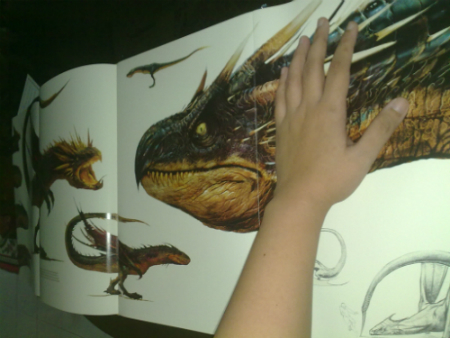
Harry Potter Page To Screen is a narrative from the producer's skepticism (at first) towards Harry Potter and the Philosopher's Stone, to the making of every movie, to the actors, to the settings, to the props, and down to the last day of the filming. There were also a hundred of photos taken from the set. I specifically love all the concept arts. Since the book was a big one, the images were quite big and you can see everything in detail.
This image of a dragon is as big as my hand.
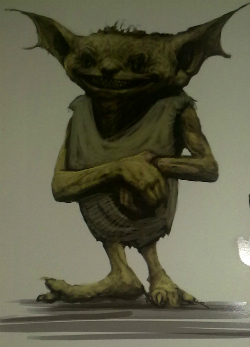
It's really impressive. But some of the images were creepy like those of Voldemort, Inferi, and even Dobby. Something that goes in the back of the subconscious mind that is responsible for giving nightmares later. I remember turning the page and a full page image of Fenrir stares back. I got quite a scare.
One of the Dobbys drawn. I'm glad Dobby didn't turn out like this.
Some of the tricks used in the movie were also explained. Most of the scenes in the movie were applied with CGI but you would be surprised to know that the most simplest and practical techniques were also used especially with Prisoner of Azkaban. The making of the set and the props were also illustrated. There were a lot of props that took 40 people to make for months. It made me a little bit ashamed that I didn't even notice all of these in the movies as I was focused with the story. I didn't even notice the stitching of Professor Dumbledore's robe, didn't even realize that it took months to put hairs into the centaurs body which would only be seen for a few minutes. It made me feel overwhelmed to see how much effort were put into making Harry Potter. I am in awe and I salute every one behind the scenes.
I know the studio has been opened for everyone in London. So if you can't go there yet, Harry Potter Page To Screen will be as close as a tour for you in the Harry Potter world.
What an amazing book! Everything I expected and more.
The book consists of a detailed chapter on each of the films, characters, costumes, locations, sets, creatures, makeup /digital effects, artifacts and prop making.
It's very well written, and the balance between photos and information is just right. The behind the scenes anecdotes and unknown tidbits, really make this an interesting and enjoyable read. All of the sections were informative, without tipping over into the over detailed, boring and sometimes irrelevant info, that film tie-ins can sometimes lean towards.
The concept art really stood out in the book, practically every page has a sketch/painting/digital rendition of original ideas for sets, props or scenes for the films. It was lovely to see the transition from the first ideas, to the finished, and sometimes completely different end products in the films.
The photos are excellent, a varied mix of stills and behind the scenes shots.
The book itself is absolutely gorgeous. The biggest and heaviest book I own by far, and it's one of those books that you will look over again and again for years to come. It would have been nice to have a ribbon bookmark included for the book though, just as a useful crowning glory.
The only thing I missed, and would have liked to see was maybe a short interview from JKR herself. Although there are mentions of her collaboration in the book, it would have been nice to read her thoughts on seeing her magical world on the big screen.
This book was underwelming for me. I've never been a huge fan of the Potter movies(mostly because they leave so much out that I love about the books), but if you're going to spend this kind of money on a book about the films, you're much better off buying the Film Wizardry book that was released last year. At almost half the cost, it has as many amazing photos and actual pullouts and inserts and focuses more on the individual characters and settings, where this book has no extras and focuses more on the production of the seven films and how they actually came to life. So if you love the books more, don't waste your time or money. If you're a movie buff and love the films, at over 500 pages, this book won't let you down. I still think the $75 price tag is a little steep.
P.S~I'm not going to lie and act like I sat down and read every little detail in this book. Cause I didn't. I looked at all the pictures, read some about my favorite parts, and then decided it wasn't for me.
This book is so incredibly awesome. The first half goes through detailed steps and behind-the-scenes information about how they made the movies with access from the producers, directors, designers, and the cast. The second half is mostly pictures of the design and artistry of the sets and costumes and everything else. I wish I had bought a magnifying glass for some of the pictures, and I wish I had more time with the book (I borrowed it from the library, but I would love to buy it someday). It reminded me of the many reasons why I love the movies and feel that they only add to the enjoyment of the books. And then I immediately started re-reading the books for the umpteenth time. It's a great addition to the Harry Potter experience.