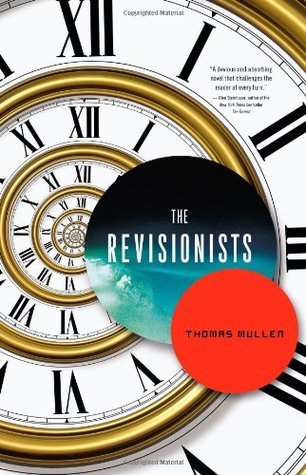
Mullen's third novel, a dystopian time-travel, was drowned out in the literary world by Stephen King's time travel epic, 11/22/63. Actually, both novels are ideal as bookends; in King's book, the protagonist goes back in time to try and alter history, whereas Mullen's protagonist, Zed, is an agent from the future employed to preserve history exactly as it is and prevent disruption or changes. If you add Orwell's 1984 (constant surveillance) and Farenheit 451 (destruction of historical documents), you have a riff of Mullen's themes. However, he created his own artistic, original, and literary novel that asks disturbing questions from all sides and parallels many of the contemporary concerns of our post 9/11 world.
Date unknown, but we have survived the "Great Conflagration," a period of warfare and global destruction that started in Washington, D.C. during the 21st century and led to the now "Perfect Present." The Perfect Present is canny once you understand that this semi-utopian existence is a mixed bag. Yes, there is world peace, no hunger, and no religious wars (and no religion), and race is essentially a non-issue, as everyone is mixed.
But, at what cost this Perfect Present? For one thing, all history is sacred, yet exiled from citizens' knowledge. The past is considered dangerous, because it is psychologically and socially harmful to dwell on the events that caused wars and disasters. The government forbids historical knowledge to circulate; moreover, when a loved one dies, all traces of them are erased in a haunting and treacherous manner.
Zed, a government-employed time-traveler, is known as a Protector, another sly term used to denote the active preservation of history, a euphemism for protecting atrocities such as the Holocaust, 9/11, and World Wars--necessary in order to ensure that the Perfect Present now exists. Zed is cybernetically enhanced with the power of GPS and superhuman surveillance skills. His "contemp" (21st century) name is Troy Jones.
Certain rebels or "hags" are anti-government agitators who believe that people deserve to know their history, and part of their job is finding ways to access hidden and confidential historical documents. The hags travel back to the past and attempt to prevent specific horrors from occurring. These time travels provoke cat-and-mouse chases between the Protectors and the hags. Zed's job is to eliminate the hags and protect the Perfect Present.
This is as much a novel of ideas as it is a spy thriller. Characters wrestle with themes of protection vs power, of morality vs truth, and also grapple with identity, memory, and loss. In addition, the question of life's narrative is ubiquitous in the story--continuity, progression, recall, and interpretation. Moreover, how do you preserve history, when you are standing in it? What happens if you get involved with a person from the past? Supposedly, some people count more than others, and minor changes with insignificant members of the population don't necessarily affect the future. But Zed is standing close to the precipice, facing a steep chasm of people and history, flirting with fissures.
Tasha is a young corporate lawyer in D.C. grieving for her soldier brother's death in Iraq, and troubled by the information she was given. She doesn't believe the government's story about what happened, which leads her to a mission of her own, and a potentially perilous breach of ethics. She meets Zed at a demonstration. He is breaking the rules by consorting with "contemps," but figures that there will be no butterfly effect from his interactions with her.
Leo is a former CIA spy now working for a morally ambiguous security company. He is asked to tail some anti-government/anti-war activists in the D.C. area. While grocery shopping, he meets a beautiful Indonesian nanny, Sari, who works for a Korean diplomat and his wife. Her inscrutable air fails to conceal some ugly facial bruises, but she isn't talking.
The twists and turns are about two steps ahead of the reader, but with a casual pace that burns slowly and effectively, allowing time for character building and depth, and for ideas to flesh out. And, no matter how refined the technology, everyone is damaged and, to some extent, working with crude tools. And, as in life, not all questions can be resolved. But there's love, and a knock at the door. Will (s)he answer it?