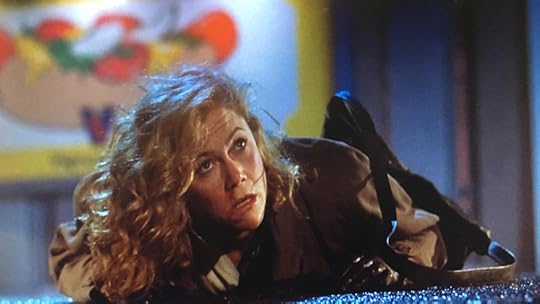
Oddly, even though I've read many of the V.I. Warshawski novels, I'd yet to read the first one until; now.
I have certain expectations of one of Vic Warshawski's exploits: well-written; tightly plotted; intricately bound up with Chicago culturally, politically. and topographically; gritty, and, of course, depressing as all get-out.
That Vic is always always under the hammer isn’t surprising; most detectives are. That she faces tall odds is also expected. However, she's the only detective I’ve read of so far whom everyone outside of her ‘inner circle’ (put in quotes because even these folks only get so close) seems to have some problem, from slight discomfort to outright loathing. Very few people like Warshawski on first sight, and those that do soon change their tune. Part of it has to do with the massive ‘me against the world’ complex Vic carries around with her, crystalized in visions of her deceased mother’s recalled ferocity. This means that Warshawski usually winds up at odds with everyone, from the people she’s against to her clients, and sometimes even to those in her inner circle. She’s a lone crusader, battling against the world, willing to fight the good fight right up until the moment she falls. Which, by the way, is going to happen, sooner or later. Warshawski never out-and-out says this, but there’s a certain fatalistic air to the novels that makes me feel that way.
Why read them, then? Because it’s damned good writing! God knows I wouldn’t want to be Warshawski — I’d probably be tempted to eat a bullet at some point, only the remembered stare of my mother’s fierce eyes would guilt me out of doing it, setting me up for more misery — but Paretsky’s words make it worth the slog.
Which is why Indemnity Only came as a surprise. Things are gritty in it, yes, but Vic hasn’t yet reached that level of fatalism that darkens the later books. There’s more, much more chauvinism against her, especially from homicide detective Bobby Mallory (not one of my favorite characters in any of the books, but he reaches new —or old, I suppose— heights of m.c. oinkhood here) but the foreword keeps you aware that this is to be expected: this was the early eighties, and the things we accept that women can do in the post ‘naughts without (much) of a blink was still new and raw then. And hell, one of Warshawski’s clients actually doesn’t turn on her!
So, if you’re a fan and like me, haven’t read this book, by all means pick it up and celebrate V.I. Warshawski’s thirtieth anniversary in style. And if you’re new to our lady of scrap-iron, this is a great place to start making her acquaintance. Just remember, things do get better, and, of course, worse.