

What do you think?
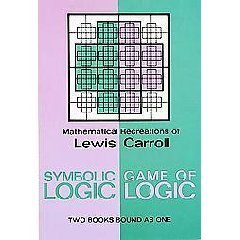
Lewis Carroll's Symbolic Logic
Lewis Carroll’s Symbolic logic : part I, Elementary, 1896, fifth edition, part II, Advanced, never previously published : together with letters from Lewis Carroll to eminent nineteenth-century logicians and to his "logical sister," and eight versions of the Barber-shop paradox / edited, with annotations and an introd., by William Warren Bartley, III.
496 pages, Hardcover
First published January 1, 1896
About the author
Lewis Carroll
6,461 books8,610 followersThe Reverend Charles Lutwidge Dodgson, better known by the pen name Lewis Carroll, was an English author, mathematician, logician, Anglican clergyman and photographer.
His most famous writings are Alice's Adventures in Wonderland and its sequel Through the Looking-Glass as well as the poems "The Hunting of the Snark" and "Jabberwocky", all considered to be within the genre of literary nonsense.
Oxford scholar, Church of England Deacon, University Lecturer in Mathematics and Logic, academic author of learned theses, gifted pioneer of portrait photography, colourful writer of imaginative genius and yet a shy and pedantic man, Lewis Carroll stands pre-eminent in the pantheon of inventive literary geniuses.
He also has works published under his real name.
His most famous writings are Alice's Adventures in Wonderland and its sequel Through the Looking-Glass as well as the poems "The Hunting of the Snark" and "Jabberwocky", all considered to be within the genre of literary nonsense.
Oxford scholar, Church of England Deacon, University Lecturer in Mathematics and Logic, academic author of learned theses, gifted pioneer of portrait photography, colourful writer of imaginative genius and yet a shy and pedantic man, Lewis Carroll stands pre-eminent in the pantheon of inventive literary geniuses.
He also has works published under his real name.
Ratings & Reviews
Friends & Following
Create a free account to discover what your friends think of this book!
Community Reviews
Displaying 1 - 15 of 15 reviews

August 1, 2020
1. Le anatre non ballano il walzer.
2. Un ufficiale non rifiuta mai di ballare il walzer.
3. Tutti i miei animali da cortile sono anatre.
(I miei animali da cortile non hanno il grado di ufficiale.)
1. Nessuna poesia interessante è impopolare tra chi ha veramente buon gusto.
2. La poesia moderna non è mai priva di affettazione.
3. Tutte le tue poesie hanno per soggetto le bolle di sapone.
4. La poesia affettata non è mai popolare tra le persone veramente di buon gusto.
5. Nessuna poesia antica ha per soggetto le bolle di sapone.
(Tutte le tue poesie sono poco interessanti.)
1. Quando lavoro a un esempio di logica senza brontolare, potete star certi che riesco a capirlo.
2. Questi polisillogismi non sono disposti in ordine regolare come gli esempi cui sono abituato.
3. Gli esempi semplici non mi danno mai il mal di testa.
4. Non riesco a capire gli esempi che non siano disposti in ordine regolare allo stesso modo di quelli cui sono abituato.
5. Non brontolo mai per un esempio, a meno che mi dia il mal di testa.
(Questi esempi di polisillogismi sono difficili.)
Insomma, carino. Ho qui trascritto alcuni dei miei sillogismi preferiti, quelli che mi hanno fatto ridere, ma ce ne sono tanti che non dicono alcunché, almeno a mio avviso. Trovate il pdf gratuito online tra i Millelire di Stampa Alternativa su stradebianchelibri.com, insieme a tanti altri librini piccini molto interessanti che ho scaricato come se non ci fosse un domani.
2. Un ufficiale non rifiuta mai di ballare il walzer.
3. Tutti i miei animali da cortile sono anatre.
(I miei animali da cortile non hanno il grado di ufficiale.)
1. Nessuna poesia interessante è impopolare tra chi ha veramente buon gusto.
2. La poesia moderna non è mai priva di affettazione.
3. Tutte le tue poesie hanno per soggetto le bolle di sapone.
4. La poesia affettata non è mai popolare tra le persone veramente di buon gusto.
5. Nessuna poesia antica ha per soggetto le bolle di sapone.
(Tutte le tue poesie sono poco interessanti.)
1. Quando lavoro a un esempio di logica senza brontolare, potete star certi che riesco a capirlo.
2. Questi polisillogismi non sono disposti in ordine regolare come gli esempi cui sono abituato.
3. Gli esempi semplici non mi danno mai il mal di testa.
4. Non riesco a capire gli esempi che non siano disposti in ordine regolare allo stesso modo di quelli cui sono abituato.
5. Non brontolo mai per un esempio, a meno che mi dia il mal di testa.
(Questi esempi di polisillogismi sono difficili.)
Insomma, carino. Ho qui trascritto alcuni dei miei sillogismi preferiti, quelli che mi hanno fatto ridere, ma ce ne sono tanti che non dicono alcunché, almeno a mio avviso. Trovate il pdf gratuito online tra i Millelire di Stampa Alternativa su stradebianchelibri.com, insieme a tanti altri librini piccini molto interessanti che ho scaricato come se non ci fosse un domani.
December 28, 2013
Concise, engaging, great for self-learners
The Kindle edition is a little strange; I can't seem to find the references diagrams in it, although web searching the book will help you on those occasions.
It's a short book that touches mostly on the basics of symbolic logic, so it might be stuff that you've already learned in middle school math class. However, Carroll will probably make this topic a thousand times clearer than your teacher could dream to. He simplifies most propositions into one of only three forms, so you wouldn't have a hard time remembering. And if you're struggling with converting sentences into letters, you have his logic diagrams to aid you reach your conclusions (he claims his diagrams to be much more efficient than Euler's and more complete than Venn's, although he's kinda pushing it on that later claim. His diagrams are definitely simpler to use for small discussions).
His comments on other popular views of the topic are a must-read; they will let you judge where Carroll and his book stand in the topic before you move on to his subsequent writings or to other authors. Now wish me luck as I try to find a similarly great summary of Russell and Whitehead's epic
The Kindle edition is a little strange; I can't seem to find the references diagrams in it, although web searching the book will help you on those occasions.
It's a short book that touches mostly on the basics of symbolic logic, so it might be stuff that you've already learned in middle school math class. However, Carroll will probably make this topic a thousand times clearer than your teacher could dream to. He simplifies most propositions into one of only three forms, so you wouldn't have a hard time remembering. And if you're struggling with converting sentences into letters, you have his logic diagrams to aid you reach your conclusions (he claims his diagrams to be much more efficient than Euler's and more complete than Venn's, although he's kinda pushing it on that later claim. His diagrams are definitely simpler to use for small discussions).
His comments on other popular views of the topic are a must-read; they will let you judge where Carroll and his book stand in the topic before you move on to his subsequent writings or to other authors. Now wish me luck as I try to find a similarly great summary of Russell and Whitehead's epic

October 5, 2018
Great book! Teaches logic and gets the user to appreciate a graphical way of representing propositions. The second book, the 'game of logic' is method of using the first books graphical interface to represent propositions as a game. This is a no-nonsense straight to the point read that is delightful.

October 11, 2014
In many ways, a fascinating book, though I do admit I didn't actually do all of the exercises and quite a lot of the stuff was already known to me, I still enjoyed reading it and it was very interesting to see some of Carroll's other work.
April 27, 2021
"I see! And the hero’s name is what?"
"There is no hero, sir."
"No hero? Well, lucky I reminded you. Better put one in pronto! Ermm… call him `George’. `George’ is a good name for a hero. Er, now; what about heroines?"
"There is no heroine, sir… unless it is our Mother Tongue."
"Ah, the *mother’s* the heroine. Nice twist. How far have we got, then? Old Mother Tongue is in love with George the Hero. Now what about murders? Mother Tongue doesn’t get murdered, does she?"
"No she doesn’t. No-one gets murdered, or married, or in a tricky situation over a pound note!"
"Well, now, look, Dr. Johnson, I may be as thick as a whale omelette, but even I know a book’s got to have a plot."
But the real reason for my low review is because I was confused by abook about something I already know. A well written four-page tutorial might have worked better.
"There is no hero, sir."
"No hero? Well, lucky I reminded you. Better put one in pronto! Ermm… call him `George’. `George’ is a good name for a hero. Er, now; what about heroines?"
"There is no heroine, sir… unless it is our Mother Tongue."
"Ah, the *mother’s* the heroine. Nice twist. How far have we got, then? Old Mother Tongue is in love with George the Hero. Now what about murders? Mother Tongue doesn’t get murdered, does she?"
"No she doesn’t. No-one gets murdered, or married, or in a tricky situation over a pound note!"
"Well, now, look, Dr. Johnson, I may be as thick as a whale omelette, but even I know a book’s got to have a plot."
But the real reason for my low review is because I was confused by abook about something I already know. A well written four-page tutorial might have worked better.

December 30, 2022
A mind opener
A local (accredited) university allows a course in Propositional Logic to replace algebra. There is even Propositional Calculus. I find algebra a lot simpler.
Well, this critter is symbolic logic (Mathematical logic) is not the same but it is close enough. It is more English orientated however eventually moves into symbol tables. But still a toughie. Lewis Carroll gives a warning at the front of the book to not try to dive into the middle of the book or peak at the last chapter or you will be confused and toss out your opportunity to learn symbolic logic. Each chapter (I found page) builds on the previous one.
I am only a few chapters in at this time however I see the world of communication in a new light.
For example:
A person with no concept of electricity sees a switch and knows it is on and off and that is it. Others will look at the switch and see the end product of how the electricity operates from the physical wires to the A.C. concept. They may even follow the power to the source. Then the source of the materials. Then the materials to physics. Then to the quantum. Eventually from the quantum to us and back to turning on the switch.
All of that is simpler than this book on logic gets around to. It is someone’s idea of logic.
Amazingly, the mathematician Lewis Carroll could write about something so deep over a century ago and still be spot on. Of course, he does mention cities that use gas for lighting.
So, enjoy, dig in, discuss with friends, and be thankful for this opportunity to expand your mind.
What Carroll did not know:
The less-than sign plus the equals sign (<=) is used for an approximation of the less-than-or-equal-to sign (≤).
ASCII does not have a less-than-or-equal-to sign.
But Unicode defines it at code point U+2264.
In BASIC, Lisp-family languages, and C-family languages (including Java and C++), operator <= means "less than or equal to".
A local (accredited) university allows a course in Propositional Logic to replace algebra. There is even Propositional Calculus. I find algebra a lot simpler.
Well, this critter is symbolic logic (Mathematical logic) is not the same but it is close enough. It is more English orientated however eventually moves into symbol tables. But still a toughie. Lewis Carroll gives a warning at the front of the book to not try to dive into the middle of the book or peak at the last chapter or you will be confused and toss out your opportunity to learn symbolic logic. Each chapter (I found page) builds on the previous one.
I am only a few chapters in at this time however I see the world of communication in a new light.
For example:
A person with no concept of electricity sees a switch and knows it is on and off and that is it. Others will look at the switch and see the end product of how the electricity operates from the physical wires to the A.C. concept. They may even follow the power to the source. Then the source of the materials. Then the materials to physics. Then to the quantum. Eventually from the quantum to us and back to turning on the switch.
All of that is simpler than this book on logic gets around to. It is someone’s idea of logic.
Amazingly, the mathematician Lewis Carroll could write about something so deep over a century ago and still be spot on. Of course, he does mention cities that use gas for lighting.
So, enjoy, dig in, discuss with friends, and be thankful for this opportunity to expand your mind.
What Carroll did not know:
The less-than sign plus the equals sign (<=) is used for an approximation of the less-than-or-equal-to sign (≤).
ASCII does not have a less-than-or-equal-to sign.
But Unicode defines it at code point U+2264.
In BASIC, Lisp-family languages, and C-family languages (including Java and C++), operator <= means "less than or equal to".
March 11, 2011
Lewis Carroll presents a delightfully light-hearted approach to predicate logic, in illustrating the very principles of logic that underly even the furthest reaches of mathematical practice.

March 30, 2020
Simpatico passatempo per me abbastanza senza senso...

Did Not Finish
March 21, 2026Still interested. Didn't read enough to draw an opinion.
November 15, 2025
Probably only worthwhile if read recreationally. I tried to look through it for value, but the electronic version was painful, the exposition is poor, and the definitions seem imprecise/outdated. It seems largely useless for learning mathematics. Read something with truth trees instead.
My value judgment might be wrong if: historical context makes it interesting or it's of interest for philosophical reasons. Both seem unlikely.
My value judgment might be wrong if: historical context makes it interesting or it's of interest for philosophical reasons. Both seem unlikely.
October 17, 2016
Terrible format. Got the free electronic copy. This is some pretty ''special interest'' stuff. Felt like a mix of reading someone going through a delusional mental breakdown and an artistic way to over complicate simple basic notions. Might be worth going through this with a proposed ''genial friend'' and a hard copy of this book in hand. Overall ,left me in a state of WTF.
June 16, 2008
Hard, but worth the read.

February 6, 2011
Read about in The Believer

January 6, 2017
Fascinating exercise.
Displaying 1 - 15 of 15 reviews