

What do you think?
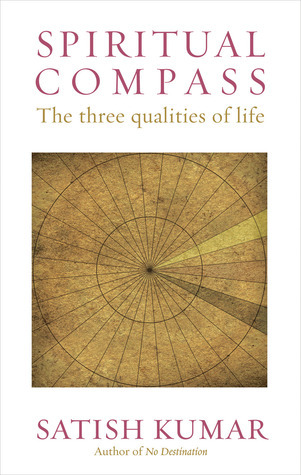
Spiritual Compass: The Three Qualities of Life
In our modern, materialistic world it is easy to separate spirituality from everyday life. But spirituality is not just for saints, neither is it confined to the Sunday Service, Friday prayers or holy books. It must be a part of our ordinary, everyday it needs to be implicitly present in business, in politics, in farming, in cooking, and in our relationships.
To illustrate this, Satish Kumar draws on the Indian Ayurvedic tradition which characterises the mind as having three gunas, or primary sattva (characterised by calmness, clarity and purity), rajas (energy and passion), and tamas (dullness and ignorance). These qualities can be applied to our work and the for example, there are sattvic foods, rajasic
foods and tamasic foods. The Ayurvedic aim is to live a life which is simple and close to nature (sattvic), to reduce rajasic tendencies, and to avoid tamasic. When we see ourselves in the light of the three gunas, they can orient us towards the direction in which we wish to go. They can help us to recover the art of living, and lead us towards a peaceful and contented existence.
Extending the meaning of spirtuality further, Satish explains that there is no dualism between spirit and matterall matter is imbued with spirit, and spirit manifests through matter. This integrated world-view forms the core of his book.
To illustrate this, Satish Kumar draws on the Indian Ayurvedic tradition which characterises the mind as having three gunas, or primary sattva (characterised by calmness, clarity and purity), rajas (energy and passion), and tamas (dullness and ignorance). These qualities can be applied to our work and the for example, there are sattvic foods, rajasic
foods and tamasic foods. The Ayurvedic aim is to live a life which is simple and close to nature (sattvic), to reduce rajasic tendencies, and to avoid tamasic. When we see ourselves in the light of the three gunas, they can orient us towards the direction in which we wish to go. They can help us to recover the art of living, and lead us towards a peaceful and contented existence.
Extending the meaning of spirtuality further, Satish explains that there is no dualism between spirit and matterall matter is imbued with spirit, and spirit manifests through matter. This integrated world-view forms the core of his book.
- GenresSpirituality
Hardcover
First published January 1, 2007
About the author
Satish Kumar
278 books71 followersSatish Kumar is an Indian, currently living in England, who has been a Jain monk and a nuclear disarmament advocate, and is the current editor of the magazine Resurgence, founder and Director of Programmes of the Schumacher College international centre for ecological studies and of The Small School. His most notable accomplishment is a "peace walk" with a companion to the capitals of four of the nuclear-armed countries-- Washington, London, Paris and Moscow-- a trip of over 8,000 miles. He insists that reverence for nature should be at the heart of every political and social debate. Defending criticism that his goals are unrealistic, he has said, "Look at what realists have done for us. They have led us to war and climate change, poverty on an unimaginable scale, and wholesale ecological destruction. Half of humanity goes to bed hungry because of all the realistic leaders in the world. I tell people who call me 'unrealistic' to show me what their realism has done. Realism is an outdated, overplayed and wholly exaggerated concept."
Ratings & Reviews
Friends & Following
Create a free account to discover what your friends think of this book!
Community Reviews
Displaying 1 - 10 of 10 reviews

January 22, 2022
Satish Kumar uses Ayurveda to characterise the mind as having three gunas or qualities being sattva, rajas and tamas.
Like using a compass he uses the three qualities and applies them to everyday life.
To live a simple contented life within our means, non harming and close to nature is the sattvic way.
The rajasic way is impressive, seeking results and improvement of things.
The tamasic way moves away from nature, embracing violence and dominance.
A wonderful book exploring values of living a sattvic lifestyle.
Like using a compass he uses the three qualities and applies them to everyday life.
To live a simple contented life within our means, non harming and close to nature is the sattvic way.
The rajasic way is impressive, seeking results and improvement of things.
The tamasic way moves away from nature, embracing violence and dominance.
A wonderful book exploring values of living a sattvic lifestyle.
This entire review has been hidden because of spoilers.

January 31, 2024
It is not give MORE to the poor
but TAKE less FROM the poor
This small book contained alot of insight and wisdom that served as another reminder how I can live a more harmonious, connected partnership with my surroundings.
The divide between nature and humans brings about a disconnection, but Kumar addresses ways we can heal this, with bits of advice on perspective/mindset and direct action.
Poverty is the result of SEIZURE of the gifts of the Earth by the few
but TAKE less FROM the poor
This small book contained alot of insight and wisdom that served as another reminder how I can live a more harmonious, connected partnership with my surroundings.
The divide between nature and humans brings about a disconnection, but Kumar addresses ways we can heal this, with bits of advice on perspective/mindset and direct action.
Poverty is the result of SEIZURE of the gifts of the Earth by the few

March 13, 2019
Helps us understand the universal forces in all life's areas, and reflect where and how each could be used. The ultimate aim is the positive balance, for all beings happiness.
October 25, 2022
As always a spark for the soul to awake

September 30, 2025
Philosophy of the Environment class
Read from 5:30-7:00
Read from 5:30-7:00

December 8, 2022
This book was lent to me by a friend, and I found it quite perplexing. It’s very thought-provoking in terms of how we live our lives, both as individuals and as a society. Where we’ve gone wrong in the world is highlighted very clearly, and I don’t disagree with any of the major points made by the author. However, I was left quite despondent as I feel it’s too late for us to go back to a better way of living our lives. How could capitalism be dismantled in reality?
There were some small ways in which we as individuals can live better, for our own sakes and those of others, but as to how we change society as a whole, particularly Western society, I just don’t see how there’s any way back from current methods.
There were some small ways in which we as individuals can live better, for our own sakes and those of others, but as to how we change society as a whole, particularly Western society, I just don’t see how there’s any way back from current methods.

June 28, 2012
Spiritual Compass by Satish Kumar is a novel that tries to help the reader become more spiritual in his/ her everyday life. It uses the ancient Indian tradition of Ayurveda to do this. Specifically, Kumar asserts that the mind has three primary characteristics: sattvas, rajas, and tamas. By relating these three mind states to different aspects of life, Kumar helps teach his readers how to live more wholesome and spiritual lives. Sattvas, the ideal quality, is translated as the natural and simple way of life. It encompasses everything that is “uncorrupted, original…honest, undiluted, refreshing, lucid, luminous, and spiritual.” Rajas comes from the root raj, which means kingdom in Hindi. So, it makes sense that the rajasic way of life is glamorous, seductive, and exciting. Tamas is the least desirable quality of the three. It is dark, vengeful, and depressing. The tamasic way of life is described as heavy and ignorant. Kumar successfully expands on these three mind states (including how they permeate through all aspects of life) and explains their pros and cons.
Later in the novel, Kumar shifts gears slightly and talks about the importance of permeating spirituality throughout life, rather than living a dualistic life. He maintains that spirituality is a mind state, rather than a separate aspect of life. For example, he explains how a basic activity like baking bread can turn into a spiritual experience). Kumar shows the reader that many of his/her actions and thoughts stem from which of the three mind states he/she is in. After showing some of the pros and cons of each quality of life, he offers an 11 point plan to help shift our minds into the Sattvic way of living:
1. change attitude towards the world
2. live more simply
3. consume less
4. do not waste
5. do not use harmful products
6. walk more
7. bake your own bread
8. meditate
9. work less
10. be informed
11. be organized
I thought this novel was really interesting because it offered a way for me to incorporate mindfulness and spirituality into my everyday life. I do not think I will adhere to the eleven point plan by the dot, but I love Kumar’s idea of trying to focus on one activity at a time and living simply. I also love the concept of treating everything you do as if it is spiritual rather than living a dualistic life of materialism and spirituality. During this last year, I have been trying to live less materialistically anyways and I think this novel’s message of spirituality through everyday life is a great addition to that. I also think that this novel strengthened my moral compass because it does not let you perceive the soul and the body as separate. This means that everything I do must be moral and righteous for me to live a satvic life. I really like this way of looking at life and I think it is my biggest takeaway from Spiritual Compass. This novel really opened me up to a new way of looking at the world and hopefully I can use this perception to become more spiritual in life.
Later in the novel, Kumar shifts gears slightly and talks about the importance of permeating spirituality throughout life, rather than living a dualistic life. He maintains that spirituality is a mind state, rather than a separate aspect of life. For example, he explains how a basic activity like baking bread can turn into a spiritual experience). Kumar shows the reader that many of his/her actions and thoughts stem from which of the three mind states he/she is in. After showing some of the pros and cons of each quality of life, he offers an 11 point plan to help shift our minds into the Sattvic way of living:
1. change attitude towards the world
2. live more simply
3. consume less
4. do not waste
5. do not use harmful products
6. walk more
7. bake your own bread
8. meditate
9. work less
10. be informed
11. be organized
I thought this novel was really interesting because it offered a way for me to incorporate mindfulness and spirituality into my everyday life. I do not think I will adhere to the eleven point plan by the dot, but I love Kumar’s idea of trying to focus on one activity at a time and living simply. I also love the concept of treating everything you do as if it is spiritual rather than living a dualistic life of materialism and spirituality. During this last year, I have been trying to live less materialistically anyways and I think this novel’s message of spirituality through everyday life is a great addition to that. I also think that this novel strengthened my moral compass because it does not let you perceive the soul and the body as separate. This means that everything I do must be moral and righteous for me to live a satvic life. I really like this way of looking at life and I think it is my biggest takeaway from Spiritual Compass. This novel really opened me up to a new way of looking at the world and hopefully I can use this perception to become more spiritual in life.

November 5, 2012
It's amazing how easy Satish Kumar dwells with supposedly complex matters, simplifying them and making it available to everyone who can read. Very inspiring and useful book, with lots of practical examples of how spirituality is present in everyday life. A must read if you care about your actions and choices. Really enjoyed it :)

February 1, 2009
Very simple and profound book. I recommend if you are interested in spirituality.
February 8, 2016
People must create a balance by feeding the body , the mind and the sou!!!
Displaying 1 - 10 of 10 reviews