

What do you think?

Embodiment and the inner life: Cognition and Consciousness in the Space of Possible Minds
To understand the mind and its place in Nature is one of the great intellectual challenges of our time, a challenge that is both scientific and philosophical. How does cognition influence an animal's behaviour? What are its neural underpinnings? How is the inner life of a human being constituted? What are the neural underpinnings of the conscious condition?
Embodiment and the Inner Life approaches each of these questions from a scientific standpoint. But it contends that, before we can make progress on them, we have to give up the habit of thinking metaphysically, a habit that creates a fog of philosophical confusion. From this post-reflective point of view, the book argues for an intimate relationship between cognition, sensorimotor embodiment, and the integrative character of the conscious condition.
Drawing on insights from psychology, neuroscience, and dynamical systems, it proposes an empirical theory of this three-way relationship whose principles, not being tied to the contingencies of biology or physics, are applicable to the whole space of possible minds in which humans and other animals are included. Embodiment and the Inner Life is one of very few books that provides a properly joined-up theory of consciousness, and will be essential reading for all psychologists, philosophers, and neuroscientists with an interest in the enduring puzzle of consciousness.
Embodiment and the Inner Life approaches each of these questions from a scientific standpoint. But it contends that, before we can make progress on them, we have to give up the habit of thinking metaphysically, a habit that creates a fog of philosophical confusion. From this post-reflective point of view, the book argues for an intimate relationship between cognition, sensorimotor embodiment, and the integrative character of the conscious condition.
Drawing on insights from psychology, neuroscience, and dynamical systems, it proposes an empirical theory of this three-way relationship whose principles, not being tied to the contingencies of biology or physics, are applicable to the whole space of possible minds in which humans and other animals are included. Embodiment and the Inner Life is one of very few books that provides a properly joined-up theory of consciousness, and will be essential reading for all psychologists, philosophers, and neuroscientists with an interest in the enduring puzzle of consciousness.
218 pages, Paperback
First published July 1, 2010
About the author
Murray Shanahan
5 books22 followersMurray Shanahan is Professor of Cognitive Robotics in the Department of Computing at Imperial College London. He is the author of Solving the Frame Problem (MIT Press) and Embodiment and the Inner Life.
Ratings & Reviews
Friends & Following
Create a free account to discover what your friends think of this book!
Community Reviews
Displaying 1 - 5 of 5 reviews

to-be-considered
November 20, 2015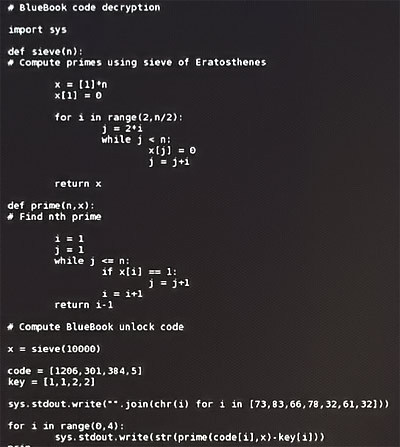
This screenshot is from the film Ex Machina . Can you guess what the "Bluebook unlock code" is?

December 11, 2016
We live on the inside of a collage of philosophical, scientific and folkloric statements about the nature of the mind. It is an old and vexing question that has generated more of a tangle than can be parsed out in a lifetime, to say nothing of adding any positive contribution. Trying to get out of it, above it, beyond it, past it, is far more difficult than simply clearing your mind for an objective view; we couldn't dry erase our tabula rasa, even if it were that simple.
Something more radical is required, and Shanahan utilizes the most clear and lucid interpretation of Wittgenstein's later thought that I have seen. The therapeutic interpretation of Wittgenstein can be paralyzing, in the sense that one feels that “nothing is hidden” means that there is nothing left to be seen; a lesson of Philosophical Investigations is a distrust of the feeling of “penetrating” a phenomenon. It leaves one profoundly suspicious of positivist science and philosophical system building. But there is still a world beyond this, even if our training and culture says otherwise. In order to show us, Shanahan re-centers the question from the investigation of the mind to that of the mapping of the space of possible minds, employing the state-space terminology of physics and system theory.
This characterization, along with some re-defining of the domains of conscious vs unconscious or automatic behavior and an emphasis on embodiment, is free from the burdensome intellectual history of the Mind's nature that makes a question like “what is it like to be a bat?” so philosophically crippling: A bat's mind/embodiment is one thing, while a human's is quite different, and there is no imperative to try and cast one into the other. But in trying to do so, we reel and feel there is something we must figure out. The obvious fact is that we are not bats, and bats are not us. The insidious, head spinning element is that “to know” here is used to denote some kind of inner grasping with absolute certainty, an idea of knowing that is metaphysically burdened and vague beyond prehension, and is at cross purposes with our usual use of the word. Seeing this, it isn't a matter of proving this idea wrong; it is a matter of proving it strange, and leaving the other party to try and stammer out an explanation.
Focusing on the space of possible minds also lowers the empirical data burden on theory-making in so far as a theory no longer needs to be the account of “the mind”, but an account of any number of modalities of minds. This gives an enormous amount of expressive power to scientists and philosophers, and gives a foundation for more speculative work that moves beyond current data, though to his credit, Shanahan is rigorous in showing how his model is consistent with contemporary neuroscience.
More specifically, this model is explained in terms of clustered networks of connections mediated by a central “global workspace” that broadcasts incoming information from coalitions of these clusters. It is essential that these coalitions compete with each other for the limited capacity connection to the workspace. The chaos introduced by limited capacity, high levels of competition, and independent association of clusters into novel co-operations is exactly what allows fluid and original response to a new situation or problem. An as yet unseen coalition of brain processes can come together, transiently dominate the work space and broadcast globally, and then be superseded by another. That is problem solving. This summary leaves a lot out, but it is one example of how Shanahan develops a system that can blanket neuroscience as so far developed without being fixed in place by its tenants.
There is a lot going on in this ambitious book, but Shanahan is more of a sketch artist than a system builder, and there is a fluidity that makes his ideas adaptable and open to revision. Together with their expressive depth and width, you have a powerful system for developing new research programs and theoretical frameworks.
Something more radical is required, and Shanahan utilizes the most clear and lucid interpretation of Wittgenstein's later thought that I have seen. The therapeutic interpretation of Wittgenstein can be paralyzing, in the sense that one feels that “nothing is hidden” means that there is nothing left to be seen; a lesson of Philosophical Investigations is a distrust of the feeling of “penetrating” a phenomenon. It leaves one profoundly suspicious of positivist science and philosophical system building. But there is still a world beyond this, even if our training and culture says otherwise. In order to show us, Shanahan re-centers the question from the investigation of the mind to that of the mapping of the space of possible minds, employing the state-space terminology of physics and system theory.
This characterization, along with some re-defining of the domains of conscious vs unconscious or automatic behavior and an emphasis on embodiment, is free from the burdensome intellectual history of the Mind's nature that makes a question like “what is it like to be a bat?” so philosophically crippling: A bat's mind/embodiment is one thing, while a human's is quite different, and there is no imperative to try and cast one into the other. But in trying to do so, we reel and feel there is something we must figure out. The obvious fact is that we are not bats, and bats are not us. The insidious, head spinning element is that “to know” here is used to denote some kind of inner grasping with absolute certainty, an idea of knowing that is metaphysically burdened and vague beyond prehension, and is at cross purposes with our usual use of the word. Seeing this, it isn't a matter of proving this idea wrong; it is a matter of proving it strange, and leaving the other party to try and stammer out an explanation.
Focusing on the space of possible minds also lowers the empirical data burden on theory-making in so far as a theory no longer needs to be the account of “the mind”, but an account of any number of modalities of minds. This gives an enormous amount of expressive power to scientists and philosophers, and gives a foundation for more speculative work that moves beyond current data, though to his credit, Shanahan is rigorous in showing how his model is consistent with contemporary neuroscience.
More specifically, this model is explained in terms of clustered networks of connections mediated by a central “global workspace” that broadcasts incoming information from coalitions of these clusters. It is essential that these coalitions compete with each other for the limited capacity connection to the workspace. The chaos introduced by limited capacity, high levels of competition, and independent association of clusters into novel co-operations is exactly what allows fluid and original response to a new situation or problem. An as yet unseen coalition of brain processes can come together, transiently dominate the work space and broadcast globally, and then be superseded by another. That is problem solving. This summary leaves a lot out, but it is one example of how Shanahan develops a system that can blanket neuroscience as so far developed without being fixed in place by its tenants.
There is a lot going on in this ambitious book, but Shanahan is more of a sketch artist than a system builder, and there is a fluidity that makes his ideas adaptable and open to revision. Together with their expressive depth and width, you have a powerful system for developing new research programs and theoretical frameworks.

September 2, 2021
One of the must complex points of view upon artificial intelligence. The Bibliography is huge as the reference.
January 18, 2015
Interesting ideas about how modeling the brain can be used to construct an artificial mind.

July 13, 2020
This gave me a better sense of how consciousness functions
Displaying 1 - 5 of 5 reviews